
Medical Disclaimer: This article is for informational purposes only and does not replace professional medical advice. Read our full Medical Disclaimer.
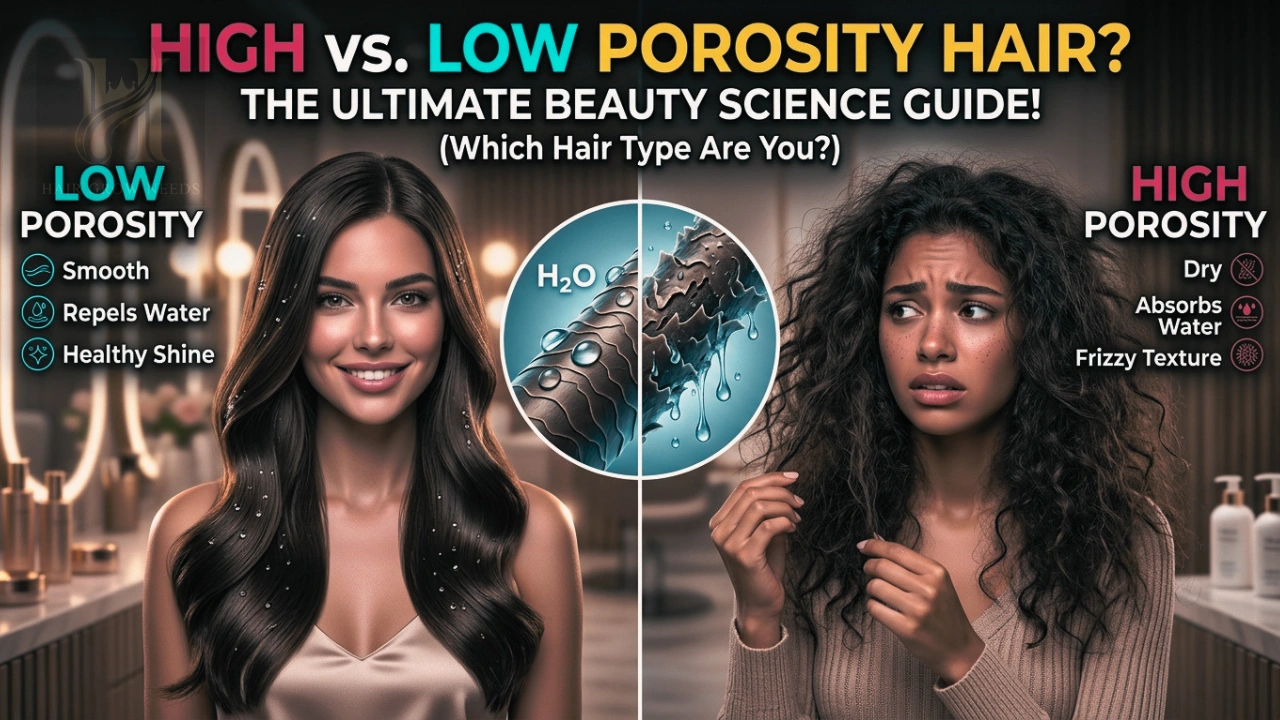
High vs Low Porosity hair. Arguably the most crucial yet misinterpreted topic in hair care science, it has a direct impact on how hair absorbs moisture, reacts with products, and remains healthy in the long run. So many people struggle with dry or frizzy hair or product buildup, and just do not realize it’s actually a matter of hair porosity. This article will explain everything in a simplified, expert-supported way, helping you finally grasp your hair like a professional stylist will. We’ll cover porosity vs low porosity, hair structure and differences, different kinds of tests to know which one yours might be, routines to apply to achieve different hair goals with them, costs involved, and all kinds of mistakes to avoid. Curly or straight, coily or textured, this will fundamentally shift the way you care for your hair and what kind of products you’ll be selecting for its hydration and shine, while it strengthens.
What Is Hair Porosity?
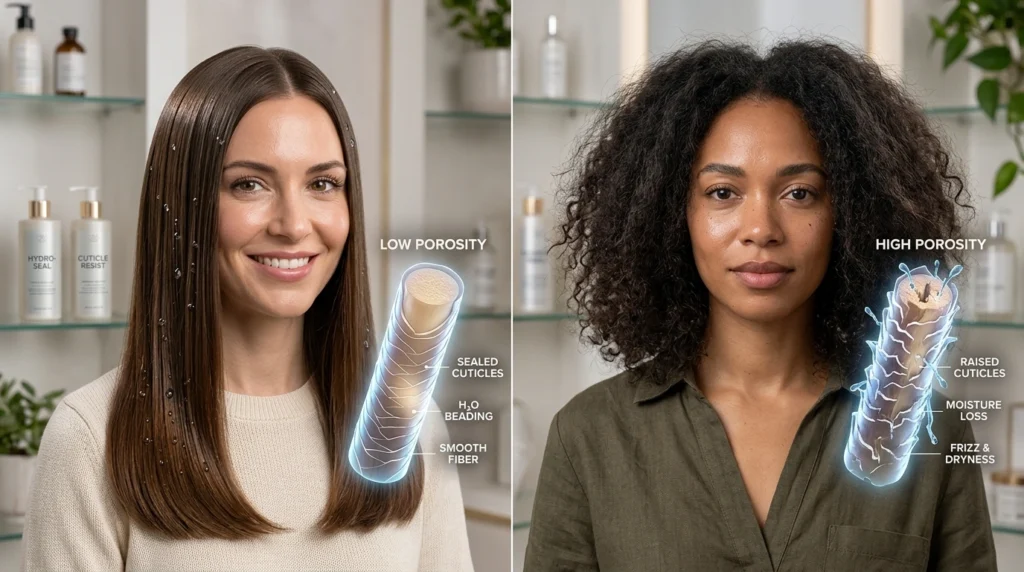
One of the most critical (yet also confusing) areas of hair science is high and low porosity hair, which impacts how each and every one of your products works on your hair.
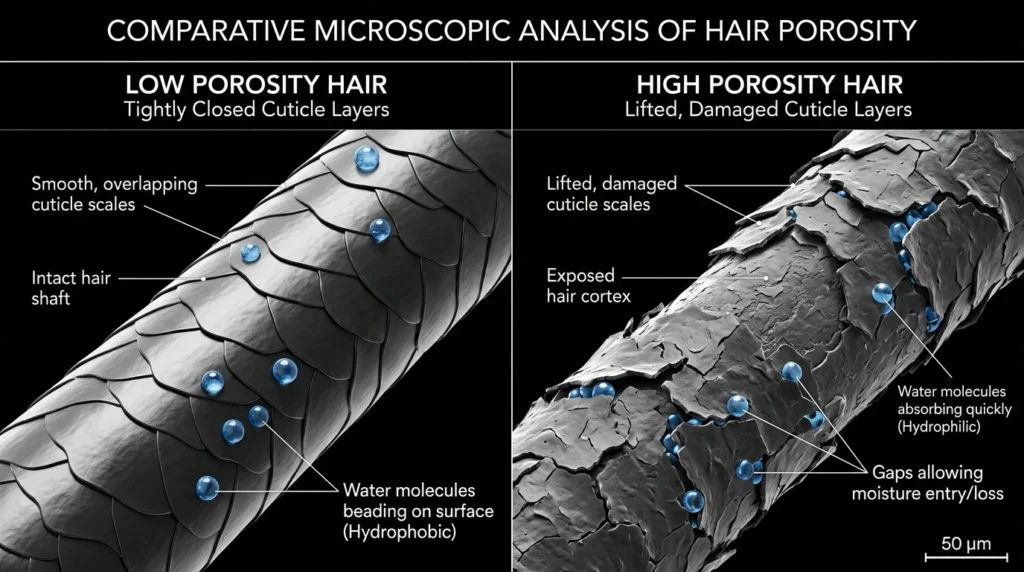
Porosity measures how easily your hair cuticle is able to absorb and hold on to moisture. This cuticle is the outermost layer of every strand and resembles a shingles-like texture of interlocking scales. When your cuticle’s scales are compact and lie flat, moisture has a tough time entering; however once the hair’s scales open up, the moisture it absorbed stays in. When the scales are lifted or broken, moisture enters and exits the hair shaft quickly.
This distinction between high and low porosity hair is the key to why 2 women could be using the same conditioner, with opposite effects.
Genetics, as well as styling habits, chemical history (bleaching, chemical relaxers, color processes) and environmental factors influence our hair’s porosity level. The International Journal of Trichology says thermal damage is a top reason for women 18-45 in America to have highly porous hair.
High vs Low Porosity Hair: Key Differences
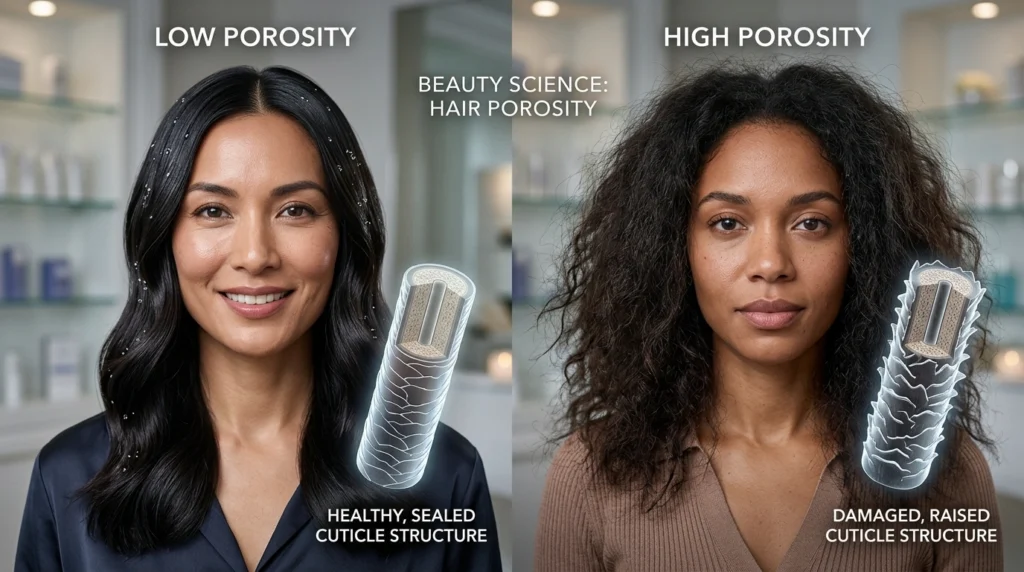
It’s more than just how fast or slow your hair dries when you’re looking at low porosity vs high porosity hair. Each tendency you’ve experienced-whether it be why your hair feels so dry even though it’s been conditioned, why your products tend to just sit on top of your hair, why your hair frizzes up when it’s humid, all comes back to cuticle structure.
Cuticle Structure
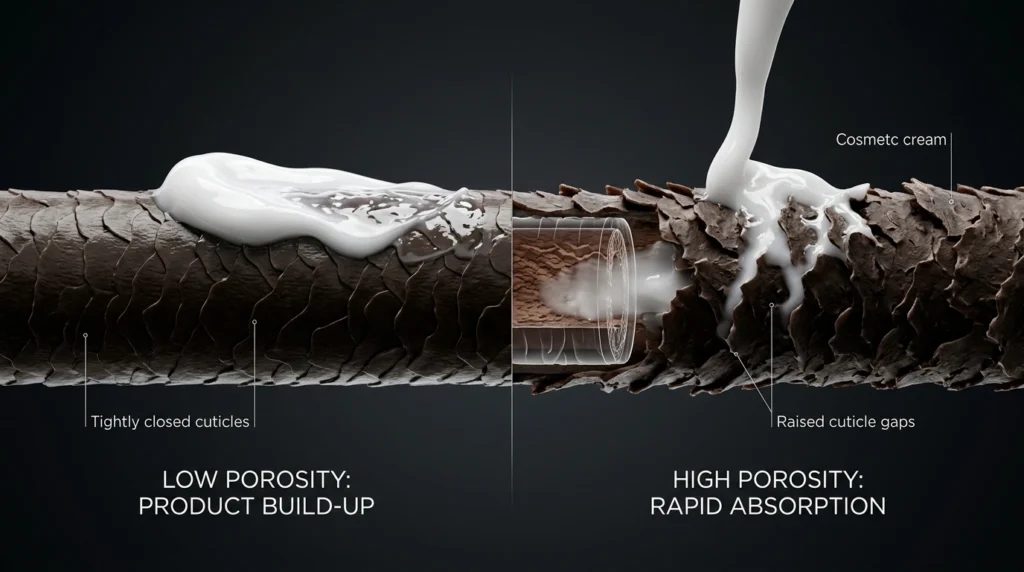
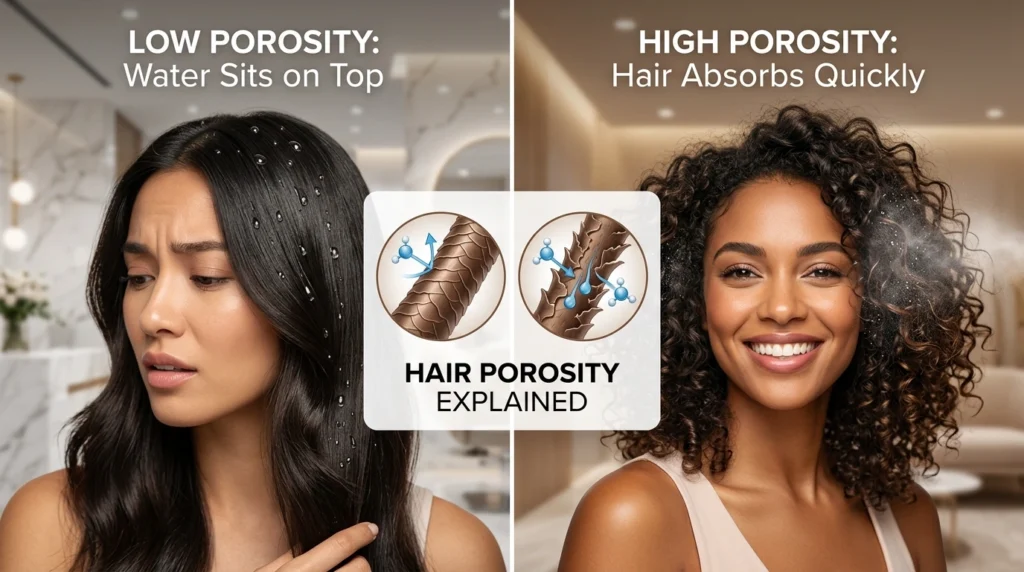
The cuticle on low porosity hair lays very flat against the shaft. This allows for the smooth surface and causes water to just bead up on the hair surface rather than absorbing immediately.
High porosity hair has lifted, rough or damaged cuticles with holes/gaps in between the scales, allowing water and products to enter immediately, but also for the moisture to escape quickly from the holes.
Moisture Absorption and Retention
| Feature | Low Porosity Hair | High Porosity Hair |
| Moisture Absorption | Slow – water resists entry | Fast – absorbs instantly |
| Moisture Retention | High – holds moisture well | Low – loses moisture quickly |
| Product Absorption | Slow – products sit on top | Fast – absorbs but dries fast |
| Appearance When wet | Water beads on surface | Soaks in immediately |
| Drying Time | Long – slow to dry | Short – dries very fast |
| Texture Feel | Smooth, often shiny | Rough, often frizzy |
| Common Problem | Product buildup | Dryness and breakage |
| Best Product Type | Lightweight, water-based | Heavy creams, butters, oils |
| Heat Sensitivity | Needs heat to open cuticles | Already open – handle gently |
| Protein Response | Protein overload risk | Benefits from protein treatments |
Elasticity and Strength
Because the cuticle layer of low porosity hair is so tight and complete, it tends to have more elasticity. The porosity of high porosity hair may lead to less elasticity in a higher risk of breakage and snap under pressure due to cuticle damage; it is relevant especially for 4C and chemically processed hair.
How Products Behave
This is where most will see a difference in porosity in everyday life:
Thick creams & oils on low porosity will feel greasy, sitting on the hair instead of soaking in. With high porosity products on low porosity hair will feel dry again within a few hours as it slips out through the gaps in the cuticle.
How to Test Your Hair Porosity at Home
Prior to purchasing anything or starting any routine, test what your true hair porosity level is. While there are three reliable tests, they have varying levels of accuracy, which all measure high porosity vs low porosity.
Test 1: The Water Spray Test (Most Accurate)
This is by far the most accurate way to determine your hair’s porosity using an at-home test.
How to do it:
- Ensure you hair is clean (no dry shampoo, no leave in conditioner).
- Spray small section of hair with water lightly.
- Watch for 30 seconds.
Results:
- Beads of water on the surface and rolls off Low porosity.
- Water absorbs in 10 seconds High porosity.
- Absorbs in 10-30 seconds Medium porosity (normal).
Why this works: When the hair is clean and free of any product application, the actual reaction of the cuticle can be determined without the influence of added chemicals.
Test 2: The Float Test (Basic Indicator)
How to do it:
- Get one clean piece of shed hair (not from your hair on the brush, not plucked from your head).
- Let the hair drop into room temperature water in a glass.
- Let it rest for 2-4 minutes.
Results:
- Hair floats to the surface. Cuticles are sealed, so hair traps air within (low porosity).
- Hair sinks to the middle slowly (medium porosity).
- Hair sinks to the bottom quickly (high porosity, allowing water to enter).
Important caveat: This test is not as accurate as the water spray test as the amount of product, the presence of oils and the thickness of the strand all influence whether the hair floats or sinks. Use as secondary confirmation.
Test 3: The Slide Test (Texture Check)
Grasp one hair fiber between your thumb and forefinger. Your finger tips, from the base of the hair, should be dragged up towards the root.
- Smooth, no bumps felt Low porosity (flat cuticles).
- Rough, bumpy, or snags felt High porosity (raised cuticles).
This test works best when your hair is clean and dry and does not have any product residue on it.
Low Porosity Hair: Complete Care Routine
The right approach to Low Porosity Hair is necessary because low porosity hair has tightly closed cuticles which don’t let moisture in. Our aim is to gently force open the cuticle just for a short time in order to let moisture in, and then seal the cuticles again.
Step 1: Clarifying Shampoo (Monthly or Bi-Weekly)
Since low porosity hair is reluctant to absorb products it begins to build up on the hair shaft. By using a sulfate clarifying shampoo bi-weekly to monthly you can strip the hair and it will be ready to absorb again.
US product examples: Neutrogena Anti-Residue Shampoo, Kinky-Curly Come Clean, Malibu C Wellness Shampoo
Step 2: Heat-Activated Deep Conditioning
This is the most crucial step for low porosity hair. Heat lifts the cuticle slightly, causing the conditioner molecules to go in and sit on the hair shaft.
How to apply:
- Smooth on a light, water-based deep conditioner through your damp hair.
- Wrap your hair in a plastic processing cap.
- Process under a hooded dryer, steamer, or warm towel wrap for 20-30 minutes.
- Rinse thoroughly with cool water to seal the cuticle back.
Deep conditioning without heat on low porosity hair doesn’t really do much, due to the lack of penetration in a tightly closed cuticle.
Step 3: Lightweight Product Selection
For low porosity hair it’s crucial to apply products that the hair easily absorbs rather than ones that rest on top.
Use:
- Leave-in conditioners with aloe vera
- Humectants with glycerin (in average humidity)
- Light liquid oils (e.g., argan oil, jojoba oil, sweet almond oil)
- Water based gels and styling creams
Avoid:
- Shea butter and coconut oil (too thick, creates build up)
- Protein products (low porosity hair rarely lacks protein)
- Thick waxes and butters
Step 4: Damp Hair Application
When applying any product make sure your hair is only damp, it’s not so wet that water is dripping from it, but it isn’t completely dry either. Damp hair means that the hair’s cuticle is open slightly more, so that lighter products can be absorbed into the hair more readily.
High Porosity Hair: Complete Care Routine
High porosity hair has the opposite challenge: it absorbs moisture easily but cannot hold onto it. The routine focuses on sealing the cuticle after hydrating to prevent rapid moisture loss.
Step 1: Gentle, Sulfate-Free Shampoo
For hair with high porosity, hair cuticles are already damaged or raised. Sulfated shampoos dry out the hair, strips off natural oils and damages the cuticle layer of hair, which speeds up the loss of moisture from the hair. Use gentle and moisturizing sulfated-free shampoo for every 5-7 days.
Examples in the US: SheaMoisture Manuka Honey & Mafura Oil Shampoo, As I Am Curl Clarity Shampoo, TGIN Moisture Rich Sulfate-Free Shampoo
Step 2: Protein Treatment (Weekly or Bi-Weekly)
Due to cuticle gaps from breakage, high porosity hair tends to be protein deficient. Protein treatments will temporarily fill these cuticle gaps in high porosity hair, thus lowering moisture loss and providing a stronger hair strand.
Look for these hydrolyzed proteins: Hydrolyzed wheat protein, hydrolyzed keratin, hydrolyzed silk protein
A Balance to remember: Too much protein causes high porosity hair to feel stiff and brittle, alternating protein treatments with deep moisture treatments prevents over loading and NEVER use a protein and deep moisture treatment in the same wash cycle.
Step 3: Heavy Moisture Deep Conditioning
The most high porosity hair reacts very well to a heavy rich conditioner as the cuticle is open to receive it. As with high porosity, heat is not always necessary, the cuticle is open already.
Use:
- Shea butter based deep conditioners
- Oils: castors oil, olive oil, avocado oil
- Rice water to get protein and shine
Step 4: LOC or LCO Method for Moisture Sealing

The LOC Method is a liquid oil cream formula, made for high porosity hair, and intended to seal moisture in the layers of the hair
- Liquid: water or a water based leave in conditioner
- Oil: a more heavy oil such as castor, jojoba or olive oil to seal the cuticle
- Cream: a thick butter or cream to lock it all in
Step 5: Cold Water Final Rinse
Always finish with cold water rinse. Cold water closes up the cuticle and make it flatter, it help to seal temporarily cuticles open scale to prevent moisture loss and reduce frizz.
Best Products for Each Porosity Type
Low Porosity Hair Products USA Market 2026
| Product Type | Recommended Ingredients | What to Avoid |
| Shampoo | Clarifying, sulfate for monthly reset | Heavy conditioning shampoos |
| Conditioner | Lightweight, humectant-based | Thick butters and heavy creams |
| Leave-In | Aloe vera, glycerin, water-based | Coconut oil, shea butter |
| Styling | Light hold gels, water-based creams | Heavy waxes, thick creams |
| Treatment | Steam or heat-based hydration | Protein treatments (often unnecessary) |
High Porosity Hair Products USA Market 2026
| Product Type | Recommended Ingredients | What to Avoid |
| Shampoo | Sulfate-free, moisturizing | Clarifying shampoos (too stripping) |
| Conditioner | Shea butter, hydrolyzed protein, oils | Lightweight, thin conditioners |
| Leave-In | Protein + moisture balanced formulas | Glycerin in low humidity (draws moisture out) |
| Styling | Heavy creams, butters, sealing oils | Light water-based products (evaporate fast) |
| Treatment | Protein treatments every 2 weeks | Over-reliance on protein (causes brittleness) |
High vs Low Porosity Hair for Curly and 4C Hair
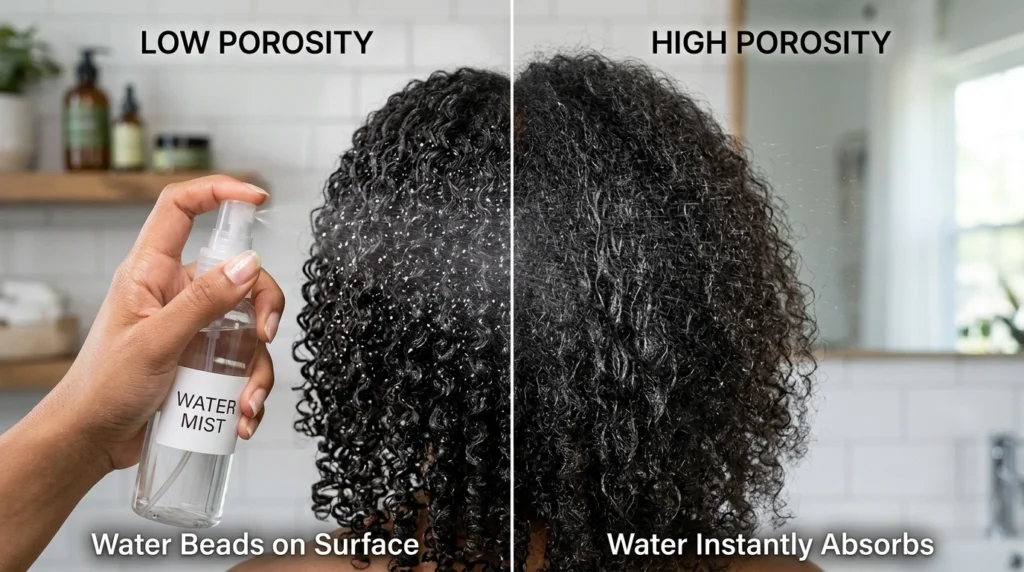
Porosity and curl pattern have a relationship with each other, which means a set of issues are involved in this particular situation that are not applicable to a straight-haired situation.
Curly Hair (Type 2C–3C)
Low porosity curly hair can get product build up because your curl pattern does not distribute products easily and sealed cuticles do not soak in moisture. Heat activated deep conditioners and lightweight products are needed.
High porosity curly hair tends to frizz because the cuticle is raised and gets damp and swells up. High porosity curly hair experiences less frizz using the LCO method and a lot of heavy sealing products.
4C Hair Specifically
4C is the highest texture and has a high porosity, either genetically due to the angle in which hair strands emerge from the scalp, or from heat, chemical processing and styling practices that the Black hair care history uses.
High vs low porosity 4C hair differences:
- Low porosity 4C hair does not get rid of water on wash day but retain it well with products: heat is essential in deep conditioning
- High porosity 4C hair instantly soaks up water/products but has rapid dryness, sever shrinkage and breakage: heavy sealing is non-negotiable
In the case of 4C hair the Greenhouse Method (applying oils then covering hair overnight to lock in heat and moisture) is very beneficial for any hair porosity, but particularly for low porosity 4C hair.
Cost and Maintenance Comparison USA 2026
It is crucial for the US consumer to understand the financial difference between having low vs. High porosity hair so they are not purchasing products in unrealistic budget.
| Category | Low Porosity Hair | High Porosity Hair |
| Monthly Product Cost | $30 – $70 | $60 – $130 |
| Salon Deep Conditioning | $40 – $80 (monthly) | $50 – $100 (bi-weekly) |
| Protein Treatments | Rarely needed ($0 – $20/month) | $20 – $50/month |
| Clarifying Treatments | $10 – $20/month | Not typically needed |
| Annual Maintenance Cost (DIY) | $360 – $840 | $720 – $1,560 |
| Annual Maintenance (Salon) | $800 – $1,500 | $1,200 – $2,500 |
On average, high porosity hair is 40-60% more expensive to maintain each year compared to low porosity hair due to the need for more frequent protein treatments, the use of heavy moisturizing products, and consistent sealing procedures.
Common Problems and How to Fix Them
Low Porosity Hair Problems
Problem 1: Product Buildup
Reason: Product cannot get through the cuticle and sits on top.
Remedy: Use clarifying shampoo once every 2-4 weeks. Switch to water based products that are lightweight.
Problem 2: Hair Feels Dry Despite Regular Conditioning
Cause: Conditioner is not penetrating the sealed cuticle.
Fix: Always use heat with the deep conditioner. Steamer or hooded dryer for 20-30 min will fix this.
Problem 3: Slow Growth Appearance
Cause: Buildup is heavy and is camouflaging the hair’s length.
Fix: Frequent clarify plus light weight moisture is a MUST to see hair’s true length and is preventing breakage.
High Porosity Hair Problems
Problem 1: Chronic Dryness
Reason: Quick evaporation of water from the open parts of cuticle.
Remedy: LOC method and then grease oils with weight 1.2 pounds; cold water rinse after each wash.
Problem 2: Frizz in Humidity
Cause: The cuticle is then raised and draws moisture from the air.
Fix: Every wash with heavy cream or butter to seal. Don’t use any glycerin in high humidity conditions (glycerin draws moisture in and out very quickly).
Problem 3: Breakage and Low Elasticity
Why: The cuticle is weakened and has holes within its structure.
To fix: Apply protein treatment (e.g. Hydrolysed keratin or wheat protein) regularly to fill the gaps in the cuticle temporarily. Protect hair from heat damage with a heat protectant spray before using any heated styling equipment.
Before and After: Realistic Results Timeline
Be realistic. Porosity is structural, and not something that your changing- you are simply altering your routine to cater to your hair’s current state.
Low Porosity Hair Results
| Timeframe | What Changes |
| Week 1 – 2 | Product buildup reduces after clarifying; hair feels lighter. |
| Week 3 – 4 | Moisture absorption improves with consistent heat conditioning. |
| Month 2 – 3 | Noticeable improvement in shine and softness. |
| Month 4 – 6 | Optimal routine established; hair behaves predictably. |
High Porosity Hair Results
| Timeframe | What Changes |
| Week 1 – 2 | Frizz reduces after LOC method; immediate improvement. |
| Week 3 – 4 | Moisture retention improves; hair dries slower. |
| Month 2 – 3 | Breakage reduces with protein-moisture balance. |
| Month 4 – 6 | Elasticity noticeably improves; curl definition clearer. |
This is likely the #1 giving up on the new routine in week 2 since you’re not seeing your results yet. Hair science takes time and 90 days of the porosity driven routine will not yet be getting you 100% of what you see by then.
FAQs:
Q: What is high vs low porosity hair?
Hair porosity refers to the capacity of hair cuticles to absorb and retain moisture. Hair with low porosity cuticles are tightly closed and does not easily take in moisture but would retain it once in the hair. While high porosity hair cuticles are open and have damages that quickly takes in moisture and also loses it as fast which results in constant dry and frizz-prone hair.
Q: How do I tell if I have high or low porosity hair?
This method is the most accurate: spritz clean, product-free hair and watch. If water beads off, it means you have low porosity. If the water absorbs in 10 seconds or less, your hair has high porosity. The float test-dropping a clean strand in water-is also a confirmation test:
Q: Which is better high or low porosity hair?
Neither one is “better” then the other. Both has its ups and downs. Low porosity hair has a good moisture retention but difficult to absorb products. High porosity hair has great product absorption but it is hard for it to retain moisture. Product success completely relies on applying it in the right product and techniques.
Q: Can hair porosity change over time?
Yes. Hair porosity goes up with damage. Heat styling, chemicals (bleaching, straightening, perms), sun and mineral buildup from hard water will gradually lift the cuticle layer, thus increasing the porosity over time. It works one way. It is impossible to reduce the porosity that has been increased by damage, but protein treatments will help hair with high porosity behave like the lower porosity would.
Q: What are the best products for high porosity hair?
It is important that high porosity hair uses heavy butters (shea, mango), castor oil, olive oil, hydrolyzed protein treatments, and sulfate-free moisturizing shampoos. The method that is most effective at sealing moisture into high porosity hair is the LOC method (liquid, oil, cream) to damp hair.
Q: What are the best products for low porosity hair?
The hair’s pores need a light, water-based moisturizer. Some that are suited for low porosity hair would be; aloe vera gel, glycerin leave-in, argan oil, or any light hold, liquid styling product. Butters, creams, or other heavy products will build up on low porosity hair without adding moisture to the hair.
Q: Can I have mixed porosity hair?
Yes, that is quite a normal phenomenon actually. A lot of people have low porosity at the roots and high porosity at the ends and would apply a heavier product only at the ends and light products at the roots.
Q: Is 4C hair always high porosity?
It is not always true but high porosity is seen more in 4C hair. This is because the hair is tightly coiled, but more so because black hair has been historically manipulated through the use of heat and chemical treatment. A more exact way to determine the porosity of your hair is to try the spray test on your 4C hair rather than judging solely based on hair type.
Conclusion
High or low porosity hair is literally the key to everything else in hair care, whether it is about which products, condition, or treatment is best to use, as well as styling techniques. The water test takes only 30 seconds and gives you one of the most valuable answers about your hair.
Low porosity needs heat to open the cuticle and light weight products which can penetrate without creating any buildup on the hair structure. High porosity needs a sealant to bind everything together and has to maintain the balance of protein. Both have beautiful results if the routine is adopted to the actual biology of the hair.
When you get the right routine for the hair type it provides more moisture, less breakage, better curl definition, as well as lowering of total expense of your hair maintenance.
Written & Reviewed By
Written by: Wajiha Aqeel
Co-Founder & Hair Restoration Research Lead
Data & publication oversight: Daniel Brooks
Co-Founder & Senior Operations & Data Director
Clinic & Pricing Data Last Reviewed: July 2026
Last Updated: July 2026
Medical & Affiliate Disclaimer:
The content on Hair Grow Needs is for general informational and educational purposes only and should not be considered professional medical advice. For full details regarding our policies, please read our official Disclaimer.
Sources:
- American Academy of Dermatology (AAD)
- International Journal of Trichology
- Journal of Cosmetic Science
- Natural Hair Science Research Publications (2020-2024)