
Medical Disclaimer: This article is for informational purposes only and does not replace professional medical advice. Read our full Medical Disclaimer.
In America, a hair Transplant for women can cost anywhere from $4,000-$18,000. FUE and DHI are the two most popular approaches with graft survival rate ranges between 90-95% in expert facilities. Not every instance of female hair thinning will be right for this option, however; a discrepancy that is far more critical than any sum of cash, the same that goes for the below choices: Monthly financing options starting at $130-$150 or Per-graft rate ($6 to $10+). A Safe and effective hair transplantation procedure for the appropriate candidate. Hair Transplantation in women with stationary pattern hair loss and good donor capacity is possible, where patients can achieve a permanent, and natural restoration of their own hair follicles.
After you’ve fallen down the hair-loss forum rabbit hole for a solid hour or so, you might already be realizing just how complicated this all is. Almost all the information that exists on hair transplants is aimed squarely at men and simply reworked for women-and as anyone who has experienced female hair loss knows, it is, most of the time, not male-pattern baldness at all. We constructed this guide based entirely on how women actually lose their hair: with thinning spread evenly across the scalp, parted spaces that expand and spread over time, traction injury that results from hair styles, and post-partum shedding. And wherever information within this article has the potential to inform a medical decision, we tested it against real 2026 clinic data, not decades-old averages.
What is Hair Transplant for Women Exactly?
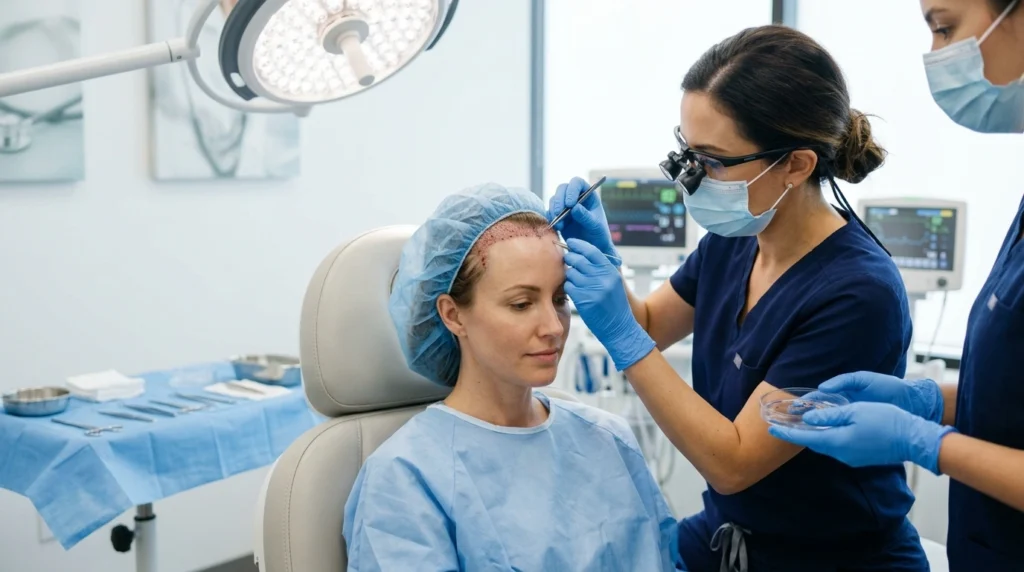
A hair transplant involves the minimally invasive transplantation of your naturally hair follicle-resistant hair (from the donor region, most commonly from the back and sides of the head) to regions of your head that are thinning or balding. It’s a procedure performed under local anesthesia, out-patient, using your own hair only (no synthetic fibers or transplanted donor hair).
The primary difference for women: few of women clients suffer from the clear balding pattern seen in men. Most have their hair thin on an even basis on the scalp with a gradually expanding middle part, thinning front hairline that never quite goes completely away. Experienced surgeon will take that information and build behind existing front hairline, fill in wide part or build up thin crown as opposed to constructing a new hairline entirely as he would do on a man.
Key Facts Worth Knowing Upfront
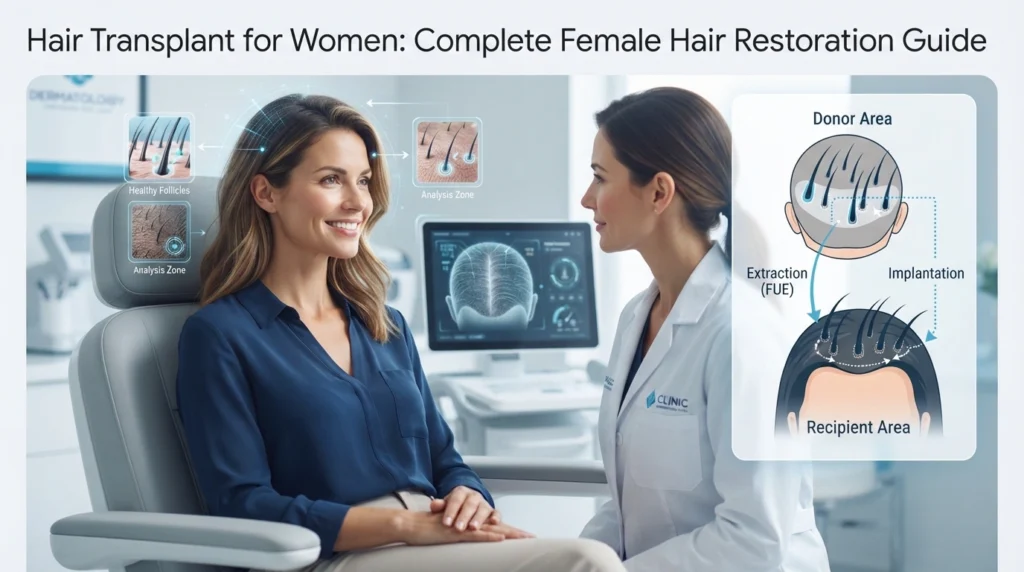
- The Results are permanent, Your new follicles will always have the same ability to resist DHT as the follicles did in the original donor area.
- The devices themselves (which use the robots NeoGraft or ARTAS) has been approved by the FDA, although there are not a whole lot of devices specifically certified as “hair clinics.”
- While a hair transplant can solve three distinct women’s hair issues-thinning or receding hair lines, wide middle parts and crown volume, it does not “fix” hair loss and will not halt thinning in any other area of your head.
Am I a Good Candidate? (Most Women Skip This Step)
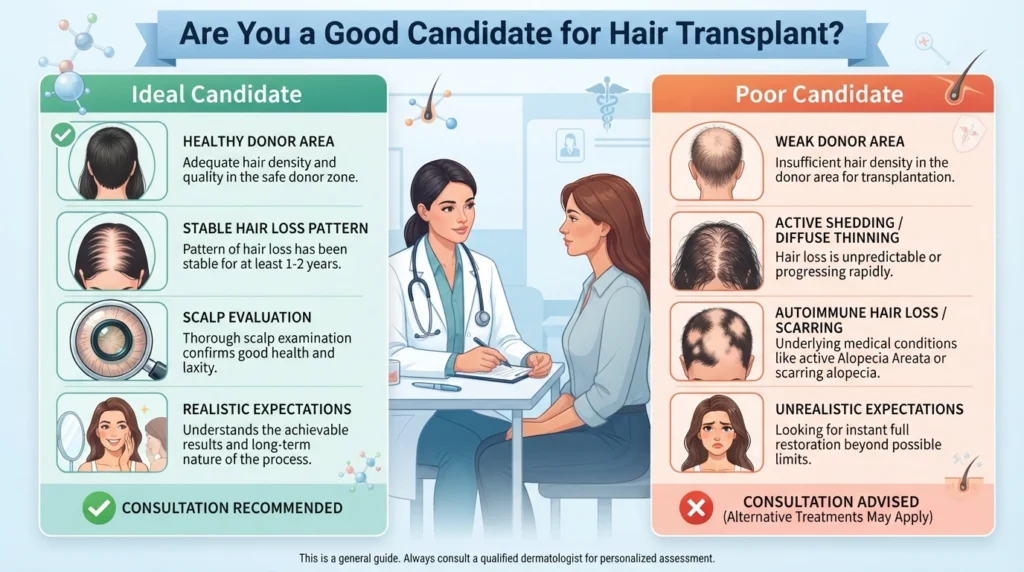
This is undoubtedly the most important section of the entire guide. It is the section that most blogs will neglect; and that is because not all thinning haired women are suitable for surgical treatment. In fact, a good hair restoration doctor may tell you “no” if you are not an ideal candidate.
| Criteria | Good Candidate | Poor Candidate |
|---|---|---|
| Hair loss pattern | Stable, defined pattern (androgenetic alopecia) | Active, diffuse shedding or telogen effluvium |
| Donor area | Dense, healthy hair at back/sides | Thin or weak donor zone |
| Age | 25+, with a stable pattern | Under 25, loss pattern still evolving |
| Medical health | No active scalp infection or autoimmune condition | Active lupus, alopecia areata, or scarring alopecia |
| Expectations | Realistic density improvement | Expecting a full return to original volume |
| Lifestyle | Non-smoker or willing to pause 2 weeks pre/post-op | Heavy smoker (lowers graft survival) |
In fact, in many patients with hyperthyroidism, hypothyroidism, PCOS, or a vitamin or mineral deficiency (iron deficiency/ferritin is a common one!), most surgeons want this condition treated before operating, as operating over an untreated hormonal problem generally yields undesirable results.
Why Women Actually Lose Hair (This Changes Everything About Treatment)
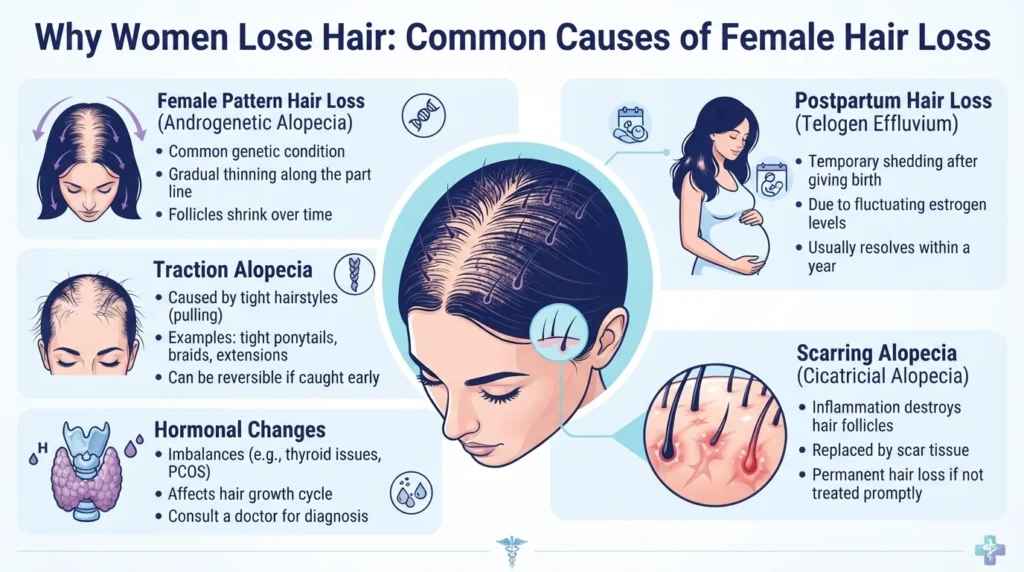
As the problem has more bearing on transplant outcomes than perhaps for any other cosmetic surgery procedure, determining what is causing your hair to fall out. Some cause are well suited to hair transplantation, whilst others cannot be helped by surgery.
Female Pattern Hair Loss (FPHL): The Most Common Cause of Female Hair Thinning
Female Pattern Hair Loss (FPHL / Androgenetic Alopecia) is the most frequent form of hair loss in women, and around 30 million women in the US are suffering from this type of hair loss. FPHL is caused by having an increased sensitivity in hair follicles to dihydrotestosterone (DHT) hormone, which makes the hair follicles shrink and leads to thin hair first in the central hair part/crown and thinning of hair there.
Traction Alopecia: Hair Loss Caused by Repeated Pulling
What Is Traction Alopecia? traction alopecia is caused by constant pressure on hair follicles, like pulling on your hair tight braids or a pony tail. It’s common among black women and it affects the hairline, around the temples most of the time. This condition is usually one of the ones that responds best to hair transplantation as long as there isn’t any permanent scarring of hair follicles.
Hormonal & Medical Causes of Female Hair Loss
The underlying hormonal imbalance PCOS, thyroid condition, estrogen drop at menopause are a cause of shedding and a surgeon wants that to be resolved first for a sustainable result.
Postpartum Hair Loss (Telogen Effluvium After Pregnancy)
Loss may start approximately 2 months after you give birth, two to six months postpartum, and for the most part hair loss is temporary and rarely requires surgery. The shedding generally starts on its own in most women’s postpartum year.
Cicatricial Alopecia (Scarring Hair Loss)
Cicatricial alopecia Scarring (cicatricial) alopecia: This kind is uncommon but irreversible, it is brought about by inflammation of the hair root. Transplantation is only an option after the ailment is entirely calm and stagnant, it should be monitored in the long-term.
Medication and Treatment-Related Hair Loss
Hair loss from medicines and treatment (chemo, radiation, certain antidepressants, blood-thinning drugs). Hair usually starts to grow back when the treatment stops.
FUE vs. DHI vs. FUT: Which Technique Is Actually Right for Women?
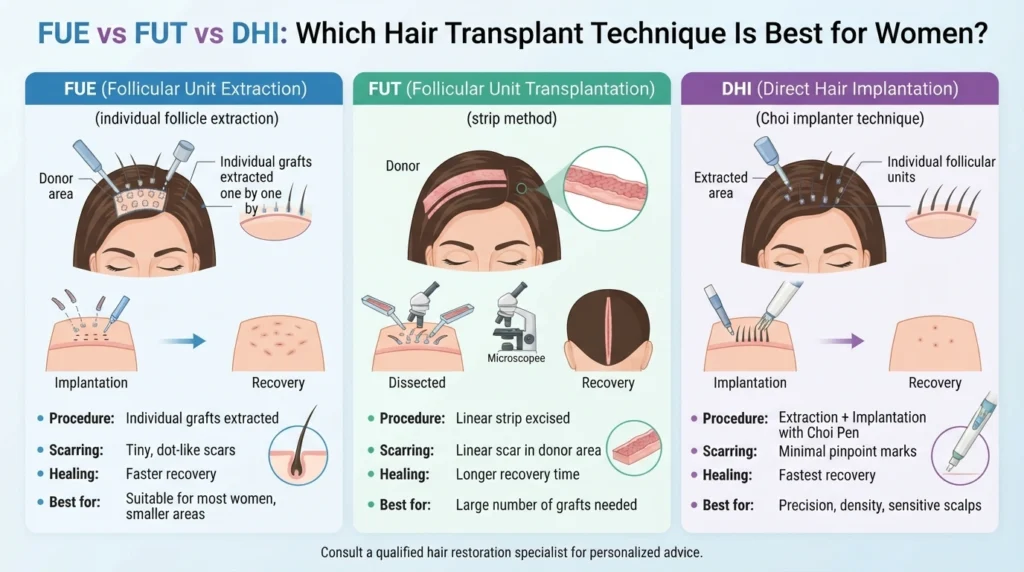
This is where the majority of hair-transplant content is failing, by lumping the three techniques together into one. If you’re a woman, they don’t all work out the same.
FUE (Follicular Unit Extraction)
FUE (Follicular Unit Extraction): In this technique, individual hair follicles are removed one at a time with a miniature punch and a micro-dot scars that are practically invisible are left behind. The procedure is done often in the U.S., is the appropriate procedure for the management of mild to moderate hair loss, and the recover time is about seven days to 10 days. Prices range from approximately $4,000 to $15,000.
FUT (Follicular Unit Transplantation)
FUT (Follicular Unit Transplantation) strips a thin section of scalp from the donor region, which is subsequently divided into single follicular units with the help of a microscope. Follicular Unit Transplantation FUT results in a greater number of graft harvests for each procedure (makes this option better for greater loss), however, results in a linear scar in the donor region (though often concealed with the other hair). It typically requires 10 to 14 days of downtime. It’s about $3,500 to $10,000 to have done.
DHI (Direct Hair Implantation)
This procedure is a high-tech modification of the FUE technique. The hair is taken from the skin, and placed into the scalp with the aid of a Choi implanter pen. The advantage with a Choi implanter is that the surgeon has a lot more control of the depth, angle and direction of the implanted hairs. It heals in 5 to 7 days and results are very accurate and thus it’s a very suitable procedure for hairline transplantation. However, this procedure is relatively expensive, costing about $6,000-$18,000.

A note specifically for women who don’t want to shave their head: Unlike the majority of male patients, women who get transplants don’t necessarily want to shave the donor area because they can use long hair to conceal their progress. Find out if any clinics offer unshaven FUE or long hair DHI. This type of hair transplant involves only shaving a narrow strip of the donor area so that it will still be completely concealed by surrounding hairs and you can style your hair as you usually would very soon after surgery. While an unshaven or long hair transplant generally costs slightly more than the regular method due to the extra effort involved from the surgeon and surgical team, this may be worthwhile.
Cost Comparison at a Glance USA, 2026
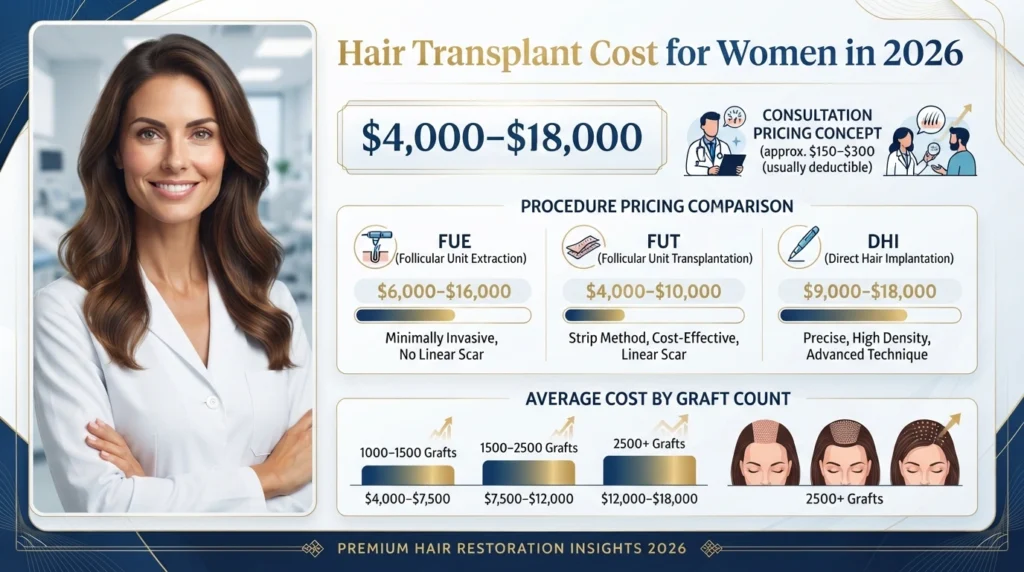
| Procedure | Average USA Cost | Grafts Required | Recovery Time | Best For |
|---|---|---|---|---|
| FUE | $4,000 – $15,000 | 1,000 – 3,500 | 7 – 10 days | Natural hairline & mild thinning |
| FUT | $3,500 – $10,000 | 2,000 – 5,000 | 10 – 14 days | More advanced hair loss |
| DHI | $6,000 – $18,000 | 1,000 – 3,000 | 5 – 7 days | High-precision hairline density |
| Robotic FUE (ARTAS) | $8,000 – $20,000 | 1,000 – 3,000 | 7 – 10 days | AI-assisted precision extraction |
| Non-shaving (stealth) FUE | $7,500 – $16,500 | 1,000 – 3,000 | 7 – 10 days | Women who won’t shave the donor area |
Hairline Lowering / Forehead Reduction for Women
For others, it’s not a matter of thinning, but a desire to advance an existing high hairline or high forehead to achieve a more aesthetically pleasing proportion. It’s still classified as a hair transplant because donor tissue is used to lower and reconstruct the frontal hairline and usually falls within the high end of the FUE/DHI price scale because it’s so precise you have one shot at hairline perfection. Depending on who is doing your procedure in the States, you can expect to spend between $6,000 to $14,000 for one such procedure. That’s the equivalent of a normal DHI procedure, but with the price of one correlating more with how many skilled hands are needed to craft the new hairline and not how many grafts are involved.
Traction Alopecia Repair
Areas of Traction Alopecia at the hairline and temples which can develop after years of tight protective hair styles – react unusually well to transplantation; the remaining hair is usually already otherwise normal; the surgeon is filling in a specific area of damage rather than battling a progressive condition. The actual grafts required should also be considerably lower than with a regular, total hairline repair and the cost for the USA is likely to be somewhere in the region of $4,500 – $9,500 although assuming the hairs at the base have not scarified.
Non-Shaving (Stealth) Female FUE
Covered above under technique, but it is worth restating because it’s perhaps the single biggest difference between a generic hair restoration clinic and one that has genuine knowledge and expertise with women’s hair transplantation, the narrow strip of hair to be used is still trimmed and perfectly hidden by your remaining hair and thus is entirely not visible. So you may continue your usual hairstyles almost right after the procedure. USD $7,500 – $16,500.
Step-by-Step: What the Procedure Day Actually Looks Like
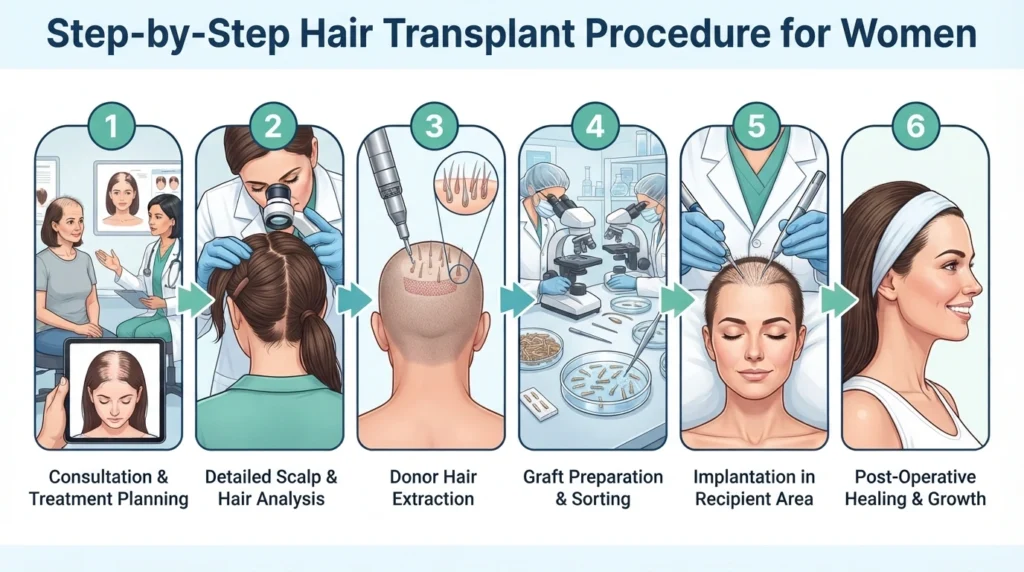
- Consultation & scalp analysis: The procedure involves microscopic hair exam trichoscopy, donor density study and a personal consultation to discuss expectations and history of hair loss.
- Pre-op preparation: Blood tests, hold some medicines and avoid alcohol before your date. No donor hair cuts prior to your appointment for non shave procedures.
- Anesthesia: Local anesthesia at the site and at recipient sites. Many clinics provide light sedation for the more nervous patient.
- Donor harvesting: Your surgeon harvests the follicular units (FUE/DHI or strip removal FUT), then they inspect these units under the microscope and sort them into single, 2 hair and 3 hair groups to achieve a more natural result.
- Graft storage: After processing the follicles, they are transferred to a cold solution, which allows them to remain viable while the extraction area is prepared for planting.
- Recipient-site creation: Your surgeon will make tiny incisions at an angle between 15 and 45 degrees in the same direction you were naturally growing hair it’s in this step that designing a female specific, softer, more rounded hairline shape is vital.
- Implantation: How are they applied? Each graft is done by hand so a full session will be around 4-8 hours long (including the number of grafts used).
- Aftercare instructions: A special shampoo, possibly some topical or oral medication such as a short course of antibiotics or an anti-inflammatory medication and an appointment schedule with the vet.
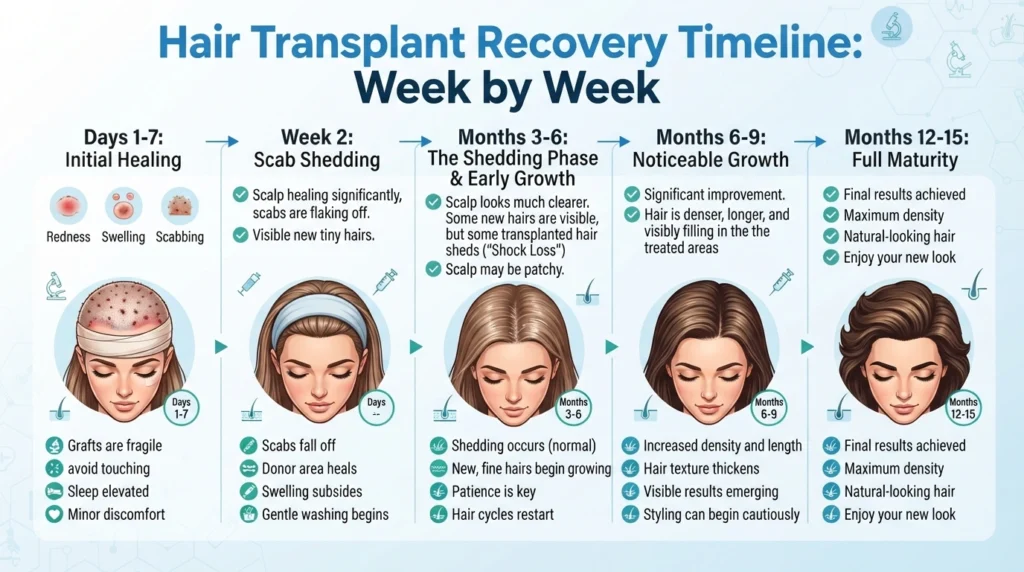
Recovery Timeline: Week by Week
| Timeframe | What to Expect |
|---|---|
| Days 1 – 3 | Mild swelling, tightness, small scabs form |
| Days 4 – 7 | Scabs soften; gentle washing begins with medicated shampoo |
| Week 2 | Scabs fall off naturally; return to office work |
| Weeks 2 – 4 | “Shock loss” most transplanted hairs shed. This is normal, not failure |
| Months 3 – 4 | New hair growth begins, slowly |
| Months 6 – 9 | Noticeable density improvement, roughly 60–70% of end result |
| Months 12 – 15 | Final, full results |
Most of our first time patients balk when they hear the word shock loss so let’s reiterate the hair falls out, the hair follicle under the skin is alive and growing on it’s own clock, and if they do 1, 3 and 6 month PRP shots then the studies suggest this may help with graft survival (not required but an option for most patients).
What a Hair Transplant Can and Can’t Do
It can: Restore density at a thinning hairline or crown. Minimize a widening part. Integrate and blend in with existing hair in an undetectable fashion. Look natural 100%. 5 years, once the treatment has healed you will be able to cut and style your hair normally like the rest of your hair and colour it as you wish
It can’t: Reverse hair thinning to your youthful hair thickness, prevent the loss of existing hair in un-transplanted regions, fill an area devoid of donor hair, or achieve an unreasonably faster growth result than biology permits.
Risks and Side Effects
Most complications of a hair transplant are short-term and heal up within a few weeks: Swelling and little scabs on and around the scalp (small); itching; shock loss shedding of the new grafts and the native surrounding hair Temporary; folliculitis (ingrown hair) or redness at the recipient site (uncommon); Infection (less than 1% preventable with prescription antibiotics.
These kinds of bad outcomes are invariably the result of the technician or physician doing the procedure, not the hair transplant method: Unnatural hairline shape. Unduly aggressive donor harvest (leading to the tell tale see through thinness of the skin at the back). Scarring like keloids or hypertrophic scarring in individuals who are susceptible. Cobblestoning a bumpy, elevated texture caused by placing the grafts too shallow or too closely together.
The number one way to avoid problems: Ask your surgeon if he or she is ABHRS-certified or an ISHRS member, and inquire specifically what aspects of your procedure-like creating your hairline or making the recipient sites where your hair will be transplanted-he or she is personally performing and what he or she is delegating to the clinic technicians. Any reputable practice is willing to answer this, and it’s something you should ask.
Hair Transplant vs. Non-Surgical
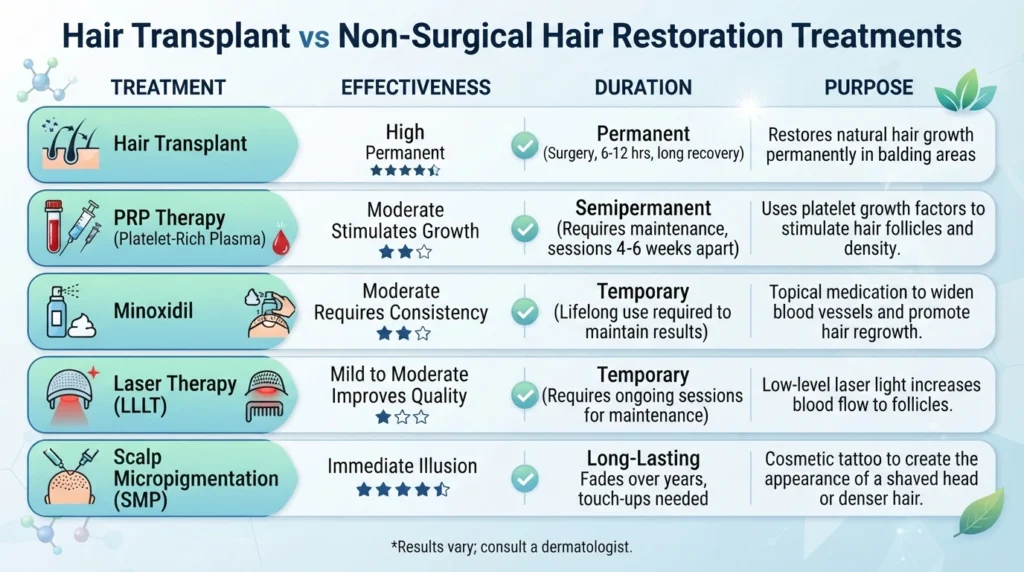
| Treatment | Effectiveness | Duration | Average Cost | Downtime |
|---|---|---|---|---|
| Hair Transplant (FUE/DHI) | High, permanent | Lifetime | $4,000 – $18,000 (one-time) | 7 – 14 days |
| PRP Therapy | Moderate, needs maintenance | 12 – 18 months | $1,500 – $4,500/year | None |
| Minoxidil (Rogaine) | Moderate, ongoing | Only while used | $200 – $600/year | None |
| Low-Level Laser Therapy | Mild to moderate | Ongoing use needed | $300 – $3,000 | None |
| Wigs / Hair Systems | Cosmetic only | Replace every 1 – 3 years | $500 – $5,000/year | None |
| Scalp Micropigmentation (SMP) | Cosmetic illusion only | 3 – 5 years | $1,500 – $4,000 | 2 – 3 days |
If you are still experiencing an episode of active shedding (telogen effluvium, un-treated hormonal, diffuse unpatterned alopecia), non surgical approaches are prioritised first- surgery with unstable shedding has disappointing results. A trichoscopy with a Dermatologist or Hair Restoration specialist is a great starting point if you aren’t sure where your hair loss sits.
Hair Transplant Cost by US State 2026
The price varies a little more than you might think state-by-state – not because of technique, but because of demand, supply, surgeon costs.
| State | Average Cost (FUE) | Low Range | High Range | Cost Level |
|---|---|---|---|---|
| New York | $11,500 | $8,000 | $24,000 | Very High |
| California | $10,800 | $5,400 | $20,250 | Very High |
| Massachusetts | $9,500 | $7,000 | $18,000 | Very High |
| Washington | $9,200 | $6,500 | $18,000 | High |
| Illinois | $8,400 | $4,200 | $15,750 | High |
| Colorado | $8,300 | $4,300 | $16,200 | High |
| Florida | $7,800 | $3,900 | $14,700 | Medium–High |
| Arizona | $7,600 | $3,800 | $14,250 | Medium |
| Texas | $7,200 | $4,500 | $14,000 | Medium |
| Georgia | $7,200 | $3,600 | $13,500 | Medium |
| Pennsylvania | $7,900 | $4,000 | $15,000 | Medium–High |
| New Jersey | $9,800 | $6,000 | $18,500 | High |
| Virginia | $8,200 | $4,200 | $15,500 | High |
| Maryland | $8,500 | $4,500 | $16,000 | High |
| North Carolina | $7,100 | $3,800 | $13,800 | Medium |
| Tennessee | $6,900 | $3,500 | $13,200 | Medium |
| Ohio | $6,800 | $3,400 | $13,000 | Medium |
| Michigan | $7,100 | $3,700 | $13,600 | Medium |
| Minnesota | $7,900 | $4,200 | $15,500 | Medium–High |
| Oregon | $8,200 | $4,500 | $15,800 | High |
The East Coast, namely New York and Massachusetts, holds two of the top spots mainly due to demand for surgeons and their level of expertise, and the West Coast generally maintains a similar price for this reason. The Southeast and Midwest region of the U.S. Are always cheaper, mainly because their clinics carry lower expenses and there is more competition. Across the U.S. A woman typically pays between $6,000 to $15,000 to undergo the full treatment.
Hair Transplant Cost by Major US City 2026
| City | Estimated Range | Average |
|---|---|---|
| New York, NY | $8,000 – $18,000 | $12,500 |
| Los Angeles, CA | $7,500 – $17,000 | $11,000 |
| Boston, MA | $7,000 – $18,000 | $9,500 |
| Chicago, IL | $7,000 – $15,000 | $9,500 |
| Philadelphia, PA | $6,500 – $15,000 | $9,500 |
| Miami, FL | $5,500 – $14,500 | $9,000 |
| Houston, TX | $6,500 – $13,500 | $9,000 |
| Atlanta, GA | $6,500 – $13,500 | $9,000 |
| Dallas, TX | $6,500 – $14,000 | $9,000 |
| Pittsburgh, PA | $5,500 – $12,000 | $7,500 |
The ranges below are estimated based on average regions – get a formal written quote from a clinic.
International Cost Comparison: USA, UK, Turkey, UAE, and Canada 2026
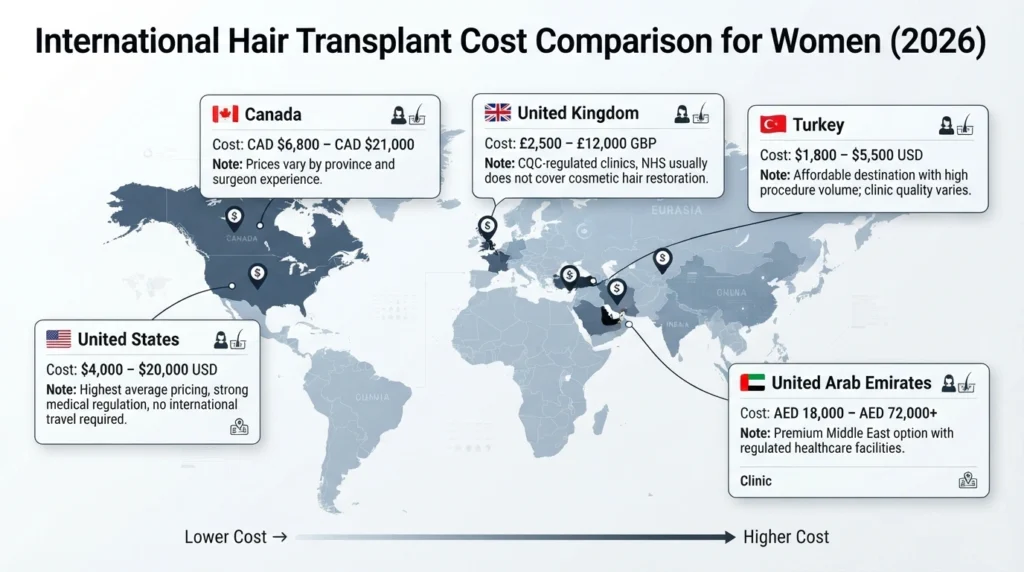
| Country | Typical Cost (2026, Local Currency + USD Equivalent) | Notes |
|---|---|---|
| USA | $4,000 – $20,000 USD | Highest average pricing |
| UK | £2,500 – £12,000 GBP ($3,300 – $16,000 USD) | CQC-regulated clinics |
| Turkey | ₺84,000 – ₺259,000 TRY ($1,800 – $5,500 USD) | Lowest cost; verify clinic quality |
| UAE | AED 18,000 – AED 72,000+ ($4,800 – $19,500 USD) | Premium treatment destination |
| Canada | CAD $9,000 – CAD $29,000 ($6,800 – $21,000 USD) | Prices vary by province |
A caution about Turkey specifically, Here’s one other fact that seems to appear in most if not all articles on this topic: The country performs the most transplants in the world, and yes, there is a huge difference between a clinic in the West and one in Turkey. It’s also, not surprisingly, the country with the most variability when it comes to quality. Some highly-publicized clinics in Istanbul now have a chief surgeon in title, who may indeed design the hairline but not personally conduct the extraction and implantation, which is a perfectly legal business practice, though not what many people assume they’re paying for (verified in independent reviews from 2026).
When considering going abroad, always write and ask: What specific procedures-hairline design, creation of recipient sites, overseeing of hair follicle extraction-will your named surgeon perform in person, and how many patients are treated each day by the clinic-responsible clinics supervised by a board-certified surgeon will limit their daily patient count to 2-4 patients.
Female-Specific Hair Restoration: Clinics and Doctors Worth Knowing
This isn’t a ranked “top 10” list female hair restoration outcomes depend heavily on your individual case, and no directory can substitute for a real consultation. These are practitioners and clinics with a documented focus on treating women, organized by country.
United States
| Doctor / Clinic | Location | Known For |
|---|---|---|
| Dr. Gary Linkov, Linkov Hair Surgery | New York, NY | FUE and FUT hair transplants for women including for black women as well as medical causes for hair loss |
| Dr. Paul McAndrews | Los Angeles, CA | One of two people to have served as President of both ISHRS and ABHRS; performs one procedure per day personally |
| Dr. Robert Bernstein, Bernstein Medical | New York, NY | Research-driven robotic-assisted FUE and FUT |
| Dr. Yael Halaas | New York, NY | Surgical hair restoration specifically for women |
| Dr. David Rosenberg | New York, NY | FUT-focused natural hairline design for women |
| Dr. William Rassman & Dr. Jae Pak, NHI Medical | Los Angeles, CA | FUE pioneers; ARTAS robotic system |
| Dr. DiStefano, MediTresse / Northeast Hair Restoration | New England | 2,500+ female patients treated; ABHRS member |
| Dr. Maas, The Maas Clinic | San Francisco, CA | Female-specific hairline shaping for diffuse thinning |
United Kingdom
| Clinic | Location | Notes |
|---|---|---|
| Wimpole Clinic (Dr. Michael May) | London (Harley Street) | 35+ years’ experience; FUT technique pioneer |
| Harley Street Hairline (Dr Qurbain) | London | GMC-registered, consultant-led FUE |
| Westminster Medical Group | London | CQC-regulated; women’s and Afro-textured hair transplants |
| Vinci Hair Clinic | London & Manchester | Transparent per-graft pricing |
| KSL Clinic | Multiple UK cities | Dedicated women’s hair loss program |
Turkey
| Clinic | Location | Notes |
|---|---|---|
| Vera Clinic | Istanbul | Signature “OxyCure” graft-survival technique; 30,000+ patients since 2013 |
| Dr. Serkan Aygin Clinic | Istanbul | 25,000+ procedures; DHI specialization |
| Sule Hair Transplant (Dr. Selahattin Tulunay) | Istanbul | 95–98% reported graft survival; hairline design led personally by the founder |
| Heva Clinic | Istanbul | No-shave DHI and female FUE documented on video |
United Arab Emirates
| Clinic | Location | Notes |
|---|---|---|
| Hairplasis Clinic (Dr. Alexander Dionyssopoulos) | Dubai | AI-assisted scalp analysis; board-certified in UK/EU/UAE |
| American Aesthetic Medical Center (Dr. Fadi Al Sabbagh) | Dubai | 18+ years’ experience; ABHRS diplomate |
| CosmeSurge | Dubai & Abu Dhabi | Female FUE without full head shaving |
| Maison Lutétia (Dr. Ahsen Farooque) | Dubai | DHI specialist, 5,000+ procedures |
Canada
| Clinic | Location | Notes |
|---|---|---|
| Toronto Hair Transplant Clinic (Dr. Cory Torgerson) | Toronto, ON | Head-and-neck surgeon; 18+ years’ experience |
| Sure Hair Transplants | Toronto, ON | 31 years operating; transparent per-graft pricing |
| Rahal Hair Transplant | Ottawa, ON | 13,000+ procedures |
| Vancouver clinic (Dr. Victor Hasson & Dr. Jerry Wong) | Vancouver, BC | 20,000+ surgeries combined experience |
| HairClub Montreal | Montreal, QC | Bilingual consultations, women’s programs |
You should always cross check credentials/reviews at the point of booking- a clinic can change their staff, prices and even owners, this data was accurate around mid 2026.
Insurance and Financing
For most hair transplant providers in the U.S., a hair transplant is cosmetic surgery, meaning that insurance will probably not cover it. (There are two major exceptions: the transplant is because hair was lost to injury or illness such as burns, scarring alopecia, and reconstructive surgery after treatment for cancer.) In all other cases, women will pay out of pocket via:
| Payment Option | How It Works | Typical Terms | Best For | Notes |
|---|---|---|---|---|
| CareCredit | Medical credit card accepted by many clinics | 6 – 24 months promotional financing (eligibility varies) | Patients wanting monthly payments | Interest may apply after promo period |
| Prosper Healthcare Lending | Fixed-payment medical loan | Terms depend on credit profile | Predictable monthly payments | APR and approval vary |
| Clinic Payment Plans | Financing offered directly by clinic | Usually 3–24 months | Patients preferring clinic financing | Availability varies |
| HSA | Uses eligible pre-tax healthcare funds | Depends on account balance and IRS rules | Qualifying medical expenses | Confirm eligibility first |
| FSA | Employer-sponsored pre-tax healthcare account | Annual contribution limits apply | Eligible medical expenses | Check with plan provider |
| Personal Loan | Bank, credit union, or online loan | Usually 24–84 months | Patients not using medical financing | Compare rates and fees |
| Cash / Debit Payment | Full payment before procedure | No financing | Patients paying upfront | Some clinics may offer discounts |
Insurance Coverage: Since hair transplantation is considered an elective cosmetic procedure, it’s typically not covered by most health insurance policies. Medical necessity cases – such as loss of hair due to fire or burn trauma, reconstruction surgery, or in instances of documented diseases and conditions – may be covered under special circumstances per your plan guidelines and require pre-approval from your carrier. We strongly advise you to confirm with your insurer to understand coverage prior to seeking treatment.
How to Choose the Right Clinic: 7 Non-Negotiables
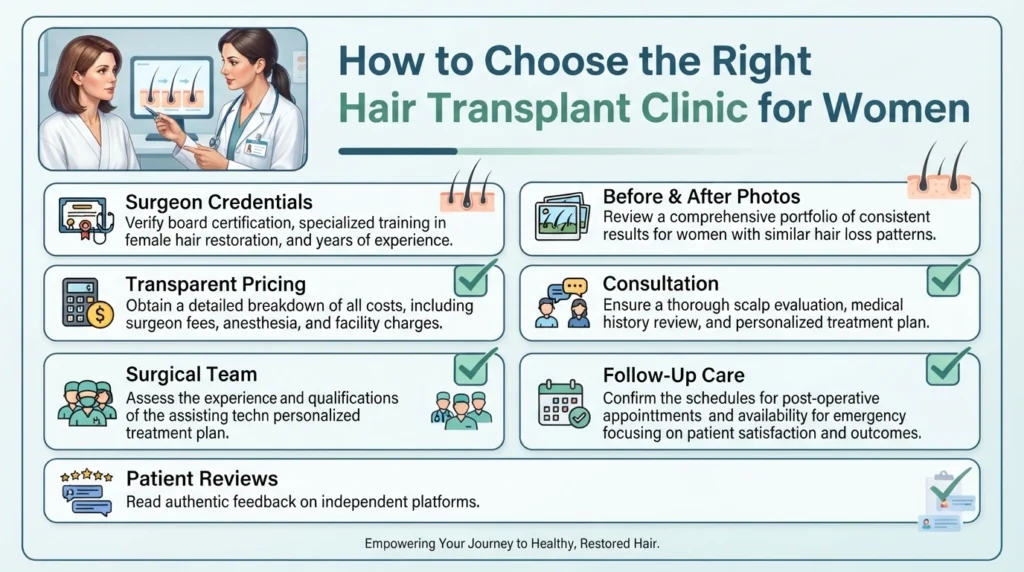
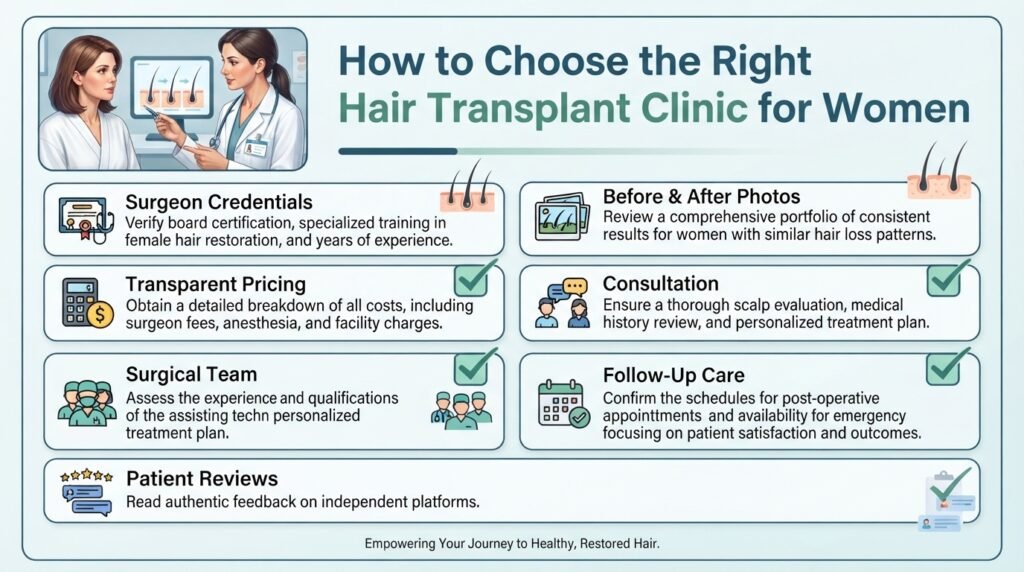
| What to Check | What to Look For | Why It Matters | Red Flag |
|---|---|---|---|
| Surgeon Credentials | Board certification, hair restoration training, professional memberships | Shows specialized expertise and standards | Credentials unclear or unverifiable |
| Before & After Gallery | Similar female cases, hair type, age, and hair loss pattern | Helps set realistic expectations | Limited or edited photos only |
| Transparent Pricing | Written quote with grafts, fees, anesthesia, medications, and follow-up included | Prevents unexpected costs | Hidden charges or vague pricing |
| Consultation Process | Scalp analysis, donor evaluation, and personalized treatment plan | Ensures the procedure fits your condition | Price offered without proper evaluation |
| Surgical Team | Clear information about who performs extraction, implantation, and key steps | Team skill affects outcomes | Clinic avoids explaining roles |
| Follow-Up Care | Scheduled visits after surgery and recovery support | Helps monitor healing and results | No structured aftercare plan |
| Patient Reviews | Reviews from multiple platforms and similar patients | Provides broader experience insights | Only promotional testimonials |
Before booking surgery, you must ensure to ask whether your extraction, site creating as well as transplant are going to be carried out by a physician. Make certain that the clinic provides you with a written plan and breakdown of treatments in addition to a number of grafts you are going to be implanted and also the expected recuperation duration so that you’re capable to make an effective assessment among the clinics.
FAQs:
Q: Is a hair transplant effective for women?
Is this something women candidates would be good for? Only women who have an obvious and predictable pattern and have an ample donor supply would be good candidates. Diffuse loss without a predictable pattern is much more difficult to predict success with.
Q: Does it hurt?
During the procedure, you’ll receive local anesthesia, which will numb the treated area. While the actual process feels like mild vibration or pressure on your face, there’s little to no pain involved. Afterward, you might feel some irritation and discomfort for a week, which can often be treated with common pain relievers.
Q: How long do results last?
In the transplanted area, in the long term, it also retains its resistance to DHT that the hair previously possessed. Hair that you haven’t transplanted, can still become thinner and thinner with time.
Q: Can women with diffuse thinning get a transplant?
This is possible at times but DUPA cases are often not very suitable as the donor region may eventually also get involved. Trichoscopy helps in establishing this fact.
Q: How many grafts does a woman typically need?
The average female hair transplant typically requires between 1,000 and 3,000 grafts. For a procedure focused solely on creating a natural looking hairline, you might expect anywhere between 800 to 1,500, and for hair loss in the crown it could even reach as high as 3,000.
Q: Do women get hair transplants as often as men?
The number of male and female patients undergoing hair restoration treatments. In the vast majority of cases, men undergo more procedures, primarily because male pattern baldness tends to be easier to create permanent zones from which healthy, stable donor hairs may be harvested. Female patients are also eligible for hair transplant procedures, but this depends on the type and the extent of hair loss. For women whose hair loss is caused by a particular type of female pattern baldness, a traction alopecia or localized scarring on the scalp then hair transplant is a viable procedure, while for patients with a global type thinning hair loss condition will probably need treatment first.
Q: What’s the difference between a hair transplant and hair restoration for women?
Hair transplant A hair transplant surgery is the movement of healthy hair from one part of the body to the bald part of the body. It works in areas where there is permanent hair loss and thinning hair or an adequate number of healthy hair follicles in donor sites, usually in the back and side of your scalp. The hair transplant is generally a hair loss treatment choice for patients with stable hair loss conditions.
Q: What are different kinds of Hair Loss treatments?
A personalized hair loss plan, depending on the specific cause of your hair loss may include treatments such as: medications (such as minoxidil), PRP therapy, LLLT, nutrition management and even hair transplant. A hair transplantation might not always be the recommended treatment, especially if it’s one of the hair loss causes that women frequently suffer from, such as hormonal changes, nutritional deficiency, hormonal issues (likethyroid),etc.. It’s advisable to get a correct diagnosis to start treatment.
Q: What’s the ideal age?
In fact, most hair loss doctors suggest you hold off for at least 25, so your hair loss pattern has stabilized and you can design around it.
Q: Can I dye or style my new hair?
Yes, in approximately 6 months post recovery transplant hair act like the rest of your natural hair.
Q: Where can I verify a surgeon’s credentials?
For the nearest hair transplant specialist and board-certified hair surgeons and dermatologists, visit the ISHRS Web site’s “Find A Doctor” section (ishrs.org) or search the ABHRS Web site’s practitioner database (abhrs.org).
Conclusion
A hair transplant is the only procedure to restore hair to a woman with hair loss that follows a well-established, predictable pattern; has adequate coverage in the donor area; has realistic expectations; has lasting density-and you just can’t do that with a topical product, or a surgery that isn’t designed with the unique anatomy and goals of female hair restoration in mind. Ultimately, you achieve results in three key areas: getting an accurate diagnosis, choosing a board certified hair transplant surgeon who treats female patients frequently, and sticking to after-care. Many experienced clinics report graft survival rates around 90–95%, although outcomes vary depending on patient selection, surgical technique, and surgeon experience.
Written & Reviewed By
Written by: Wajiha Aqeel
Co-Founder & Hair Restoration Research Lead
Data & publication oversight: Daniel Brooks
Co-Founder & Senior Operations & Data Director
Clinic & Pricing Data Last Reviewed: July 2026
Last Updated: July 2026
Sources Reference:
- International Society of Hair Restoration Surgery (ISHRS)
Hair transplant surgery standards, physician education, patient resources, and surgeon directory. - American Board of Hair Restoration Surgery (ABHRS)
Hair restoration surgeon certification and credential verification. - American Academy of Dermatology (AAD)
Evidence-based information on female hair loss, alopecia, diagnosis, and treatment options. - American Society of Plastic Surgeons (ASPS)
Information regarding cosmetic and reconstructive surgical procedures. - American Board of Dermatology (ABD)
Dermatology board certification verification and physician standards. - U.S. Food & Drug Administration (FDA)
Medical device approvals, treatment safety information, and regulatory guidance. - National Institutes of Health (NIH)
Medical research and evidence-based health information. - National Library of Medicine – PubMed
Peer-reviewed studies related to hair loss, FUE, FUT, DHI, PRP, and transplantation outcomes. - MedlinePlus (U.S. National Library of Medicine)
Patient-focused information about medical conditions and treatments. - American Hair Loss Association (AHLA)
Educational resources covering male and female hair loss conditions. - Mayo Clinic – Hair Loss Information
Medical overview of causes, diagnosis, and treatment options for hair loss. - Cleveland Clinic – Hair Loss Resources
Clinical information about alopecia, diagnosis, and management. - ABHRS Physician Directory
Used for verifying certified hair restoration surgeons. - ISHRS Find a Doctor Directory
Used for checking hair restoration specialists and professional memberships. - State Medical Licensing Boards (United States)
Used to verify physician licenses and disciplinary records through individual state medical boards.
Medical & Affiliate Disclaimer:
The content on Hair Grow Needs is for general informational and educational purposes only and should not be considered professional medical advice. For full details regarding our policies, please read our official Disclaimer.