
There is no single hair transplant technology that is proven to be the best for every patient in 2026. FUE-based techniques, robotic-assisted harvesting such as ARTAS, and implanter-based approaches such as DHI each have different characteristics, indications and trade-offs. The final result also depends heavily on donor characteristics, graft handling, surgical technique, hairline design and the surgeon’s experience.
Medical Disclaimer: This article is for informational purposes only and does not replace professional medical advice. Read our full Medical Disclaimer.
When Most of you ask about the “best hair transplant technology”, your true question is really: what method will get me the most natural looking hair line, the quickest recovery and most importantly, hair that grows?
In 2026, the choice is better understood as a comparison of techniques rather than a single technology ranking. Sapphire FUE is a variation of FUE that uses sapphire blades for recipient-site incisions. ARTAS is an FDA-cleared computer-assisted hair-harvesting system. DHI refers to implantation using an implanter pen, while hybrid approaches combine different steps of the procedure. Evidence for specific advantages varies, so claims about survival, recovery and density should be interpreted in the context of the individual study or clinic.
Sapphire FUE: Sapphire-Blade Variation of FUE
A prospective observational study involving 1,000 hair-restoration patients reported graft survival of 94.7% in its Sapphire group versus 88.9% in its steel-blade group. Because this was a single observational study with a specific patient population and protocol, the result should not be interpreted as a universal Sapphire FUE survival rate or proof that Sapphire blades are superior for every patient.
ARTAS Robotic Hair Harvesting
ARTAS uses interactive, image-guided computer assistance under physician control to assist with follicular-unit harvesting and recipient-site creation.
DHI / Implanter-Based Hair Implantation
DHI (Direct Hair Implantation) is commonly used to describe an implanter-based graft placement technique. The International Society of Hair Restoration Surgery (ISHRS) notes that DHI is not a separate hair-transplant method and may refer to immediate implantation of a follicular unit following extraction or implantation using a sharp implanter. The exact workflow therefore depends on the surgeon, implanter and surgical protocol used.
AI-Assisted Hairline Planning
AI-assisted planning tools may help clinicians visualize facial proportions, proposed hairline geometry and graft distribution. They should be treated as planning and visualization aids rather than substitutes for clinical assessment and surgeon judgment.
Why Technology Matters in Hair Transplant 2026
Modern hair transplantation offers several harvesting, recipient-site and implantation options, but technology alone does not determine the final cosmetic result. Donor characteristics, graft handling, recipient-site design, surgical technique and surgeon experience remain important factors.
Today’s patients looking for best hair transplant technology are increasingly comparing natural appearance, recovery, graft handling, donor management and surgeon involvement rather than simply choosing a technology based on marketing claims.
| Factor | What can reasonably be compared | What the comparison cannot prove |
|---|---|---|
| Graft survival | Results reported by a specific study | A universal survival rate for a technology |
| Recovery | Study- or procedure-specific recovery reports | One fixed recovery time for every patient |
| Scarring | FUE and FUT scar patterns | “Scarless” surgery |
| Recipient-site creation | Blade, forceps or implanter approach | Guaranteed density or cosmetic outcome |
| Surgeon involvement | Which surgical steps the surgeon performs | Outcome quality based on credentials alone |
| Cost | Published clinic pricing | A national technology-specific average |
ISHRS notes that hair-transplant surgery is not scarless and that technology and instruments are used to assist trained hair-restoration surgeons rather than automatically performing every aspect of the procedure.
| AI-assisted planning can help with | What still requires clinical judgment |
|---|---|
| Visualization of proposed hairline | Donor-area assessment |
| Facial proportion analysis | Expected future hair loss |
| Graft distribution visualization | Hairline age-appropriateness |
| Patient preview where available | Surgical planning and execution |
AI-assisted planning should be described as a planning or visualization aid rather than a substitute for surgeon assessment. The reliability of any prediction depends on the specific software, data and clinical workflow used.
Best Hair Transplant Technology
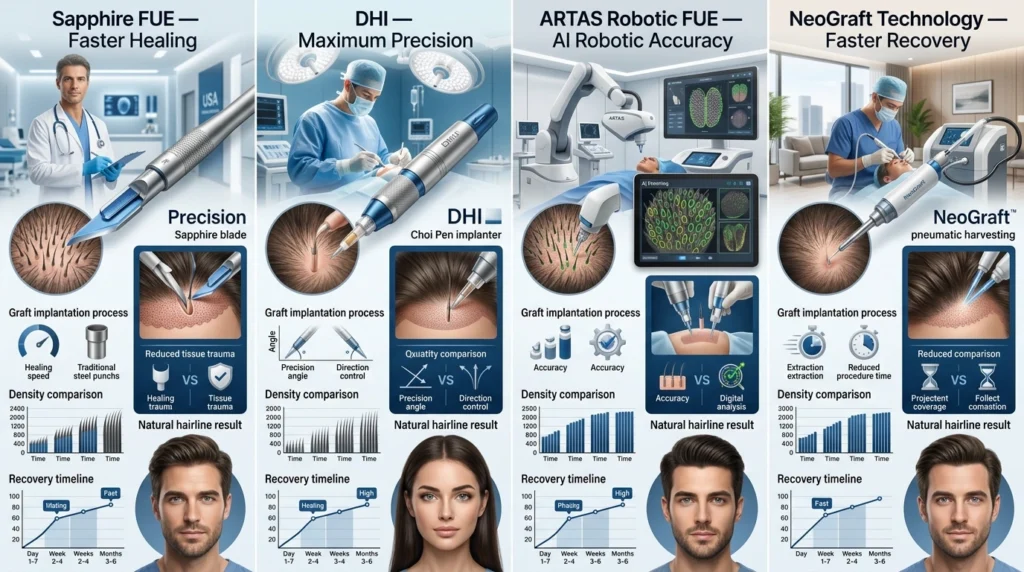
| Technology / Approach | Description | Regulatory note |
|---|---|---|
| Standard FUE | Follicular-unit extraction technique | Technique itself is not an FDA-cleared device |
| Sapphire FUE | FUE using sapphire blades for recipient-site creation | Technique/marketing terminology; not itself an FDA-cleared device |
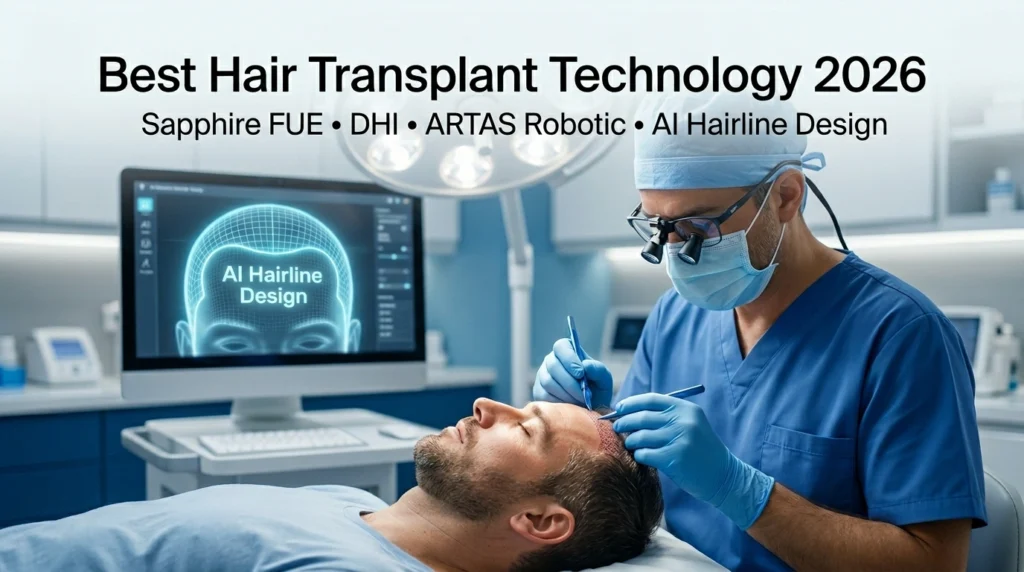
| ARTAS | Computer-assisted robotic hair harvesting | FDA-cleared computer-assisted hair harvesting system |
| DHI / Choi-type implanter | Implanter-based graft placement | Verify the specific device |
| FUT | Strip-based graft harvesting | Surgical technique, not itself an FDA-cleared device |
| AI-assisted planning | Software-assisted planning/visualization | Depends on the specific software |
ARTAS Robotic FUE
ARTAS is an FDA-cleared computer-assisted hair harvesting system. FDA documentation describes the ARTAS System as an interactive, image-guided, computer-assisted system used under physician control to assist with follicular-unit harvesting and recipient-site creation.
How ARTAS works:
The ARTAS System uses interactive, image-guided computer assistance under physician control to assist with follicular-unit harvesting and recipient-site creation. The FDA documentation describes a robotic arm, imaging system, needle mechanism and computer as components of the system.
| ARTAS Feature | Evidence-based description |
|---|---|
| FDA status | FDA-cleared computer-assisted hair harvesting system |
| System type | Interactive, image-guided, computer-assisted system |
| Physician involvement | Used under physician control |
| Main function | Assists with follicular-unit harvesting and recipient-site creation |
| Graft survival | Do not state a universal percentage |
| Extraction accuracy | Do not claim “sub-millimeter” without a direct source |
| Recovery | Patient/procedure dependent |
| Cost | Keep only if separately supported by current pricing sources |
The FDA indication for the documented ARTAS system specifies men with black or brown straight hair and androgenetic alopecia.
Benefits:
- Image-guided robotic assistance
- Computer-assisted follicular-unit harvesting
- Physician-controlled operation
- Assistance with recipient-site creation
FDA-cleared indication: The ARTAS System is indicated to assist in follicular-unit harvesting in men with androgenic alopecia who have black or brown straight hair.
Sapphire FUE Technology
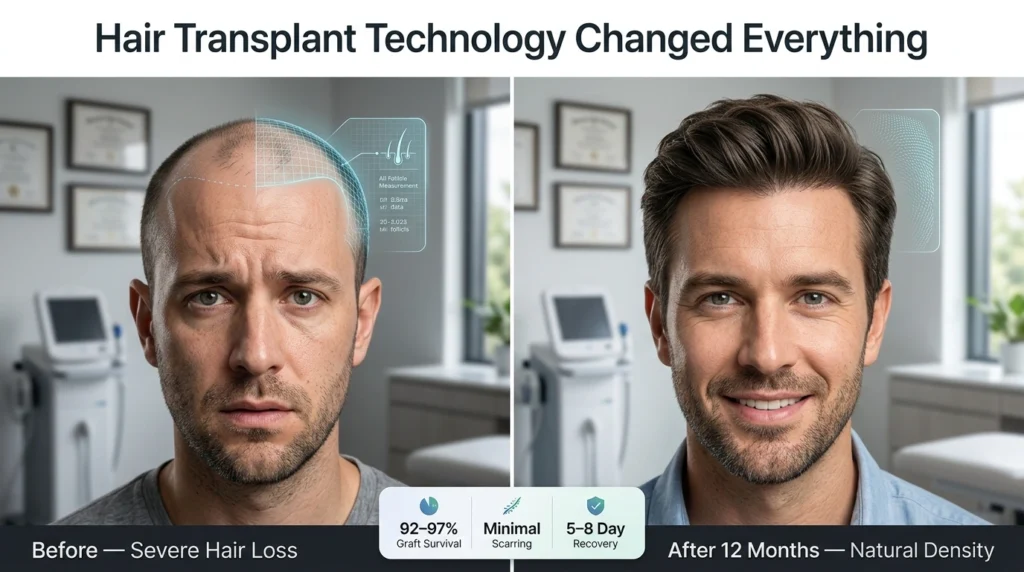
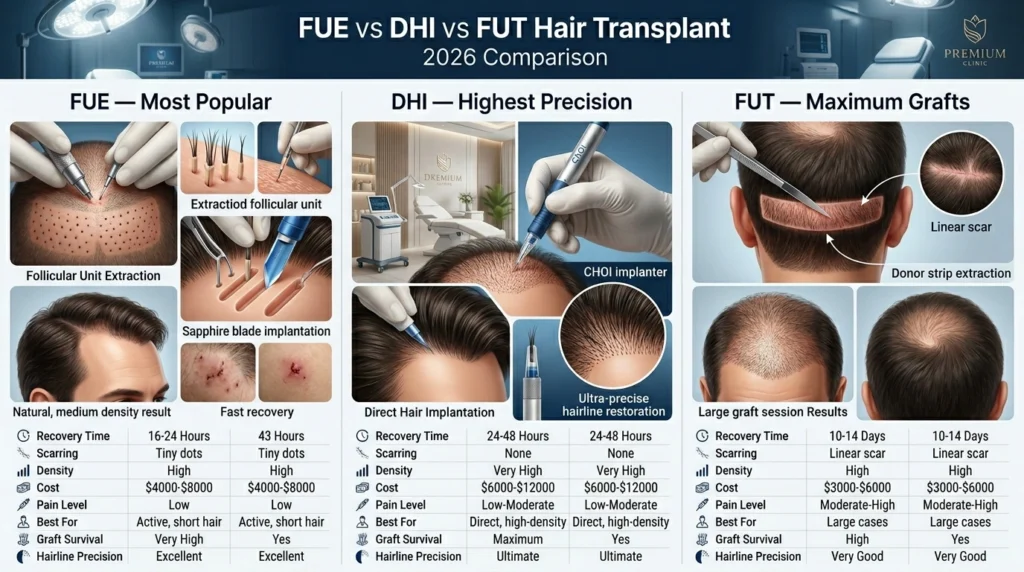
Sapphire FUE is generally used to describe FUE in which sapphire-tipped blades are used for recipient-site creation. The International Society of Hair Restoration Surgery (ISHRS) does not recognize “Sapphire FUE” as a separate standardized hair-transplant method and lists it among marketing terms used to describe variations of FUE. The term should therefore be understood as a description of instrumentation rather than a distinct surgical category.
What Research Has Reported About Sapphire FUE
Evidence comparing sapphire and steel blades is still procedure- and study-specific. A 1,000-patient prospective observational study reported higher graft survival in its Sapphire group than its steel-blade group, but the study design does not establish that Sapphire FUE is universally superior for healing, infection risk or graft survival.
| Feature | Standard FUE | Sapphire FUE |
|---|---|---|
| Blade material | Medical steel | Sapphire-tipped blade |
| Recipient-site creation | Slit/channel creation | Sapphire-blade slit/channel creation |
| Graft survival | Study-dependent | 94.7% in one prospective observational study |
| Recovery | Study/procedure dependent | Study/procedure dependent |
| Infection risk | Depends on surgical and postoperative factors | Depends on surgical and postoperative factors |
Benefits:
- Sapphire blades are used for recipient-site incision/channel creation.
- A prospective observational study reported higher graft survival in its Sapphire group than its steel-blade group.
- Individual healing and cosmetic outcomes vary with surgical technique, graft handling and patient factors.
Potentially suitable for: Patients for whom a surgeon recommends sapphire-blade recipient-site creation based on graft characteristics, recipient area and surgical plan.
DHI / Choi Implanter Technology
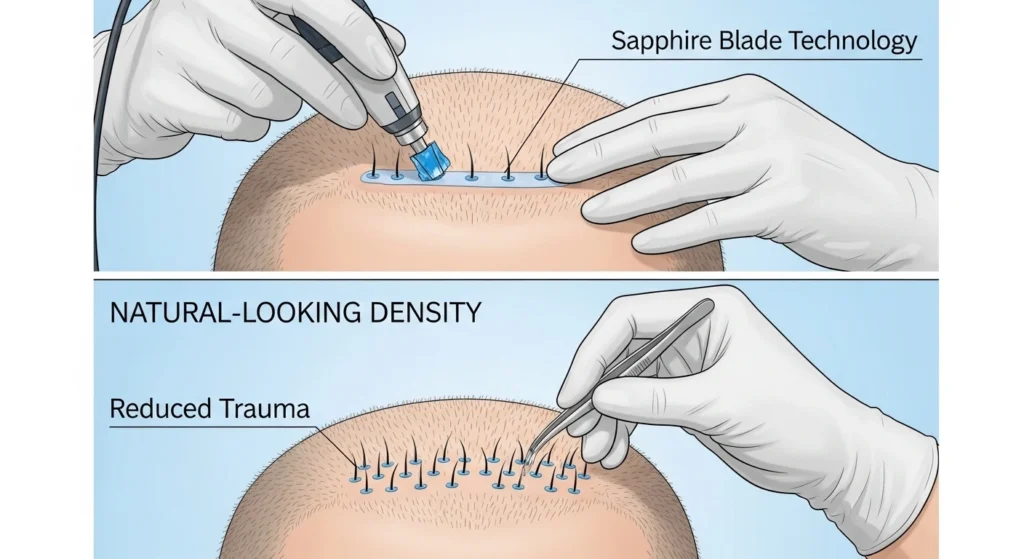
DHI generally refers to implantation using a Choi-type implanter pen, which allows a graft to be loaded into an implanter and placed into the recipient area. The exact technique and workflow vary by surgeon and device.
How DHI works:
Implanters can be used to place follicular-unit grafts while limiting direct handling of the follicular bulb compared with forceps. However, graft survival depends on multiple factors, and this mechanism alone does not establish a universal DHI-specific survival advantage. ISHRS
| DHI Feature | Evidence-based description |
|---|---|
| Implanter | Implanter device used to place follicular-unit grafts |
| Technique | Depending on the device, implantation may occur through a pre-made incision or with a sharp implanter |
| Angle/depth | Determined by the surgeon and the specific implanter/protocol |
| Graft handling | Implanters can reduce direct handling of the follicular bulb compared with forceps, but this does not establish a universal survival advantage |
| No-shave option | May be offered by some clinics; verify the clinic-specific protocol |
| USA cost | Not a standardized national DHI price |
| Recovery | Procedure- and patient-dependent |
| Graft survival | No universal DHI-specific survival rate established here |
DHI vs FUE: When an Implanter-Based Workflow May Be Considered
An implanter-based workflow may be considered when the surgeon prefers this approach for recipient-site placement or for selected hairline and density-focused cases. The appropriate technique depends on the patient’s hair-loss pattern, donor supply, recipient area and the surgeon’s preferred surgical workflow.
Benefits:
DHI may be considered when an implanter-based workflow is preferred for recipient-site placement, including some hairline or density-focused cases.
AI-Assisted Hairline Design
AI-assisted planning tools may help clinicians visualize facial proportions, hairline geometry and proposed graft distribution, but they should be treated as planning aids rather than substitutes for clinical judgment.
Hybrid FUE and Implanter Workflows
Some clinics combine different recipient-site and implantation techniques in the same procedure. These hybrid workflows are not necessarily standardized across providers, so patients should ask exactly which instrument creates the recipient sites, who performs each surgical step, and how graft handling is managed.
NeoGraft Automated FUE
NeoGraft is a mechanical FUE device designed to assist with follicular-unit extraction. ISHRS describes it as using a rotating sharp punch and suction to extract follicular units into a collection tray.
| NeoGraft Feature | Detail |
|---|---|
| FDA clearance | Specific device clearance should be verified separately |
| Mechanism | Pneumatic-assisted FUE extraction |
| Recovery | Patient- and procedure-dependent |
| Graft survival | Study-dependent; no universal percentage stated here |
| Cost | Varies by clinic and graft number |
Hair Transplant Cost in the USA: Published Clinic Examples
| Clinic | Location | Published pricing evidence | Pricing status |
|---|---|---|---|
| Parsa Mohebi Hair Restoration | California | FUE: $16/graft with Dr. Mohebi; $10/graft with Dr. Marshall and Dr. Gujrati | 🟢 Published by clinic |
| Arocha Hair Restoration | Houston, TX | FUE: $4,000–$15,000; FUT: $4,000–$10,000 | 🟢 Published by clinic |
| Shapiro Medical Group | Minneapolis, MN | Published estimates: $4,000–$7,000 up to 1,000 grafts; $15,000+ for 4,000+ grafts | 🟢 Published by clinic |
| Bernstein Medical | New York, NY | Consultation fee is published; procedure fee varies by procedure/graft requirements | 🟢 Published pricing structure |
| Bauman Medical | Boca Raton, FL | Clinic explains FUE pricing varies by graft volume, complexity and physician; no single public national price listed | 🟡 Price not publicly fixed |
| Chicago Hair Institute | Oak Brook, IL | Procedure pricing not publicly listed on the source reviewed | 🟡 Not publicly listed |
| Natural Transplants | Florida | No current public price located during review | 🟡 Not publicly listed |
| True & Dorin Medical Group | New York, NY | No current public price located during review | 🟡 Not publicly listed |
| Foundation for Hair Restoration | Miami, FL | Current public procedure price not established from a source reviewed | 🟡 Not publicly listed |
| Cole Hair Transplant Group | Atlanta, GA | No current public price located during review | 🟡 Not publicly listed |
Published prices are clinic-specific examples, not national U.S. averages. Final pricing can vary according to graft number, procedure, surgeon, clinic and individual treatment plan. Verify the current price and what is included before paying a deposit.
USA vs Turkey vs UK Technology
| Factor | USA | Turkey | UK |
|---|---|---|---|
| ARTAS | Available at some clinics; verify clinic-specific availability | Verify clinic-specific availability | Available at some clinics; verify |
| Sapphire FUE | Marketed/available at some clinics | Marketed/available at some clinics | Marketed/available at some clinics |
| DHI / Implanter | Available at some clinics; terminology varies | Availability varies; verify workflow | Availability varies; verify workflow |
| NeoGraft | Available at some U.S. practices | Verify clinic-specific availability | Verify clinic-specific availability |
| Regulation | Medical practice and devices subject to U.S. federal/state requirements | Subject to Turkish regulatory and medical requirements | Subject to UK regulatory requirements |
| Pricing | Varies widely by clinic/graft count | Usually clinic-specific | Varies widely by clinic/graft count |
| Surgeon involvement | Verify who performs each surgical step | Verify who performs each surgical step | Verify who performs each surgical step |
Availability, regulation and pricing vary by clinic and jurisdiction. A technology being available in a country does not establish that it is clinically superior. Verify the specific device, surgeon and surgical workflow before treatment.
Hair Restoration Surgeons to Research
| Surgeon | Clinic / Location | Credential source | Current practice source | Procedure source | HairGrowNeeds Directory | Verification |
|---|---|---|---|---|---|---|
| Dr. Robert M. Bernstein | Bernstein Medical, New York, NY | ABHRS / ISHRS | Official ISHRS profile / clinic | Official ISHRS profile / clinic | ✅ Listed | 🟢 Claim-level |
| Dr. William Rassman | NHI Medical, Marina Del Rey, CA | ISHRS | Official ISHRS profile / clinic | Official ISHRS profile | Not currently listed | 🟢 Claim-level |
| Dr. Jeffrey Epstein | Foundation For Hair Restoration, Miami, FL | ABHRS / ISHRS | Official ISHRS profile / clinic | Official ISHRS profile | ✅ Listed | 🟢 Claim-level |
| Dr. Alan Bauman | Bauman Medical, Boca Raton, FL | ABHRS / ISHRS | Official ISHRS profile / clinic | Official ISHRS profile | ✅ Listed | 🟢 Claim-level |
| Dr. Ronald L. Shapiro | Shapiro Medical Group, Minneapolis, MN | ABHRS / ISHRS | Official ISHRS profile / clinic | Official ISHRS profile | Not currently listed | 🟢 Claim-level |
| Dr. John P. Cole | ForHair, Atlanta, GA / New York | ABHRS / professional sources | Official clinic | Official clinic | Not currently listed | 🟢 Claim-level |
| Dr. Raymond J. Konior | Chicago Hair Institute, Oakbrook Terrace, IL | ABHRS / ISHRS / clinic | Official ISHRS profile / clinic | Official clinic | ✅ Listed | 🟢 Claim-level |
| Dr. Parsa Mohebi | Parsa Mohebi Hair Restoration, Beverly Hills, CA | ABHRS / ISHRS | Official ISHRS profile / clinic | Official clinic | ✅ Listed | 🟢 Claim-level |
| Dr. Jerry E. Cooley | Cooley Hair Center, Charlotte, NC | ABHRS / ISHRS | Official ISHRS profile / clinic | Official ISHRS profile | Not currently listed | 🟢 Claim-level |
| Dr. Carlos Wesley | True & Dorin, New York, NY | ABHRS / ISHRS | Official ISHRS profile / clinic | Official ISHRS profile | Not currently listed | 🟢 Claim-level |
| Dr. Bernardino A. Arocha | Arocha Hair Restoration, Houston, TX | ABHRS / ISHRS | Official ISHRS profile / clinic | Official clinic | Not currently listed | 🟢 Claim-level |
Note:
The surgeons listed above are provided for research purposes and are not ranked as the “best” hair-transplant surgeons. Credential, practice and procedure information is based on identifiable professional and clinic sources available at the time of review. Verification applies only to the specific claim supported by the cited source and does not represent an endorsement of clinical skill, treatment quality or expected results. Readers should confirm current credentials and surgical arrangements directly with the relevant professional organization and clinic before treatment.
How to Choose Based on Technology
| Patient consideration | What to discuss at consultation |
|---|---|
| First transplant | Whether FUE or FUT is appropriate for donor supply and long-term plan |
| Large graft requirement | Whether FUT, FUE or a combined strategy is appropriate |
| Hairline-focused restoration | How recipient sites will be designed and who creates them |
| Existing hair needing added density | Whether an implanter-based workflow is suitable |
| Robotic harvesting | Whether the specific ARTAS system is appropriate for the patient’s hair characteristics and indication |
| Repair surgery | Surgeon experience with corrective/restorative cases |
| Limited donor supply | Long-term donor management rather than technology alone |
7 Questions to Ask About Technology at Consultation
| Question | Correct Answer | Red Flag |
|---|---|---|
| Which technology do you use? | Named specific system with explanation | The latest and best technology (vague) |
| Is the surgeon present all day? | Ask which surgical steps are personally performed by the surgeon and which, if any, are delegated, subject to applicable law. | Technicians use the technology |
| What is your graft survival rate? | Can you show me the source, measurement method, follow-up period and patient population behind that figure? | No data available |
| Do you use AI hairline design? | Yes, with patient preview | No planning beyond consultation |
| What FDA-cleared systems do you use? | Named FDA-cleared device | Non-specific answer |
| How many ARTAS/NeoGraft cases per year? | Specific number | “Many patients” |
| Who implants the grafts? | The surgeon personally | “Our clinical team” |
FAQs:
Q: What is the best hair transplant technology?
There is no single hair transplant technology proven to be best for every patient in 2026. FUE and FUT are established surgical approaches, while robotic systems and implanters are tools used within hair-transplant workflows. The appropriate approach depends on donor characteristics, hair-loss pattern, treatment goals, graft requirements and surgeon assessment.
Q: Is robotic hair transplant better than manual FUE?
ARTAS provides computer-assisted, image-guided follicular-unit harvesting under physician control. Whether robotic assistance is preferable to manual FUE depends on the patient’s characteristics, the system being used and the surgeon’s workflow. FDA clearance establishes the device’s cleared indication; it does not establish that ARTAS produces better cosmetic outcomes than every manual FUE approach.
Q: How much does the best hair transplant technology cost in USA?
Hair-transplant pricing in the USA varies by graft number, procedure, surgeon, clinic and pricing model. Published examples include Arocha‘s FUE range of $4,000–$15,000, Parsa Mohebi‘s published per-graft pricing, and Shapiro Medical Group’s graft-based estimates. These are clinic-specific prices, not national averages.
Q: What is Sapphire FUE, and is it better than standard FUE?
Sapphire FUE generally refers to FUE in which sapphire-tipped blades are used for recipient-site creation. ISHRS notes that “Sapphire FUE” is a marketing term rather than a separate standardized FUE technique. A recent prospective observational study reported higher graft survival in its Sapphire group than its steel-blade group, but this does not establish that Sapphire FUE is universally superior.
Q: What is DHI hair transplant technology?
DHI is commonly used to describe an implanter-based implantation technique. ISHRS notes that DHI is not a separate hair-transplant method and may refer to immediate implantation or use of a sharp implanter. Patients should ask exactly which implantation instrument and workflow a clinic uses.
Q: Which technology has the highest graft survival rate?
No high-quality evidence reviewed for this guide establishes DHI, ARTAS, Sapphire FUE or another named approach as having the highest graft-survival rate across all patients. A 1,000-patient prospective observational study reported 94.7% survival in its Sapphire group versus 88.9% in its steel-blade group, but those findings should not be generalized to every procedure.
Q: Is AI-assisted hairline design worth it?
AI-assisted hairline planning may be useful as a visualization and planning aid, but there is not sufficient independent evidence to conclude that AI-assisted hairline design produces better long-term clinical outcomes than appropriately performed surgeon-led planning. The final design still requires clinical judgment.
Q: What is the newest hair transplant technology in 2026?
There is no single newly established technology that can be identified as the universally “newest” or “best” hair-transplant approach in 2026. Current clinical workflows include manual and mechanically assisted FUE, robotic harvesting systems such as ARTAS, FUT, implanter-based placement and software-assisted planning. Emerging research should be distinguished from technologies with established clinical and regulatory documentation.
Conclusion:
There is no universally superior hair-transplant technology. Sapphire FUE, conventional FUE, ARTAS-assisted harvesting and implanter-based approaches each have different technical characteristics and potential applications. The strongest evidence should be evaluated at the level of the specific procedure, device, surgeon and patient rather than through broad claims that one technology is “best.”
Technology is only one part of the outcome. Donor management, graft handling, recipient-site design, surgical technique, realistic expectations and surgeon experience can all influence the final result.
Methodology
HairGrowNeeds researches clinic, surgeon, procedure and pricing information using publicly available professional organizations, regulatory sources, official clinic websites, licensing resources and published medical research. We distinguish independently verified information from clinic-reported information and apply verification at the individual claim level rather than treating an entire clinic or surgeon profile as automatically verified.
Medical statistics and treatment claims are checked against their underlying sources where possible, including study design, population, follow-up and the exact result reported. Published clinic prices are identified separately from clinic-confirmed or unavailable pricing and may change over time.
For the clinic and surgeon information in this article, readers should treat each verification label as applying only to the specific field or claim supported by the cited source. HairGrowNeeds does not use credentials, reviews, directory inclusion or technology availability as proof of clinical quality or treatment superiority.
For the complete HairGrowNeeds Research & Verification Methodology, see our Research & Verification Methodology page.
Written & Reviewed By
Written by: Wajiha Aqeel
Co-Founder & Hair Restoration Research Lead
Data & publication oversight: Daniel Brooks
Co-Founder & Senior Operations & Data Director
Published Date: April 18, 2026
Clinic & Pricing Data Last Reviewed: August 2026
Last Updated: August 28, 2026
All content on Hair Grow Needs is researched and organized by the Hair Grow Needs editorial team using existing, publicly published clinical studies, FDA information, and industry sources, which may not yet have been vetted and approved by licensed medical practitioners. Before considering any treatment, please see a board certified surgeon.
What to Do Next
It’s important to understand that hair type, condition of your scalp, your Norwood stage and surgeon skill all contribute to determining the ideal hair transplant technology for you, and it should not be solely based on advertisements.
To find the ideal approach:
- Check the credentials of the surgeon at abhrs.org and ishrs.org
- Schedule consultations with at least 2 qualified hair-restoration surgeons and compare their recommendations.
- Ask: Which technology do you prefer for MY pattern and explain why
- Review patient-reported experiences and before/after examples on platforms such as RealSelf and Reddit, while recognizing that these are not substitutes for clinical evidence.
- Get pricing in writing (all-inclusive) prior to deposit
Names of surgeons have been compared to the publicly available ISHRS and clinic-website lists in August 2026. Readers are warned to confirm individual credentials prior to appointment by checking ishrs.org and abhrs.org independently.
References & Sources:
- International Society of Hair Restoration Surgery (ISHRS) — Surgical Treatments for Hair Loss
- ISHRS – Questions to Ask Your Hair Restoration Surgeon
- FDA – ARTAS System, 510(k) K123548
- FDA – ARTAS System, 510(k) K173358
- Kumar S. – Accuracy in Hair Repair: Assessing Sapphire FUE, Forceps Methods, and Treatment Times in Contemporary Hair Transplantation. PubMed
- ABHRS – Diplomate Directory
- Parsa Mohebi Hair Restoration – Hair Transplant FAQ / Pricing
- Arocha Hair Restoration – Hair Transplant Pricing
- Shapiro Medical Group – Hair Grafts and Pricing
- Bernstein Medical – Consultation Fees & Hair Transplant Cost
- Bauman Medical – FUE Hair Transplant Costs
- HairGrowNeeds – Research & Verification Methodology
- HairGrowNeeds – Surgeon Directory
- HairGrowNeeds – Clinics Directory
Medical & Affiliate Disclaimer:
The content on Hair Grow Needs is for general informational and educational purposes only and should not be considered professional medical advice. For full details regarding our policies, please read our official Disclaimer.