
Rosemary oil for hair growth has become one of the most talked-about natural options for thinning hair, but how much of the hype is backed by research? One small clinical trial found results similar to 2% minoxidil after six months, while other evidence exists from laboratory and animal studies. It can potentially treat early or mild pattern hair loss but cannot regrow hair where the follicles have gone dormant. In this guide, we cover what the studies actually show, how to choose 100% pure rosemary oil, how to use it safely, and when a hair transplant becomes the more realistic option.
What Is Rosemary Oil?
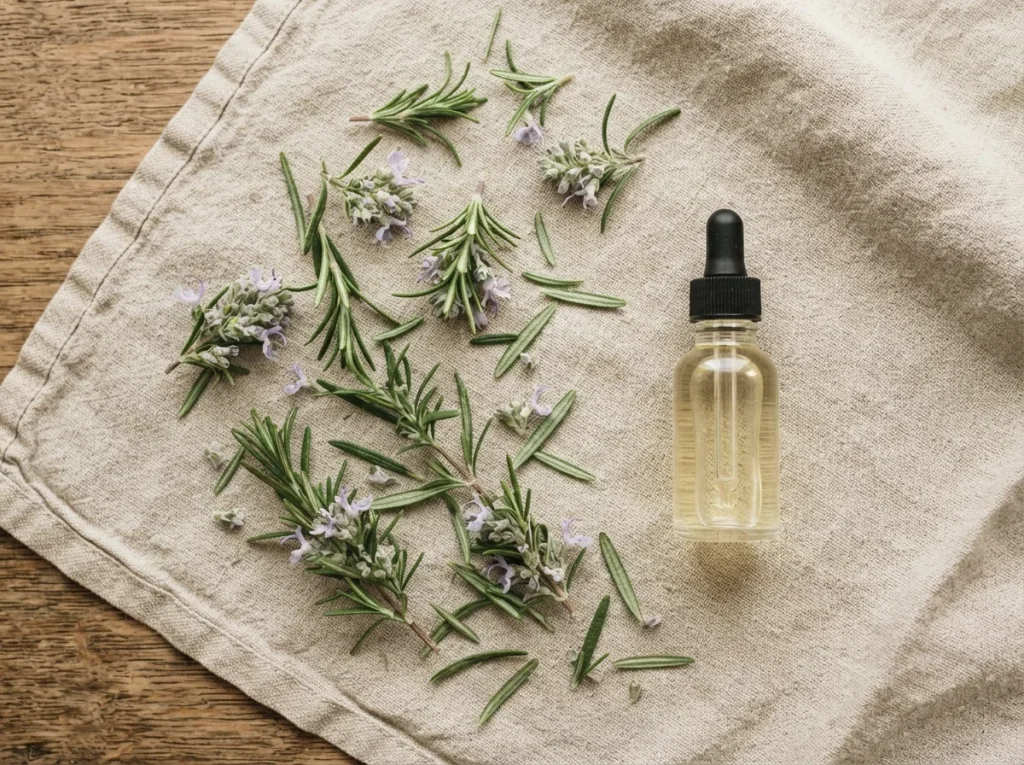
Rosemary essential oil comes from the leaves and flowering tops of Rosmarinus officinalis, a Mediterranean herb in the mint family. It is made by steam distillation and is highly concentrated. Rosemary-infused oil, made by soaking leaves in a carrier oil like olive oil, is much milder.
How Might Rosemary Oil Help Hair Growth?
Researchers have suggested a few possible mechanisms:
- Scalp circulation and inflammation. Rosemary has been proposed to improve blood flow and to have antioxidant and anti-inflammatory effects, mostly based on lab and animal work. Better blood flow alone has not been shown to regrow hair in humans.
- Anti-inflammatory and antioxidant activity. There are a number of conditions that can be associated with both inflammation and thinning.
- Possible effect on DHT. A 2013 animal study (Murata et al.) found that a rosemary leaf extract improved hair regrowth in mice. In lab tests, the extract also inhibited 5-alpha reductase, an enzyme involved in producing DHT, the hormone linked to pattern hair loss. This was not tested in humans and used an extract rather than essential oil, so the results may not carry over.
What Does the Research Actually Say?
This is the part most blogs exaggerate, so here is what we can reliably say:
Rosemary oil vs minoxidil (Panahi et al., 2015). In a randomized trial, 100 patients with androgenetic alopecia were split into two groups of 50, using either rosemary oil or 2% minoxidil for six months. There was no significant change in hair count at 3 months, but both groups improved significantly by 6 months, with no significant difference between them. Scalp itching was less frequent in the rosemary group.
Alopecia areata (Hay et al., 1998). A randomized, double-blind trial of 86 patients, published in Archives of Dermatology, tested a blend of thyme, rosemary, lavender and cedarwood oils in carrier oils against carrier oils alone. The oil blend group improved more. Alopecia areata is an autoimmune, patchy hair loss, different from pattern baldness, and because it was a blend, we cannot credit rosemary alone.
The limits. These studies are small and short. The Hay trial looked at alopecia areata, a different condition from pattern hair loss, and used a blend of oils. The Murata study was in mice and in the lab. There are no large, long-term human trials, so rosemary oil is promising but not proven to match prescription treatment.
Rosemary Oil vs Minoxidil: Which Is Better?
| Factor | Rosemary Oil | Minoxidil |
|---|---|---|
| Evidence | Small studies | Large body of research, FDA-approved |
| Time to see results | Around 3 to 6 months | Around 3 to 6 months |
| Common side effects | Scalp irritation if undiluted, allergic reactions | Dryness, itching, initial shedding |
| Cost | Usually low | Low to moderate |
| Best for | Mild thinning, people who prefer natural options | Proven option for pattern hair loss |
Neither is a cure. Minoxidil effect fades if you stop using it, and rosemary oil may behave similarly, though this has not been studied.
How to Choose 100% Pure Rosemary Oil

The market is full of products labelled “rosemary hair oil” that contain very little actual rosemary. Check for:
- The Latin name Rosmarinus officinalis on the label.
- “100% pure essential oil” with no “fragrance” or “parfum” listed.
- A dark glass bottle (amber or cobalt), because light degrades essential oils.
- Batch number and GC/MS test report, which good brands publish.
- Realistic pricing. A very cheap “pure” essential oil is often diluted or synthetic.
How to Use Rosemary Oil for Hair Growth (5 Steps)
Dilute it. Never apply undiluted essential oil. General aromatherapy guidance suggests about 1 to 2 percent, roughly 3 to 6 drops per tablespoon of a carrier oil such as jojoba, coconut or almond oil. This is a common safety guideline, not the dose tested in clinical trials.
Patch test first. Apply a little diluted amount to your inner forearm and wait for 24 hours. If you notice redness, itching or swelling, do not use it.
Massage into the scalp. Use your fingertips for 3 to 5 minutes. In a small 2016 study of nine men using a massage device for 4 minutes daily over 24 weeks, hair thickness increased, though total hair count did not change significantly. It was a tiny uncontrolled study, so treat massage as a possible extra, not a proven treatment. (Koyama et al., Eplasty, 2016)
Leave it on. Most people keep it on for 30 minutes to a few hours, or leave it on overnight with a towel over their pillow.
Wash out and repeat.Wash out with a gentle shampoo and repeat 2 to 3 times a week. In the Panahi trial, no significant change appeared at 3 months but hair count improved by 6 months, so stay consistent for about 6 months before judging.
Side Effects and Who Should Avoid It
- Scalp irritation or allergic contact dermatitis is the most common problem, usually from using it undiluted.
- Epilepsy or seizure disorders: a systematic review of essential oils and seizures lists rosemary among oils that may trigger seizures because of compounds like camphor and 1,8-cineole. The review’s strongest warning concerns internal use, but people with epilepsy are generally advised to avoid rosemary oil or ask their neurologist first.
- Pregnancy and breastfeeding: avoid unless your doctor approves, as safety is not established.
- Allergies: rosemary is in the mint family. If you react to similar herbs, be extra careful and patch test.
- Keep it away from eyes, children and pets.
Stop use and see a doctor if you develop a rash, burning, or unusual shedding.
When Rosemary Oil Is Not Enough
Rosemary oil works, if at all, on follicles that are still active. If you have:
- Advanced pattern baldness, such as a completely bald crown or receding hairline that has been stable for years.
- Scarring alopecia.
- Hair loss that continues after 6 months of consistent use.
then oils and serums are unlikely to bring the hair back. This is where a hair transplant is a realistic option. See our guides to hair transplant cost in the USA, FUE vs FUT, and how to choose a hair transplant clinic.
Some people also use rosemary oil for scalp health after a transplant, but always ask your surgeon before applying anything to the recipient area during healing.
FAQs:
Q: How long does rosemary oil take to work for hair growth?
Studies point to around 3 to 6 months of consistent use before any change in hair count becomes noticeable.
Q: Can I apply rosemary oil directly to my scalp?
No. Essential oil should always be diluted in a carrier oil first.
Q: Is rosemary oil better than minoxidil?
One small trial found similar results at six months, but minoxidil has far more evidence behind it. Rosemary oil is a reasonable option for mild thinning, not a proven replacement.
Q: How often should I use rosemary oil on my hair?
Two to three times a week is the usual recommendation for diluted oil.
Q: Can rosemary oil regrow hair on a bald spot?
Only if the follicles are still alive. It cannot regrow hair where follicles have permanently shut down.
Conclusion:
Rosemary oil is a low-cost option worth considering for early thinning, as long as you dilute it, patch test, check the safety points above, and stay patient for several months. Be realistic, take photos to monitor your progress, and if it doesn’t work, discuss your next steps with a dermatologist or hair restoration surgeon.
Written & Reviewed By
Written by: Wajiha Aqeel
Co-Founder & Hair Restoration Research Lead
Medically Reviewed by: Dr. Anam Sahibzada
Specialist Dermatologist & Trichologist
Data & publication oversight: Daniel Brooks
Co-Founder & Senior Operations & Data Director
Content reviewed by:
Mehwish Fareed
Clinical Aesthetician & Content Reviewer
Asma Shamshad
Medical Student & Content Contributor
Originally published: September 28, 2026
Research & content last reviewed: September 2026
Last updated: September 28, 2026