
Medical Disclaimer: This article is for informational purposes only and does not replace professional medical advice. Read our full Medical Disclaimer.
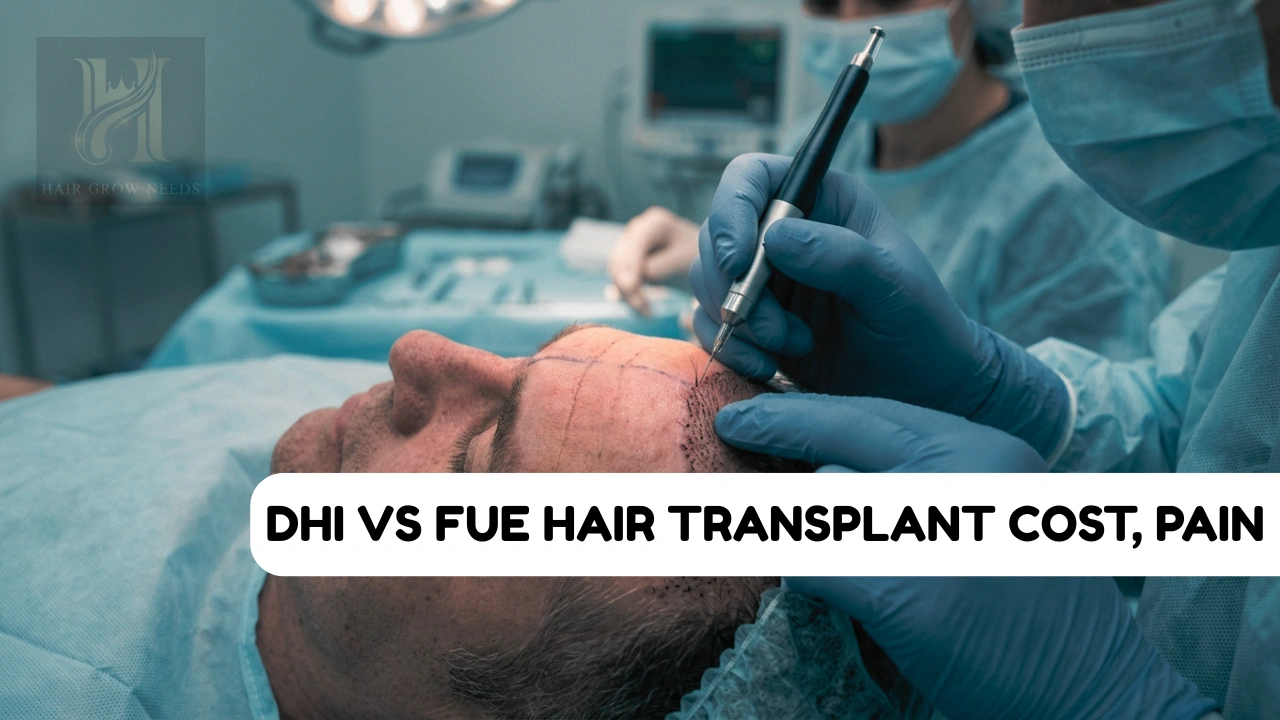
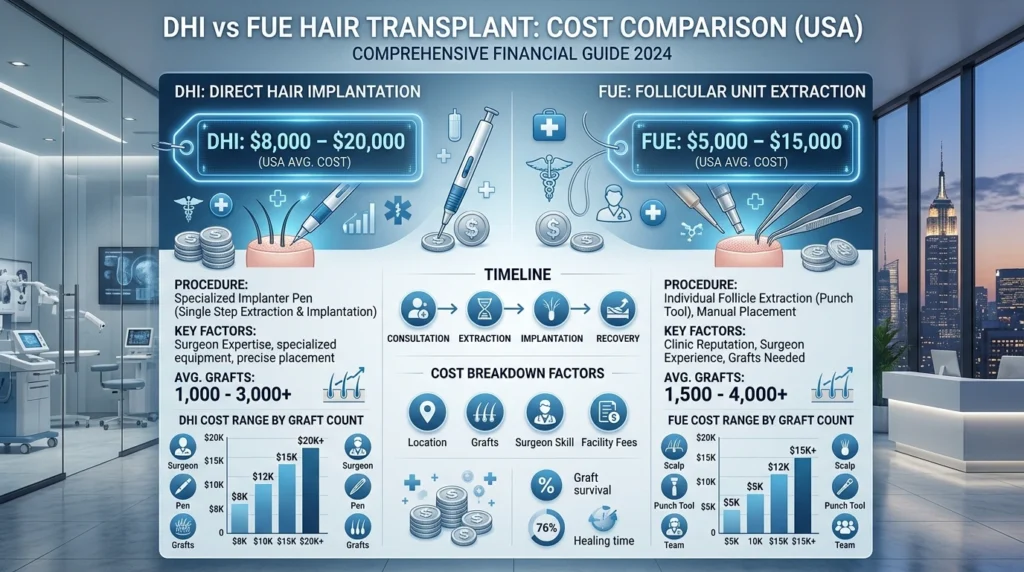
DHI vs FUE hair transplant is a comparison between the two techniques for hair loss treatment The USA DHI hair transplant prices vary between $8,000 and $20,000 depending on the grafts, the clinic’s location, and the surgeon’s expertise, while the price range for FUE is $5,000 to $15,000 in the USA, depending on the area covered and the hair characteristics.
The DHI vs FUE hair transplant comparison is one of the top queries by patients interested in permanent hair restoration solutions in the USA, especially in the US who want a more natural look with high density and less down time. Making a decision between both these cutting edge hair transplantation methods will not only be a medical decision but also a lifestyle choice with impact on confidence, appearance and cost involved for years to come.
In this guide you will find out all you need to know about the DHI vs FUE hair transplant comparison, their procedures, cost in the USA, success rates, downtime, which one to choose, its pros and cons and the opinions of professionals in relation to their actual clinic performance.
What is DHI Hair Transplant?
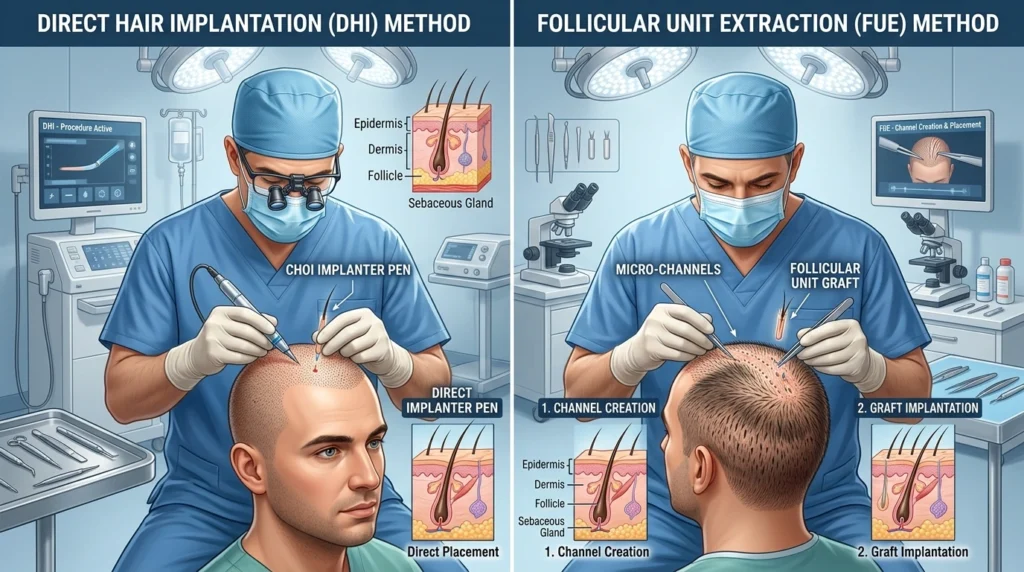
DHI (Direct Hair Implantation) Direct Hair Implantation or DHI is a hair restoration procedure whereby extracted follicles are implanted directly into the scalp with an implanter pen rather than making a pre-made incision.
The following are the most important characteristics of the DHI technique:
- Utilizes Choi Implanter pen for controlled follicular implantation and direction of hair growth.
- Higher follicular density implantation in target balding or thinning zones.
- It is the technique of choice for frontal hair line work and detailed fine cosmetic work.
- It is vital that hair surgeons operating with this technique are extremely skilled because this procedure demands great accuracy.
What is FUE Hair Transplant?
FUE (Follicular Unit Extraction) is one of the popular hair transplant techniques which works by individual hair follicles extracted from a donor area, and then transplanted in the balding recipient site with micro-incisions.
Characteristics of FUE:
- Harvesting individual follicular unit with a micro punch ranging from 0.7mm-1.0mm.
- Channels are created prior to transplantation in order to place the graft.
- Minimally invasive and leaves no linear scars.
- Well suited for extensive areas of baldness needing coverage.
- This procedure is very popular and readily available in USA clinics for a cheap price.
DHI vs FUE Hair Transplant Key Differences Comparison Table:
| Factor | DHI / Implanter-based | FUE |
|---|---|---|
| Implantation | Implanter-based placement | Grafts placed into recipient sites |
| Precision | Depends on surgeon, device and protocol | Depends on surgeon and recipient-site design |
| Recovery | Procedure-dependent | Procedure-dependent |
| Density | Depends on recipient area and surgical plan | Depends on recipient area and surgical plan |
| Typical use | May be used for selected hairline/density cases | Widely used across different restoration patterns |
DHI vs FUE Hair Transplant:
1. Technique & Precision Level
With DHI you get more control of angle, depth and direction of the hair implanted for the natural hairline.
FUE aims at good coverage making it applicable on large bald areas where accuracy isn’t essential
2. Density & Natural Results
It enables more grafts to be packed closer together, and is a treatment many prefer for hairline and aesthetic areas.
FUE gives natural results, but may not achieve the ultra-high density seen with DHI in small areas.
3. Healing & Downtime
DHI usually gives rapid recovery as it takes less touching scalp and takes less cuts that damage tissue.
FUE’s recovery is also accelerated but it can have a little more scabping and healing time according to the number of graphs.
4. Cost Factor in USA Clinics
DHI is usually more expensive because it is a time-taking processor and has modern and special tools used.
FUE is a relatively cheap and cost-better option and is easily available in most USA hair transplant clinics.
Hair Transplant Cost in USA (DHI vs FUE Price Comparison):
| Procedure | Average Cost per Graft | Total Estimated Cost (2,000 – 3,000 grafts) |
| DHI Hair Transplant | $4 – $8 per graft | $8,000 – $20,000 |
| FUE Hair Transplant | $2 – $6 per graft | $5,000 – $15,000 |
Prices vary according to clinic reputation, surgeon experience, and location such as New York, Los Angeles, Miami. Also the price depends on how many graphs the patient needs.
Pros and Cons of DHI vs FUE Hair Transplant:
DHI Pros
DHI makes a very natural hairline and meet high density results. It makes the recovery fast, the pain and scarring risk decreases, and has more control over hair follicle and directions.
DHI Cons
DHI is more expensive than other methods. It is a time-taking procedure and is not suitable for large-colored areas where more graphs are needed.
FUE Pros
FUE is relatively cheap and easily available in most US clinics. It is better to cover large balanced areas and it doesn’t make any clear linear scars.
FUE Cons
Density in FUE may be a little less than DHI. It often takes to Donor Area and scabbing and light healing phase in the early days.
Who is the Best Candidate for DHI vs FUE Hair Transplant?
- Most people prefer DHI method to recover hair loss and hair line in the early stage because it has natural and accurate results.
- In case of more hair loss (advanced baldness), where more graphs require, FUE techniques are more appropriate.
- For those who reduce hair quantity in donor area, the hybrid methods are used as needed, both techniques are mixed.
- People who find low cost and budget-frendly solutions in the US usually prefer FUE treatment because it is more cheap.
- People who want more natural density and best aesthetic accuracy, most choose the DHI method.
Step-by-Step Procedure:
DHI Procedure Steps
- Donor Area preparation and local anesthesia is made to ensure the extract of hair can be without pain.
- Follicles are immediately implanter directly through the Choi implanter pen technique.
- The constant implantation receives density and the hair direction and design is better controlled.
FUE Procedure Steps
- From Donor Zone to Hair Folicals are extracted one by one through micro punches.
- Small channels are made according to natural hair growth pattern in the receptive area.
- Graphs in finished channels are carefully applied to get equal coverage and better density.
Recovery Timeline & Results Expectations:
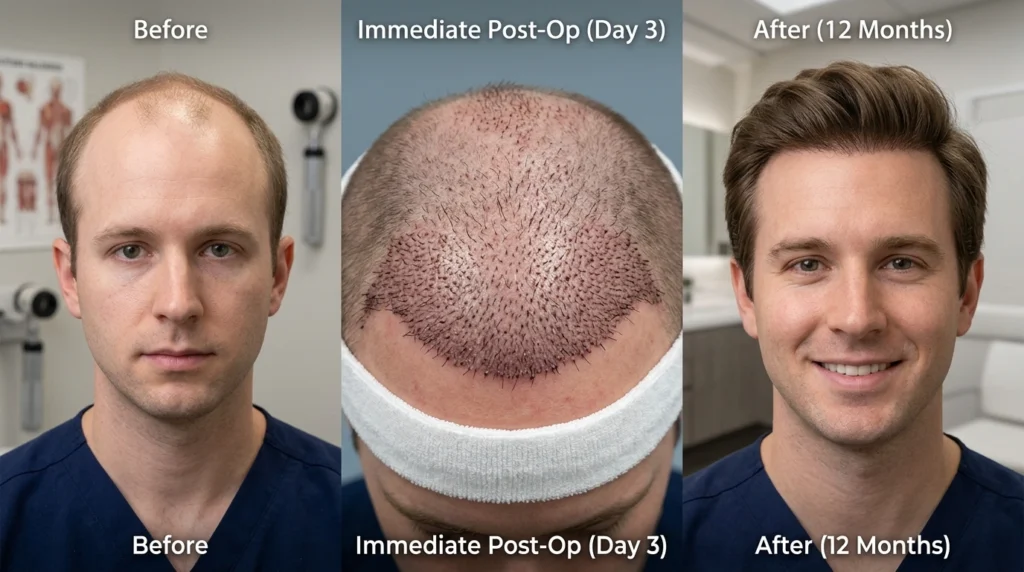
- In the first 7 days, Treated Areas can be light swelling, redness and scabbing.
- During 2 to 3 weeks the transplanted hair may be temporarily shed, which is then the beginning of the new Growth cycle.
- Generally after 3 to 4 months the clear regrowth starts and the improvements look like.
- The final results of both DHI and FUE are completely clear between 9 to 12 months.
- Following the right aftercare and clinic guidelines makes a very important effect on long-term success rate.
Conclusion:
There is no best option when comparing DHI vs FUE hair transplant. The right choice depends on your hair loss stage, budget, required density and aesthetic goals. DHI is preferred if you need more precision and natural hairline design. FUE is the most used method in more practical and USA if you need more coverage. Both techniques are very effective if done through qualified surgeons and provide long-term, natural-looking results with the right aftercare.
FAQs:
Q: Which is best in DHI and FUE?
DHI is better for more density and natural hair line design, while FUE is more suitable for large area coverage and low cost.
Q: Is DHI, more expensive than FUE?
Yes, DHI is usually more expensive as it takes innovative tools and more time.
Q: How long do the results of DHI and FUE come?
The full results of both methods are usually displayed within 9 to 12 months.
Q: Does the hair transplant look natural?
Yes, if an experienced surgeon, DHI and FUE give both natural and good results.
Q: Is the hair transplant permanent?
Yes, the transplanted hair are usually permanent because it is taken from donor Area that is protected from genetically falling hair.
Written & Reviewed By
Written by: Wajiha Aqeel
Co-Founder & Hair Restoration Research Lead
Medically Reviewed by: Dr. Anam Sahibzada
Specialist Dermatologist & Trichologist
Data & publication oversight: Daniel Brooks
Co-Founder & Senior Operations & Data Director
Content reviewed by:
Mehwish Fareed
Clinical Aesthetician & Content Reviewer
Asma Shamshad
Medical Student & Content Contributor
Originally published: May 4, 2026
Research & content last reviewed: September 2026
Last updated: September 15, 2026
Medical & Affiliate Disclaimer:
The content on Hair Grow Needs is for general informational and educational purposes only and should not be considered professional medical advice. For full details regarding our policies, please read our official Disclaimer.