
Medical Disclaimer: This article is for informational purposes only and does not replace professional medical advice. Read our full Medical Disclaimer.
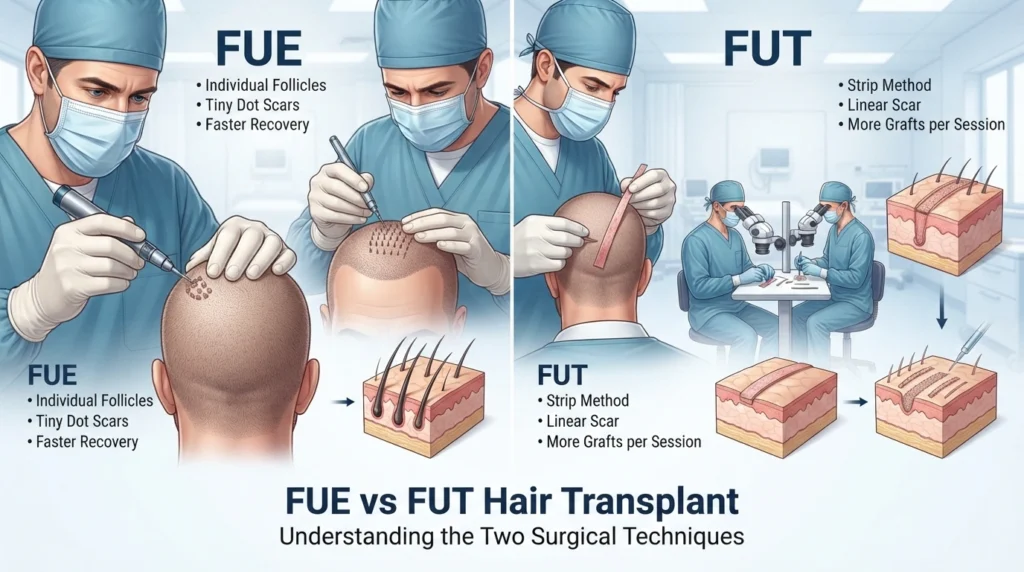
FUE (Follicular Unit Extraction) involves taking one hair at a time, resulting in very small dot-like scars you likely wouldn’t see even if you plan on keeping your hair very short. FUT (Follicular Unit Transplantation) requires taking a sliver of skin from the back of your head, and you’ll have one long linear scar, but you’ll get more grafts in a single session for cheaper a good choice for extensive hair loss if you’re on a budget.
Let me level with you something every comparison page fails to mention is that the decision really isn’t about FUE vs FUT hair transplant in the theoretical sense, it’s about “what my hair loss really looks like, and what I’m prepared to sacrifice. Once you realize it in those terms, the decision often makes itself.
FUE vs FUT Hair Transplant What They Actually Are
What Is FUE (Follicular Unit Extraction)?
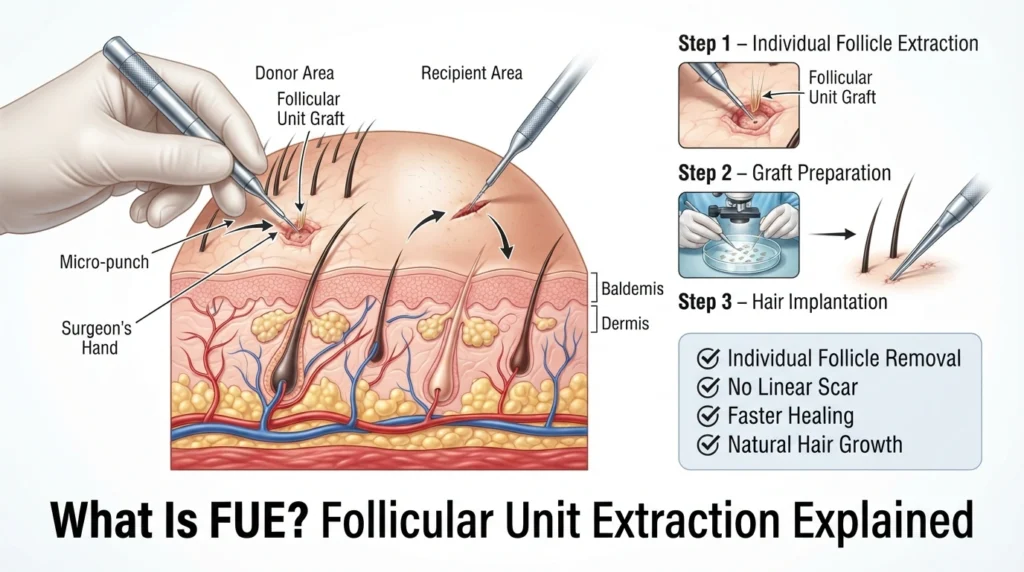
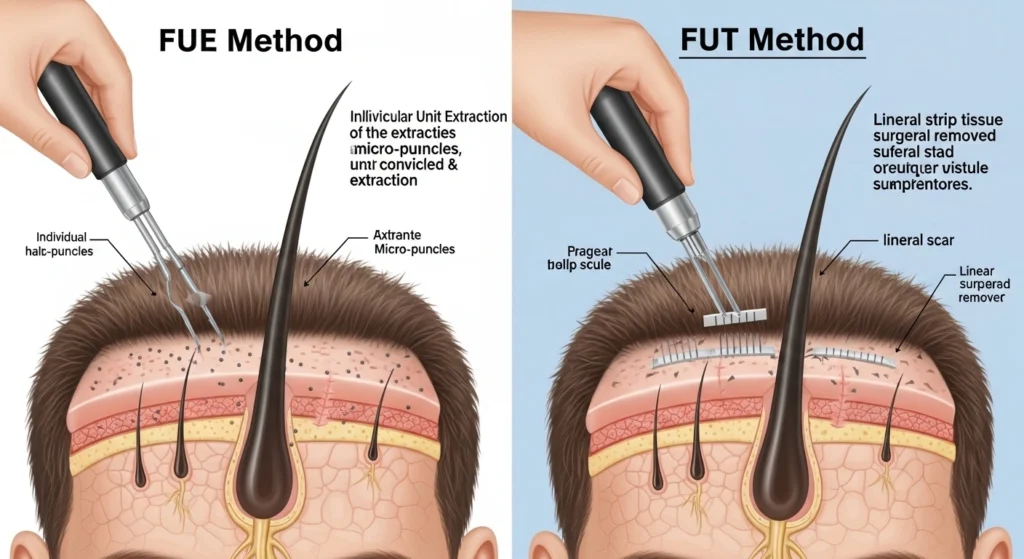
Most clinics try to sell FUE first. That stands for Follicular Unit Extraction. In this method, a surgeon takes out individual follicular units one by one using a micro-punch instrument, often 0.7 mm to 1mm wide, from the donor strip (usually the back and sides of the head) then implants the unit, one by one, into the balding or thinning section of the scalp.
What matters here:
- No linear scar: Donor area leaves behind tiny scars which are nearly impossible to see when a buzz is short.
- Still a surgical procedure: When the doctor say “minimally invasive”, that’s not saying there are no cuts or incisions. Smaller cuts or incisions therefore result.
- Healing is fast: It should begin to scabbing to heal in about 7 to 10 days.
- Outcome depends heavily on the surgeon’s hand: This is not assembly line process , hurry the process damage the success of the grafts.
- This can lead to taking too many grafts from one spot and over harvesting the donor area.
Typically you’ll see the new growth coming through somewhere around month 3-4 and the full result won’t actually start setting in until 12 months later.
What Is FUT (Follicular Unit Transplantation)?
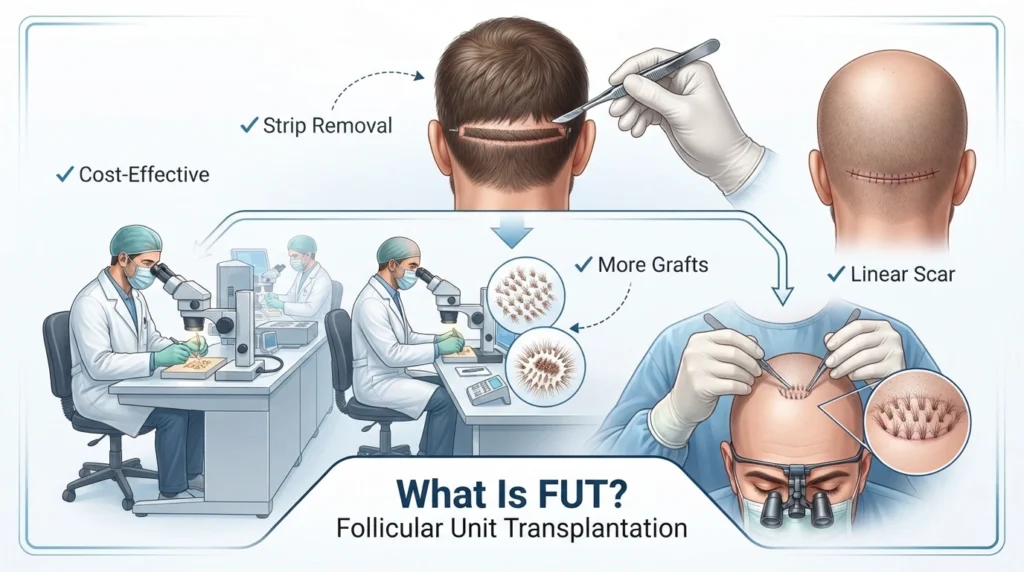
FUT – Also know as the “strip method” takes an entirely different process. Hair follicles are surgically taken from the back of the head in a strip (hair left attached), the back is closed by stitches, then the strip is handed off to the technicians, and cut with a microscope into individual hair follicles and planted with a similar procedure.
What matters here:
- One linear scar left at donor site, the scar will likely be covered with just under ½ inch length of hair and visible on a shaved head.
- Able to harvest more grafts per procedure (all the strip is processed together).
- Surgical stitches used – some tightness, more limited activity and less vigorous motion for about two weeks.
- Each graft is less expensive on average (as grafts are processed as a whole strip, not individual grafts).
FUE vs FUT Hair Transplant
| Feature | FUE | FUT |
|---|---|---|
| Extraction method | Individual follicles | Strip removal |
| Scarring | Tiny dot scars | Single linear scar |
| Recovery | 3 – 7 days | 10 -14 days |
| Pain level | Low | Moderate |
| Cost | Higher | Lower |
| Grafts per session | Moderate | High |
| Best for | Small to medium hair loss | Large bald areas |
The Real Differences Between FUE and FUT Hair Transplant
1. Extraction Technique
This is what it all hinges on, and all other comparisons come after that. FUE hair transplant vs FUT hair transplant really depends on the way the follicle gets removed from your scalp. FUE punches them out one by one with a micro-punch– no massive incision, more detail, more of the surgeons’ time for each follicle. FUT pulls out the follicle on a solid strip quicker to remove but with the closing process and stitches involved.
2. Scarring FUE vs FUT Scar
For patients, this typically carries the most weight. FUT typically results in a thin line of scar tissue along the back of the head (which is effectively covered by hair when your hair is over half an inch but visible on shaved heads and buzzcuts). FUE results in a series of tiny dotted scars that is extremely difficult to see at a short length (or no length). For most individuals who will shave their head or prefer shorter hair lengths, this one difference is typically enough to make the FUE vs. FUT hair transplant decision for them.
3. Recovery Time
FUE recovery is so much faster most are back to routine activity within a week, without the need for sutures to maintain the grafts. Recovery after FUT can involve stitch removal, tightness at the harvest site, and limitations for approximately two weeks. That two-week period may make a much larger difference than most anticipate going in, if you have time off to deal with it all.
4. Cost Difference FUE vs FUT Hair Transplant Cost
FUE, since it’s a manual process and takes the surgeon the time of an individual follicle extraction (ideally), is generally more costly per graft than FUT which process a large number of grafts in less time by harvesting them in strip form.
5. Graft Availability and Yield
FUE usually gives us more raw yield in high volume (advanced Norwood V and VI cases), and that’s best accomplished over multiple sessions, unless we have one of those high volume clinics. FUE is more suitable for more localized, smaller procedures.
6. Pain and Discomfort
FUE pain is usually at the minor point of the punctures, it’s also fairly minimal. The FUT pain is often felt much greater across the donor area where the stitches are, because the cut is much bigger.
7. The 2,000 Graft Rule of Thumb
A key number that almost no guides bother to include. Most seasoned transplant surgeons will work with something in the ballpark of 2000 follicles per transplant as a rule of thumb. Under that figure, patients typically prefer FUE. Over that 2000 number per transplant, the surgeon’s strip method (FUT) quickly becomes more cost-effective simply because picking one follicle at a time (FUE) cannot match the volume per hour achievable by harvesting a single strip.
8. Graft Transection Rate A Technical Difference Worth Knowing
This is referred to as “transection rate” the number of follicles to become damaged or severed at the time of extraction. Damaged grafts will simply not survive. Manual FUE was, historically, associated with higher transection rates compared to FUT because each individual follicle must be individually punched, thousands of times manually. However, in recent years, robotic FUE machines have been closing the gap and experienced centers now provide FUE that can be equal to FUT graft quality. You may also want to know what “FUE” actually means.
9. Body Hair Transplant (BHT) When Scalp Donor Isn’t Enough
If you have already run out of donor area in your donor zone (usually due to a past surgery), some sophisticated clinics use a combined FUT/FUE and Body Hair Transplant (BHT) technique during several days, to be able to exceed standard 5,000 grafts using single methods alone. Body hair(chest, beard) is seen as a second-quality option in relation to head hair and therefore it should be used as a last option to increase number of grafts in your scalp, after you ran out of it in donor zone.
10. Success Rate FUE vs FUT Success Rate
| Method | Success Rate |
|---|---|
| FUE | 90 – 95% |
| FUT | 85 – 90% |
Both numbers would represent favorable outcomes when done by an experienced board-certified surgeon. The difference between these two number is significantly less important then the difference between a good surgeon and a bad surgeon, as how well technique was applied will always trump what technique was used.
FUE vs FUT Hair Transplant Cost: USA vs Turkey
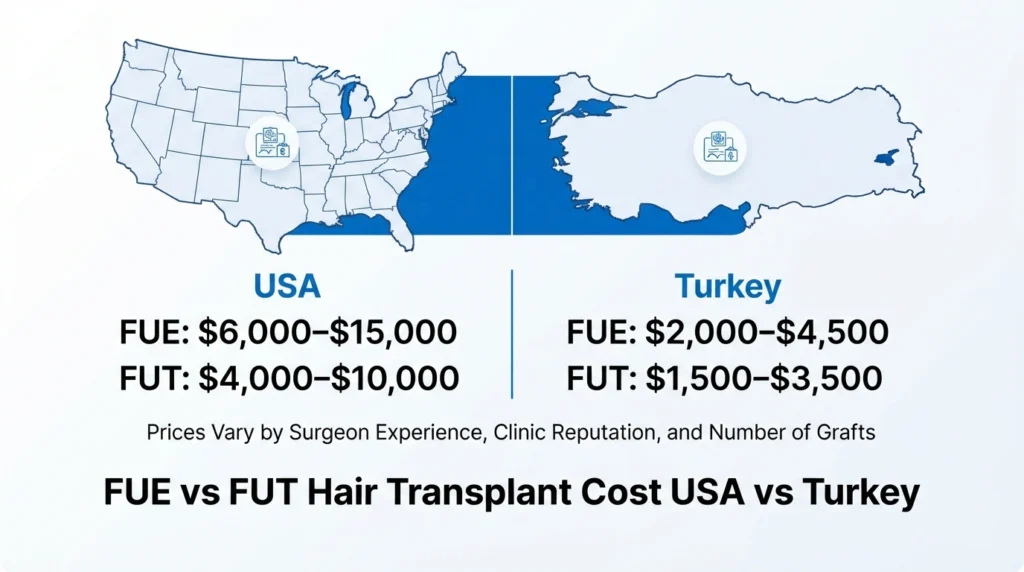
| Location | FUE Cost | FUT Cost |
|---|---|---|
| USA | $6,000 – $15,000 | $4,000 – $10,000 |
| Turkey | $2,000 – $4,500 | $1,500 – $3,500 |
The costs of either FUE or FUT transplants will also change depending on the clinic’s renown, the experience of your surgeon and the actual amount of grafts you would require (above numbers being a range rather than fixed rates).
Top 15 US States Estimated FUE vs FUT Hair Transplant Cost 2026
| State | Estimated FUE Cost | Estimated FUT Cost |
|---|---|---|
| California | $8,000 – $18,000 | $6,000 – $12,000 |
| New York | $8,000 – $17,000 | $5,500 – $11,500 |
| Florida | $6,500 – $15,000 | $5,000 – $10,000 |
| Texas | $5,500 – $13,000 | $4,000 – $9,000 |
| Illinois | $6,500 – $14,000 | $4,500 – $9,500 |
| Georgia | $5,500 – $13,000 | $4,000 – $8,500 |
| Pennsylvania | $6,000 – $14,000 | $4,500 – $9,500 |
| Washington | $7,000 – $15,500 | $5,000 – $10,500 |
| Massachusetts | $8,000 – $17,000 | $5,500 – $11,500 |
| Arizona | $5,000 – $12,000 | $3,500 – $8,500 |
| Colorado | $6,000 – $14,500 | $4,500 – $9,500 |
| Nevada | $6,000 – $14,000 | $4,500 – $9,000 |
| North Carolina | $5,500 – $12,500 | $4,000 – $8,500 |
| Michigan | $5,000 – $11,500 | $3,500 – $8,000 |
| Ohio | $5,500 – $12,500 | $4,000 – $8,500 |
Recovery Time
| Method | Initial Recovery | Full Recovery |
|---|---|---|
| FUE | 3 – 7 days | 2 – 3 weeks |
| FUT | 10 – 14 days | 3 – 4 weeks |
FUE is the clear winner when it comes to recovery time and there is a genuine, real-world difference that matters for people who aren’t able to take long leaves from work.
FUE vs FUT vs DHI Hair Transplant
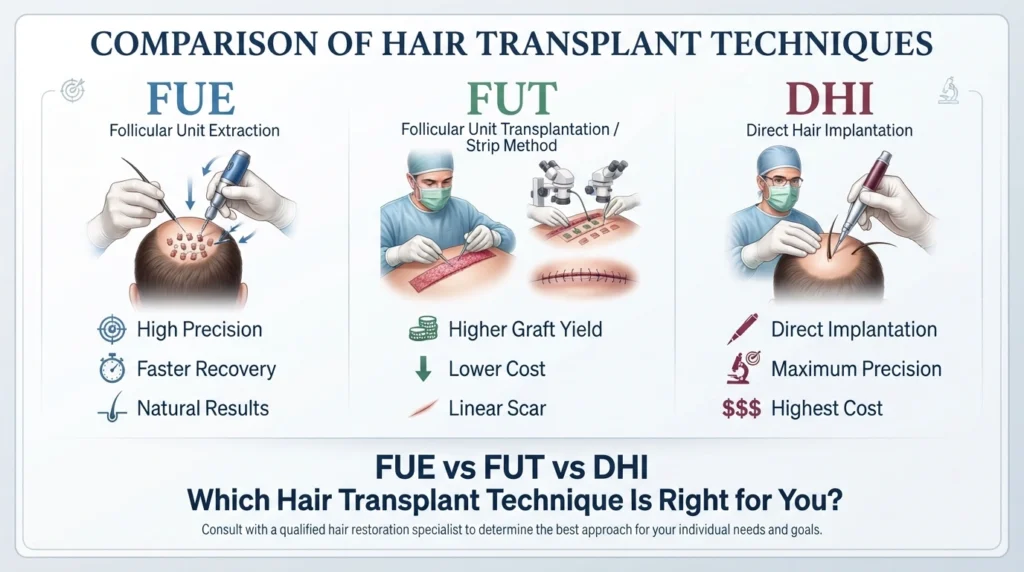
| Method | Precision | Recovery | Cost | Result Quality |
|---|---|---|---|---|
| FUE | High | Fast | High | Natural |
| FUT | Medium | Moderate | Lower | Dense |
| DHI | Very High | Faster | Highest | Very Natural |
DHI is the slightly upgraded version of FUE where it implants hair grafts in a particular pattern using an implanter pen immediately after the hair is removed from the donor site. While it allows for better results and in most cases, for a quicker recovery, it also costs more compared to the others. You can consider the DHI hair transplant procedure if hairline density is an issue.
FUE vs FUT Hair Transplant: Which Is Better For You?
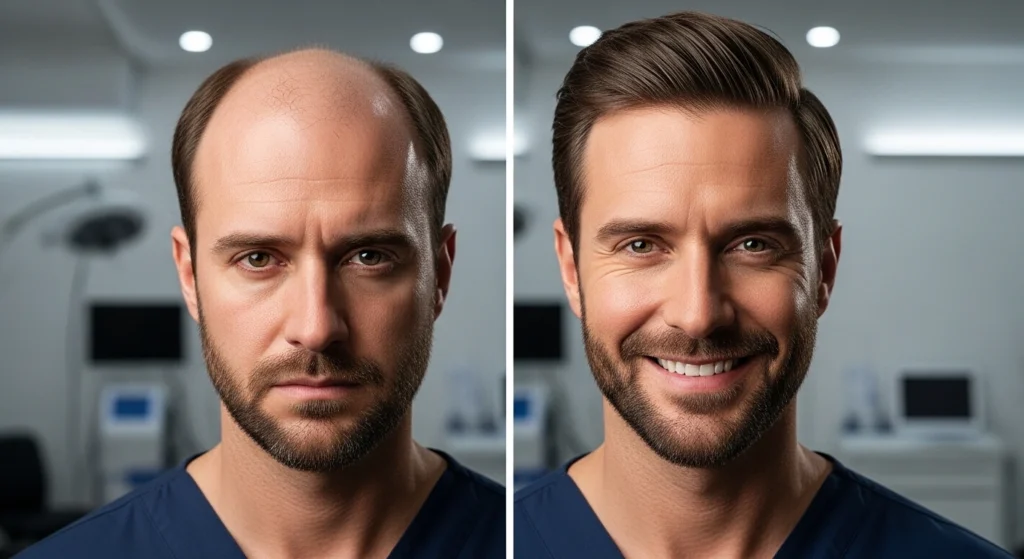
Choose FUE If:
- You want to keep your hair short even buzzed without visible scarring.
- Fast recovery and getting back to work quickly matters more than saving money.
- You’re doing a small-to-medium session and want precise, individual placement.
- You’re comfortable paying more per graft for a less invasive procedure.
Choose FUT If:
- You need a large number of grafts in a single session because of advanced hair loss.
- Budget is the deciding factor and you’re comfortable wearing your hair slightly longer at the back.
- You don’t mind stitches and a longer initial recovery window.
- Your donor area has good density and you want to maximize the yield from one procedure.
USA vs Turkey for FUE and FUT
United States
While there are a number of U.S. Hair restoration surgery clinics, the majority of them are heavily regulated by the medical board, with a majority of clinics even investing in FUE and DHI technologies, with even robot-assisted extraction in some. What it costs is higher, much higher, than what you’ll be looking at when considering Turkey and India not because you’ll get inferior surgical results, but because you’re paying much higher overhead and surgeon prices. Your main benefit is that you aren’t on an airplane if you experience a problem or require a follow up from your surgeon.
Key to recall is more does not necessarily mean better outcome – surgeon skills are truly what matters – as well as many can achieve same quality at fraction of the price in International clinics – assuming your vetting is solid.
Turkey
Turkey’s Medical Tourism Industry Has the Global Medical Hair Transplant Scene on Lock Medical tourism in Turkey is booming thanks to low price points, an incredibly high volume of procedures performed, and packaged deals. It is very common for clinic pricing to include accommodation, transport from the airport and medicine as part of the procedure price which adds to its popularity.
Here’s the catch. The sheer volume of cases results in an experience workforce for your good clinics. But some practices put technicians way ahead of the namesake surgeon at the cheaper end of the spectrum. Moreover, follow-ups after surgery are more difficult once you’ve returned home as you’re most likely going to communicate from afar.
Local, in-person, easily available care is more important than price; it should be US then. Price is important and an all-inclusive package, but you are willing to look up the surgeon individually, Turkey works better.
Doctors and Clinics Performing FUE and FUT in the USA
| Clinic | City | Lead Surgeon(s) | Techniques Offered | Price Range |
|---|---|---|---|---|
| Bernstein Medical | New York, NY | Dr. Robert M. Bernstein, Dr. Christine Shaver | FUE, FUT, Robotic FUE | $12,000 – $30,000 |
| Shapiro Medical Group | Minneapolis, MN | Dr. Ron Shapiro, Dr. Paul Shapiro, Dr. David Josephitis | FUE, FUT | $8,000 – $22,000 |
| Miami Hair Institute | Miami, FL | Dr. Bernard Nusbaum, Dr. Aron Nusbaum | FUE, FUT | $8,000 – $20,000 |
| MHTA Clinic | Los Gatos, CA | Dr. John Diep | FUE, FUT | $9,000 – $22,000 |
| True & Dorin Medical Group | Garden City, NY | Dr. Robert Dorin | FUE, FUT | $10,000 – $24,000 |
| Foundation Hair Restoration | Miami, FL | Dr. Jeffrey Epstein | FUE, FUT, DHI | $8,000 – $22,000 |
| Cooley Hair Center | Charlotte, NC | Dr. Jerry Cooley | FUE, FUT | $7,000 – $18,000 |
| Charles Medical Group | Boca Raton, FL | Dr. Glenn Charles | FUE, FUT, ARTAS | $8,000 – $16,000 |
| Lam Institute for Hair Restoration | Dallas, TX | Dr. Samuel Lam | FUE, FUT | $7,000 – $16,000 |
| Leonard Hair Transplant Associates | Boston Area, MA/RI/NH | Dr. Matthew Lopresti, Dr. Mary Lopresti | FUE, NeoGraft, PRP | $7,000 – $18,000 |
Should your hair loss be quite advanced to the point of even considering FUT as your only option for yield, opt for any of the surgeons from this list who do not shy away from FUT, since not many contemporary clinics offer it nowadays and the majority focuses on FUE and DHI procedures.
Common Mistakes People Make Choosing Between FUE and FUT
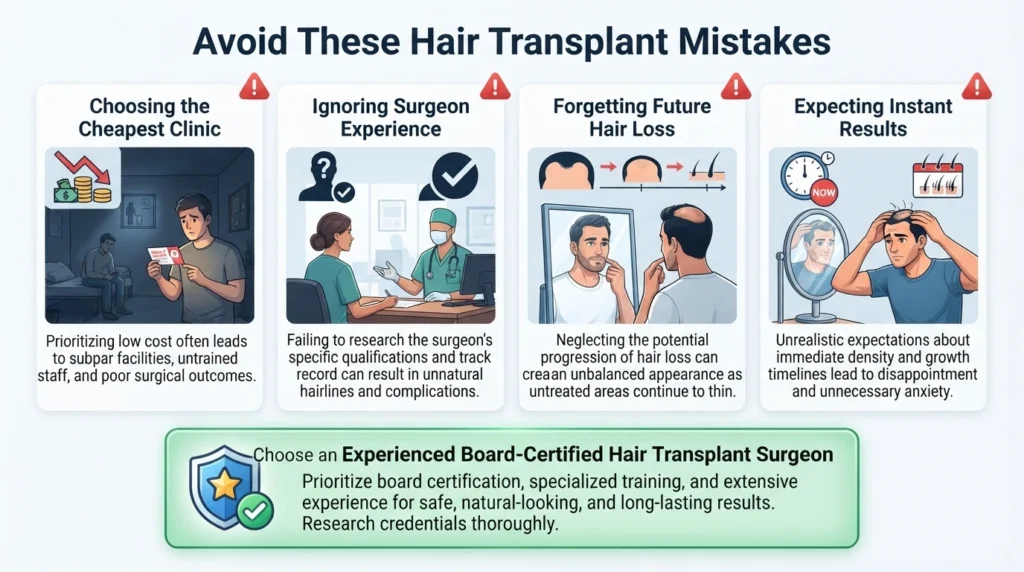
The truth of the matter is the choice of method will matter about as little as most patients believe it will, if they don’t get these things right:
Chasing the cheapest clinic: If The Cheapest Quote Is The Most Obvious Warning Sign it is generally there because of limited or no involvement of surgeon, sloppy handling of grafts, inconsistent level of sterility and hygiene, which most often occur when someone goes for the least affordable procedure.
Ignoring surgeon skill: An experienced FUE surgeon or FUT surgeon will always be better than a new surgeon using either technique. The hand, not the hand job, does it.
Not accounting for ongoing hair loss: After transplant procedures, native hairs do not stop thinning in the periphery and a perfect job would look poor and uneven if you don’t take that into consideration. A sound, long-term, strategy, sometimes using finasteride, minoxidil and/or topical shampoos must be part of the consultation from the very beginning, not a last-minute addition.
Expecting instant results: Full hair transplant results aren’t completely evident for up to 12 months. If you’re expecting a full head of hair that looks completely natural a few weeks after treatment it is not going to happen, regardless of the method that you choose.
FAQs:
Q: FUE or FUT hair transplant, which one is better?
The winner isn’t definitive: Choose FUE if minimal scarring and faster recovery are the most critical factors and FUT is a better option for a high number of grafts in one surgery or a lower cost.
Q: Is FUE hair transplant cost more than FUT hair transplant?
Yes, usually. The FUE technique requires more meticulous surgical effort for each individual hair, which in turn will result in higher costs in relation to FUE’s strips-based surgery.
Q: Does FUT leave a scar?
Yes – the donor site is a straight scar line and you can cover it fairly easily, provided you keep your hair longer.
Q: Which procedure gives a better result FUE or FUT?
Both techniques yield natural looking, permanent hair loss results when performed by a surgeon with the right experience. The difference boils down to scarring pattern and number of follicles used per cm2, rather than one technique is more naturally attractive then the other.
Q: Can I switch between FUE and FUT, or combine them?
Yes, many people opt for a combination of both at different stages – FUT to address a large volume in a first session, and FUE for later refinements, such as hairline work or filling in a smaller area.
Q: What’s the difference between FUE, FUT, and DHI?
Extraction FUE vs FUT, they each involve extracting a strip of skin and separating it into individual follicles whereas FUT removes a linear strip which is later divided into smaller follicular grafts. DHI is another type of FUE treatment which places the grafts immediately into the scalp using a specialized implanter pen for more precise results, but it costs more.
Q: Is FUE vs FUT hair transplant cost worth the difference for a small session?
For the most part, when the total number of grafts is small (below 1,500 grafts) a lot of patients will justify the added cost of FUE due to not having to experience scarring. For the more major session, however, the difference in price can’t be disregarded.
In My Opinion Final Words:
If you take nothing else from this, then FUE vs FUT hair transplant is less of a versus and more of a versus for, if that makes sense? Minor loss, short hair and you don’t want visible scarring? FUE. Extreme loss and you can compromise a slightly longer length of hair at the back for a tighter budget? FUT. Anything in between, the experience of the surgeon you pick, an honest assessment of your hair loss and what a successful result 12 months down the line will look like to you is of far more importance than the name on the bottom of the consent form. See two or three credentialed hair restoration surgeons and ask which technique they’d advise for your hair loss pattern, rather than which technique they have a particular expertise in, before making your decision.
Editorial & Medical Review
Written by: Wajiha Aqeel
Co-Founder & Hair Restoration Research Lead
Medically Reviewed by: Dr. Anam Sahibzada
Specialist Dermatologist & Trichologist
Data & publication oversight: Daniel Brooks
Co-Founder & Senior Operations & Data Director
Content reviewed by:
Mehwish Fareed
Clinical Aesthetician & Content Reviewer
Asma Shamshad
Medical Student & Content Contributor
Originally published: April 26, 2026
Research & content last reviewed: July 15 2026
Last medically reviewed: August 2026
Last updated: September 15, 2026
Medical & Affiliate Disclaimer:
The content on Hair Grow Needs is for general informational and educational purposes only and should not be considered professional medical advice. For full details regarding our policies, please read our official Disclaimer.
Medical References
ISHRS – International Society of Hair Restoration Surgery
ABHRS – American Board of Hair Restoration Surgery
AAD – American Academy of Dermatology
NIH – National Institutes of Health
PubMed
Cleveland Clinic
Mayo Clinic
NHS (UK)
American Society of Plastic Surgeons (ASPS)
International Alliance of Hair Restoration Surgeons (IAHRS)