
Medical Disclaimer: This article is for informational purposes only and does not replace professional medical advice. Read our full Medical Disclaimer.
The rate of hair transplant success is one of the first questions on everyone’s mind when considering the surgery. After all, you don’t want to spend a fortune without knowing the likelihood of a natural and long-lasting outcome.
Today, with advanced methods like FUE, DHI, and robots, hair transplant success rates are better than ever, but the outcomes will vary among people. Many factors influence whether or not your surgery is a true success.
- The real percentage of hair transplant success rate
- The differences between FUE, FUT, and DHI
- Factors determining graft survival rate
- Why hair transplants fail
- How to maximize your hair transplant results
There is no single universal “hair-transplant success rate.” Studies may report graft survival, hair growth, patient satisfaction or cosmetic outcomes using different methods and follow-up periods. Published survival rates should therefore be interpreted according to the specific study population, technique and measurement method.
Some studies report graft-survival rates in the 90–95% range under specific surgical conditions, but this should not be presented as a universal success rate for all hair transplants.
Hair Transplant Success Rate:
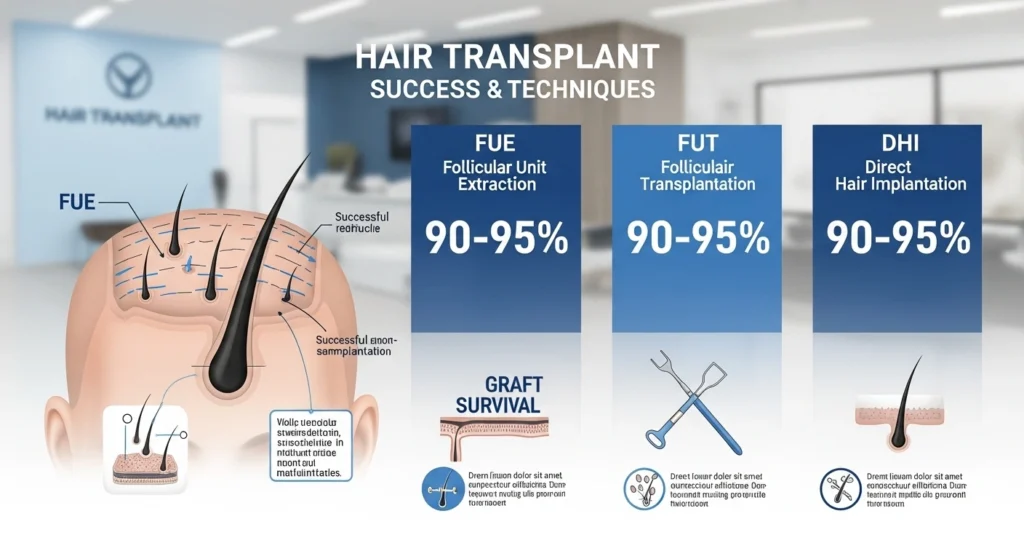
| Procedure | Success Rate | Notes |
| FUE | 90–95% | Most popular, natural results |
| FUT | 85–90% | Slightly higher graft yield |
| DHI | 92–96% | Precise implantation |
| ARTAS | 90–95% | Robotic-assisted accuracy |
These figures represent the graft survival rate, which is the parameter that really counts.
What Does Hair Transplant Success Actually Mean?

This is probably what most people don’t understand.
The outcome of a transplant is not simply hair growing, but:
- High graft survival rate (the maximum number of hair follicles survives and develops)
- Natural design of hairline, blended well into the natural hairline.
- Appropriate density across the entire scalp.
- Long-lasting result with stability over many years.
A perfect transplant looks 100% natural, even when checked at extremely close range.
Factors That Affect Hair Transplant Success Rate:
Surgeon Experience & Skill:
Experienced surgeon takes care of the right angle, direction & depth for the graft placement. This is of paramount importance for higher success rates and natural look.
Donor Area Quality:
Densely populated and robust donor hair provides optimum chances of graft survival with quality results.
Technique Used (FUE, FUT, DHI):
Modern and precise techniques such as FUE and DHI minimizes damage to hair follicles, while increasing the survival rate.
Aftercare & Patient Compliance:
A strict adherence to post-operative care including maintaining clean scalp and preventing stress on transplanted hair increases chances of survival.
Patient’s Health & Lifestyle:
Lifestyle such as smoking, excessive drinking, high level of stress, poor eating habits deteriorates the blood flow to the transplanted follicles and drastically reduces the success rate of the procedure.
FUE vs FUT vs DHI Success Rate Comparison:
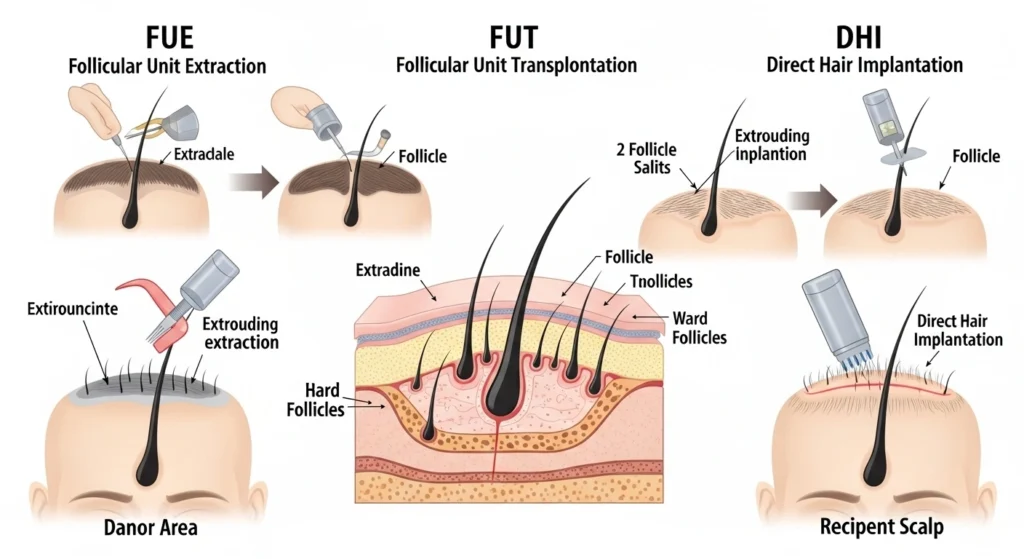
| Method | Success Rate | Recovery | Result Quality |
| FUE | 90–95% | Fast | Natural |
| FUT | 85–90% | Moderate | Dense |
| DHI | 92–96% | Faster | Very precise |
DHI frequently shows a bit better results owing to direct implanting methodology.
Hair Transplant Success Rate (USA vs Turkey):
USA:
Hair transplants are performed in America in highly regulated clinical environments, with advanced technology and high safety standards, which has also result in the high success rate which is around 90-95%. The clinics are usually well-furnished, focusing on high quality of treatment to patients.
Turkey:
In Turkey there are a high volume of daily surgeries meaning that a surgeons have a lot of practical experience. Turkey also has a lot of cheap prices. The country offers roughly the same success rate of 90-95% ( in a well-known clinic).
The location is less important than the quality of the clinic in terms of success.
Why Do Some Hair Transplants Fail?
However, in spite of having good success rate, it’s not impossible for failure to occur.
Factors That Can Lower Hair Transplant Success:
- The unspecialized or incompetent surgeon may do great damage, by misplacing the graphs, poor survival rate, or unnatural appearance of hairline.
- Damage to follicles by manipulating them while being removed and implanted leads to lower success and density rates.
- Not following the care instructions like touching the head, over sweating or getting infection may damage the transplanted hair.
- Poor donor area where hair quantity and quality is very limited can be also a factor for less density and natural results.
What Is Graft Survival Rate?
Percentage of transplanted follicles that produce hair = graft survival rate
Example:
3000 grafts transplanted
2700 grow successfully
Success rate = 90%
How to Increase Hair Transplant Success Rate:
Tried and tested tips:
- Pick experienced clinic
For highest success rate, it is advisable to always choose an experienced clinic which possesses before/after photos. - Adhere to the aftercare strictly
The highest survival rate of grafts and quicker healing depends greatly upon correct hair wash, medication and avoiding the strain to the head. - Do not smoke or drink
These reduce the blood flow to the scalp and gravely affect the success rate of the transplants. - Eat a balanced diet
Protein, Vitamins, and Minerals contribute to a proper growth of hair.
Realistic Expectations:
Even if 95% successful it could still:
- Mean density isn’t full (100%)
- Results may take years (12-15 months)
- Hair thinning slightly with aging
- But an incredible improvement all the same and lasting
| Stage | Expectation |
| 1 Month | Shedding phase |
| 3 – 4 Months | Initial growth |
| 6 – 9 Months | Visible density |
| 12 Months | Final results |
Who Gets the Best Results?
Who can benefit from a hair transplant?
- Candidates whose hair loss pattern is not rapidly progressive are good candidates. This ensures the final result will be permanent for many years.
- A donor site with healthy and abundant hair is required. This donor hair is typically taken from the back or sides of the scalp.
- Candidates should have realistic expectations. It takes six months to a year and half to see the full results of hair transplantation.
Younger candidates are still prone to progression of further hair loss, so later sessions might be required to maintain or further density.
Conclusion:
Success rates of modern hair transplants are now extremely high due to modern methods and proficient surgeons. The results if done properly, appear completely natural and last for a lifetime. However, the outcome relies not only on the surgery alone but on many other things as well, such as selecting the right clinic, carrying out appropriate post-treatment advice and being realistic throughout the whole process. Patients who know what they are getting involved in and who will be committed to the post-surgery process tend to be successful. Ultimately a hair transplant if done properly can be a safe, efficient and life-changing procedure which can restore confidence and result in hair growth for the rest of the patient’s life.
FAQs:
Q: What is the success rate of hair transplant?
90-95% graft survival rate is common.
Q: Is FUE more successful than FUT?
Yes, slightly better. And better recovery.
Q: Can hair transplant fail?
Yes, but it’s rare if you choose an experienced surgeon.
Q: How long do results last?
Normally the results are permanent.
Q: Does success depend on age?
Yes, younger patients might require further treatments later.
Written & Reviewed By
Written by: Wajiha Aqeel & HairGrowNeeds Team
Wajiha Aqeel : Co-Founder & Hair Restoration Research Lead
Data & Publication Oversight: Daniel Brooks
Daniel Brooks: Co-Founder & Senior Operations & Data Director
Content Reviewed by:
- Mehwish Fareed — Clinical Aesthetician & Content Reviewer
- Asma Shamshad — Medical Student & Content Contributor
Originally published: April 26, 2026
Research & content last reviewed: September 2026
Last medically reviewed: September 2026
Last updated: September 9, 2026
Medical & Affiliate Disclaimer:
The content on Hair Grow Needs is for general informational and educational purposes only and should not be considered professional medical advice. For full details regarding our policies, please read our official Disclaimer.