
Medical Disclaimer: This article is for informational purposes only and does not replace professional medical advice. Read our full Medical Disclaimer.
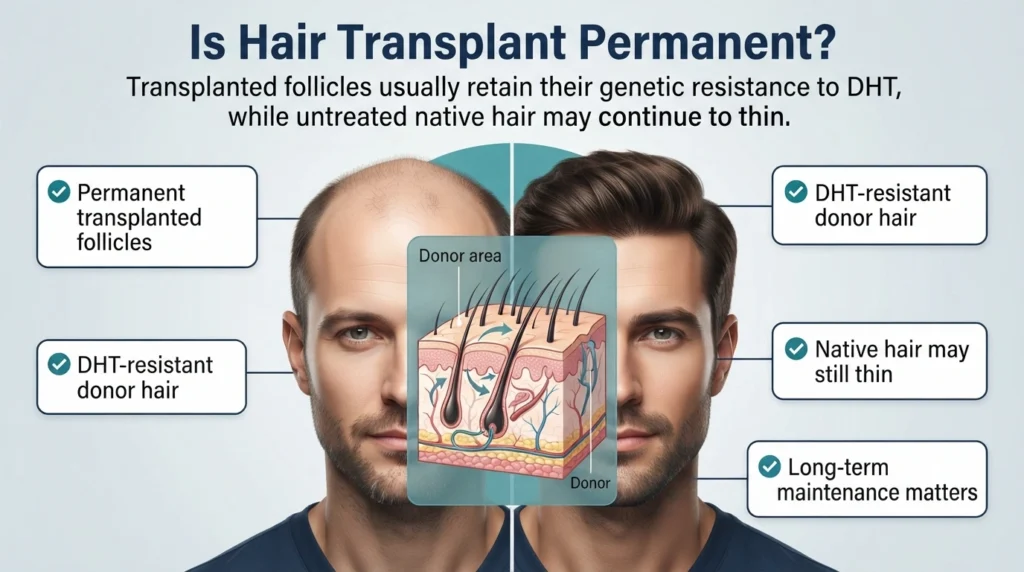
Yes, a hair transplant is permanent in the sense that matters most: Transplanted follicles from relatively DHT-resistant donor areas are generally expected to retain their resistance to androgenetic hair loss, but long-term outcomes vary and native, non-transplanted hair can continue to thin.
And I want to say that as plainly as I possibly can, because most hair loss sites carefully skirt this point: Hair transplants don’t prevent hair loss; they rearrange hair that you currently have. And if nobody has already given you that little tidbit, it’s the number one thing you need to know before you schedule your first procedure.
How Hair Transplant Works Why Results Last:
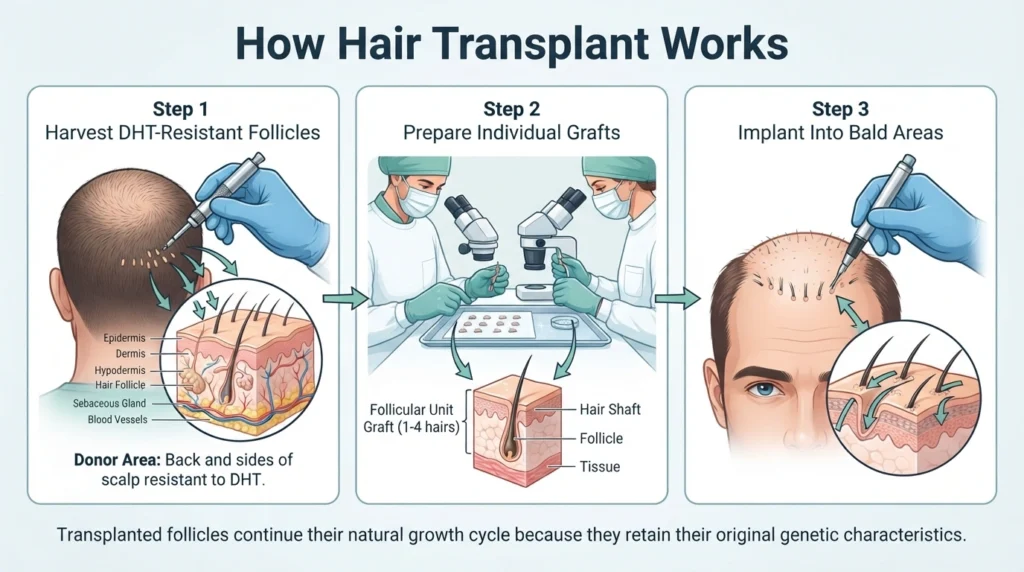
A hair transplant procedure is an outpatient surgery. During the operation, hair follicles are harvested from one area of your head, and surgically implanted in another:
- You’re removing hair follicles from the donor site, usually the back and sides of the scalp.
- You insert the transplanted follicles into the balding and thinning parts of the scalp.
- The transplanted hair follicles grow in with the other hair – and can be cut, colored, styled and grown out like anything else.
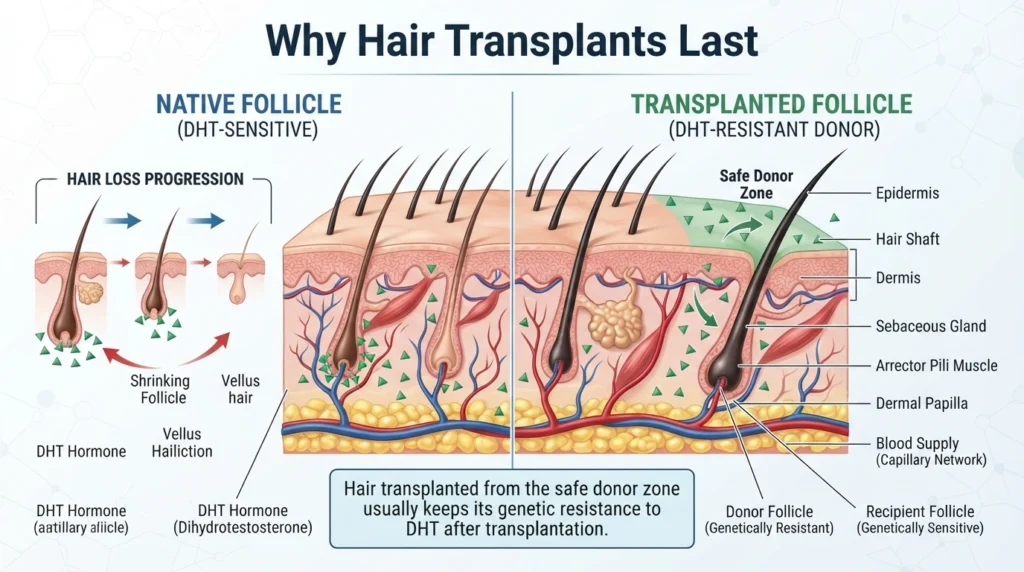
How this doesn’t fall apart after many years boils down to the following fact: The hair that naturally exists on most people’s scalp on the sides and the back of the scalp are genetically predisposed to being DHT (Dihydrotestosterone) resistant the hormone byproduct which causes hair follicles to shrink, resulting in Male Pattern Baldness & Female Pattern Hair Loss. Once a surgeon takes that hair and transplants it to a bald spot it remains with that inherent DHT resistance. That’s the scientific argument behind calling it a permanent hair transplant.
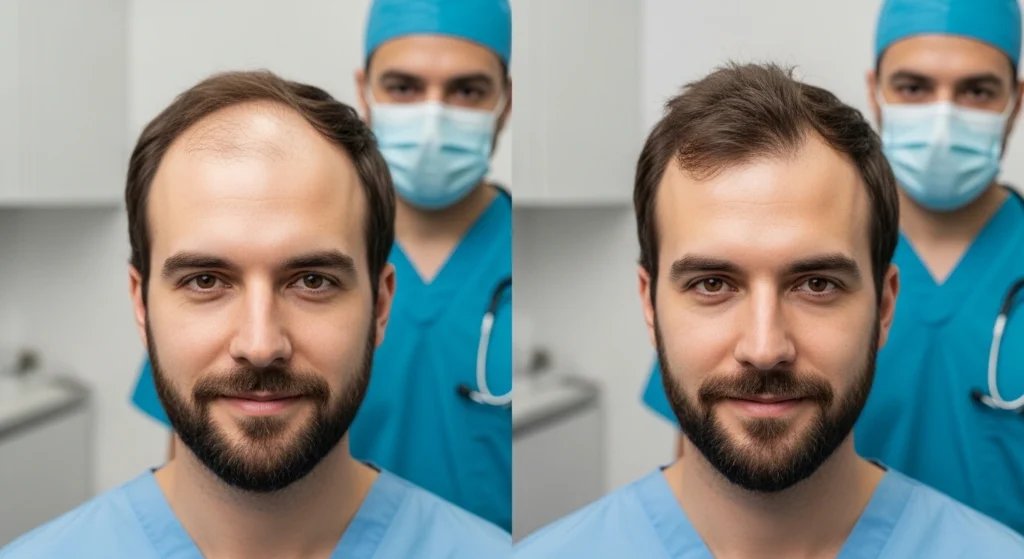
The “Safe Donor Zone” Why Surgeon Skill Actually Matters Here
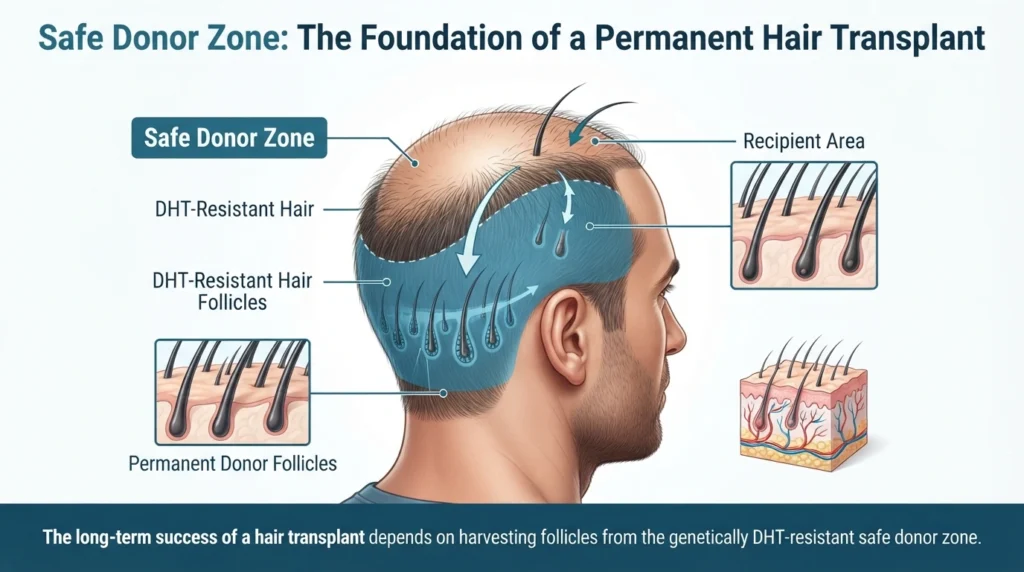
One piece of information most review articles and comparisons leave out: moving the hair follicles doesn’t make them immune to their genetic proclivities. To be effective and permanent, the grafts need to come from a place called the “safe donor area” – the part of the head which is guaranteed not to be affected by DHT throughout the course of your life. If hair grafts were removed just beyond that area of your scalp (an area in which less skilled assistants could potentially perform this procedure, perhaps if they are working too quickly) you run the risk of having those newly transplanted hairs carry over their original hair loss genetic tendencies to the new region of your head. This is one of the reasons why a surgeon’s skill is much more important than a clinic’s logo or a flashy advertisement.
A Quick Origin Note
Hair transplantation is not an old method in a new costume that relies on a catchy brand campaign. It was introduced back in 1959, by a surgeon named Dr. Norman Orentreich, who presented a surgical approach that relied on a 4-6mm block of tissue that could be transferred. The methodology and science behind it hasn’t change so much the accuracy did and the appearance so drastically.
Hair Transplant Recovery Timeline
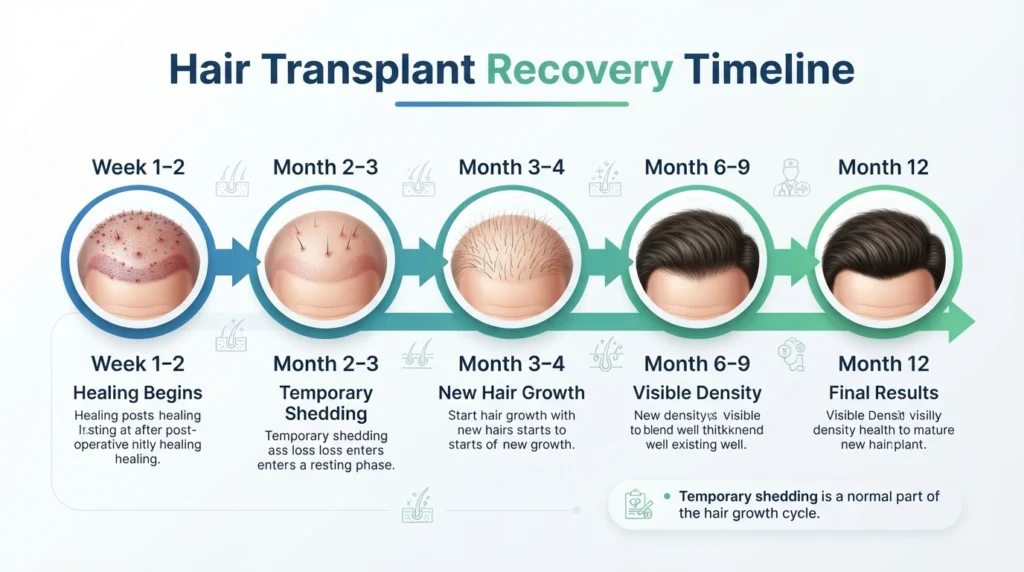
| Stage | Timeline | What Happens |
|---|---|---|
| Initial Healing | 1–2 weeks | Scabs form and heal, redness reduces |
| Shedding Phase | 2–12 weeks | Transplanted hair sheds — this is normal, not failure |
| Early Growth | 3–4 months | New hair starts growing from the follicle |
| Visible Results | 6–9 months | Hair becomes noticeably thicker |
| Full Results | 12 months | Final density is reached |
That hair loss shock almost always takes you by surprise. After the few weeks, you lose the newly planted hair feels like failure – it’s completely normal though and the follicle still sits alive underneath getting ready for growth.
What’s Actually Permanent vs. What Isn’t
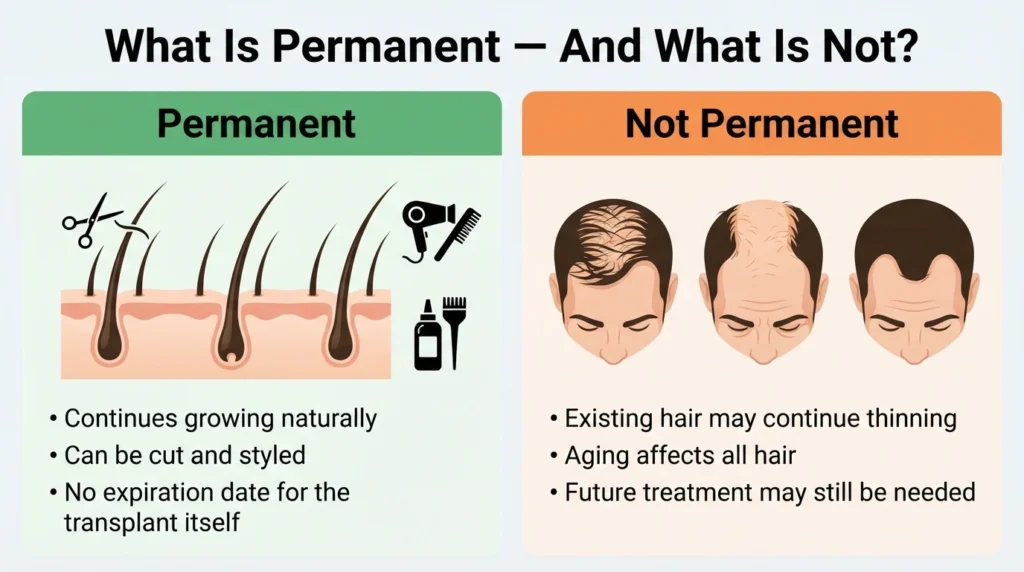
Permanent:
- Grafts harvested from the donor zone are then guaranteed to grow and shed a natural cycle, for a lifetime once grafted.
- Your grafts will function naturally with the hair in the hair line: shampoo them, cut them, color them,style them.
- There is not a ‘wearing off’ of the transplant itself.
Not Permanent:
- Your original hair, untouched by transplant surgery, will still respond to your genes and aging process.
- This hair may continue to thin through the years. Your natural loss pattern will continue even if you have the best transplant possible.
- As your native hair gets finer or more scarce over the years due to age, your scalp overall density will also decrease as time goes on.
So to put it plainly: The actual transplant does not fail, it’s possible for your appearance to still change down the line with the hair that you kept in its original position.
What Happens 10 – 20 Years After a Hair Transplant?
It’s one of the most Googled “follow-up” questions there is and as you might expect, there’s a much more direct answer than just general platitudes or reassurances. Years down the road:
- Most implanted follicles should keep producing new hair because there is no “expiration date” for DHT resistance.
- Any hair follicles that are transplanted do tend to reduce slightly over time as they too are natural ageing – as in – a permanently implanted follicle is not forever at month 12!
- When existing native thinning hair wasn’t treated or managed medically, the distinction between transplanted and native hair can actually become more prominent as time goes by, within about 15-20 years.
- A lot of my patients opt for a second (and sometimes a third) transplantation even years after their initial one, not because their first one failed, but simply to boost their overall hair volume in an ever evolving hair loss situation.
Do You Need Another Hair Transplant Later?
In some cases, yes. A second session may make sense if:
- Thinning is still visible in the originally treated area.
- You want additional density for a fuller look than the first session delivered.
- Results didn’t fully match expectations the first time around.
- Your untreated native hair has continued to recede, creating a new gap to address.
Plenty of patients are genuinely happy with a single session. Others plan for a second one from the very start. Neither is a sign that something went wrong. It’s simply a normal part of long-term hair restoration.
FUE vs FUT Which One Actually Lasts Longer?
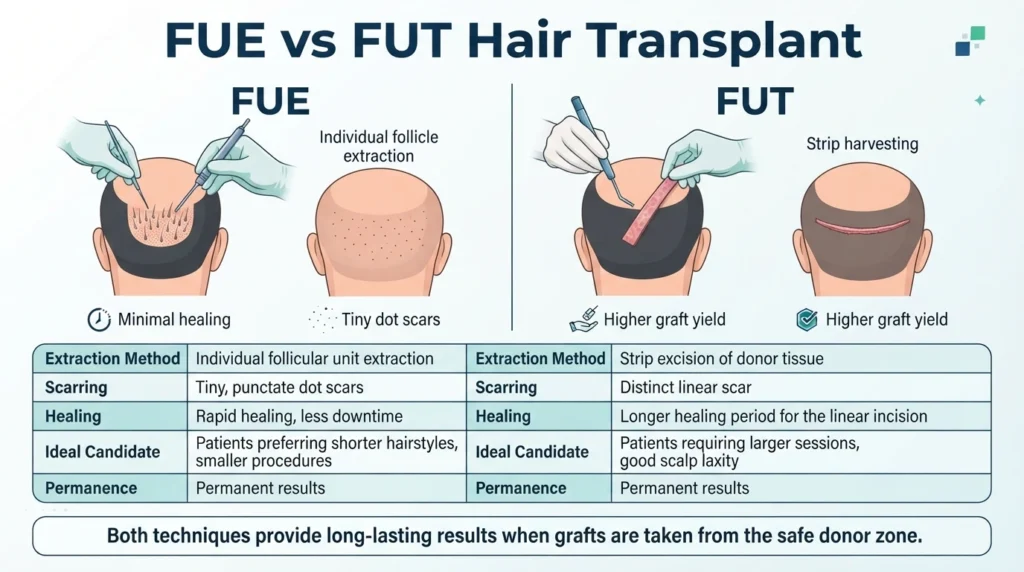
The only real thing here we can answer, and something. This is one of the most common follow-up questions people search alongside is hair transplant permanent Does the technique itself change the answer? It doesn’t.
| Method | Process | Scarring | Permanence |
|---|---|---|---|
| FUE (Follicular Unit Extraction) | Individual follicles harvested one at a time | Tiny, scattered dot scars | Permanent if from the safe donor zone |
| FUT (Follicular Unit Transplantation) | Strip of scalp removed, dissected into grafts | One linear scar | Equally permanent if from the safe donor zone |
Both are capable of providing a permanently restored head of hair, when carried out by a qualified practitioner. The method influences scarring and recovery time but not your retained rate of hair grafts.
Hair Transplant Cost for 3,000 Grafts USA, 2026
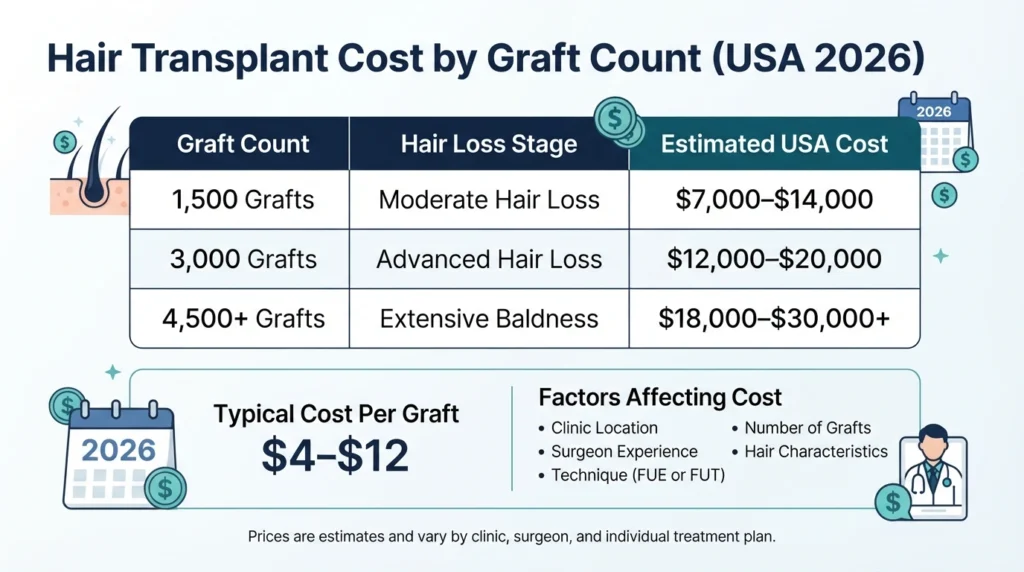
There’s a popular, useful number worth adding right to the top: A transplant of 3,000 grafts can address most of the middle-to-higher end range of hair loss and the cost falls into a reasonably predictable range for most patients.
| Graft Count | Hair Loss Stage | USA Cost Range (FUE) |
|---|---|---|
| 1,500 grafts | Moderate loss | $7,000–$14,000 |
| 3,000 grafts | Advanced loss | $12,000–$20,000 |
| 4,500+ grafts | Extensive baldness | $18,000–$30,000+ |
US: a graft typically costs between $4-12. This number will fluctuate based on city, surgeon expertise and technique used (FUE, FUT or DHI).
Average Hair Transplant Cost by US State 2026
| State | Average Cost Range | Market Tier |
|---|---|---|
| New York | $10,000 – $25,000 | Premium |
| California | $9,000 – $22,000 | Premium |
| Massachusetts | $8,000 – $20,000 | Premium |
| New Jersey | $8,000 – $18,000 | High |
| Washington | $8,000 – $18,000 | High |
| Florida | $7,000 – $18,000 | High |
| Illinois | $7,500 – $17,000 | High |
| Maryland | $7,500 – $16,500 | High |
| Colorado | $6,500 – $16,000 | Mid-High |
| Nevada | $6,500 – $15,500 | Mid-High |
| Pennsylvania | $6,500 – $15,500 | Mid |
| Minnesota | $6,000 – $15,000 | Mid |
| Virginia | $6,000 – $14,500 | Mid |
| Texas | $6,000 – $14,000 | Mid |
| Georgia | $5,500 – $14,000 | Mid |
| Ohio | $5,500 – $13,500 | Mid |
| North Carolina | $5,500 – $13,000 | Mid |
| Wisconsin | $5,500 – $13,000 | Mid |
| Missouri | $5,000 – $12,500 | Value |
| Indiana | $5,000 – $12,000 | Value |
| Oregon | $5,500 – $13,500 | Mid |
| South Carolina | $5,000 – $12,000 | Value |
| Michigan | $5,000 – $11,500 | Value |
| Arizona | $5,000 – $12,000 | Value |
| Tennessee | $5,000 – $13,000 | Value |
Disadvantages of Hair Transplants
No fair guide skips this, so here it is directly:
- It’s surgery. Even in minimally invasive FUE procedures, there are cuts, an healing process and a small amount of surgical risk.
- It won’t halt future thinning. This can’t be stressed enough transplants move existing hair to other areas, they don’t prevent the loss of any hair you already have.
- Results take about a year. You simply need to be patient; biology takes its course.
- Even the most experienced surgeons will lose a small number of grafts simply due to normal biological processes (how many take is, essentially, random).
- The cost can add up quickly. Hair loss that require many thousands of grafts or multiple surgeries can run into the tens of thousands.
- The donor site can be thinned by too much harvesting. An expert will limit the number of hairs taken from any area to preserve its natural appearance.
Who Is a Good Candidate for a Permanent Hair Transplant?
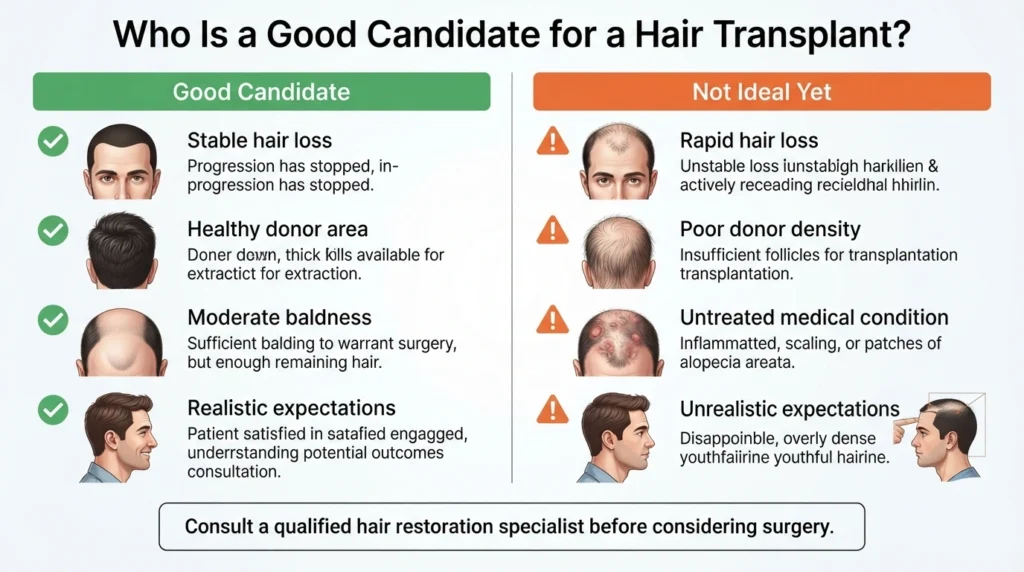
Good candidates typically:
- Have hair loss that’s stabilized, or is at least slowing down not rapidly progressing
- Have a strong, healthy donor area with enough density to harvest from.
- Are dealing with moderate-to-advanced thinning and want to restore density in specific bald areas.
Not ideal candidates: anyone with active progressive hair loss which hasn’t established a steady pattern of loss, if it’s still on the rise then transplanting into the “pattern of change” doesn’t hold up so well.
When to Talk to a Doctor First
Before confirming your booking if:
- You continue to experience hair loss at a rapid rate instead of it plateauing.
- You have reason to believe there’s an underlying medical issue that’s causing your hair to fall out (i.e., thyroid issues, iron deficiencies, and a myriad of other things can look like the signs of hair thinning.
- You’re not sure if you’re even a candidate yet.
| Specialist | What They Handle |
|---|---|
| Dermatologist | Diagnoses and treats underlying skin, hair, and scalp conditions |
| Hair transplant surgeon | Specializes specifically in FUE/FUT surgical hair restoration |
| Cosmetic surgeon | May perform hair restoration as part of broader aesthetic/reconstructive practice |
Always ask about: Real before-and-after photos that have similar results to your hair type, their personal success rate with graft survival, and genuine patient comments and I mean actual patient comments and not the pre-written ones on a clinic’s website.
Common Mistakes That Ruin Permanent Results
Choosing the cheapest clinic available: The increased time and complexity associated with hair restoration will naturally result in an increase in costs but this will often be associated with hurried removal and poorer graft survival rates.
Skipping aftercare instructions: slows recovery and has the potential to undermine take rate of skin and other grafts.
Walking in with unrealistic expectations: The most successful surgical procedures feel disappointing if expectations weren’t realistic.
Not researching the actual surgeon: Don’t assume the clinic is as great as the surgeon.
US Clinics Known for Long-Term, Permanent Results
| Clinic | City | Lead Surgeon(s) | Known For |
|---|---|---|---|
| Bernstein Medical | New York, NY | Dr. Robert Bernstein, Dr. Christine Shaver | Published graft survival data |
| Shapiro Medical Group | Minneapolis, MN | Dr. Ron Shapiro, Dr. Paul Shapiro, Dr. David Josephitis | Long-term repair & mega-sessions |
| Miami Hair Institute | Miami, FL | Dr. Bernard Nusbaum, Dr. Aron Nusbaum | Female & complex long-term cases |
| Cooley Hair Center | Charlotte, NC | Dr. Jerry Cooley | ABHRS/ISHRS-level donor management |
| Foundation Hair Restoration | Miami, FL | Dr. Jeffrey Epstein | High-volume documented outcomes |
Protecting Your Investment After Hair Transplant
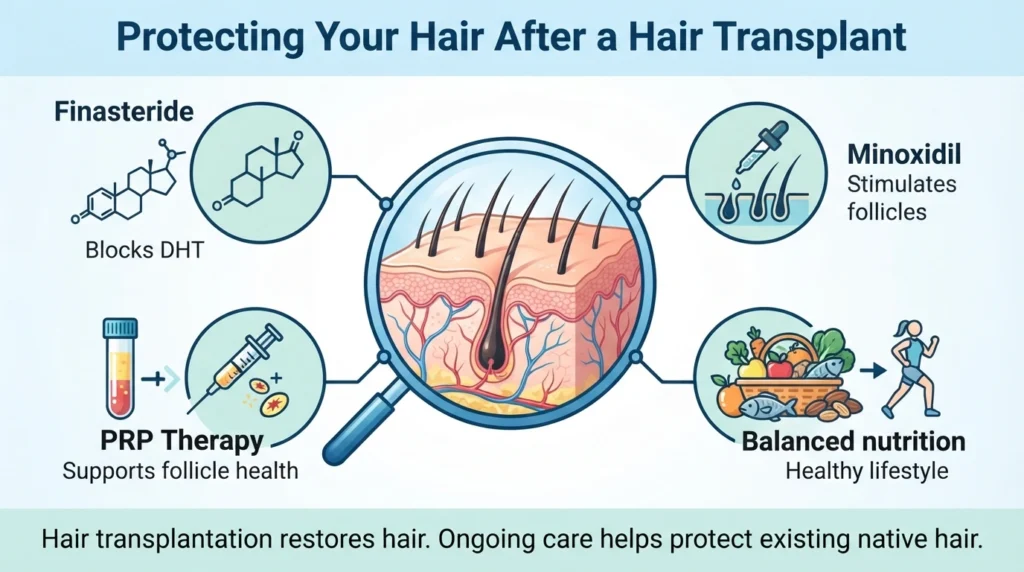
While native (non-transplanted) hair keeps thinning over time, transplanted hairs aren’t lost the same way. Actually, the main reason patients need a follow up appointment isn’t because their original procedure failed – it’s because their native hair continued thinning out. Two effective treatments are commonly advised by many surgeons and prescribed with approval by the FDA for protecting hair not transplanted:
| Treatment | How It Works | Cost | Best For |
|---|---|---|---|
| Finasteride (oral) | Blocks DHT production | $20–$50/month | Men — slows native hair loss |
| Minoxidil (topical) | Stimulates follicle activity | $30–$60/month | Men and women |
| Minoxidil (oral) | Provides a stronger systemic effect | $30–$80/month | Advanced cases |
Starting one or both of those medications and staying on them for years is why many patients still see strong results a few decades later versus many who need a redo in 5-7 years.
PRP Therapy for Long-Term Result Maintenance
At 6 month or 12 month follow-up, PRP (platelet-rich plasma) therapy is used to support the health of transplanted hair follicles and existing native hair. Cost: $500 – $2000 per treatment.
FAQs:
Q: Is a hair transplant permanent for life?
Yes, hair follicles implanted should continue producing hair throughout your life because they are harvested from your body’s own DHT-resistant donor zone. The existing hair on your head can still thin naturally with time.
Q: Will the transplanted hair fall out again?
No, not permanently. You should expect to shed in the first couple of months post surgery – that is entirely normal and your new growth will come from the same hair follicle that is alive.
Q: How long do hair transplants actually last?
Transplanted follicles retain their DHT resistance permanently, they do not revert to being sensitive to the hormone that caused your original hair loss. Very gradual thinning can occur as a natural part of aging, but not in the same pattern as androgenetic hair loss.
Q: What happens 20 years after a hair transplant?
That transplanted zone will, almost without fail, continue to provide the result you initially had from it, although with extreme, gradual miniaturisation over time as is the natural state for any hair follicle. More usually, over a 20 year time span, your primary concern will be the progressive recession of your own non-transplanted hair line.
Q: How much do 3,000 hair grafts cost in the USA?
From $12K to $20K- depending on the clinic, location, surgeon and the specific technique.
Q: What are the disadvantages of hair transplants?
You’re still looking at an actual surgery with actual healing time. It takes months (up to a year for results) and there’s still a chance that a percentage of your grafts simply won’t take root. The costs involved are usually substantial and — the biggest factor — the hair loss itself is likely to continue in non-transplanted areas.
Q: Will I need surgery again later?
Maybe. The majority of patients are happy with a single session but there is the option to add another session down the line, to fill in density.
Q: When will I actually see results?
The actual results of your treatment can begin appearing at the 3-4 months point and you’ll be able to fully achieve your desired mature results at 12 months.
Q: Can I cut, style, or color transplanted hair?
Absolutely – after it heals, it functions just like your original hair in all ways.
Conclusion:
If you remember only one thing from this entire guide: transplant is permanent, your hair loss journey doesn’t end there. The follicles you’ve had moved to the front will grow out your life. The fate of your existing hair however, still remains subject to your genes, your age, and if you treat the un-transplanted regions with a plan that includes medication like finasteride and/or minoxidil. When you sit in a consultation with a clinic, ask about how your donor region is being managed – not about graft counts and cost – this part alone will tell you more about its permanence than everything else.
Editorial & Medical Review
Written by: Wajiha Aqeel
Co-Founder & Hair Restoration Research Lead
Medically Reviewed by: Dr. Anam Sahibzada
Specialist Dermatologist & Trichologist
Data & publication oversight: Daniel Brooks
Co-Founder & Senior Operations & Data Director
Content reviewed by:
Mehwish Fareed Clinical Aesthetician & Content Reviewer
Asma Shamshad Medical Student & Content Contributor
Originally published: April 25, 2026
Research & content last reviewed: July 2026
Last medically reviewed: September 2026
Last updated: September 15, 2026
Medical & Affiliate Disclaimer:
The content on Hair Grow Needs is for general informational and educational purposes only and should not be considered professional medical advice. For full details regarding our policies, please read our official Disclaimer.
Medical References
ISHRS – International Society of Hair Restoration Surgery
ABHRS – American Board of Hair Restoration Surgery
AAD – American Academy of Dermatology
NIH – National Institutes of Health
Mayo Clinic
Cleveland Clinic