
Medical Disclaimer: This article is for informational purposes only and does not replace professional medical advice. Read our full Medical Disclaimer.
A beard hair transplant moves hair follicles from a donor area most commonly the scalp into areas of the face where beard density is limited. Techniques used may be FUE, harvesting individual grafts, or strip excisions for the hair transplanted. The amount of grafts will vary depending on the location the grafts are being placed, the natural density on a patient’s chin and face, desired pattern, and the number of hairs in the donor areas.
One key thing to remember is that where some products might change the appearance or promote the growth of facial hair you already have, transplantation uses your existing donor follicular units and puts them into the recipient area. Not every follicle implanted will be successful in growing, though, and it does take time to see your final results.
What Is a Beard Hair Transplant, Exactly?
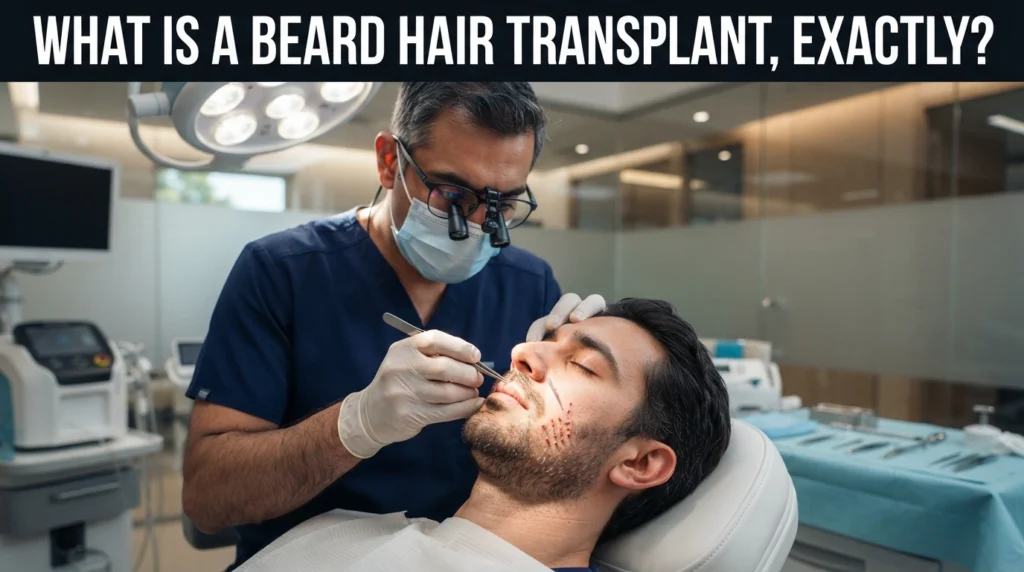
How a Beard Transplant works Beard Hair Transplants are a short outpatient procedure involving the transplantation of healthy, active hair follicles from a donor site-most commonly, the sides or back of the head-to a desired area of the beard, utilising Follicular Unit Extraction (FUE). ISHRS says FUE micro-punches can vary, with its general FUE guide giving approximately 0.7–1.2 mm in size, and then implanted, one by one, to achieve natural hair direction and density along your jaw, cheeks, mustache, or sideburns.
Once successfully transplanted and healed, the follicles can produce long-lasting hair growth, although individual graft survival is not guaranteed.. The surgery typically takes 4 to 8 hours based on graft size, Hims and Cross Plastic Surgery sites estimate, and patients can resume light activity in a few days.
Why People Consider a Beard Hair Transplant
Beard density can be naturally sparse or patchy, and some patients have congenital areas with little or no facial hair. Others seek reconstruction after scarring from burns, injuries, acne, or surgery. Beard transplants may also be considered for selected reconstructive cases where appropriate.
Patients most commonly come in for:
- Naturally sparse or patchy beard growth
- Congenital areas with little or no beard hair
- Beard loss caused by scars or trauma
- Uneven cheek, jawline, mustache or sideburn density
- Selected reconstructive cases
How the Procedure Actually Works, Step by Step
Step 1: Consultation and Facial Design
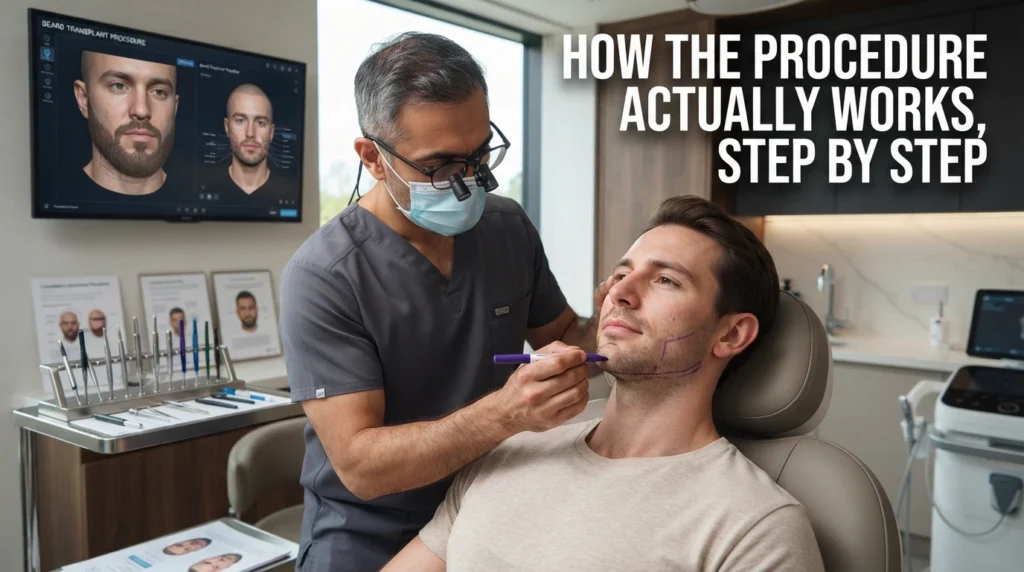
The surgeon assesses facial symmetry, current beard density, donor hair quality thickness, curl, color match, skin condition, and medical history. This is where a graft estimate is built, not guessed at, but mapped to your actual facial zones.
Step 2: Donor Site Selection
The hair typically harvested from donor areas are from the scalp back or side of the head since it has texture most similar to hair on your face. In some cases, where the individual has undergone previous surgery on their scalp or does not have sufficient donor hair in the scalp, the surgeon will explore utilizing beard hair to do an “inverted” hair transplant, utilizing hair on the chin/neck for other applications, or a “beard to scalp” hair transplant procedure to supplement the mid-scalp/crown density.
Step 3: Local Anesthesia
Beard-transplant procedures are commonly performed under local anesthesia. The anesthesia plan should be determined by the treating surgeon based on the procedure and patient circumstances.
Step 4: FUE Extraction
This procedure involves removing single hair follicular units one by one using micro-punches. The method doesn’t involve slicing out a strip of skin at all, which explains why FUE is commonly used for facial-hair transplantation. patients recover more quickly and they’re nearly unnoticeable for scarring.
Step 5: Recipient Site Creation and Implantation
Then comes the artistry. Small cuts are angled along the natural growth patterns for a beard that doesn’t flow with your natural topography different on a cheek than a jawline, chin, or upper lip. A doctor who approaches everything at one flat angle results in a hairpiece-like appearance.
Can Beard Hair Be Used for Hair Transplant?
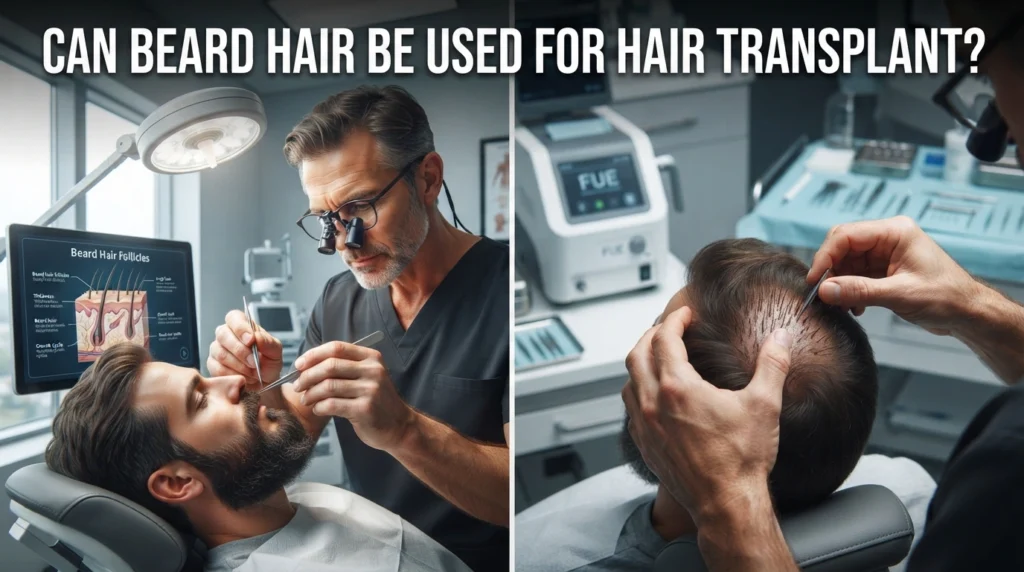
Yep, but there are definite limitations, and that statement can go both ways.
Scalp hair → beard is the standard, common procedure – this is what most people mean by a ‘hair transplant to beard.’
Beard hair: beard to hair to scalp transplant or beard to head transplant is a more intensive technique that isn’t as popular or routinely performed and is normally used in specific circumstances such as:
- Patients with no supply of scalp donor hairs remaining after previous procedures.
- High graft requirement when the patient has limited scalp resources – already used most of the available scalp donor area.
- This is applicable in those cases that possess a healthy, thick, coarse beard that can be utilized as an additional donor region.
While beard hair tends to be thicker and coarser than scalp hair, it is not normally recommended that hair transplant surgeons plant beard hair around the front hairline, as finer scalp hair leads to a more desirable, natural transition. To use beard hair to increase the density in the mid scalp and crown areas.Beard hair can be used as an additional donor source in selected patients, particularly when scalp donor supply has been reduced by previous procedures. However, beard donor supply is limited and the surgeon must consider differences in hair caliber, curl, color and growth characteristics before using beard follicles elsewhere.
Hair Transplant to Beard vs. Beard to Head Hair Transplant
| Procedure | Goal | Donor Area | Recipient Area | Typical Candidate |
|---|---|---|---|---|
| Hair transplant to beard | Build or thicken facial hair | Scalp | Beard/face | Patchy beard, scarring, thin sideburns |
| Beard to head (beard to scalp) hair transplant | Add scalp density | Beard | Scalp (crown/mid-scalp) | Limited scalp donor supply, multiple prior surgeries |
FUE vs. FUT for Beard Procedures
ISHRS explicitly says that when scalp hair is being transplanted into the beard, either FUE or FUT/LSE may be used, depending on surgeon preference, experience and patient circumstances.
| Feature | FUE | FUT / Linear Strip Excision |
|---|---|---|
| Donor harvesting | Individual follicular units | Strip of scalp tissue |
| Donor scar | Multiple small scars; FUE is not scarless | Linear scar |
| Beard use | Commonly used, including beard donor harvesting | Can be used when scalp hair is the donor |
| Main consideration | Distributed donor extraction | Linear donor scar |
| Who decides | Surgeon based on donor characteristics and goals | Surgeon based on donor characteristics and goals |
FUE is commonly used for facial-hair transplantation because it harvests individual follicular units and avoids the linear donor scar associated with strip harvesting.
Source: ISHRS
FUE vs. DHI Beard Transplant: What’s the Real Difference
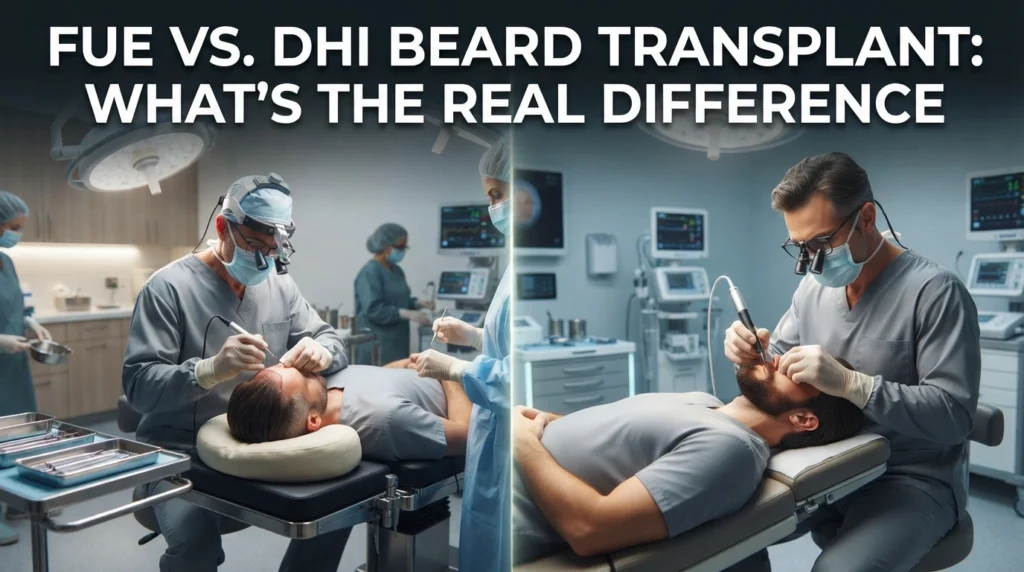
FUE and DHI are often compared as though they are completely separate transplant procedures. In practice, FUE primarily describes the graft-harvesting method, while DHI commonly refers to implantation using an implanter device. A beard transplant may therefore involve FUE harvesting followed by implantation with forceps, pre-made recipient sites or an implanter.
| Factor | FUE harvesting + conventional implantation | FUE harvesting + implanter |
|---|---|---|
| Donor harvesting | Individual follicular units | Individual follicular units |
| Implantation | Forceps into prepared recipient sites | Graft loaded into an implanter |
| Recipient-site approach | Pre-made sites may be used | Sharp implanter can create and implant |
| Main advantage | Established, flexible approach | Can combine site creation and implantation |
| Best choice | Depends on surgeon and facial design | Depends on surgeon and facial design |
Neither approach is universally superior. The appropriate implantation method depends on the surgeon’s technique, facial anatomy, graft characteristics, recipient-site design and treatment goals.
Who’s a Good Candidate?
Good candidates generally have:
- Stable (not actively advancing) hair loss of scalp and beard.
- Healthy, sufficient donor hair.
- Good general health and skin not in a state of infection.
- Realistic timelines and density expectations.
- Non active auto immune and skin diseases (often requiring initial medical treatment).
The recipient skin should be evaluated before surgery. Active infection, inflammation or acne may need treatment before transplantation.
Beard Hair Transplant Recovery Timeline
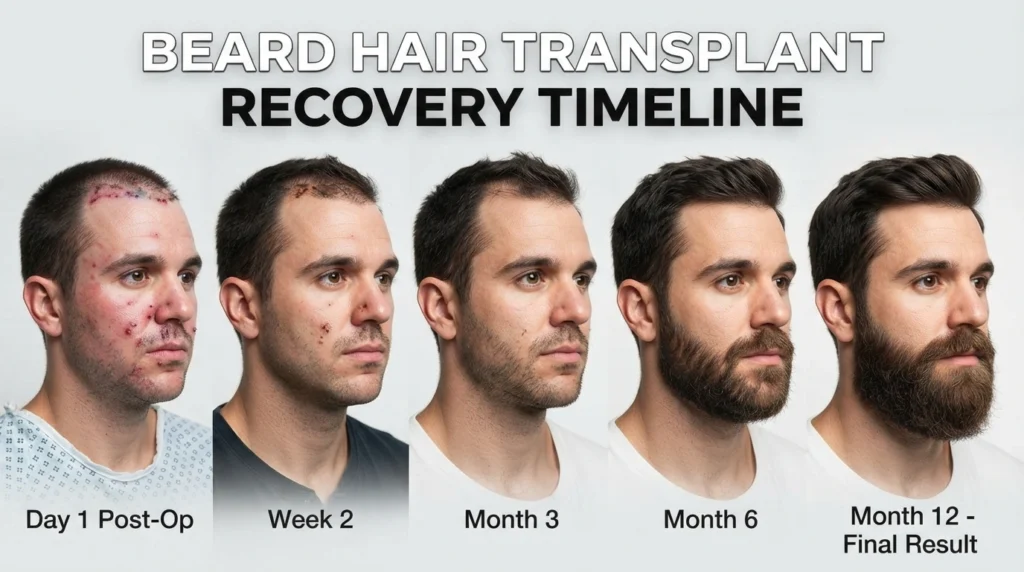
| Time | What may happen |
|---|---|
| First few days | Redness, swelling, scabbing and tenderness may occur |
| First 1–2 weeks | Scabs gradually clear; follow the surgeon’s washing and shaving instructions |
| Following weeks | Transplanted hairs may shed |
| Around 3–4 months | New growth may begin becoming visible |
| 6+ months | Density gradually improves |
| 10–14 months | Overall growth is generally much more mature |
ISHRS specifically reports shedding followed by regrowth around 3–4 months and overall growth around 10–14 months.
Hims independently reports that new growth can take several months, with about 8–9 months as an average in its guide.
How We Compare Beard Transplant Prices
HairGrowNeeds does not treat a single clinic’s advertised package as the average price for an entire country. National prices provided reflect market reference ranges based on clinic pricing as advertised in their publications, known treatment marketplaces , and individual provider rates where available. Prices can vary significantly by graft amount, procedure, level of surgeon intervention, clinic type, travel deals or Packages ,and post procedure, and where no good data is available for an entire country we will not produce a false national cost price for that country.
Beard Hair Transplant Cost in the U.S. 2026
U.S. beard hair transplant costs vary substantially by graft count, surgeon, clinic, technique, and the amount of facial coverage required. Published market and clinic references give a more useful benchmark than assigning unsupported prices to individual cities or states.
- RealSelf reports an average beard-transplant cost of $9,267, based on patient-reported data. Its published range is $3,599–$16,000. This should be treated as a market reference rather than a guaranteed clinic price, because actual quotes depend on the patient’s graft requirement and treatment plan.
- Kopelman Hair Restoration also reports an average of $9,267 and a $3,599–$16,000 range, while noting that these figures reflect self-reported patient experiences rather than fixed clinic rates. Kopelman notes that these figures reflect self-reported patient experiences rather than fixed clinic rates, so they should be treated as a market reference rather than a guaranteed quote.
- Signature Hair Restoration’s 2026 analysis places the U.S. beard-transplant range at $3,000–$15,000, with an average reported procedure cost of approximately $9,000. It states that most beard-transplant patients require 1,500–3,000 grafts, placing the typical procedure at approximately $5,000–$12,000.
The final price should still be based on an individual consultation. Graft requirements, the areas being restored, desired density, surgeon experience, technique, and what the quoted package includes can all affect the final cost.
U.S. Beard Transplant Cost Benchmark
| Reference | Published figure | How to interpret it |
|---|---|---|
| RealSelf | $9,267 average | Market/patient-reported benchmark, not a guaranteed quote |
| Kopelman Hair Restoration | $3,599–$16,000 | Published clinic/market price range; individual cases vary |
| Signature Hair Restoration, Cost 2026 | $3,000–$15,000 | Published 2026 U.S. range |
| Signature Hair Restoration, 2026 | $9,000 average | Published average estimate |
| Signature Hair Restoration, 2026 | 1,500–3,000 grafts | Typical graft range stated by the source |
| Signature Hair Restoration, 2026 | $5,000–$12,000 | Approximate range for many procedures based on its graft/pricing analysis |
Don’t pick just from a national average! The final quote you get should be dependent on: how many grafts are needed, on what part of your face they will go, the quality of the donor hair on your scalp, which doctor does your hair transplant surgery, method, and whatever is included in the package and after-care plan.
Beard Hair Transplant Cost by Country 2026
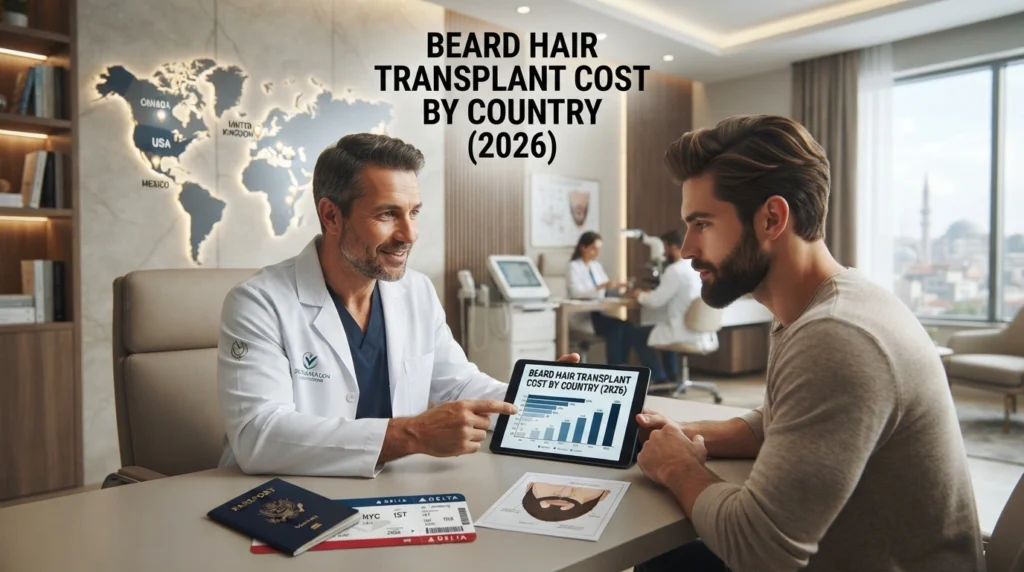
Beard-transplant prices vary significantly by country, technique, graft count, surgeon and clinic. The figures below are published or aggregated market references rather than guaranteed prices for individual patients.
| Market | 2026 published/Aggregated Beard-Transplant Pricing | Source basis |
|---|---|---|
| United States | $3,000–$15,000+ | Hims |
| Mexico | $2,600–$4,300 | Bookimed, 2026 |
| Thailand | $2,000–$3,600 | Bookimed, 2026 |
| Turkey | from about $2,070 in Bookimed’s current comparison | Bookimed, 2026 |
What Should Be Included in a Beard Hair Transplant Quote?
| Quote item | Why it matters |
|---|---|
| Surgeon fee | Clarifies who is actually responsible for surgery |
| Number of grafts | Lets you compare quotes fairly |
| Donor source | Scalp vs beard affects planning |
| FUE/FUT/LSE or implantation method | Different surgical approaches |
| Local anesthesia | Confirms what is included |
| Postoperative medication | Avoids surprise costs |
| Follow-up appointments | Important if you travel internationally |
| Revision policy | Useful if density is lower than expected |
| Travel/hotel package | Relevant to medical tourism |
| Who performs extraction/implantation | One of the most important quality questions |
Turkey vs. Mexico vs. USA: Which Country Should You Actually Pick
Almost every patients’ shortlists include all three, and all three “win” for different reasons, not just because they are affordable.
| Factor | Turkey | Mexico | United States |
|---|---|---|---|
| Typical pricing position | Generally lower than U.S. | Generally lower than U.S. | Generally higher |
| Travel | International travel for many patients | Convenient for some U.S. patients | No international travel for U.S. residents |
| Follow-up | More difficult after returning home | Potentially easier for nearby U.S. patients | Usually easiest for U.S. residents |
| Clinic selection | Credentials vary by provider | Credentials vary by provider | Credentials vary by provider |
| Main consideration | Verify surgeon and who performs surgery | Verify surgeon, facility and follow-up | Higher cost does not automatically mean better results |
This is another one that’s sort of neither ‘right’ answer it’s sort of where the rubber meets the road for value, travel preference, and how important it is to you to be able to walk back into that same clinic in six months.
Why Turkey Is Commonly Considered for Beard Transplants
Turkey is very well-known as a international center for hair transplantation and nowadays it is reported that there are many providers listed in international clinic directories offering beard transplantation. However, the quality of service varies among providers and one should be cautious with a quality assessment relying solely on the country.
Why Mexico Appeals to US Patients Specifically
Proximity. Clinics in Tijuana, Guadalajara, Cancun and Mexico City attract a high percentage of American patients looking to avoid the trans-Atlantic travel in order to access face-to-face post-operative care. According to confirmed data from Bookimed, a beard transplant in Mexico will cost 50% – 70% less than it would in the United States.
5 Questions to Ask Before Booking a Beard Transplant
- Who personally performs the FUE harvesting?
- Who creates the recipient sites?
- Who implants the grafts?
- How many beard-transplant cases has the surgeon personally performed?
- Can I see 10–12 month results from patients with a similar beard pattern and hair characteristics?
Where Is Beard Hair Transplant Available in the U.S.?
If you are interested in a beard and facial-hair transplant, many U.S. Cities have specialists who can perform the procedure. Cost not uniform across the state. Unlike a fixed price by state, costs can vary from surgeon to surgeon based on such factors as number of grafts, complexity of the procedure, the type of facility where the surgery is performed, and the surgeon’s expertise.
New York
California
Florida
Texas
Beard Hair Transplant Clinics & Surgeons to Research in 2026
Editorial verification note: The names below are not presented as a ranking of the “best” surgeons. HairGrowNeeds includes a provider only when we can verify relevant professional, clinic and/or beard-transplant information from a primary source or established professional organization. Availability, credentials and clinic affiliations can change, so readers should confirm current details before booking.
United States
| Surgeon / Clinic | Location | Notes |
|---|---|---|
| Dr. Anthony Bared | Miami | Dual board-certified (Facial Plastic & Reconstructive Surgery, Otolaryngology); Foundation Aesthetic Hair Restoration Method |
| Dr. Lawrence Barnard / MAXIM Hair Restoration | NYC & Chicago | Dedicated beard/mustache/eyebrow work |
| Dr. Michael Gartner / Nova Medical Hair Transplant | New Jersey | High-volume FUE/FUT clinic |
| Dr. Michael Vories / Carolina Hair Surgery | North & South Carolina | FUE-exclusive practice |
| Dr. Carlos Wesley | New York City | Long-established hair restoration specialist |
Canada
| Surgeon / Clinic | Location | Notes |
|---|---|---|
| Dr. Cory Torgerson / Toronto Hair Transplant Clinic | Toronto, ON | 18+ years, head & neck surgical background, dedicated beard sessions |
| Dr. Rahal / Rahal Hair Transplant | Ottawa, ON | 13,000+ hair restorations performed |
| Dr. Paul Cotterill | Toronto, ON & St. John’s, NL | ISHRS Verified Surgeon 35+ years exclusively in hair restoration |
| Dr. Jamil Asaria | Toronto, ON | Board-certified facial plastic surgeon, beard-transplant specialist |
| Dr. Ashlin Alexander | Toronto, ON | Facial plastic surgeon, artistic approach to beard design |
United Kingdom
| Surgeon / Clinic | Location | Notes |
|---|---|---|
| Dr. Michael May (FRCS) / Wimpole Clinic | Harley Street, London | Medical Director & Principal Surgeon; Wimpole named Best UK Hair Transplant Clinic 2021–2026 |
| Dr. Ismail Ughratdar (FRCS) / Wimpole Clinic | London + UK-wide | FRCS-qualified, GMC-registered |
| Dr. Umear Ahmad (GMC) / Wimpole Clinic | London + UK-wide | GMC-registered surgeon |
| Westminster Medical Group | Harley Street, London | Expert team, UGraft Zeus FUE system |
| Berkeley Hair Clinic | Central London | Surgeon-led FUE, dedicated beard/facial hair team |
Mexico
| Surgeon / Clinic | Location | Notes |
|---|---|---|
| Dr. Ileana Martinez | Guadalajara | Sapphire FUE specialist for international patients |
| Dr. Joaquin Ayala Del Muro | Mexico | 33+ years plastic surgery experience, trained under Ivo Pitanguy |
| Esthetic Hair Mexico Clinic | Tijuana, Monterrey, CDMX | Turkish-trained surgeons relocated to Mexico |
| Kaloni Cancun / CosMed Clinic | Cancun | Board-certified plastic surgeons, ISAPS/ASPS affiliations |
Turkey
| Surgeon / Clinic | Location | Notes |
|---|---|---|
| Dr. Serkan Aygin | Istanbul | High-volume beard clinic, DHI-dominant protocols |
| Dr. Oya Şişman | Istanbul | Experienced hair transplant specialist with thousands of FUE procedures performed at the Istanbul Aesthetic Center. |
| Dr. Mehmet Erdogan / Smile Hair Clinic | Turkey | Sapphire FUE specialist, 4,000+ transplants performed |
| Dr. Firdavs Ahmedov / Smile Hair Clinic | Turkey | Micro-Sapphire FUE technique |
| Adem and Havva Medical Center | Turkey | Turkish Medical Association & ISO-certified facility |
Thailand
| Surgeon / Clinic | Location | Notes |
|---|---|---|
| Dr. Kulakarn Amonpattana / BHI Clinic | Bangkok | ISHRS Verified Surgeon & Frequent international conference speaker on hair restoration |
| Dr. Prima Tossaborvorn / Hairsmith Clinic | Bangkok | ISHRS Verified Surgeon, 3,000+ patients |
| Dr. Patra Pinyopawasutthi / Grow & Glow Clinic | Bangkok | Internationally certified hair restoration specialist |
Sources include: Bookimed Global directory; Ape to Gentleman’s doctor list; Dr. Anthony Bared’s website; HairPalace’s Canada guide; Wimpole Clinic; and BHI Clinic Bangkok. Always confirm current board certification ABHRS, ISHRS, GMC, CMCPER directly with the governing body prior to booking, as clinic rosters can shift.
How to Choose the Right Clinic
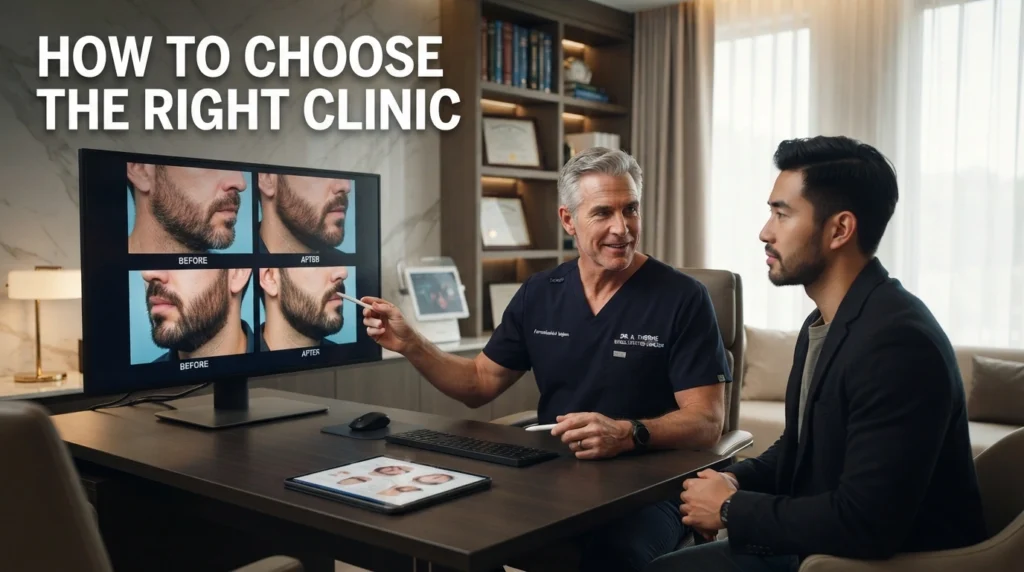
It shouldn’t be the first thing you filter by-instead, it should be the last. Above all else, before considering any factor:
Who actually performs each stage of the surgery?
In some high-volume clinics, technicians, not the surgeon, do the extraction and implantation. Ask directly who does what.
Are the before-and-after photos real and varied?
Don’t be fooled by only one or two types of skin, one type of beard or the top 3 photos you see at the top of their website page, which most clinics provide. Look for more types of skin, more beard shapes and also their results over a long period of time (12 months or so).
Is the treatment plan personalized?
It is a red flag for a consultation to be only 15 minutes and rush over the topic of your exact desired density, donor potential and facial frame to be considered.
| Consultation Question | Why It Matters |
|---|---|
| How many beard procedures have you personally performed? | Confirms real experience with facial (not just scalp) work |
| Who performs the extraction and implantation? | Confirms surgeon involvement vs. technician-only work |
| How many grafts will I realistically need? | Sets accurate expectations and cost |
| Which technique — FUE, DHI, or Sapphire FUE? | Affects scarring, recovery, and precision |
| What’s included in aftercare? | Impacts graft survival and final results |
Realistic Graft Counts No, You Don’t Need 8,000 Grafts
| Treatment area | Typical planning approach |
|---|---|
| Mustache | Usually requires fewer grafts than full-beard restoration |
| Goatee/chin | Depends on the desired shape and existing density |
| Sideburns | Depends on the size of the missing area |
| Partial beard | Often several hundred to more than 1,000 grafts |
| Full beard | Can require 2,000+ grafts in some cases |
There is no universal graft number for a “full beard.” ISHRS notes that requirements can range from a few hundred to more than 2,000 grafts depending on the area, goals and available donor supply.
Scarring, Risks, and When Beard Transplants Go Wrong
In the age of modern FUE techniques, scarring in the donor region is typically reduced to minute, almost unnoticeable dots since follicles are extracted with a small punches on a follicle-by-follicle basis, unlike a strip transplant. Complications and poor cosmetic outcomes can have multiple causes, including inappropriate graft placement, poor hair direction, donor overharvesting, infection and other surgical factors.
- Unnatural hair direction caused by poor recipient-site planning or implantation.
- Over harvesting the donor area to thin the face.
- Poor results from the inexperienced hands.
- Infection related to inadequate sterile technique or postoperative care.
- Spots of inconsistent thickness caused by speedy insertion.
Poor outcomes can result from factors including inappropriate recipient-site design, incorrect hair direction, donor overharvesting, infection and inadequate surgical planning.. Instead, it’s an inexperienced provider and a clinic being led by technicians, not a surgeon.
Combining Hair and Beard Transplants
Some clinics now offer a combined hair and beard transplant in a single visit for patients who need both scalp density and facial hair restoration, particularly useful for men also considering a beard to scalp hair transplant to supplement limited donor supply. Some clinics may combine scalp and beard transplantation in one surgical plan. The feasibility depends on graft requirements, donor supply, procedure length and the surgeon’s assessment.
Beard Transplant Myths Worth Killing
Can we use pubic hair for a beard transplant?
Body-hair transplantation is possible in selected cases, but donor-hair characteristics such as caliber, curl, growth cycle and available supply need to be considered carefully. Beard hair is a recognized donor source for selected scalp procedures, while donor choice for facial restoration should be determined by the surgeon.
A cheaper package means the same quality, just discounted.
A low quoted price does not by itself establish quality or poor quality. Compare what the package includes, who performs the surgical steps, the surgeon’s experience, donor assessment, aftercare and the clinic’s documented results.
Results are visible right away.
These are not, and this is entirely expected! Your transplanted follicles actually enter into a shed cycle before coming back in to the hair growth phase on their natural growth cycle. You’re going to see density come in gradually until month 4-6, and it won’t become fully mature until about 10-12 months out.
Beard Transplant vs. Beard Growth Products: What’s Actually Different
Most guides overlook the above comparison, but the comparison should be the initial topic any patient needs to review before spending any cash on the options below.
| Factor | Beard Oils / Balms | Minoxidil | Supplements (biotin, etc.) | Beard Hair Transplant |
|---|---|---|---|---|
| What it does | Softens and conditions existing hair | May stimulate some follicles to grow thicker/longer | Supports hair health if you have a deficiency | Physically adds new, permanent follicles |
| Increases follicle count? | No | No — works on existing follicles only | No | Yes |
| Results if you stop using it | Reverts immediately | May improve the appearance | Fullness of existing beard hair in some patients; results require continued use and are less predictable than transplantation. | Permanent – follicles stay for life |
| Cost over 5 years | Low, but recurring forever | Moderate, recurring forever | Low, recurring forever | High upfront, one-time |
| Best for | Maintenance of an already-decent beard | Mild thinning, not true patchiness | General hair health support | Genuinely patchy, scarred, or absent areas |
The straight facts: If your hair isn’t full but is distributed around, minoxidil or PRP is your jam. If there’s actual bald spots, scarring or any type of completely missing area no product on the surface is gonna magically fill those in for you, a transplant is one option for physically adding follicles to areas where hair is absent or substantially sparse, but candidacy should be assessed by a qualified clinician.
FAQs:
Q: How long does a beard hair transplant take?
The procedure time varies according to graft number, technique and case complexity. Your surgeon should give you an expected operating time after assessing the treatment area.
Q: Is it painful?
The procedure is generally performed using local anesthesia, but discomfort varies between patients. Swelling, redness, tightness or tenderness can occur during recovery.
Q: How many grafts does a full beard need?
There is no universal graft count for a full beard. The number depends on the areas being restored, existing beard density, desired density and donor supply. Published guidance ranges from several hundred grafts for limited areas to more than 2,000 for larger restorations, while some 2026 U.S. pricing analyses report approximately 1,500–3,000 grafts for many patients.
Q: Can transplanted beard hair be shaved or trimmed like normal?
Yes, transplanted beard hair can generally be trimmed or shaved once the recipient area has healed, but the exact timing should come from your surgeon. ISHRS notes that shaving instructions vary between surgeons.
Q: Can beard follicles be transplanted to the scalp?
Yes. Beard follicles can be used as an additional donor source for scalp transplantation in selected patients, particularly when scalp donor supply is limited. Beard hair has different characteristics from scalp hair, so donor-recipient matching is important.
Q: Does it leave a visible scar?
FUE does not mean scarless. It produces multiple small donor-site scars rather than the linear scar associated with strip/linear excision. Their visibility varies by patient, technique and healing.
Q: When will I see final results?
Growth develops gradually. ISHRS reports that regrowth can begin around 3–4 months and that overall graft growth is assessed around 10–14 months.
Q: Can women get facial hair transplants?
Facial-hair transplantation can be considered for selected reconstructive or gender-affirming indications. Suitability depends on the individual’s goals, anatomy, donor supply and medical assessment.
Q: Is Turkey safe for this procedure?
The country alone cannot determine whether a beard transplant is safe. Patients should independently verify the surgeon’s credentials, facility, who performs each surgical step, aftercare arrangements and documented experience with facial-hair transplantation.
Q: Is a beard transplant covered by insurance?
Because beard transplantation is commonly performed for cosmetic restoration, patients should not assume it will be covered by insurance. Coverage depends on the policy and the medical indication; confirm directly with your insurer.
Conclusion
A beard hair transplant is a surgical way to physically add donor follicles to areas where facial hair is sparse or absent. It can be useful for genetic patchiness, selected scar-related hair loss and other carefully assessed cases, but the result depends on donor supply, graft survival, facial design, hair characteristics and surgical skill.
Before booking, get at least two consultations when practical. Ask exactly who performs extraction and implantation, how many beard procedures the surgeon has personally performed, how many grafts are being proposed and whether you can review long-term results rather than only early postoperative photographs.
Written & Reviewed By
Written by: Wajiha Aqeel
Co-Founder & Hair Restoration Research Lead
Data & publication oversight: Daniel Brooks
Co-Founder & Senior Operations & Data Director
Published Date: July 15, 2026
Clinic & Pricing Data Last Reviewed: August 2026
Last Updated: August 25, 2026
Medical & Affiliate Disclaimer:
The content on Hair Grow Needs is for general informational and educational purposes only and should not be considered professional medical advice. For full details regarding our policies, please read our official Disclaimer.
Sources References:
- International Society of Hair Restoration Surgery (ISHRS) — Beard and Mustache Transplant
International Society of Hair Restoration Surgery (ISHRS) — Everything You Need to Know About a Beard Transplant
International Society of Hair Restoration Surgery (ISHRS) — Guide to FUE Hair Transplant
Hims / Good Health — Beard Transplant: Procedure, Cost, Side Effects, and More - RealSelf — How Much Does a Beard Transplant Cost?
Supports: $9,267 average; $3,599–$16,000 range; patient-reported cost context. - Kopelman Hair Restoration — Beard Transplant: Cost, Procedure, and Recovery
Supports: $9,267 average; $3,599–$16,000 range; self-reported patient-cost qualification; graft/cost factors. - Signature Hair Restoration — Beard Transplant Cost: 2026 Data
Supports: $3,000–$15,000 range; approximately $9,000 average; 1,500–3,000 grafts; approximately $5,000–$12,000 typical procedure range.