
Medical Disclaimer: This article is for informational purposes only and does not replace professional medical advice. Read our full Medical Disclaimer.
Hair-transplant recovery generally follows a sequence of healing, temporary shedding and subsequent regrowth, but the timing varies between patients and procedures. Many patients begin seeing meaningful growth during the first several months, while maturation can continue for 12–18 months or longer, particularly in the crown.
The vast majority of people go to a hair transplant procedure and assume within a couple weeks they’ll have growing hair. Then comes week three and all of their transplanted hair is falling out, which of course sends people to an panicked 2AM internet Google search!
So I guess the real truth is: the hair loss is no reason for failure; instead, evidence that what I’m trying to do to regrow the hair is actually working!
This article is for anyone interested in hair transplantation who also want the peace of mind of knowing what to expect-the complete hair transplant results timeline, beyond just before and after photos that clinic sites post. This knowledge is the one thing that distinguishes successful patients, those who manage their journey calm and cool, stick to their post-operative plan, and ultimately enjoy stunning outcomes…and prevent premature meltdown or graft destruction.
This blog covers each stage, beginning immediately after you leave the operating table, right up until the day your procedure starts to reach its ultimate, realistic density. Whether you’re having your procedure done in New York, California, Texas, or anywhere else in the country then the process that this guide details the biological timeline for would affect every method, clinic or individual as it naturally plays out.
The First 14 Days
The first two weeks following your procedure are probably the hardest in the process – not physically, as in painful, but physically in the sense of what you have to and are allowed to do and what you absolutely don’t! In the first two weeks after surgery your scalp is undergoing incredible physical recovery at the cellular level, and almost every single thing you do or do not do will impact the fate of your grafts.
Days 1 Through 3: The Immediate Aftermath
Once you get home you would never think that six months after you would look as a hair donor site this is a natural color and there will be a little bit of swelling above your eyes. This is normal especially following your graft.
Your head will be prescribed to stay at about a 45-degree angle. That is not a recommendation; when sleeping flat the first couple of days fluid will settle at the front of the head and press onto your new grafts. The simplest way to do this is use two or three standard pillows propped behind your back, or a travel neck pillow works as well.
The grafts implanted at this point still come loose quite easily. They do not have those small “hairline” blood vessels to form a good connection and to integrate at this stage. If you bump it or rub it, scratch at it, or get water directly into your wound that could knock them loose before they take properly. You’ll receive saline and wash instruction from your surgeon; make sure you are diligent with washing instructions.
What’s going on underneath the surface: 1. The body’s wound-healing process has begun. Blood vessels are in the process of developing around each implanted follicle. This is known as neovascularization, which is responsible for ensuring that grafts can survive and take hold.
Days 4 Through 7: Grafts Are Securing
After day four, any sharp soreness may subside; the head typically transitions from truly sore to that tight or tender feeling on the scalp. People generally find they can comfortably get by without potent painkillers during this time.
You will be developing tiny little scabs around each donor area. Don’t freak out, it is normal, it is good, and shows that the skin is covering the transplanted follicle. DO NOT rub them, wipe them, or have your towel scrub over them.
The area from which hair was taken for the procedure – the back and sides of the scalp (for FUE and DHI) or a line at the back of the head (FUT) – will also be tender. If you had the FUT technique, you’ll still have staples and sutures in your donor line at this time.
Desk-job patients can usually return to work around day five-to-seven if they do not have to endure dust, direct sunlight or labor work.
Days 10 Through 14: Scabs Fall Away
This marks an exciting day on the hair transplant journey. The tiny scabs that form over each implanted hair follicle will loosen and come off by this time – during a normal wash of the scalp, and/or with the progression of time.
By 14 days for most of you the scalp has a fairly natural appearance when viewed by the non professional eye. There’s reduced redness. The small entry points are healed shut. If you had FUT it’s around now that donor sutures or staples are removed.
You may want to try and remove scabs prematurely because it feels gross or because it just itches (yes, even if the scabs were softened during the process). Don’t – this will pull out follicular units along with the scabs. The routine washing process during the immediate post-op phase is enough to get the scabs off over time.
What does this mean for your timeframe? The odds are the cards have played your timeline so high, all transplants have done what they can to survive the initial 2 weeks then you can consider yourself as almost definitely having permanent results – no, that is not possible but as the foundation is established odds of survival are very good.
Weeks 2 Through Month 3
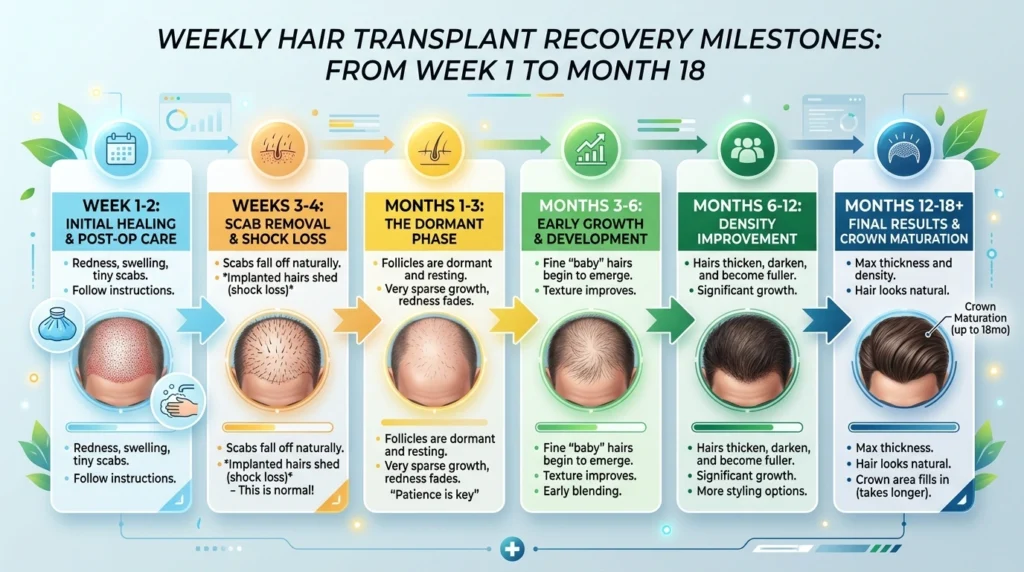
Most patients hit a “dark tunnel” at this part of the recovery journey. Physically things may become much smoother and the symptoms may be less noticeable. You may just feel like you are going backward in recovery just visually – and knowing why – and why that actually IS a sign that your body is moving in the right direction – is how you can survive this part of the journey!
Weeks 2 to 4: The Shedding Phase (Shock Loss Explained)
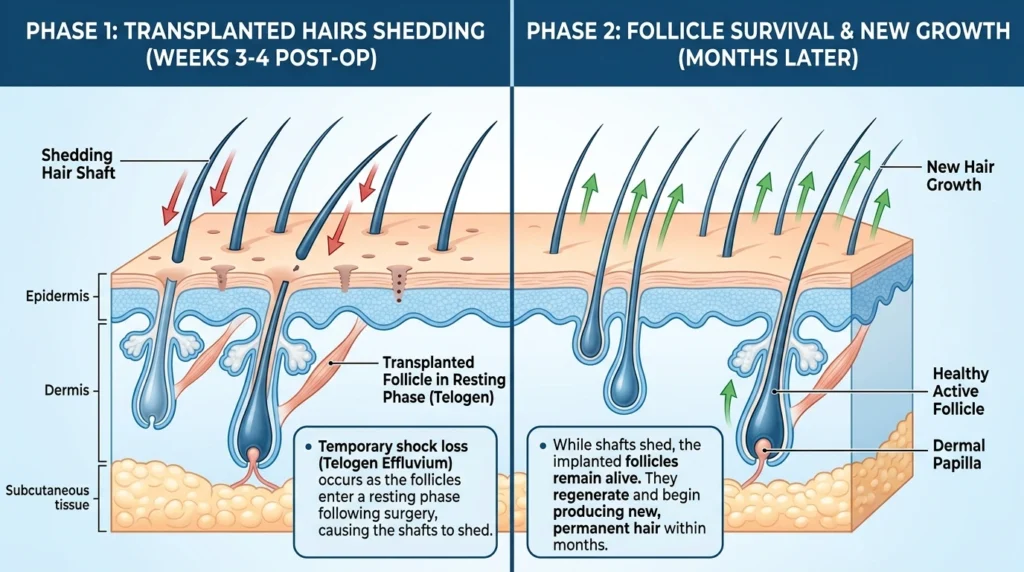
At about the three week mark after your surgery, something frightening will likely occur your hair will begin falling out. For most patients who had not been properly prepared this feels nothing short of a disaster. Don’t panic this called a shock loss, and to be more technically precise telogen effluvium secondary to trauma.
Moving a hair from the donor zone to the balding recipient site creates tremendous physiological stress.
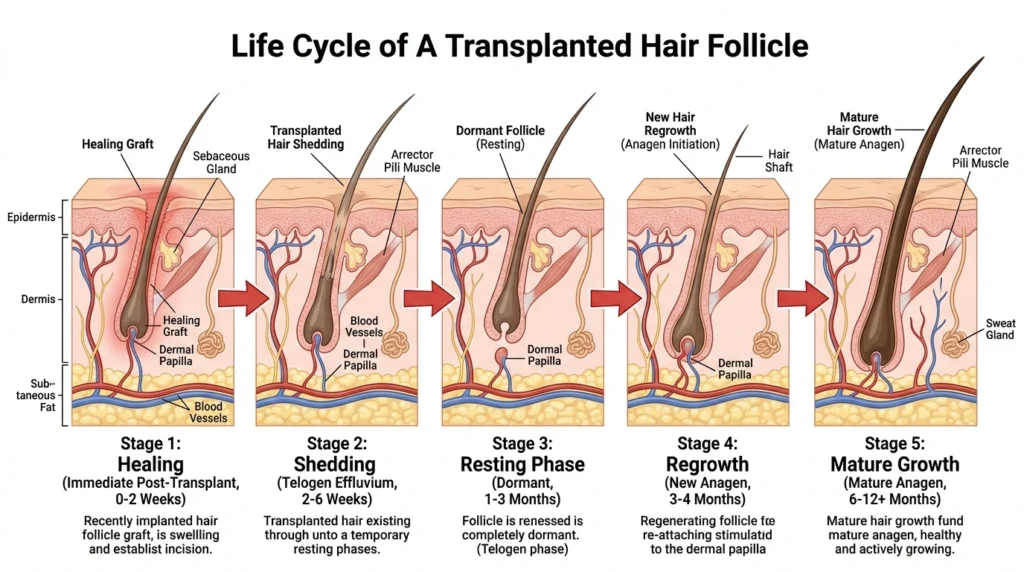
The body reacts to this stress, by shutting down the hair at this follicle into a resting phase of growth – shedding the hair that grows above the skin. Remember it is the hair shaft that will detach – the root or follicle remains intact and alive beneath the skin.
The procedure does not mean your grafts didn’t succeed. In most cases, it is exactly the opposite-it means the healthy new hair that the follicle shed is healthy in the healing and adjusts. Another experience some may have is also a shedding of non-transplanted hairs in and around the recipient area. This too is part of the process and is temporary.
This phenomenon takes place due to trauma to the local tissue which can affect the neighbouring follicles. Appearance: You may look a little more patchy and a little more thinner than you were prior to surgery. The experts in hair loss restoration call this “ugly ducklingphase” and it will pass.
Month 1: The Dormant Phase
By the one month mark, the main physical changes usually have already resolved. Your scalp should look largely normal with just the possibility of some residual redness or minor textural variation of the skin. But, when it comes to hair: dead zone ahead. Follicles spend this month in their resting phase. Below the skin’s surface, they’re gearing up to kick their hair cycle back into high gear, but above the surface, the stage has been reset with nothing to show for it yet.
The “shock period” is a tough one from a mental perspective. At times patients feel like the operation has failed. What is vital to know, is that it’s completely normal for follicles to go into “shock” or “sleep” for a period post-op. This does not mean you’ll end up with a bad result. At some points patients experience mild itching, this just indicates healing and should be managed with topical solutions/sprays prescribed at the time of surgery. Please resist scratching at all costs.
Months 2 and 3: The First Signs of Life
2 or 3 months: the rewards begin It is at this point between two or three months after hair transplantation where you can really notice and begin to enjoy the fruits of your labour. The first fine, delicate hairs will begin to appear in the recipient areas. In the early stages these will be finer, lighter in colour and may resemble “peach fuzz”. Your hair will appear patchy The reason why the new hair might not appear all over the area at the same time is because each of your hair follicles takes its own individual amount of time to begin regrowing.
Patients who received surgery on their hairline the first few signs of hair growth will often appear here. Usually, this section is further along than the crown, or vertex, of your head. You’ve now exited “healing mode” and moved into the next phase: “growth mode” and your recovery timeline has effectively passed from the hard stage.
Month 4 to Month 18+
Four months out is when you’ll really begin to see the change speed up a. The most anticipating time for any patient- it’s time to see you hard earned money work for you in the mirror.
Months 4 to 5: The First Real Sprouts
That sparse covering of light hairs that first showed up back at the three-month mark now start to take on some form and length. It’s nothing like the mature hair but at least you can see them, even though they’re light and a little wispy in texture. Your coverage is also starting to fill in more evenly with no obvious bald spots left in the surgery recipient area.
If your transplant surgery was located around the hairline the actual line itself begins to sharpen. It is still a very immature transplant procedure and neither the texture nor the thickness is what it will be eventually. You can, however, begin to see what direction the final outcome is taking. By month five, many notice a meaningful jump toward the 40 to 50 percent mark still patchy in places, but clearly heading in the right direction..
Months 6 to 9: The Density Boom
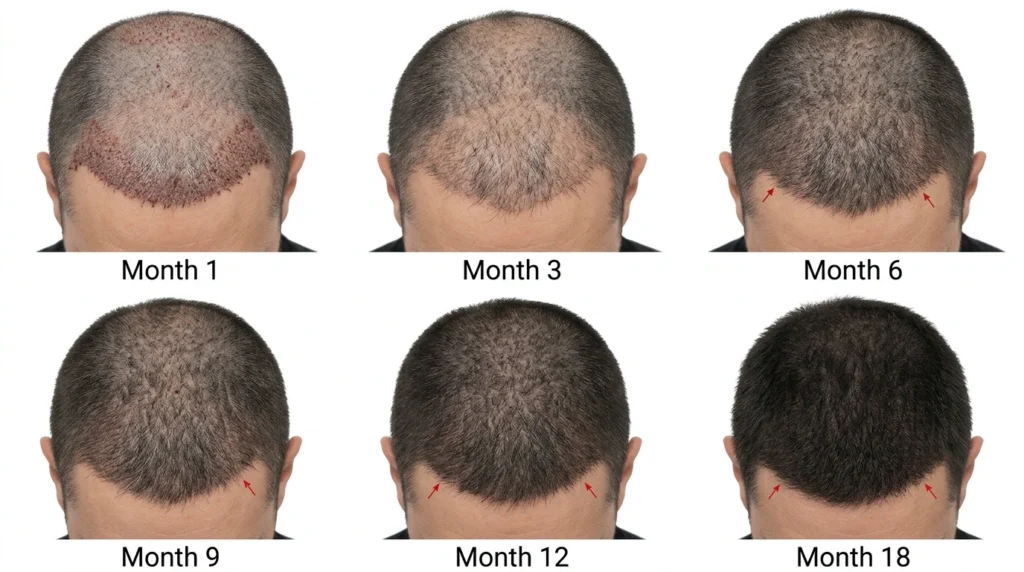
It’s our favorite part of the entire hair transplant results timeline and by far the most exciting, not to mention the part that patients talk about the most! Between month six and month nine you’ll see quite a few dramatic changes: Transplanted hairs continue to thicken. Transplanted hairs turn to their natural pigment (aka black hair for blacks, blonde for blondes). Recipient area density significantly improves! Any remaining sparse areas that were present at month four now start to completely fill in.
9 Months By month nine most patients have reached 60 to 80 percent of their final outcome. Patients are finally able to begin styling. They may begin applying product to their hair, combing, and beginning to manipulate the hairline to their style and direction. The period of month six through nine is when many patients will have their post-op and consultation. If the doctor is evaluating graft success, month six through nine will reveal this fairly well.
Month 12: The Final Transformation
Around the 12-month mark, almost every patient can cross the 12 month “finish line” by a consensus from the patients and the surgeons. The transplanted hair now fully grows and becomes similar to the original native hair in texture, coloration and behavior. It may be trimmed and treated with hair products similar to native hair.
The hairline (and crown, or other region operated upon) blends in so perfectly that it not only appears better than the pre-transplanted appearance it appears completely natural, as if you were born with the transplanted hair! In most cases, at 12 months after transplantation, hair transplant timeline is complete.
Months 15 to 18: The Crown Area Exception
Let’s cover something that may not be openly advertised at a clinic: the top, or crown area, takes the most amount of time for complete fullness. Even if the crown was part of your hair transplant you should assume this region will still be maturing until month 15 to 18, and sometimes longer! This isn’t an indicator of unsuccessful graft retention. The circulation in that part of the scalp along with follicle maturation in the crown is just a different phenomenon.
If you are 12 months in and think your crown may still be a little thinner than you expected, try not to get too worried yet. In fact, you probably should wait for about 18 months to be able to tell exactly what the final result will be like.
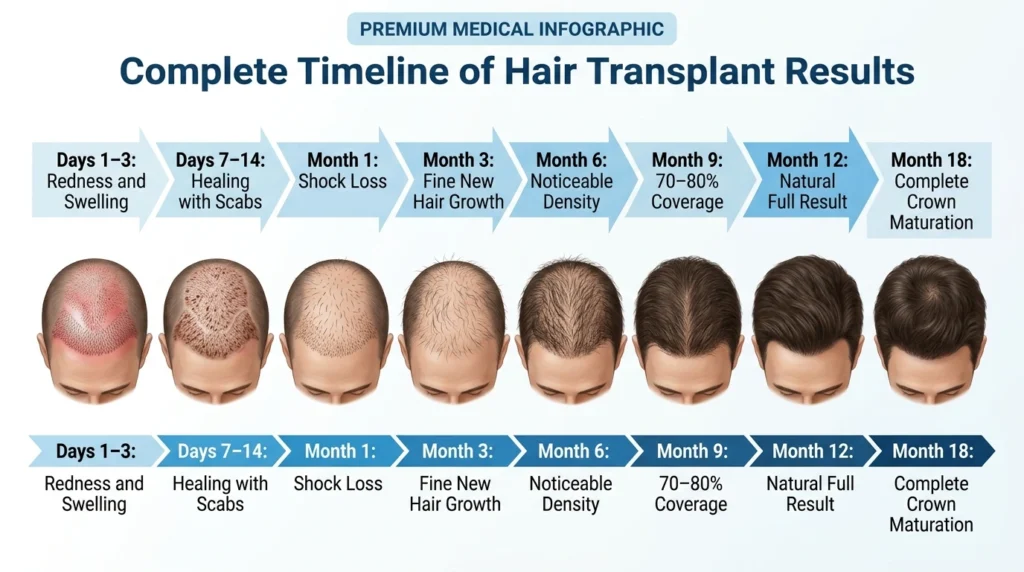
Hair Transplant Results Timeline:
| Time Period | What’s Happening | Visible Changes | % of Final Result |
|---|---|---|---|
| Days 1–3 | Initial healing, swelling | Redness, puffiness | — |
| Days 4–7 | Graft anchoring | Scabs forming, tenderness | — |
| Days 10–14 | Scabs fall away | Scalp normalizing | — |
| Weeks 3–4 | Shock loss / shedding | Hair falls out — follicles intact | — |
| Month 1 | Dormant phase | Minimal visible change | 0–5% |
| Months 2–3 | Early growth | Fine, thin hairs emerging | 10–20% |
| Months 4–5 | Active early growth | Baby hairs gaining structure | 20–30% |
| Months 6–9 | Density boom | Thick, styled hair becoming possible | 60–80% |
| Month 12 | Full results | Natural texture, color, density | 90–95% |
| Months 15–18 | Crown maturation | Complete density in vertex area | 100% |
FUE vs FUT vs DHI: Does the Technique Change the Recovery Timeline?
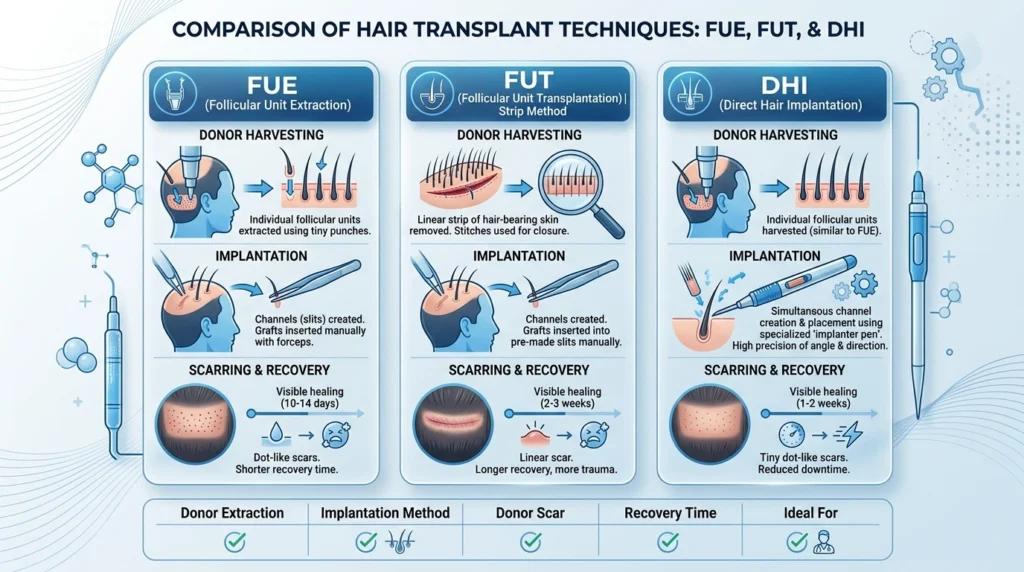
One of the most frequent concerns our patients present is: Will this method take more time than another? To be totally transparent, biologic healing processes and timelines remain the same. The differences lie in your experience and timeline within that initial 2-4 week recovery phase.
FUE (Follicular Unit Extraction):
Individual follicles are removed individually with a tiny punch instrument from the donor area. Quicker donor area recovery time. No linear scar. Patients can get back to some activity in as few as seven to ten days. In many instances, tiny circular scars in the donor area are not perceptible after hair has regrown over them.
FUT (Follicular Unit Transplantation):
A thin strip of donor skin is then cut out and divided into single grafts. The donor site takes longer to heal, leaving a strip of linear scarring, but FUT can produce a large volume of graft in a single session which makes a difference for severely thinning individuals. Sutures removed around days ten to fourteen.
DHI (Direct Hair Implantation):
In another FUE variation – which involves implanting grafts with an implant pen (also known as the ‘Choi pen’) so the grafts go straight into the recipient site, rather than via drilled channels – the recovery of the donor area is identical to FUE. Certain clinics report higher density and more controlled angles with DHI but again, it’s very dependent on the surgeon.
Female hair transplant recovery timeline:
The women hair transplant recovery timeline is identical to that for hair restoration in men. The visual nature of hair loss after a surgery can be slightly more unnerving in women given that hair tends to be a bit longer around an operative sites and therefore the contrast between thinning hair is a lot greater. But the procedure is the same.
Factors That Speed Up or Slow Down Your Hair Transplant Results
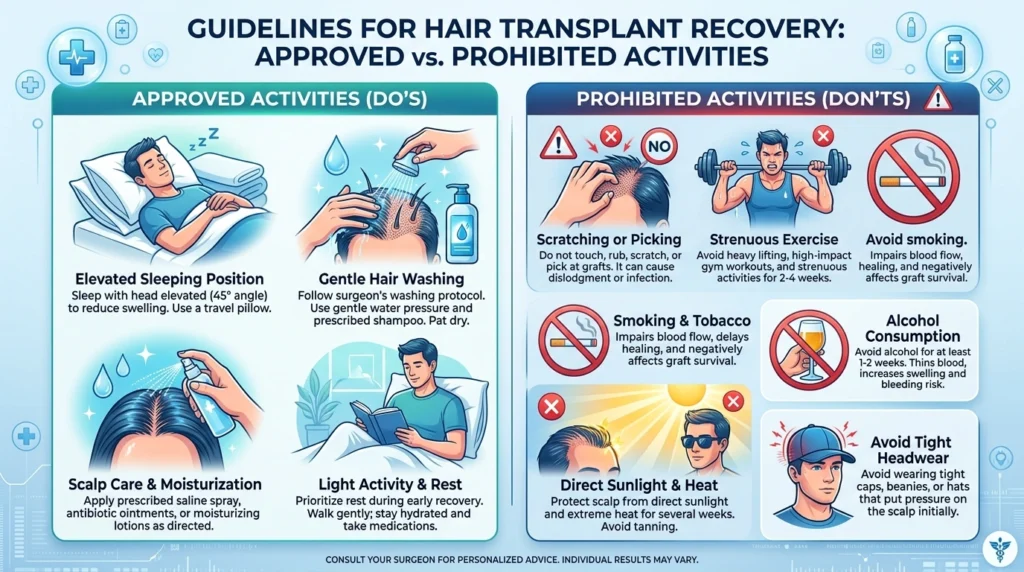
Not all patients reach recovery stages on the same timeline. This is how long it takes to get on with your journey to a better YOU.
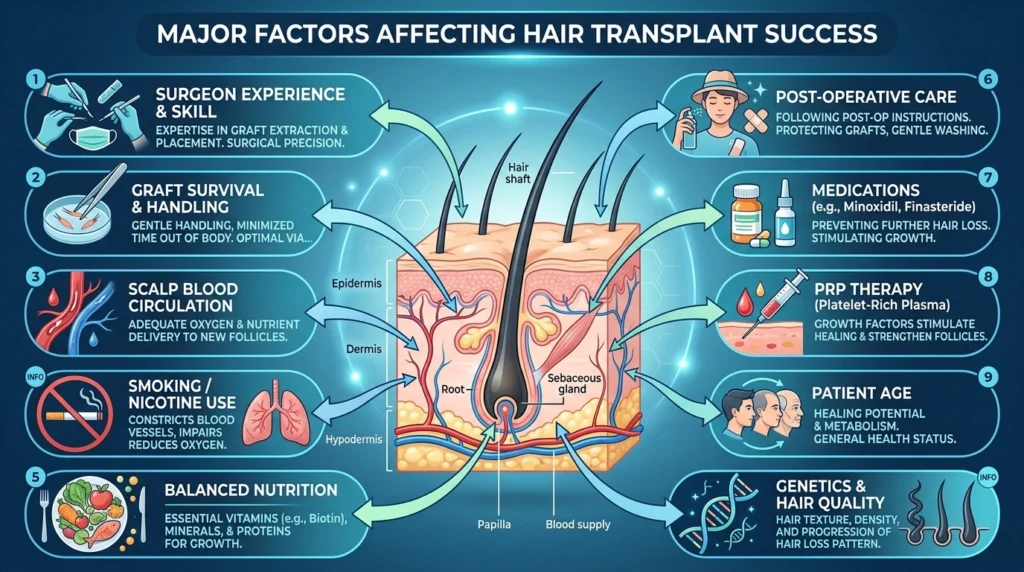
Surgeon skill and graft handling:
Survival Rate of Follicles A number of factors influence graft success such as the method by which follicles are removed, stored, and transplanted. Those that get dehydrated or spend too much time out in the air as well as the position in which they are transplanted may compromise success. A highly trained team aims to reduce any out-of-body exposure time and maintain grafts within the best holding solution during their entire visit.
Graft survival rate:
This is how many transplanted follicular units successfully implant, taking hold to initiate hair growth. At the best, most professional clinics with skilled surgeons, the survival rate should be 90-98 percent. A lower rate – because of poor surgical skills, lack of patient post-op diligence, or simply patient error in the first week – directly decreases the density on the top of the head.
Individual healing ability:
Your age, genetics, amount of looseness in the scalp and overall health determine the rate of bodily healing, and how well blood vessels will form a healthy network to nourish your grafts and encourage hair to emerge. Those who are young and healthy may find that the earliest indications of graft success, but this can vary greatly.
Post-operative care:
Don’t break your surgeon’s rules, as tempting as that may be. Easy washing, sleeping position, sunscreen, avoiding lifting and excessive bending (at minimum in the first couple weeks) are arguably factors in your eventual success you’ll have the most control over. Those patients who cheat the system in these areas absolutely show poorer results.
Lifestyle habits:
Smoking reduces circulation in your scalp-one of the absolute worst things you can do immediately after healing. Alcohol is also very disruptive immediately after surgery. Not enough sleep or way too much stress will encourage you to stay dormant even longer. Foods high in protein, iron, biotin, and zinc contribute to your scalp health.
Support Therapies That Improve Your Hair Transplant Results Timeline
As it stands, there are two forms of treatment that are supported by clinical data for the purpose of increasing recovery, and subsequent final density, of hair growth. It’s important that you understand that neither is a “magic bullet” however both are well worth your attention.
PRP (Platelet-Rich Plasma) Sessions:
PRP utilizes a few milliliters of your own blood, centrifuged for growth factor separation and injected back into your scalp. These growth factors, or “active” components such as PDGF, VEGF and EGF, encourage healing and improve follicle response according to hundreds of peer-reviewed clinical trials. Most US hair transplant clinics (e.g. Long Island clinics) provide PRP therapy in addition to hair transplant procedures. PRP therapy is often offered in 3 separate sessions: immediately post-operative and then a second and third sessions at three and six months respectively.
Finasteride and Minoxidil:
These don’t actually affect recovery from the grafts themselves, but do hugely impact long-term results: Finasteride (for males) works by inhibiting DHT, the hormone that drives androgenetic alopecia, so it stops the thinning of your natural non-transplanted hair. Minoxidil prolongs the anagen (growing) phase of hair follicles, and there’s some evidence suggesting it helps the transplanted hair to grow and may also improve graft density when combined with Finasteride. This is commonly prescribed before and after hair transplant.
Hair Transplant Recovery: Common Mistakes That Damage Results
It is behavior that actually holds patients back – nothing theoretical, but actual reason for their poor outcomes.
Touching or rubbing grafts in the first ten days
You could still dislodge an unsecured graft just by putting pressure to it: for instance, when trying to sleep, you put your hand on your head. You also put yout hand underneath a stream of shower water for example, when you try to scrape the scabs of.
Ignoring sun exposure warnings
Sunlight in the earliest stages of recovery and skin growth can increase and create inflammation on top of the newly grafted skin and leave an even distribution in the receiver skin. Typically doctors recommend a three to six month period of no exposure to sunlight for the treatment area.
Returning to heavy exercise too soon
Extreme cardio, hardcore weights, and really anything with high-impact motion that gets you sweating all put major physical and physiological strain on tissues that are trying to repair. Two weeks, at a minimum, say most surgeons, before they’ll tell you it’s safe to resume intense workouts – and then only in moderation.
Panicking during shedding and self-treating
There are many patients who do experience shock loss and panic, and resort to using off-label remedies, harsh shampoos, or excessive rubbing or massaging of the scalp. Any of these actions may lead to damaging or destroying freshly planted grafts that have yet to secure.
Expecting results at month three
If you enter the process believing you will have a full head of hair in month three, you may feel disappointed, and make some bad choices. It’s still too early for Month 3. It not only is a great virtue, but also a medical necessity to practice patients.
Hair Transplant Across the USA: Top States, Cities, and What Patients Pay
A hair transplant timeline is biologically similar where in the US it’s done. It’s not similar when it comes to cost-per-graft, # board-certified physicians, and accessibility of newer surgical methods such as Robotic FUE and DHI. State-by-state what is happening to American transplants.
Estimated Top 14 US States for Hair Transplant Procedures
| State | Key Cities | Avg. Cost Per Graft | Technique Availability | Notes |
|---|---|---|---|---|
| New York | NYC, Long Island, Buffalo | $7–$12 | FUE, FUT, DHI, Robotic | Highest concentration of ISHRS-certified surgeons in the US |
| California | Los Angeles, Beverly Hills, San Francisco | $6–$11 | FUE, FUT, DHI, Robotic | Strong celebrity-driven demand; many high-volume clinics |
| Texas | Houston, Dallas, Austin | $5–$9 | FUE, FUT, DHI | Rapidly growing market; competitive pricing vs. coastal states |
| Florida | Miami, Orlando, Tampa | $5–$10 | FUE, FUT, DHI | Large medical tourism crossover; international patient base |
| Illinois | Chicago, Naperville | $5–$9 | FUE, FUT | Midwest hub; several university-affiliated hair restoration centers |
| Georgia | Atlanta, Savannah | $4–$8 | FUE, FUT | Growing cosmetic surgery market; lower cost-of-living pricing |
| Arizona | Phoenix, Scottsdale | $4–$8 | FUE, FUT, DHI | Popular for medical tourism from neighboring states |
| Nevada | Las Vegas, Henderson | $4–$9 | FUE, FUT | High-traffic cosmetic surgery corridor; many med-spa hybrid clinics |
| New Jersey | Newark, Jersey City, Princeton | $6–$10 | FUE, FUT, DHI | Directly serves NYC overflow; strong board-certified presence |
| Pennsylvania | Philadelphia, Pittsburgh | $5–$9 | FUE, FUT | Academic medical centers offer hair restoration programs |
| Massachusetts | Boston, Cambridge | $6–$11 | FUE, FUT, Robotic | Strong academic hospital affiliation; higher average surgeon credentials |
| Washington | Seattle, Bellevue | $5–$9 | FUE, FUT, DHI | Tech-industry demographic drives demand; clean, modern clinics |
| Colorado | Denver, Boulder | $5–$8 | FUE, FUT | Growing market; younger demographic driving hairline restoration demand |
| North Carolina | Charlotte, Raleigh | $4–$8 | FUE, FUT | Affordable relative to northeast; board-certified options increasing |
USA Estimated HairGrowNeeds Team Research Hair Transplant Cost Overview by Session Size
The cost typically increases with the number of grafts and depends on the surgeon and the location. If you want an idea about the range that you’ll be charged throughout the U.S.
| Session Size | Estimated Grafts | Budget Market (South/Midwest) | Mid-Range (Most States) | Premium Market (NY/CA/MA) |
|---|---|---|---|---|
| Hairline only | 500–1,000 | $3,000–$5,000 | $4,500–$7,000 | $6,000–$10,000 |
| Moderate thinning | 1,500–2,500 | $6,000–$10,000 | $9,000–$14,000 | $12,000–$20,000 |
| Advanced hair loss | 3,000–4,000 | $10,000–$16,000 | $14,000–$22,000 | $18,000–$32,000 |
| Mega session | 4,000+ | $15,000–$22,000 | $20,000–$30,000 | $28,000–$45,000+ |
There is one universal rule applicable to all markets; a price that is considerably below market is usually associated with an offset elsewhere; it could be less experienced surgeons assisting you; improper handling techniques of grafts; neglected follow-up procedures, or surgeon-only attention for patients. Hair transplant timeline will remain the same irrespective of the cost incurred, while graft survival can vary dramatically.
New York and Long Island: Why This Market Stands Out
In the bigger context of New York and the US as a whole, Long Island is a hair restoration market that is among the most credentialed and competitive in the entire nation. Long Island patients can work with some of the very few doctors who actually wrote the textbooks on the science behind FUE and FUT hair transplants.
The Long Island communities of Great Neck and Garden City contain well-known practices, and the city of Manhattan (30–60 min by LIRR from almost any place in Nassau County) also has some international-renowned surgeons, the original developers of what has become standard procedure for follicular unit extraction surgery at many other clinics.
Long Island patients deciding between here and Manhattan – for you the biological answer (your post-operative hair transplant process timeline) remains exactly the same. What you will get for a visit vs. The next will differ only on convenience, appointment access, and post-operative appointment requirements. Both work extremely well when the surgeon is board-certified and well-experienced.
The Core Facts
How long does hair transplant recovery take?
About a week or two after the procedure, much of the immediate side-effects of transplant, such as redness, scabs, and swelling will heal almost completely. 3-4 weeks after transplantation, the actual transplanted hair will begin to fall off (the normal shock loss). Around the 3-4 month, new growth is observed. The ultimate results usually start being apparent after 9-12 months in the recipient region, with growth in the crown sometimes continuing up to 18 months.
Is it normal to lose transplanted hair 3 weeks after surgery?
Yes! And this is a process known as “shock loss,” also known as telogen effluvium. Believe it or not, it’s part of hair transplantation that is expected and is temporary, as the follicle below the surface of the skin is still intact. The transplanted hairs are only temporarily shed, and regrowth begins to happen months later.
When can I exercise after a hair transplant?
Light walking usually safe in 5-7 days. Light cardio (bike, jog lightly) is generally OK in 2 weeks. Don’t do heavy weight lifting, interval training, any contact sports or anything that gets you sweating alot for at least 3-4 weeks. Always listen to your surgeon.
When can I wear a hat after a hair transplant?
Soft, baggy hats (like a loose baseball cap) may be allowed by most plans after the first week. Do not wear tight hats which rub against the recipients’ skin for a month or so.
When can I wash my hair normally after a hair transplant?
Shampooing Many surgeons allow the use of a mild wash procedure, prescribed for you, from two or three days onwards. Your routine washing with shampoo (being careful to avoid certain products) is generally possible from about two or four weeks after your procedure, depending on how your scalp has healed. You can direct pressure from your shower directly on to the recipient area from two to three weeks onwards.
Does the country where I get a hair transplant affect results?
No . The biological process doesn’t change if done here, in turkey, or anywhere. Its about the skills of the surgeon, the quality of the infrastructure, the quality of how the grafts are treated and how disciplined aftercare is followed . A good quality hair transplant in turkey with good aftercare will always be better than a bad quality one elsewhere .
Conclusion
No hair restoration patient wants to wait another 12 months to view the final outcome of their hair transplant. This logic isn’t unusual, however. The biology of hair follicle recuperation is non-negotiable in terms of timeliness. The Hair Transplant Results Timeline Is Generally Inescapable The general process of a hair transplant will consist of healing of up to 2 weeks of time, shedding up to 3-4 weeks, dormancy up to 4 months, noticeable development at 4-6 months, and completion of fullness within nine to twelve months.
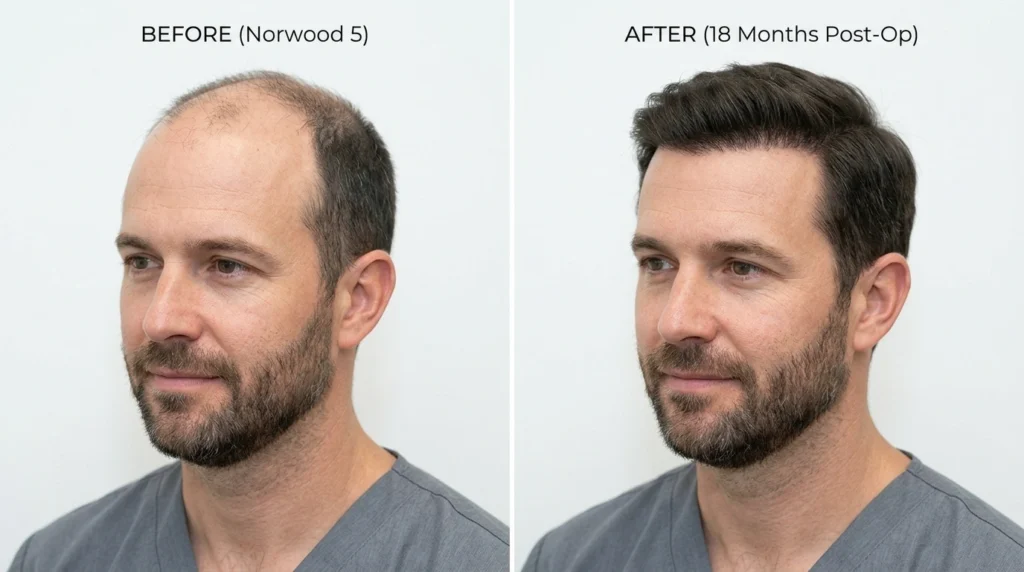
Patient satisfaction differences are typically not dictated by the surgeon as opposed to by expectations going in and post-care. Seek a board certified, seasoned surgeon this is especially true in the Long Island and NYC arena, where marketing budgets may rival talent sets. Stick with your surgeon’s aftercare directives to a letter it actually works. Allow the process the time required. When your hair undergoes the awkward duckling month phase where your scalp is unsightly and actually less cosmetically appealing than when you started, refer back to this. The follicular units exist; they’re preparing.
FAQs:
Q: When will I see full hair transplant results?
The best result – complete growth of most recipient areas – is generally observed 12 months later, the growth of the crown area may take up to 18 months to take its mature form.
Q: Is hair shedding after a hair transplant normal?
Yes absolutely fine. Loss of hairs at week 3-4 (shock loss) is anticipated and this does not mean the grafts have failed. The hair follicle remains viable and new hair growth will follow.
Q: When will my transplanted hair look natural?
At 9 to 12 months most patients report that the transplanted hair is the same as their existing native hair in regard to texture, color, growth patterns.
Q: Do results differ between FUE, FUT, and DHI?
The actual growth period (hair on the scalp growth stage) does not vary in the three procedures, as biological growth processes remain consistent in all circumstances. What does alter the three is the healing procedure to the donor site and also the scarring formed, not how as well as when the hair will grow back.
Q: Are hair transplant results permanent?
Yes. Hair follicles transplanted from the permanent donor zone (back and sides of the scalp) will naturally remain resistant to DHT miniaturization. They will live and continue to grow throughout your lifetime at the new location. That said, some of the non-transplanted hair can continue to thin over time as your androgenetic alopecia progresses without medicinal management.
Q: How do I find the best hair transplant surgeon in Long Island?
Verify the surgeon is boarded through either the International Society of Hair Restoration Surgery (ISHRS) or the American Board of Hair Restoration Surgery (ABHRS). View before-and-after albums, inquire about specific graft-survival rates and consult at least 2 to three medical doctors. Both Manhattan and also Great Neck-area hair transplant doctors will do well to the Lengthy Island populace.
Editorial & Medical Review
Written by: Wajiha Aqeel
Co-Founder & Hair Restoration Research Lead
Medically Reviewed by: Dr. Anam Sahibzada
Specialist Dermatologist & Trichologist
Data & publication oversight: Daniel Brooks
Co-Founder & Senior Operations & Data Director
Content reviewed by:
Mehwish Fareed Clinical Aesthetician & Content Reviewer
Asma Shamshad Medical Student & Content Contributor
Published Date: April 27, 2026
Clinic & Pricing Data Last Reviewed: July 2026
Last Updated: September 9, 2026
Originally published: April 27, 2026
Research & content last reviewed: September 2026
Last medically reviewed: September 2026
Last updated: September 15, 2026
Editorial Policy
Editorial Standards This article was researched and written to ensure compliance with the editorial standards.
Accuracy: Any medical claims discussed within this article have been cross-referenced against peer-reviewed sources, the International Society of Hair Restoration Surgery (ISHRS) recommendations, and published studies that come directly from board-certified hair restoration surgeons.
Independence: This article has not been sponsored or subsidized by any hair transplantation clinic, surgical center or device producer. Clinic names are provided for location and descriptive value only, and are not endorsements of such practices or manufacturers.
Currency: Article Last reviewed and updated in 2026. Treatments and follow-up care continue to advance, so patients should see a board-certified physician to follow the latest clinical guidelines.
Medical & Affiliate Disclaimer:
The content on Hair Grow Needs is for general informational and educational purposes only and should not be considered professional medical advice. For full details regarding our policies, please read our official Disclaimer.
⚠️ Important: Please Read Before Acting on Any Information in This Article.
All material in this document is for general information and educational purposes only and is not professional medical advice, diagnosis, or treatment. Hair transplantation is surgery and as such has a risk of such things as infection, scarring, graft loss, shock loss, anesthetic risk, and poor aesthetic results. Results are unique for each person and may be influenced by your medical condition, the surgeon’s experience, surgical method and follow-up routine. This material should in no way substitute a consult with a qualified health care provider. We describe typical results, recovery periods, and general steps of hair transplantation, all of which should in no way be taken as specifics to your own medical history or current conditions.
References and Sources
The information included herein for the purposes of a client education has been sourced from the professional bodies and information listed here in:
Medical Organizations & Guidelines
- International Society of Hair Restoration Surgery (ISHRS) – ishrs.org – Clinical practice guidelines for FUE, FUT and postoperative care guidelines.
- American Board of Hair Restoration Surgery (ABHRS) – abhrs.org – Surgeon certification requirements, surgeon qualification requirements.
- American Academy of Dermatology (AAD) – aad.org – Treatment guidelines for androgenetic alopecia, telogen effluvium, non-surgical hair loss treatment.
The clinical claims made in this article are based on the published findings in the Journal of Dermatologic Surgery, Journal of Cutaneous and Aesthetic Surgery, and Aesthetic Surgery Journal.
Reviewed Literature
- Bernstein RM, Rassman WR. Follicular transplantation: Patient evaluation and surgical planning. Dermatologic Surgery. 1997 Sep;23(9):771–8. A seminal text to familiarize with the FUT methodology, setting the precedent for the basics and results.
- 33(1)128–143 “Hair restoration surgery: The state of the art” (Vogel JE, F. Jiménez et al. ) This review highlights the advantages and disadvantages of FUE vs FUT vs DHI in hair transplant results.
- Avram MR, Rogers NE. “Contemporary hair transplantation.” Dermatologic Surgery. 2009;35(11):1705-1719. Deals with a lot of topics including timing until wounds heal and time to anchorage of implanted graft.
- Dhurat R, Sukesh MS. “Principles and methods of preparation of platelet-rich plasma: A review and author’s perspective.” Journal of Cutaneous and Aesthetic Surgery. 2014;7(4):189-197. – Explains how Platelet Rich Plasma works and the role of PRP in Hair Restoration.
- Gupta AK, Talukder M, Venkataraman M. “Minoxidil: A comprehensive review.” Journal of Dermatological Treatment. 2022;33(4):1896-1906. – an update on how Minoxidil works, what it can be used for and what it can achieve post-transplantation.
- Shapiro R. “Principles and techniques used to create a natural hairline in surgical hair restoration.” Facial Plastic Surgery Clinics of North America. 2004;12(2):201-217. A comprehensive guide on replicating natural hair density and designing natural hairlines.
Clinical Data Sources
ISHRS Practice Census Survey (latest available year) – US and worldwide procedures, methods and patient statistics.
American Society of Plastic Surgeons (ASPS) Annual Statistics Report US data on costs and procedure frequency.