
Medical Disclaimer: This article is for informational purposes only and does not replace professional medical advice. Read our full Medical Disclaimer.
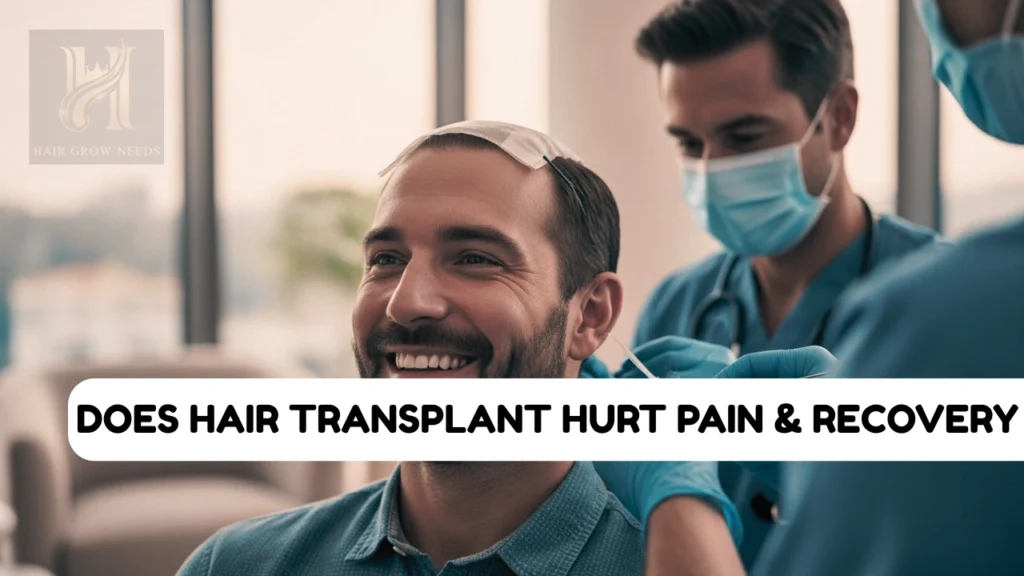
No, your hair transplant shouldn’t be painful during the operation because you’ll receive a local anesthetic so that your scalp is numb. The majority of people just experience some mild pain when they get their numbing injections for two to five minutes and don’t feel much apart from mild vibration and pressure as surgery takes place. Some mild pain and scalp tightness can remain for the first three to five days after surgery and it is usually treated by patients with some basic over the counter medication.
Pain Score: Most patients rate hair transplant pain at 2 – 3 out of 10 during surgery and 3 – 4 out of 10 during the first few recovery days.
Let’s get real: of all of the reasons you probably could put off booking your hair transplant consultation, we suspect the #1 is the fear of pain, often putting it off for a couple of months or maybe even years.
Through the years, we’ve talked with hundreds of patients in our pursuit to learn the ins and outs of hair restoration. What did we find? Without a doubt, nearly every single patient who has gone through the process said this after their treatment was finished: “This wasn’t what I expected. It was surprisingly easy.”
We are not trying to sell you. This is actual, on the record patient outcome results for both FUE and FUT procedures performed at clinics in the US, UK, and Turkey. In addition, it is supported by the explanations of hair transplant surgeons about why transplants are not as bad as you fear.
In this guide you get the honest and straight on FUE and FUT what hurts, does not hurt, and the differences; patient’s experiences from patients in USA and Turkey; a week-by-week look at the actual recovery period.
Does Hair Transplant Hurt?
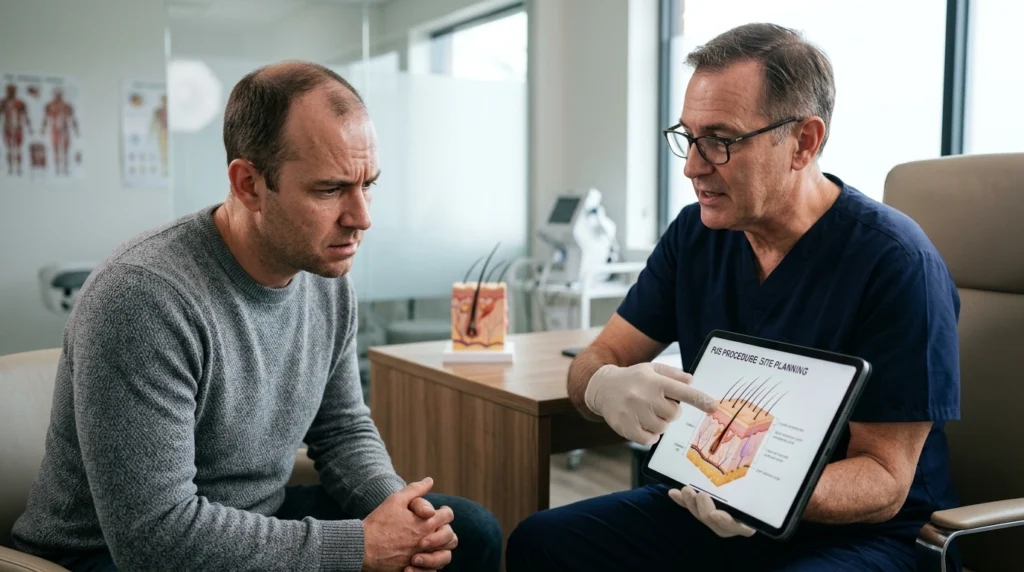
The hair transplant procedure does not hurt because your scalp is numbed with local anesthesia for the entire treatment. The worst (and only truly painful) part of hair transplant is the actual injection of the local anesthetic into your scalp. This discomfort lasts for approximately 2 – 5 minutes and patients feel a short, sharp sting similar to that of receiving a dental injection.
Pain Level at Every Stage

| Stage | Pain Level (1–10) | What You Actually Feel | Duration |
|---|---|---|---|
| Pre-procedure (anxiety) | 1 – 2 | Nervousness, anticipation | Before procedure |
| Numbing injections | 4 – 6 | Brief sting, mild burning | 2 – 5 minutes only |
| During extraction (FUE) | 1 – 2 | Mild pressure, vibration | 6 – 10 hours |
| During implantation | 1 – 2 | Slight pressure, no pain | Part of same session |
| Evening after surgery | 3 – 5 | Soreness, tightness | Hours 4 – 12 |
| Day 2 – 3 (peak discomfort) | 3 – 4 | Scalp soreness, swelling | 48 – 72 hours |
| Day 4 – 7 | 2–3 | Mild tightness, itching starts | Days 4 – 7 |
| Week 2 | 1 – 2 | Mostly itching, minimal pain | Days 8 – 14 |
| After 2 weeks | 0 – 1 | No meaningful pain | Ongoing |
The most important lesson of all: That horrific, constant surgical pain patients are afraid of (or that comes in a thousand shades of suffering from a cut at Home Depot) never even materialises. A shot of lidocaine makes that particular pain disappear completely. All they really feel is a split second of stinging when the Lidocaine goes in, several hours of pressure and vibration type sensations (not pain, just an awareness of stuff moving under the skin) and then 3-5 days of residual tenderness. The discomfort, my new friend said, feels like he’s got a wicked sunburn all around the incision line or is suffering from a truly stiff neck.
The Part That Actually Hurts

But I will tell you what no one really says – those injection stings are the most annoying part of this whole journey. which may last around 2 – 5 minutes.
The surgeon will be using a local anesthetic around your entire scalp; This includes both your donor zone (the back and sides of your head) and the recipient zone (the location the grafts will be transplanted into). The shots to the scalp may resemble small prick and have slight burning when the anesthetic travels into the skin. As most of the Reddit r/HairTransplants users say: it feels very much like dental work just take a deep breath.
Another approach some clinics will take for numbing the area is a ring nerve block – injecting around the outside edge of your scalp rather than across the entire region – as it means a lesser number of injection points, and therefore a lesser number of pains!
Some clinics rely on tumescent anesthesia, a larger volume injection of an extremely dilute concentration of a local anesthetic in saline, preferred by some surgeons for better uniform anesthetization over an entire long-day procedure.
What the Reddit community says (aggregated from r/HairTransplants):
However for just about everyone, a lot of customers declare their numbing photos are most unfortunate. Yet, “unfortunate” is a relative concept as repeated sentiment from clients holds true: “if you might handle a dental shots, you may tackle this one.” The heat through your numbing going on the scalp would be the main thing people mention experiencing and it dissipates in a couple of mins.
Does Hair Transplant Hurt During the Surgery Itself?

No. After your scalp is anesthetized, would a hair transplant hurt during the extraction and implantation? Consistently, the answer is no.
You can expect: Microscopic tools take individual hair follicles out from the donor region during FUE procedures.
- Pressure: The gentle feeling like someone is touching your scalp
- Vibration: from the extraction device.
- Tugging: mild sensation as follicles are separated
- Nothing at all: many patients report falling asleep
What you will not feel:
- Sharp pain
- Cutting sensation
- Scorching and/or stinging (unless the anesthesia is fading, in which case the surgeon gives a boost — which they do automatically)
Most surgeons use extra anesthetic during procedure if necessary to maintain full numbness. An FUE session is 6-10 hours (or more) to perform an entire FUE Procedure – the length of the surgery is determined by the number of graphs that will be extracted. Many of our patients relax by viewing movies, listening to podcasts and naps.
Implantation phase – this is even more discreet, grafts into recipient sites the phase itself goes virtually unfelt by the patients.
FUE vs FUT

I get asked this question the most when I’m consulting with patients and the truthful answer is…yes FUT tends to cause a little more post op pain, but again neither will send you to agony.
| Factor | FUE | FUT (Strip Method) |
|---|---|---|
| Procedure pain level | 1 – 2/10 | 1 – 2/10 (same – both under anesthesia) |
| Post-op soreness | 2 – 3/10 | 3 – 5/10 |
| Donor area discomfort | Mild dot-site tenderness | Linear wound – stitches |
| Tightness | Minimal | Noticeable – scalp pulled during healing |
| Itch during healing | Mild | Moderate to significant at stitch sites |
| Return to comfort | Days 3 – 5 | Days 5 – 10 |
| Stitches/staples removal | No | Yes – at Day 10 – 14, mild discomfort |
| Long-term sensitivity | Rare | Possible numbness at scar site |
Why FUT is more uncomfortable:
To do the strip surgery you need to remove a strip of tissue from your scalp, close the linear opening and then stitch it up. As the wound closes the tension on the rest of the surrounding scalp can cause some pull and tightness that FUE surgery is able to avoid. Itchy sutures can be felt pulling tight as your heal and the sutures are painful as well as removed around day 10-14.
The practical difference: FUE soreness would usually be called “minor scalp tenderness,” and FUT soreness as “significant stiffness and aches around the strip.” Management approaches would use the same off the shelf Painkillers.
Does Hair Transplant Hurt in Turkey vs USA?
Hair transplant Turkey does it hurt differently than in the US? Many patients who choose an international procedure ask us about the pain levels involved with Hair transplantation Turkey, so here is an honest answer…
The Pain on a Turkish Hair Transplant: The Real Story In a proper transplant procedure in Turkey, the hair transplant pain really isn’t all that different when compared to America or England – the anesthesia used for FUE extraction in both countries is actually a similar process.
Yet according to some, there are variations when it comes to the recovery process:
| Factor | USA/UK Clinics | Turkish Clinics (Top Tier) | Turkish Clinics (Budget) |
|---|---|---|---|
| Anesthesia quality | Consistent, FDA-approved | Consistent at top clinics | Variable |
| Procedure pain during | 2 – 3/10 | 2 – 3/10 | 2 – 4/10 |
| Post-op medication quality | Standardized | Standardized at top | Variable |
| Follow-up pain management | In-person access | Online only post-discharge | Online only |
| Shock loss discomfort | Managed locally | Managed via video | Sometimes unmanaged |
| Reddit community reports | Consistent | Positive for top clinics | More variable reports |
A good FUE that will take place at an ISHRS-affiliated clinic in Turkey will feel almost exactly like having it done in NY or LA in the moment you’re having the FUE done. But, this difference becomes obvious once the procedure is done – if and when problems or concerns are addressed, or if discomfort is abnormally significant, when something just “isn’t feeling right,” and then, your local access to the surgeon suddenly becomes vital.
What Happens to Pain After Hair Transplant Day by Day
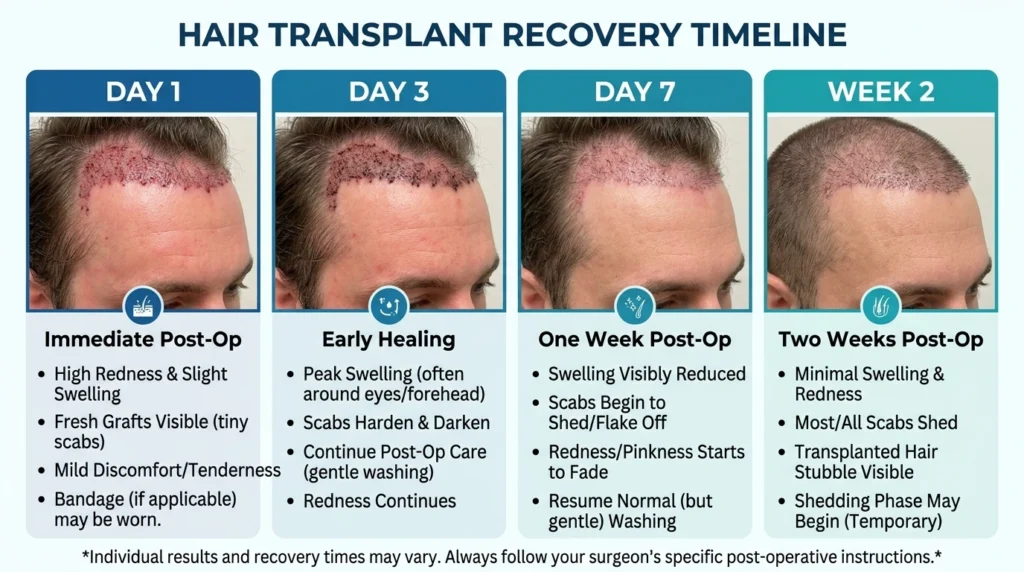
So what did that week by week week-to-week actual week experience really look like according to the uniform reports from my patients throughout USclinics
Day 1 (Surgery Day Evening)
Your anaesthetic wears off about three to six hours after your last injection has been topped up. The first night after a FUE hair transplant is for the majority of patients, the point when you will feel the most pain. Your scalp will be painful and tight. The donor area (where your hair follicles were extracted from) usually tends to be more painful than the recipient area. This is also the time that you will take your first pain relieving tablets (as per prescription) and it is recommended that you should sleep with your head elevated.
Day 2 – 3 (Peak Discomfort Window)
Most patients experience the greatest discomfort during this stage of hair transplantation surgery – but this is mostly due to swelling, not pain. The forehead and area around the eyes become noticeably swollen which can be unsettling to look at. The scalp feels quite tight. Tiny scabs begin to develop in every one of the graft recipient areas causing the patient to feel the urge to itch, which they are advised not to scratch. The pain level most patients report at this point: 3-4/10.
Day 4 – 7 (Transition Phase)
Swelling starts subsiding. Pain comes down noticeably. Skin becomes quite itchy as scabs dry out and the transplanted follicular units mature. This is referred to by patients as the “worst phase to go through”-not due to pain but the visual insecurity of looking a little patchy with concerns that any graft movement may result in loss of implanted hair.
Week 2 (Near Normal)
Almost all patients are virtually pain-free day 10-12, the remainder being some itching as scab is falling off naturally. Normal activities resumed – For desk-based jobs FUE patients often return by day 5-7 while for FUT patients it is day 10-12
Weeks 3 – 8 (Shock Loss Phase – Not Painful, But Distressing)
Not the most “painful” step of the process, but certainly the lowest emotional one for many transplant patients. Shedding of new transplant hairs is common post-procedure (shock loss/telogen effluvium) and is the result of a shedding cycle. There is NO pain associated with this. The follicle and its root live under the skin where all of the real hair growth is happening. New hair will begin to show up starting month 3-4. Not painful, just psychologically challenging for those not prepared for this phase.
Donor Area vs Recipient Area Which Hurts More After Surgery?

| Area | Pain Pattern | Why |
|---|---|---|
| Donor area (back/sides of scalp) | More soreness | Multiple extraction points, tissue disruption |
| Recipient area (top/hairline) | Less soreness | Tiny channel sites, less tissue involvement |
| FUE donor area | Diffuse tenderness | Hundreds of micro-punch sites |
| FUT donor strip | Linear aching, tightness | Wound under tension |
Typically the pain is not at the site of the transplant, but rather at the donor area of hair extraction (head or body). Surprisingly to most individuals the head, or the problem area, usually does not pain as much as the donor area.
Pain Medications What Clinics Prescribe
In a US based hair transplant clinic, they send you home with:
| Medication | Purpose | Typical Duration |
|---|---|---|
| Acetaminophen (Tylenol) | Primary pain management | 5 – 7 days as needed |
| Ibuprofen or naproxen | Anti-inflammatory, swelling | 3 – 5 days (some surgeons avoid for graft blood flow reasons) |
| Antibiotic (amoxicillin or similar) | Infection prevention | 5 – 7 days, full course |
| Anti-swelling medication | Methylprednisolone or similar | 3 – 5 days |
| Sleep aid | First night comfort | 1 – 3 nights |
| Minoxidil | Graft support | Ongoing post-healing |
Some surgeons will ask you not to take blood thinners such as ibuprofen for the first 48 hours due to it acting slightly as a blood thinner which could impact graft adherence. When it comes to prescribed drugs, you must follow your surgeons regimen, not a general guideline.
How to Sleep After Hair Transplant
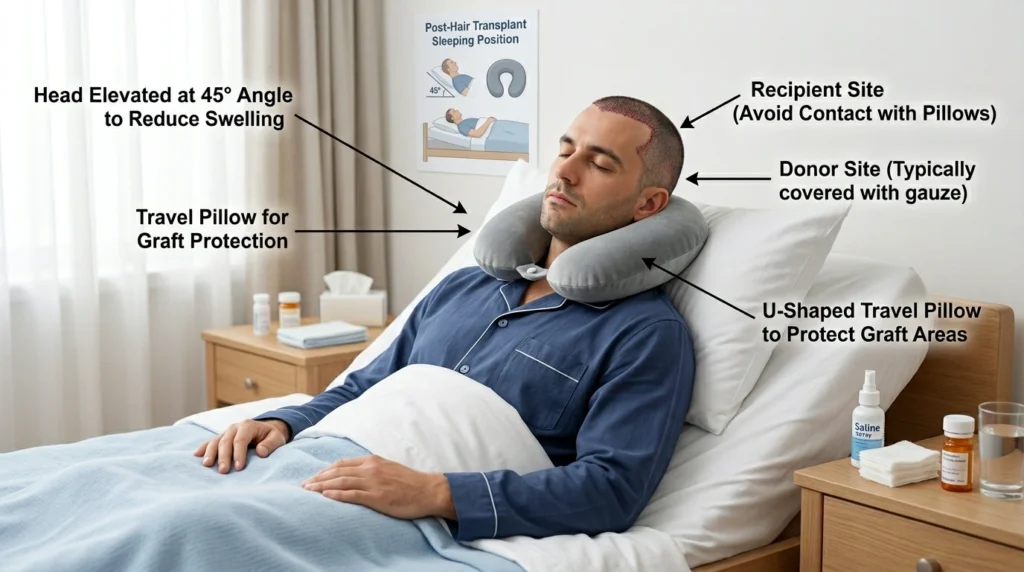
The logistics are by far the hardest aspect of early recovery – sleeping is no fun, though that’s down to position, not pain.
What Works:
- Sleep at a 30-45 degree incline – travel pillow in front of neck, normal pillow behind, reclined-sitting position.
- 1-3 nights with a recliner chair is better if one can be borrowed.
- Do not move the head to help protect sites.
What To Avoid:
- Laying flat (enhances edema).
- Sleeping face down (donor press).
- Sleeping on sides for the 5 days (lateral press at either site).
In most of you’ll be quite comfortable on the first night. It feels strange, but there’s no actual pain with the elevation. After the 3rd or 4th night, many will start to transition to sleeping.
Managing Itching The Underrated Post-Op Challenge
Something that we always hear from patients is that itching can be even more difficult to treat than pain. So, to cut to the chase here’s our honest guide.
| Day | Itching Level | Cause | Management |
|---|---|---|---|
| Days 1 – 3 | Minimal | Too early for scabs | None needed |
| Days 4 – 7 | Increasing | Scabs forming at graft sites | Saline spray, no touching |
| Days 8 – 14 | Peak itching | Scabs drying, follicles settling | Gentle medicated wash |
| Days 15 – 21 | Reducing | Scabs shedding naturally | Normal washing protocol |
What not to do: Scratch. This could pop off the graft before it attaches. I know – hard to do- so it means not to touch!!!! Gentle spritzes of sterile saline helps some!
PRP Add-On Does It Add Pain?
PRP therapy is a treatment used in addition to FUE procedures to help in increase the chance of survival. A common question patients ask is does PRP injections sting or do they hurt?
The PRP procedure introduces your body’s own growth factors, diluted at a high concentration to your scalp but as your scalp has already been numbed to transplant, many of our patients report having no feeling when the PRP therapy was carried out at the same time as hair restoration.
If the PRP is done as a follow-up by itself at 1 month, or three months, patients say the feeling at the scalp feels rather unremarkable, generally a 2 or 3 out of ten without need for anesthesia.
Norwood Stage Does Hair Loss Severity Affect Pain?
| Norwood Stage | Session Length | Pain Correlation |
|---|---|---|
| Stage II – III | 4 – 6 hours | Lower total discomfort – shorter session |
| Stage IV – V | 6 – 9 hours | Moderate – longer anesthetic maintenance |
| Stage VI – VII | 8 – 12+ hours | Higher fatigue, more post-op soreness |
Bigger sessions aren’t inherently more painful-they are just longer, increasing your exposure time to anesthetic top-ups, disruption to the scalp as whole, and therefore extending your healing timeline. Norwood V – VII patients undergoing mega-sessions FUT (4,000 – 6,000+) claim to suffer 5 – 7 days of significant discomfort vs. 3-5.
What Patients on Reddit Say Real Experience Summary (Our Team Research)
One of the greatest unadulterated aggregated experiences of real patient outcomes anywhere can be found at r/HairTransplants. A review of all threads leads us to the following:
Top surgical dread: ‘I’m worried that this is going to be completely unmanageable’ Top surgical report: ‘To be honest, I cannot believe that this was so much more manageable than I expected’
Specific Recurring Themes:
- Worst thing about it the numbing shots there is a consensus on it but everyone says they only last a minute.
- The rest of 6-8 hours in clinic it’s pretty boring rather than pain so most people pass the time watching TV, listening to music/podcasts, and napping.
- Itching is the real challenge and not so much pain or soreness from days 5-10.
- Post 3-6 weeks shock loss is the lowest part of the process (emotional more than physical).
- FUT post-op feels tight but the general consensus of FUT vs FUE patients is that FUT feels tighter.
- It seems that a vast majority of people say that if you could put me in a time machine they’d go ahead and get it done again without batting an eye.
Common Myths About Hair Transplant Pain Addressed
| Myth | Reality |
|---|---|
| It’s a major surgery so it must hurt a lot | Hair transplant is performed under local anesthesia – no general anesthesia, no post-surgical hospitalization |
| FUT leaves you in agony | FUT is more uncomfortable than FUE but is not described as agonizing by most patients |
| Turkey procedures hurt more because they cut corners | Top Turkish ISHRS clinics use identical anesthesia protocols to US clinics |
| The recovery takes months of pain | Most pain is resolved within 7 – 14 days the 12 – 18 month timeline refers to hair growth, not pain |
| You feel every graft being placed | No – placement of grafts into numbed recipient sites produces minimal to no sensation |
| I’ll need to take weeks off work for pain | Most FUE patients return to desk work within 5 – 7 days |
Is Hair Transplant Worth It Despite the Discomfort?
After years in this game, our team’s brutally honest opinion: Yes For the right patient.
A few days of mild scalp sensation in exchange for decades of natural-looking hair is a trade most patients say was worth it.
More importantly: do you want an experienced, board-certified professional to perform this surgery; what are your chances for success; do you have realistic results you hope to achieve. These things factor into your happiness way more than a few minutes of pain from injections for numbness.
Tips for Making the Procedure More Comfortable
Before the procedure:
- Get a full night of sleep.
- Eat a proper meal، you will be in the chair for hours.
- Ask your surgeon about a mild sedative if anxiety is high.
- Wear comfortable, loose-fitting clothing with a button-front (not a pullover).
- Ask specifically about their anesthesia protocol، ring block vs full scalp injection.
During the procedure:
- Bring headphones and entertainment، you will have hours to fill.
- Communicate with your surgeon if you feel anything beyond pressure.
- Do not hesitate to ask for additional anesthetic، it is completely normal.
- Take toilet breaks as needed،surgeons accommodate this.
After the procedure:
- Take prescribed medications before the anesthetic fully wears off (do not wait until you feel pain).
- Set up your sleeping position before bed, not in the middle of the night.
- Prepare saline spray for itching management.
- Have easy-to-prepare food ready you will not want to cook the first evening.
Recovery Timeline
| Period | Main Challenge | What Helps |
|---|---|---|
| Day 1 (evening) | Soreness as anesthetic wears off | Take medication proactively |
| Days 2 – 3 | Swelling, tightness, early itching | Elevation, saline spray, rest |
| Days 4 – 7 | Itching peaks, scabs visible | Gentle washing protocol, patience |
| Weeks 2 – 3 | Scabs shed, shock loss begins | Do nothing – trust the process |
| Months 1 – 3 | Shock loss (emotional, not physical) | Stay off forums, follow up with surgeon |
| Months 3 – 6 | New growth begins | Monthly progress photos |
| Months 9 – 18 | Full density develops | Maintenance medications |
Conclusion:
So, does hair transplant hurts? Fortunately, for most of patients, not as much as anticipated. The operation does not hurt. That is because the scalp is being entirely anesthetized with local anesthetic injection. The most painful feeling the patient experiences will last only for several minutes with the initial anesthetization injection. There could be certain sensitivity or tenseness in your scalp for a day or two post operation which is generally alleviated by the prescribed drugs.
FUE vs FUT If you are either choosing FUE or FUT as your preferred hair transplantation procedure, knowing the risks and benefits may enable you to relieve tension and cope with the consequences better. The overall result in your experience would hinge not only on selecting the suitable surgeon for the procedure but in addition strictly implementing post-operational guidelines and with realistic prospects about the healing method and end result. Your consultation with a hair transplantation professional will assist you to understand should you be an acceptable applicant and what will work to the best.
FAQs:
Q: Does hair transplant hurt during the surgery?
No. Your scalp will be fully numbed with local anesthesia during a hair transplant so it does not hurt during the procedure. You’ll experience brief and mild pain and pressure for only a few minutes as your scalp is being numbed, but will have no sensation of pain after that, only pressure and vibration.
Q: Does a hair transplant hurt more with FUE or FUT?
Since these procedures are both done using a local anesthesia, the actual procedure is also pain-free. The discomfort following the procedures differs: the pain is a 3-5/10 when following FUT, and a milder 2-3/10 following FUE, with a “tight” sensation around the scar for FUT patients due to the sutured strip. Patients undergoing FUT are also apt to feel itching on the donor area in the following days and weeks after the surgery.
Q: Does hair transplant surgery hurt the day after?
Usually, it’s rated around a 3–4 out of 10 for discomfort day after surgery, and consists of aches, soreness of the scalp, swelling around forehead starts, and tenderness of the donor site. This is generally most uncomfortable time frame for an FUE transplant, and can easily be managed with pain medication from our office, and rest.
Q: Does getting a hair transplant hurt in Turkey compared to the US?
The pain on a hair transplant procedure between a quality Turkish hair clinic and a US hair clinic is basically the same because the injection the doctor gives you is the local anesthetic is exactly the same type of injection protocol that all quality FUE clinics do around the US. The biggest variation for me as an American patient between going for it in US versus going for it in Turkey is what access do you have post operative if there is a complication or concern as you are receiving and going through post operative care, basically one has access to their surgeon face to face, one has remote. And that is the difference and the pain during hair transplant in Turkey really does not meaningfully differentiate from doing it at a quality US clinic.
Q: How long does pain last after a hair transplant?
It should take approximately 3–5 days for the pain of any significant substance to subside. Usually, by days 7–10, pain is practically eliminated. The itching (days 4-14) can be annoying as well, at times more than pain. If you have any pain after the first 10 days, be sure to notify your surgeon.
Q: Does hair transplant hurt more for large graft sessions (Norwood V–VII)?
Yes larger Norwood V-VII mega sessions are no more painful per graft, but are certainly more disruptive to your scalp and require longer procedure duration. The majority of patients who undergoing Norwood V-VII FUT mega sessions complain of 5-7 days of “significant” pain as opposed to 3-5 for smaller FUE sessions.
Q: What is the most painful part of a hair transplant?
No matter what patient forums you visit and whether you’re seeing a doctor in a clinical trial report, the numbing injection is the worst part. (It’s about 2-5 minutes long and usually described like an injection from the dentist – a pinch and then numb).
Q: Can I manage hair transplant pain without prescription medication?
Yes – Tylenol (acetaminophen) should be effective enough to manage most pain. Your surgeon will likely warn you away from NSAIDs (like Ibuprofen) for the first 48 hours because it can act as a blood thinner. Ask your clinic for the appropriate protocol.
Author & Editorial
Co-Founder & Lead Medical Researcher: Wajiha Aqeel
Oversees clinic auditing process and medical research compliance.
Six years of full time research for hair restoration. Including the study of clinical literature, one-on-one with surgeons and tracking patient results in clinics across the USA, UK and Turkey. No advertising partnerships. No clinic “sponsored visits”.
Co-Founder & Director of Healthcare Data Transparency: Daniel Brooks
Manages nationwide cost-index verification and operational growth.
Verification: Fact-Checked & Institutional Verification: July 2026
References
International Society of Hair Restoration Surgery (ISHRS) – ishrs.org | American Board of Hair Restoration Surgery (ABHRS) – abhrs.org | National Library of Medicine – pubmed.ncbi.nlm.nih.gov | American Hair Loss Association – americanhairloss.org | Reddit r/HairTransplants (aggregated patient testimony) | GoodRx Hair Transplant Pain Guide – goodrx.com | GlobalMedik Patient Outcome Data
Medical & Affiliate Disclaimer:
The content on Hair Grow Needs is for general informational and educational purposes only and should not be considered professional medical advice. For full details regarding our policies, please read our official Disclaimer.