
Medical Disclaimer: This article is for informational purposes only and does not replace professional medical advice. Read our full Medical Disclaimer.
Shock loss after a hair transplant refers to temporary shedding that can affect transplanted hairs and, in some cases, nearby native hairs after surgery. Transplanted hairs commonly shed during the early postoperative period, while temporary shedding of existing native hair can occur because of surgical trauma and physiological stress. The transplanted follicles generally remain beneath the skin and can produce new hair as the growth cycle resumes.
AAD specifically confirms that transplanted hair commonly falls out between two and eight weeks after surgery and that the scalp may look thinner around the third month before regrowth becomes apparent.
The exact mechanism can vary, but postoperative shedding may involve surgical trauma, local inflammation and temporary disruption of the hair-growth cycle. Physiological stress from surgery can also contribute to telogen effluvium, a temporary form of diffuse shedding. Localized telogen effluvium following hair transplantation has been reported in the medical literature, and broader telogen-effluvium literature recognizes surgery and other physiological stressors as triggers. Shock loss commonly starts in the 2-4 week range, looks at its worse from 2-3 months post-op and grows back over time from 3-6 months post-op. This type of hair loss is typical and happens in the great majority of hair transplant patients. This is a normal, temporary side of a hair transplant, not indication of failure of the transplant itself.
If shedding appears during the first several weeks after surgery, it does not automatically mean the transplant has failed. Early shedding is a recognized part of the recovery process, but individual recovery varies. AAD supports normal shedding after transplantation but does not guarantee a particular final outcome for every patient. This timeline is a general guide rather than a prediction. Recovery varies from person to person, so temporary shedding does not necessarily mean the transplant has failed.
Understanding shock loss after a hair transplant can make the early shedding phase easier to manage, especially during the first few weeks when changes in hair density can be concerning.
What Exactly Is Shock Loss?
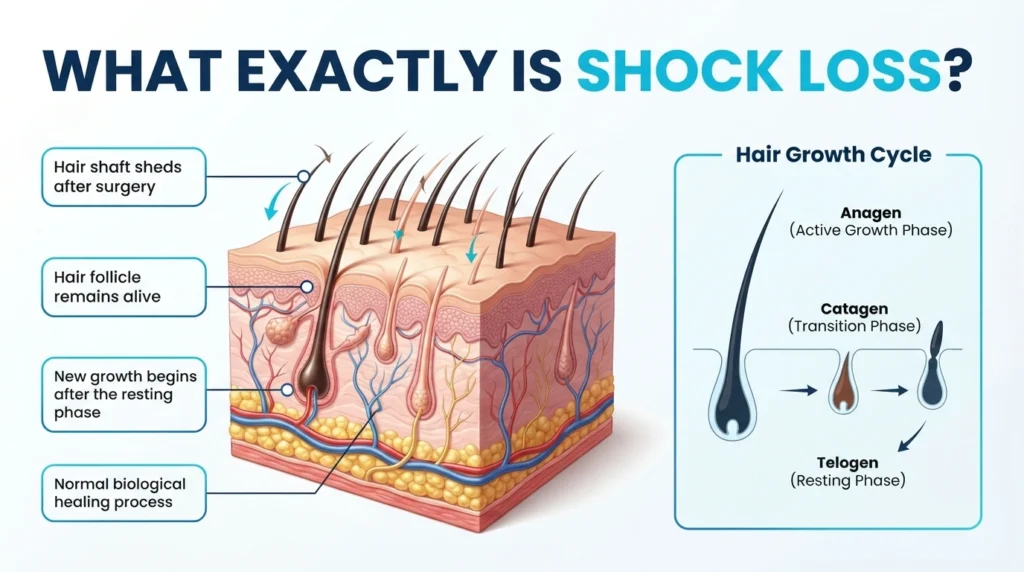
Shock loss is a term commonly used to describe temporary shedding of native hairs around the transplant area after surgery. The visible hair shaft may shed while the follicle remains viable beneath the skin. Postoperative shedding can also affect transplanted hairs as part of the normal hair-growth cycle. After hair implantation procedures in two specific regions of the scalp are of relevance for you.
- The recipient area – Within the first few weeks the recently transplanted grafts may even lose their top 1 inch tip which consists of a visible strand of hair, though the follicle survives underneath.
- The donor area – There may be thinning around the holes made for hair extraction in FUE or through the line where hair follicles are harvested in FUT, again this is a direct result of the trauma of harvesting.
It truly is one of the most counter-intuitive parts of this whole hair surgery journey – because, let’s be real, the surgery itself makes your situation look worse. Three weeks out, your scalp looks to be less dense than when you first opted to go under the knife. And that paradox of visual contrast is why tons of guys and girls start to go crazy researching frantically at 2am. do you’re the best more anxiety usually, only the top-lying layer containing the hairs will come out while the root-the hair follicle that will eventually reproduce hairs-is undisturbed. From there the hair will begin a new cycle again.
Why Does Shock Loss Happen?
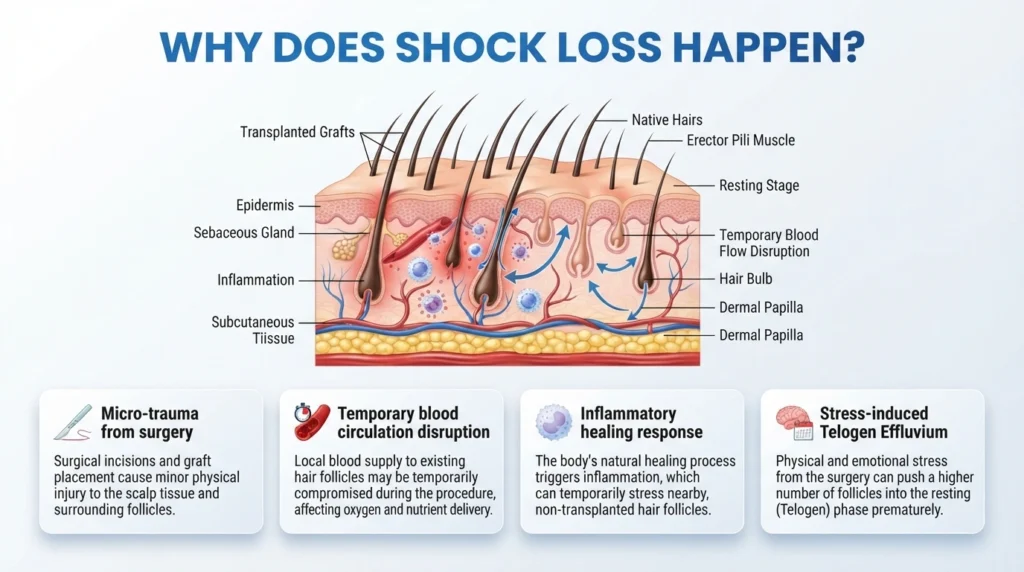
Hair naturally cycles through three phases: anagen growth. Catagen transitional. Telogen rest, and then will fall out). On average at any one time you would have about 85-90% of hair in the anagen stage.
Surgery disrupts that balance in a few specific ways:
- Micro-trauma to the scalp. There are countless miniscule wounds in implantation, and with any wound, our bodies respond with targeted inflammation in that area.
- Temporary blood flow disruption. The blood flow to a recipient site is momentarily disrupted as the grafts become established. Some of the native follicles in the surrounding area also may be disturbed as the recipient sites were being made.
- Physiological stress response. A hair transplant stresses out your body When stress disturbs your hair cycle. This is a well-known phenomenon, called Telogen Effluvium in dermatological terms, and it can be triggered by more than just an operation-also be a prolonged illness, rapid weight loss or even trauma.
- The result: Preoccupied follicles, which would have been happily toiling in their growing phase, can be jolted into a waiting phase, the hair shaft becomes loose and abandons its occupant, who will have to lay dormant for a while and start over.
And here is the best part, at least where your mental health is concerned: the follicle is actually not destroyed at all. Only hibernating for a bit.
Shock Loss Timeline, Week by Week
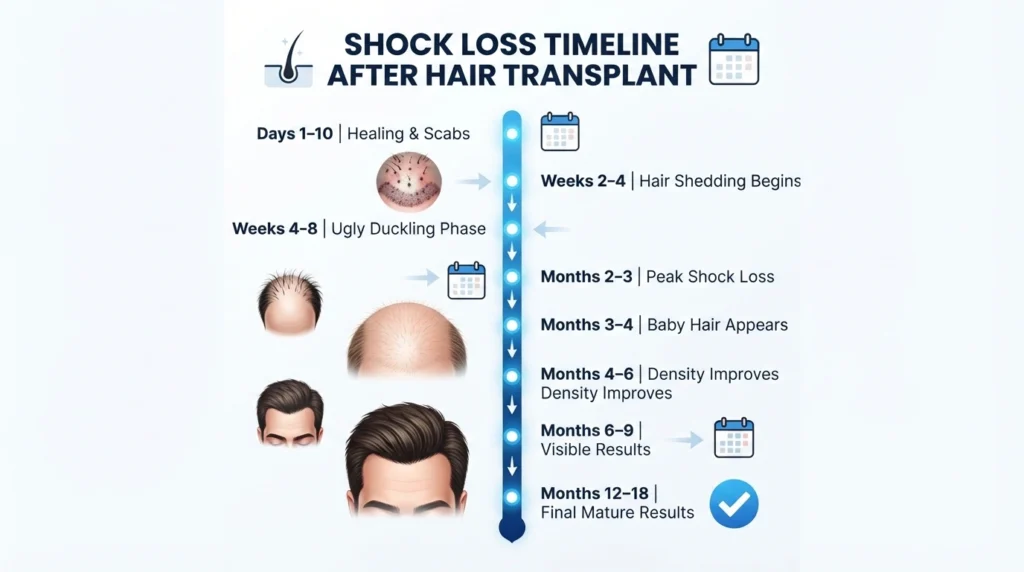
Though each patient takes a unique approach to healing, below outlines the most common stages experienced in clinics and in the patient community.
| Timeframe | What’s Happening |
|---|---|
| Days 1 – 10 | Scabbing, redness, and swelling in the recipient area. Transplanted hairs are still visibly present. No shock loss yet. |
| Weeks 2 – 4 | Shedding phase begins. Transplanted hair shafts fall out. Some native hair nearby may also shed. This is the earliest that when does shock loss start applies. |
| Weeks 4 – 8 | The scalp often looks thinner than pre-op – this stretch is nicknamed the ugly duckling phase. It’s the most emotionally difficult part of the process for most patients. |
| Months 2 – 3 | Peak thinning. Follicles are dormant under the skin, not yet visibly growing. |
| Months 3 – 4 | Fine, thin baby hairs start emerging from both transplanted and previously-shocked native follicles. |
| Months 4 – 6 | Growth accelerates. Hair starts to gain some thickness and pigment. |
| Months 6 – 9 | Noticeable density. Most patients feel confident showing results at this stage. |
| Months 9 – 12 | Continued thickening and maturing of hair shaft caliber. |
| Months 12 – 18 | Final results. Texture, density, and direction of growth fully settle. |
If you’re asking when does shock loss occur after hair transplant the honest answer is: it’s rarely a single sharp moment. It creeps in over the two-to-four-week mark and is usually only obvious in hindsight, once you notice your pillow has more hair on it than expected.
Does Everyone Get Shock Loss?
No and that is one of the most searched questions on this topic so lets be straight with you now then.
Not all patients get heavy shock loss as expected. In some patients, their recovery process goes through the minimal shedding phase and except the graft shedding nothing much is observed. Others who have thinning, weak original hair in the region they undergone transplant, experience sudden loss post completion which then reverses again.
What we can say with confidence:
- Mild shock loss is common and expected, Especially on the graft site.
- Severe or widespread shock loss is less common, We call large or devastating shock loss much less of an anomaly and much more frequently associated with risk factors (see more below).
- Whether you notice it or not doesn’t predict your final result. A zero shedding patient or a dramatic “ugly” duckling stage ultimately often does really well when performed properly.
Recipient-Area vs Donor-Area Shock Loss
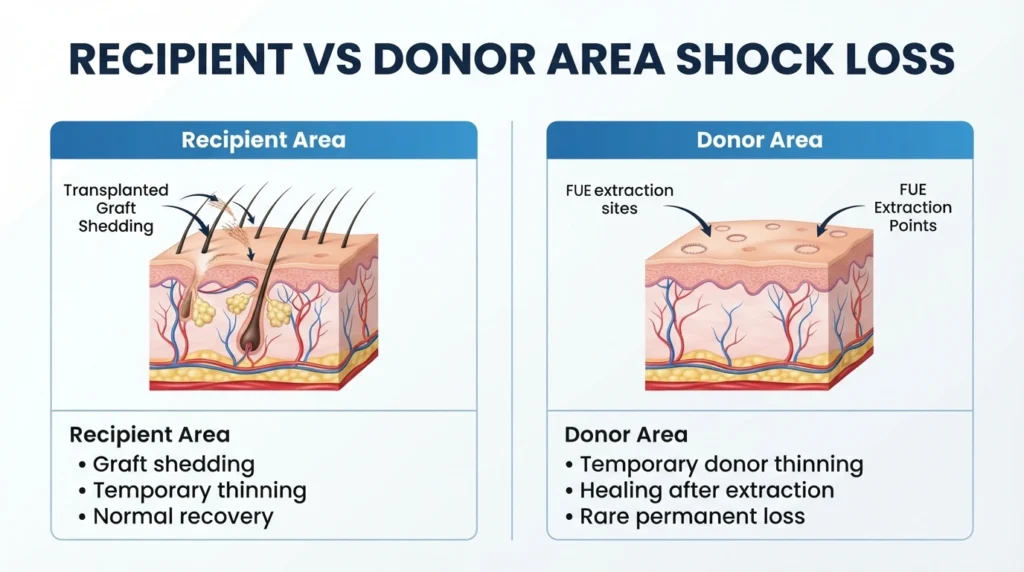
| Recipient Area Shock Loss | Donor Area Shock Loss | |
|---|---|---|
| What sheds | Newly transplanted grafts, occasionally nearby pre-existing thin hairs | Native hair surrounding extraction points FUE or the strip incision FUT |
| How common | Common as part of normal postoperative shedding | Less common, but more likely with dense FUE extraction |
| Cause | Trauma from graft placement + disrupted micro-blood supply | Trauma from punch extraction or strip removal, tension on surrounding follicles |
| Recovery | New growth from the same follicle in 3 – 4 months | Temporary thinning can occur; persistent thinning should be assessed by the treating surgeon. |
| Should you worry? | Almost never – it’s part of the expected graft cycle | Only if shedding is unusually dense or doesn’t regrow by month 6 – 9 |
Shock Loss vs Normal Post-Op Shedding
People tend to refer to any experience with hair loss post-procedure as ‘shock loss.’ However, it would be beneficial to differentiate it from regular, post-surgical hair loss because you understand which heading to access when all isn’t right.
Normal post-op shedding is the normal sloughing off the visible hairs of the transplanted grafts itself, a perfectly normal and natural process the shaft sheds to make room for new growth of a shaft at a later date from the same root follicle.
Shock loss (in the strict sense) The correct, and technical meaning for naturally occurring hair refers specifically to the presence of the subject’s own hair, previously existing on the treated surface, that never underwent treatment or grafting, falls off as a collateral damage by the trauma/inflammaction in the area.
The distinction matters because:
- Shedding of transplanted hairs after surgery is generally considered a normal part of the transplant growth cycle, whereas shock loss is commonly used to describe shedding of pre-existing native hairs near the treated area. The terms are sometimes used interchangeably online, which can cause confusion.
- What the clinician meant was the shedding of native hair you had but somehow were not anticipating losing in the region surrounding the transplant. What Clinician Really Mean by Shock Loss
This is the point where almost all patient forums merge the two and exactly where I believe people start unnecessarily confused! My best advice is; when in doubt take a picture once a week from day zero. This is unquestionably the single easiest thing you can do to identify that normal is turning into abnormal and that it may be time to mention something to your surgeon.
Temporary vs Permanent Shock Loss
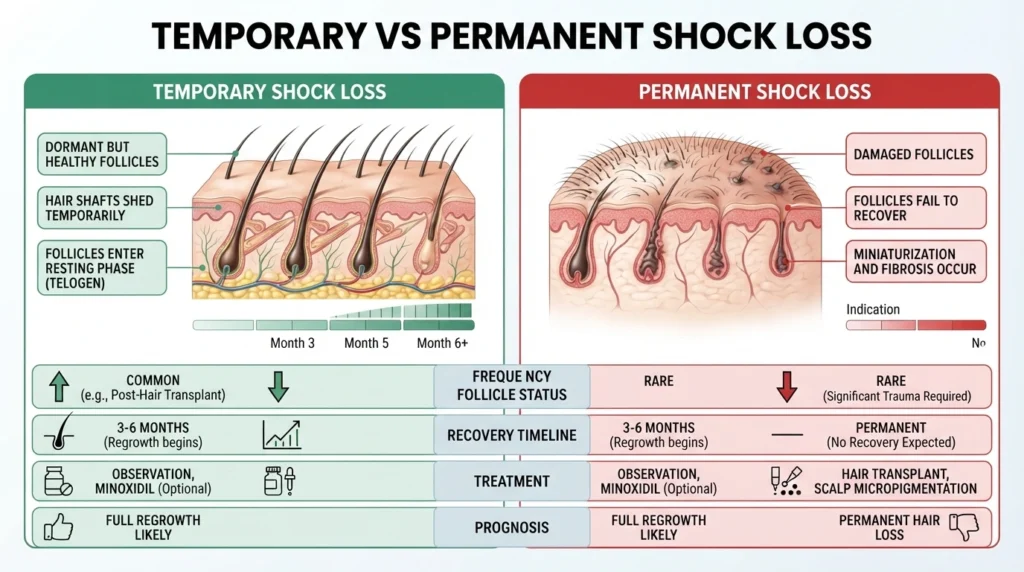
| Aspect | Temporary Shock Loss | Persistent/Severe Hair Loss |
|---|---|---|
| What happens | Hair sheds while follicles may remain viable | Persistent loss may require evaluation |
| Common cause | Postoperative shedding, surgical stress and local trauma | Depends on the underlying cause |
| Regrowth | Often occurs as the hair cycle resumes | Depends on follicle status and cause |
| What to do | Follow postoperative instructions and monitor | Contact the treating surgeon/dermatologist |
If expected regrowth is not becoming apparent over the usual recovery period, particularly if there is little or no improvement by approximately 6–9 months, contact your surgeon for an assessment.
Common Myths About Shock Loss After Hair Transplant
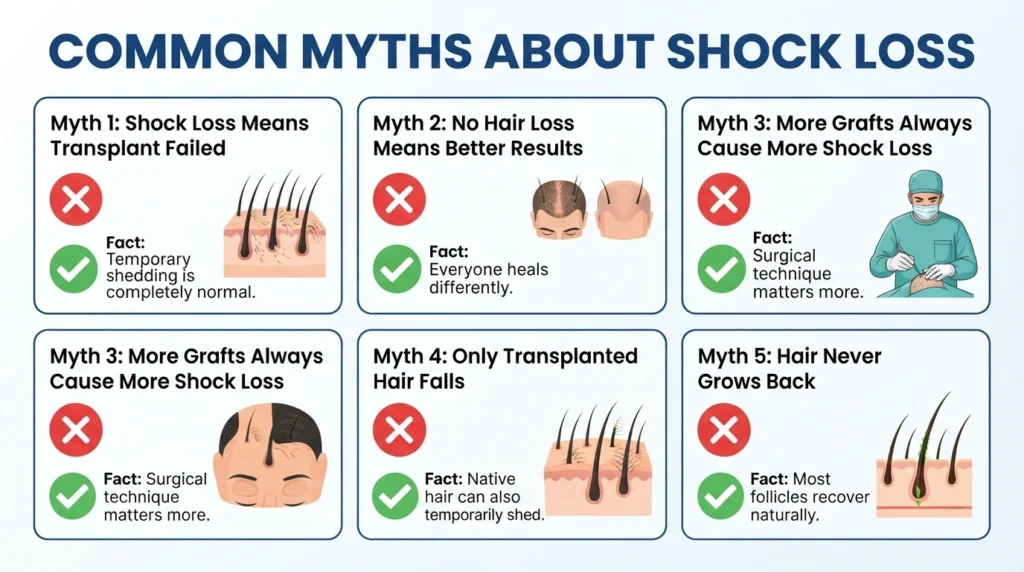
There’s so much chatter out there in forums and online reddit threads on this very same thing – and almost none of them would make any sense to a real dermatologist. Let’s go ahead and dispel some of the most prevalent ones:
Myth 1: Shock loss means the transplant failed. Wrong, while they’re not really related (the two of you might need to have a discussion), shock hair loss is a biological process and the natural expected outcome of the surgical procedure.
Myth 2: If I don’t lose hair in the first month, I won’t get shock loss later. Not really. Some patients don’t lose any hair until around week 5 or 6. In other words, not seeing that shedding process begin around week 2 of the initial treatment doesn’t necessarily mean that is impossible for the patient.
Myth 3: More grafts always means more shock loss. A lot number does not as the quantity of in terms of how close the grafts are situated in the chosen location, as to what a great deal number seems to obtain. Four- thousand implants dispersed during the location could very little shock reduction when 1- 500 implants stuffed into a smaller region containing stressed native hair follicles.
Myth 4: Shock loss only affects the transplanted area. Also not true-Donor region shock loss, yes a well documented side effect, the higher density FUE sessions tend not to be prone to it.
Myth 5: Once the hair falls out, it’s gone for good. This is the myth that causes the most concerning. In temporary shock loss – which is the vast majority of cases – the follicle survives beneath the skin and simply restarts its cycle a few months later.
The Emotional Side of the Ugly Duckling Phase
You’re also never quite prepared for how emotionally taxing this 2-3 month transition can be. It’s a big time/physical / financial investment and for weeks on end you’re getting evidence in the mirror that suggests what you dreamed most of avoiding, it just won’t work.
Here are a couple things that really get patients through this period:
- Check in just one a week with consistent lighting and pose – don’t worry so much each day. Individual days don’t show changes you need to see yet and do you’re the best more anxiety: you’ll be motivated by and excited with week-to-week transformation!
- Steer clear of hair-loss forums, in particular, during that time frames. if you’re interested in how things develop it’s one thing but forum posts, filled with cautionary tales, have a terrible habit of fueling fear and anxiety.
- Be sure to ask your surgeon if you’re worried It only takes two minutes and a reassurance chat from someone who’s watched cases like yours, but it could save another hour you might spend googling it and concerning.
- Keep in mind the curve that is the time in life. There’s an optimum point at which a man/women’s hair grows its thinnest. It then gets to the thickest again. It does not keep on thinning all through one’s life.
FUE vs FUT: Which Has More Shock Loss Risk?
| FUE (Follicular Unit Extraction) | FUT (Follicular Unit Transplantation / Strip) | |
|---|---|---|
| Donor trauma type | Thousands of small individual punch wounds spread across the donor zone | One linear incision, closed with sutures/staples |
| Recipient shock loss risk | Similar to FUT – depends on graft density and placement, not extraction method | Similar to FUE |
| Donor shock loss risk | Can occur if extraction density is too high in one area, thinning the look of the donor zone temporarily | Can occur along the edges of the incision from tension during closure |
| Recovery speed | Slightly faster surface healing | Slightly longer due to the incision |
You may encounter people that claim to use only one method as they feel it’s less prone to shock loss. If this claim were true, then they will know about the surgical skill needed. Your potential for shock loss can be significantly impacted if they pack in too many grafts and get too tight, extraction density, how they physically treat your hair during your extraction process etc. Neither FUE nor FUT can be described universally as having a lower shock-loss risk. Risk depends on factors such as the patient’s existing hair, graft density, surgical planning, local trauma and how the procedure is performed.
Who Is Most at Risk of Severe Shock Loss?
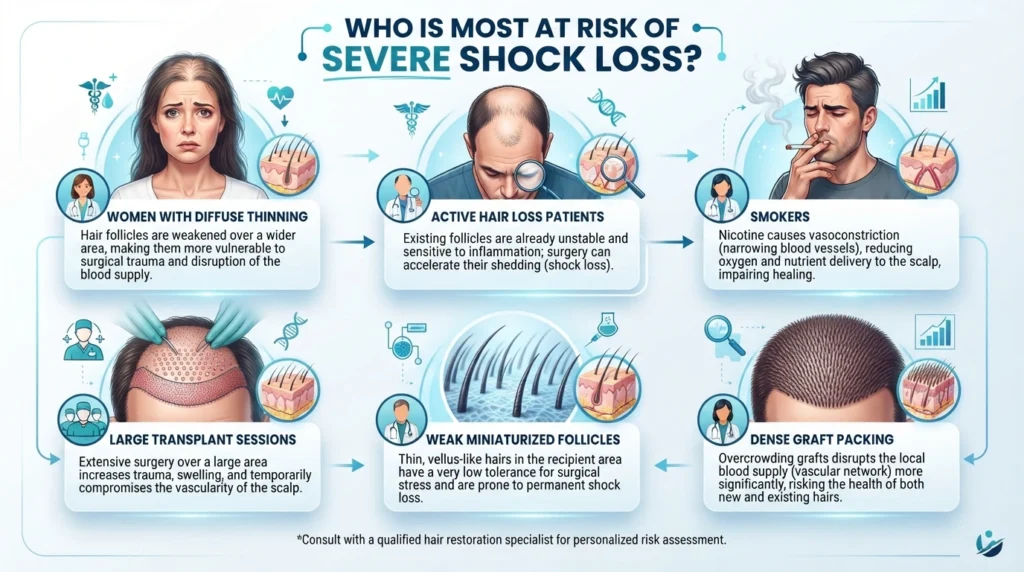
- Women presenting diffuse hair loss (which isn’t usually a nicely defined scalp area) – because of this, you want more native hair outside of the transplantable area you can disturb without being obvious.
- Patients experiencing present day active alopecia, uncontrolled by medication – existing follicles is already shrinking.
- Tight packing of the graft material around sensitive original hairs.
- Large Single Session procedures – the 3,000+ donor skin required, means more injury per operation (mega session hair restoration surgeons perform very large transplants).
- Smokers, due to reduced microcirculation and slower healing.
How to Prevent or Minimize Shock Loss After Hair Transplant
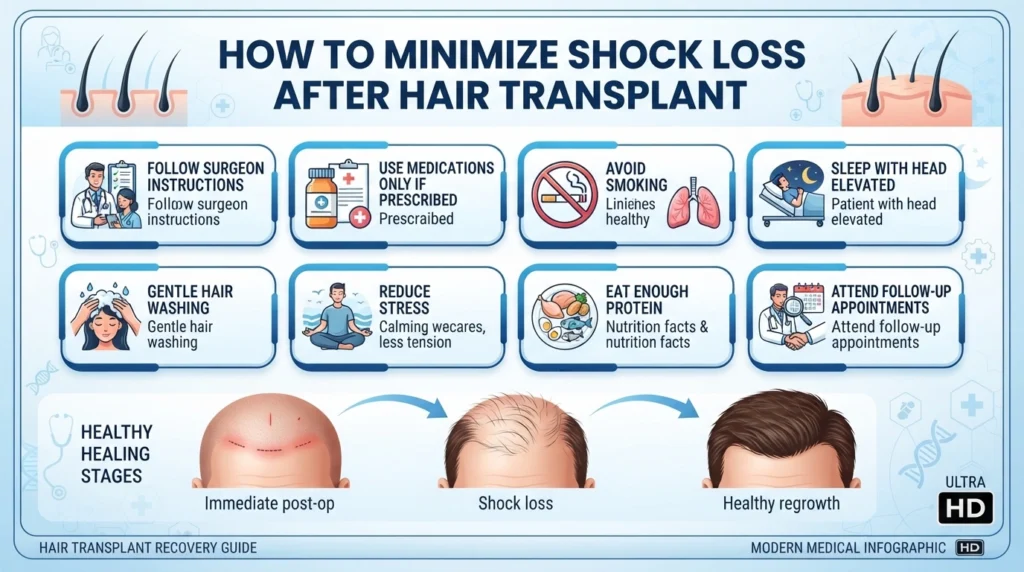
The most important thing that you need to realize is that no matter how diligent you are, all together because it’s a naturally occurring biological event following any hair transplant and there’s simply not a whole lot you can control. That being said, there are things that you absolutely will be able to do to limit the amount of shock loss:
- Start minoxidil or finasteride before surgery if your surgeon suggests. Shoring up and strengthening your current hair prior to trauma better prepares it to withstand the shocks it receives from procedure.
- Follow your surgeon‘s postoperative washing and activity instructions.
- Avoid unnecessary manipulation or scratching of the scalp during healing.
- Do not start or stop hair-loss medication without discussing it with your treating clinician.
- Avoid smoking if your surgeon advises cessation because smoking can impair healing.
- Attend scheduled follow-up appointments.
- Contact your surgeon if shedding is accompanied by increasing pain, redness, drainage or other concerning symptoms.
What Can Be Done If Shock Loss Seems Excessive?
Usually, most of your immediate post operative shedding is untreatable by itself. Treatment is determined by the reason for loss and it’s seriousness. You should ask the surgeon who treated you or a dermatologist if a situation with abnormally heavy, prolonged hair loss that causes you other symptoms on the scalp needs further treatment and/or investigations.
- Low-level laser therapy (LLLT): While limited evidence indicates that it may facilitate follicle recovery, use appears to vary.
- Patience and monitoring photos: Frankly the biggest “treatment” as typically what the follicle needs is just a few months – 3 to 6-for hair growth cycle renewal.
None of the things mentioned below should be done before speaking to your surgeon, most notably finasteride which can influence hormone levels.
Now, the key takeaway you need: “In the vast majority of men experiencing shock loss following a hair transplant, the best possible ‘treatment’ is actually just waiting and taking care of your donor and scalp according to my aftercare guide.” Interventions in such circumstances usually only applies when the shock loss is abnormally intense, extends beyond normal periods, or there’s visible thinning at the back of your scalp with minimal to no sign of recovery at the scheduled pace.
Signs Your Regrowth Is On Track
- Fine, translucent peach fuzz hairs appearing around the third month and afterward.
- Reduced shedding on your pillow/towel compared to weeks 4 – 8.
- Hairs gradually thickening in caliber (not just length) over months 5 – 8.
- Scalp visibility decreasing month over month, even slowly.
- No new redness, tenderness, or irritation in the area.
Red Flags When to Call Your Surgeon
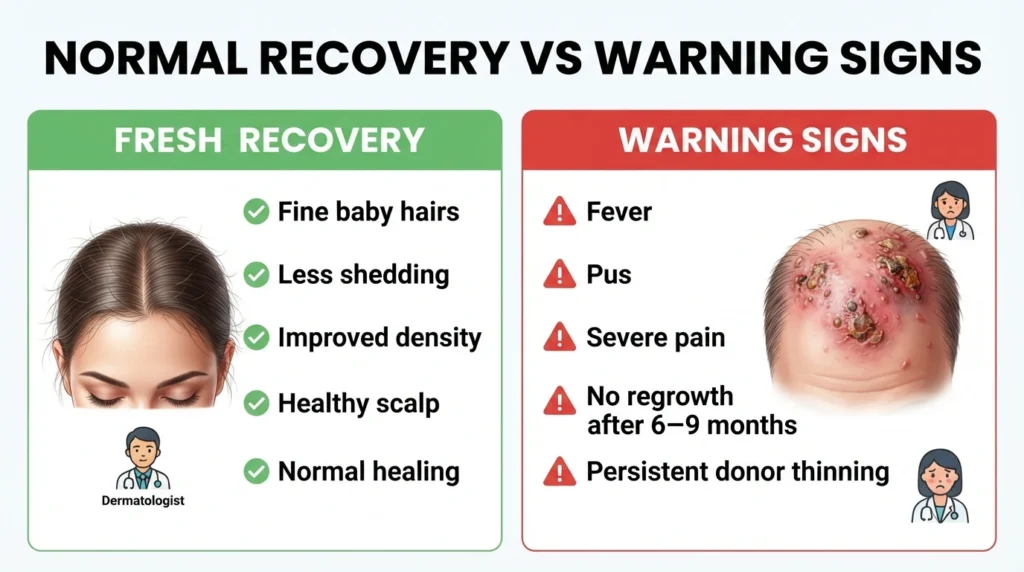
When Should You Phone Your Clinic Do not continue to wait the issue out if:
- Fever.
- Pus, foul-smelling discharge, or spreading redness around graft sites.
- Pain that worsens instead of improving over time.
- Little or no visible regrowth by around 6–9 months warrants contacting the treating surgeon for assessment, especially if there has been no gradual improvement.
- Significant, unexplained complications at the donor site.
- Signs of infection anywhere on the scalp.
- Little or no visible regrowth over the expected recovery period
This is what determines that it’s only a small issue and then something significant later on, so listen to your intuition and if your inner alarm bells have rung, go and get it sorted, don’t just shrug your shoulders and shrug off, ‘I was hoping for speeder’.
A Note On Clinic and Doctor Recommendations:
We’ve deliberately left out any “top 15 – 20” specific clinics or fixed price doctors in this guidance. Quality of Clinics, surgeons and costs tend to vary too much for a single fixed directory and can even risk guiding someone to out dated and non reliable recommendations on such important choices. Rather than this, what you will want to confirm is whether the clinics you have short-listed for example can prove as part of the initial discussion:
- Is an actual surgeon (and not just a technician) performing the extraction and implantation of the procedure (at the very least remotely guiding the process)?
- Are there any real patient results photos from you or their other patients? Or is it just generic stock pictures of good looking people?
- Do they hold board certification from an applicable national medical board?
- Does the quote they give you have itemization to it or are you quoted an and up?
- Are you able to make time to speak, if only for a few minutes, with an honest, past client?
Financing and Insurance:
Because hair transplants are almost universally viewed as cosmetic procedures, most health insurance providers won’t cover them. However, a lot of the clinics throughout the US, UK, and Canada either offer some sort of in-house financing or will work with a partner that offers 12 to 36-month medical loans to help offset your out-of-pocket expenses. If you end up Comparing local verses abroad pricing, remember that you also need to take into consideration the travel and accommodation, a cheaper country will almost end up being the same price as travelling domestically when all is said and done.
If you are still choosing a surgeon, see our guide on how to choose a hair transplant clinic.
FAQs:
Q: When does shock loss start after a hair transplant?
Majority of the individuals have discovered that it had taken them from weeks two to four post-surgery in order to see changes but this can have a difference with the amount of time of a few weeks in each direction according to how soon you healing takes place and you do need time to adjust your lifestyle after the procedure is carried out
Q: Does everyone get shock loss after a hair transplant?
No. The grafts themselves will shed, it’s near impossible to avoid but the level of surrounding native hair shedding (shock loss) varies dramatically from patient to patient, some barely have it, others go through quite a long, ugly duckling stage.
Q: How long does shock loss last after a hair transplant?
Usually between 3 to 6 months between shedding and when new growth is clearly visible. For full cosmetic effects, typically take at least 12-18 months to appreciate them.
Q: Is shock loss the same as normal post-transplant shedding?
Not so. The shedding of transplanted hair can not only expected and inherent, but can indeed occur within the graph cycle itself. And, so to speak, ‘shock-loss’ by itself should be reserved for untreated hair suffering as a consequence to neighbouring surgery.
Q: Can shock loss be permanent?
Losing hair following a transplant should not automatically be categorized as permanent shock loss. Continued loss of native original hair,or a lack of regrowth within a predictable timeframe warrants a discussion with your treating surgeon and or dermatologist as to the underlying reasons.
Q: Is FUE less likely to cause shock loss than FUT?
No. Either technique can cause shock loss; how the operation is approached is of greater importance: a proper operative plan and dense placement are keys. Taking grafts and using donor hair must be handled with finesse by the surgeon irrespective of the technique.
Q: Can I speed up shock loss recovery?
There is no guaranteed way to make the hair-growth cycle back to normal for good. Instead, it’s up to you to adhere to your surgeon’s recovery protocols and also do your due diligence by minimizing traumatization to your scalp, staying healthy overall, and showing up for your consultations and subsequent visits. Do not take any medication or undergo any supplements targeting shock loss before speaking with a clinician.
Q: How do I know if my shock loss is turning into something serious?
Watch for no new growth at month 6-9, redness or pain increasing (not better), or any sign of infection. Normally shedding through shock loss can appear as a hint of fine, new hairs at month 3-4.
Q: How long does shock loss last?
The shedding cycle can differ from person to person. Hair regeneration takes place very smoothly during the shedding cycle and a large majority of individuals will notice significant outcomes within few months. The American Academy of Dermatology Association says that the outcomes for majority can be noticed within 6 to 9 months or maximum within a year time.
Q: When does shock loss start?
Shedding after a hair transplant commonly becomes noticeable during the first several weeks after surgery. The American Academy of Dermatology Association notes that transplanted hair commonly falls out between about 2 and 8 weeks after surgery, and the scalp may appear thinner around the third month before regrowth becomes visible. Individual recovery varies.
Conclusion:
The initial shock of losing hair immediately after transplantation can be unsettling, but early shedding does not always signal a failed transplant. It’s normal to lose transplanted hairs within a few weeks of a hair transplant, and some patients’ own surrounding hair might also shed during the same time frame.
The hair from your transplant typically begins to fall out somewhere between two to eight weeks after your procedure,” explains the American Academy of Dermatology Association. “Your scalp may even appear more sparse around month three until new growth begins to emerge.” While many see significant results after six to nine months, you may need patience.
The main difference between normal shedding and the serious stuff is. When you’re post-op – make sure that you stick to the surgeons guidelines. When you experience severe pain, redness increasing, discharge, high temperature, or no regrowth after the projected healing time.
Written & Reviewed By
Written by: Wajiha Aqeel
Co-Founder & Hair Restoration Research Lead
Data & publication oversight: Daniel Brooks
Co-Founder & Senior Operations & Data Director
Published Date: July 24, 2026
Clinic & Pricing Data Last Reviewed: August 2026
Last Updated: August 23, 2026
Sources & References
- American Academy of Dermatology Association (AAD) — A hair transplant can give you permanent, natural-looking results
- American Academy of Dermatology Association (AAD) — Do you have hair loss or hair shedding?
- PubMed — Localized Telogen Effluvium Following Hair Transplantation
- PubMed — Telogen Effluvium: A Review of the Science and Current Obstacles
- PubMed — Immediate-Onset Linear Effluvium Associated With High-Density Hair Transplantation
Medical & Affiliate Disclaimer:
The content on Hair Grow Needs is for general informational and educational purposes only and should not be considered professional medical advice. For full details regarding our policies, please read our official Disclaimer.
Individual healing and hair-regrowth timelines vary, and persistent or concerning symptoms should be evaluated by the surgeon who performed the procedure or a qualified dermatologist.
Note: clinic and cost comparison resources above are all of their specific industry pricing standards, not peer-reviewed science – just check used as general price comparisons rather than fact and / or medical information. All other facts / biomedical research in the article have verified by clinical / dermatology related sources mentioned above.