
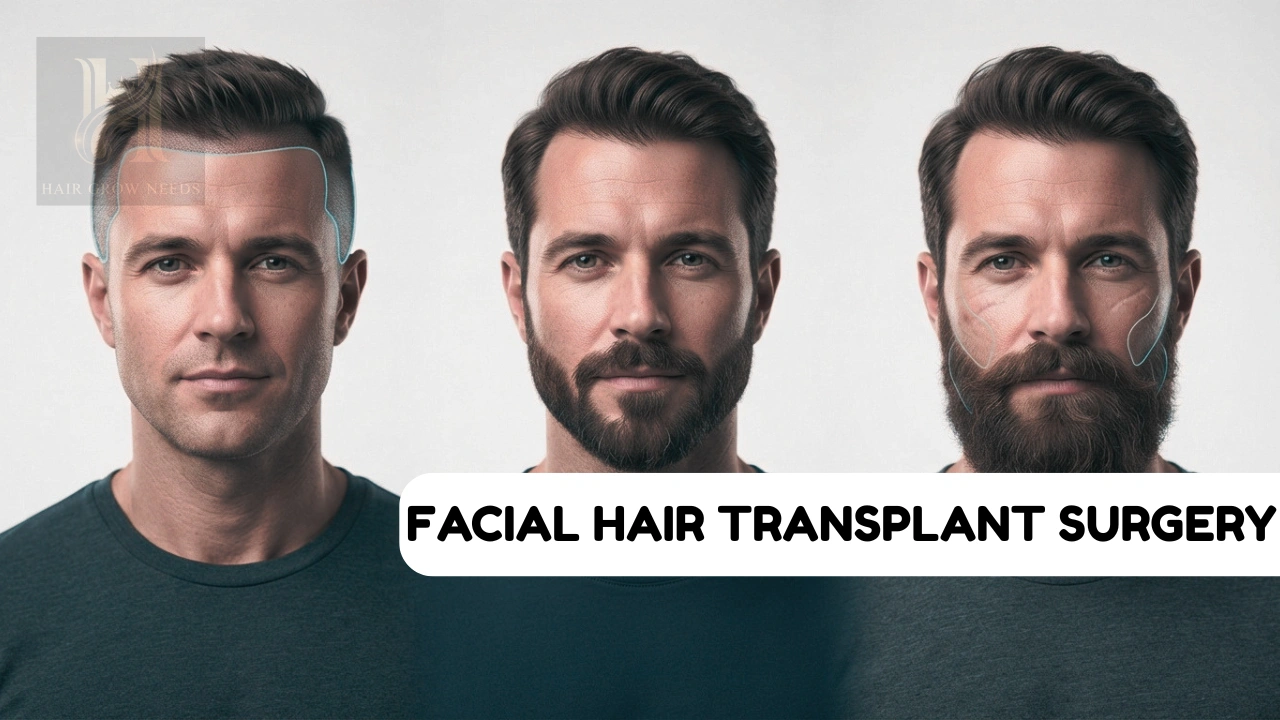
Medical Disclaimer: This article is for informational purposes only and does not replace professional medical advice. Read our full Medical Disclaimer.
In the U.S., facial-hair transplant pricing varies substantially by the area being restored, graft count, surgeon and location. Current 2026 consumer pricing data from CareCredit reports a national average of $4,734 for a partial beard transplant, with a reported range of $3,311–$8,126, while a full beard transplant averages $11,461, with a reported range of $7,607–$19,870. These figures are market benchmarks, not universal clinic prices.
Quick Facts
| Detail Info | Treatment Details |
| Treatment Type | Cosmetic hair restoration surgery |
| Duration | 2 – 8 hours |
| Anesthesia | Local |
| Recovery | 7 – 14 days |
| Visible Growth | 3 – 4 months |
| Final Results | About 10–14 months; some patients may continue maturing to 12–15 months |
| Permanent | Generally long-lasting |
| Common Technique | FUE |
| Downtime | Minimal |
I reviewed clinic pricing pages, surgeon and clinic listings, consumer pricing data and treatment information across multiple countries to separate published prices from broader market estimates. It’s an important difference because the bill for a small mustache or check repair could hardly be more divergent from one you’d receive for the repair or remodeling of a full beard.
What Is Facial Hair Transplant Surgery?
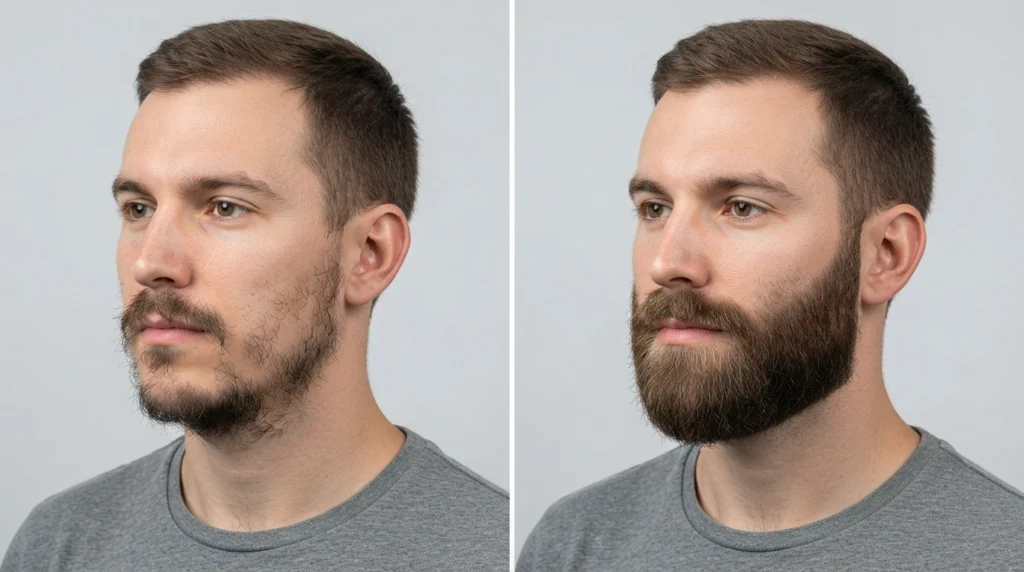
Facial hair transplant surgery is a cosmetic hair restoration procedure that moves healthy, living hair follicles, almost always from the back or sides of the scalp, into areas of the face where beard, mustache, goatee, or sideburn hair is thin, patchy, or missing entirely. Typically, it is performed as an outpatient surgery with local anesthesia. Since the transplanted hair follicles have almost always come from the patient’s donor region in the first place, you are not going to see an organ rejection issue, but issues such as graft survival, healing or other complications of the surgery may impact the outcome.
A facial hair transplant technically encompasses multiple procedures, including hair restoration for the beard, mustache, goatee and sideburn, and select scar cover. The specific treatment plan will vary with each facial site of rejuvenation, hair pattern, donor hair supply and design specifications from the patient.
How Facial Hair Actually Grows
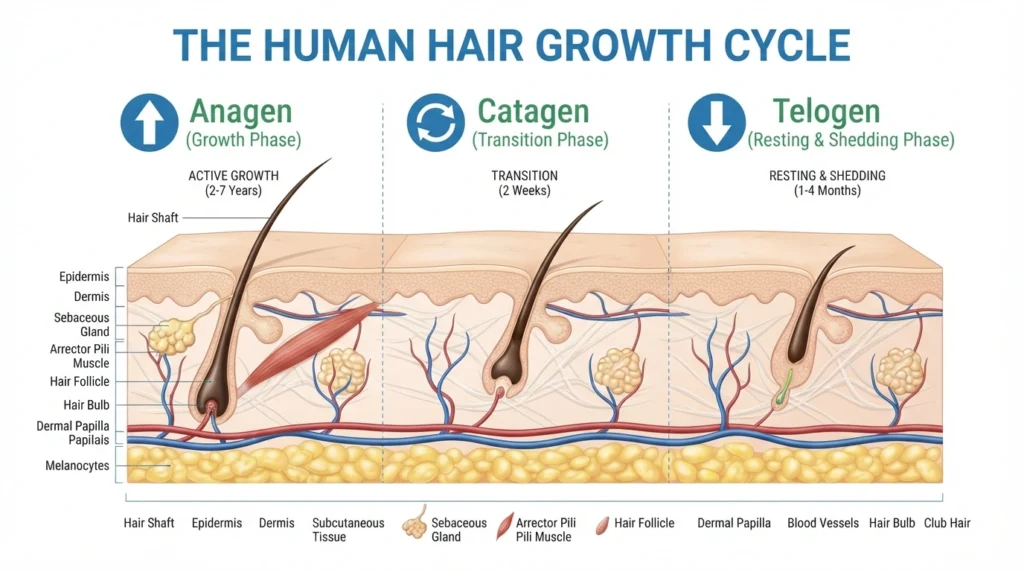
To better understand why there is candidacy, and why the results you’re seeing are so normal, let’s take a quick look at hair growth: Any hair follicle, whether transplanted or not, exists in one of three cycles. There is the anagen phase, a period where your hair is actually growing. This is then followed by a catagen phase, which is short, in which hair growth stops and the follicle starts to shrink. Lastly, there’s the telogen phase, in which the hair is resting before falling out and starting a new cycle. Temporary shedding of transplanted hair shafts can occur during the early postoperative period, often within the first several weeks; this does not necessarily mean the transplanted follicles have been lost.
Why Facial Hair Restoration Has Become So Common
It is capable of defining your jawline, can give you more equal facial features and even mask acne or scars. Genetics, hormonal factors, scarring, previous injury and other individual factors can contribute to sparse or uneven facial-hair growth.
Patients most commonly come in for:
- Genetically patchy beard growth.
- A naturally thin or uneven mustache.
- A sparse goatee that never fills in.
- Uneven or missing sideburns.
- Scarring from acne, burns, or facial trauma.
- Gender-affirming care for some transgender men, planned alongside qualified healthcare professionals.
Transgender men may undergo a hair transplant to their face as part of gender-affirming treatment. The appropriate timing and criteria should be individualized with a professional as they would take into account the progression of facial hair, donor availability, the man’s goals and general medical status.
Who’s a Good Candidate?
Good candidates generally have:
- A stable facial-hair pattern or a clearly defined area requiring restoration
- Enough healthy donor hair on the scalp.
- Good general health, with no active skin infections.
- Realistic expectations about density and timeline.
- No uncontrolled autoimmune conditions or severe scarring disorders that haven’t been medically evaluated first.
Medical conditions, skin infections or the presence of scarring problems or the like that may impact on healing or surgical safety are not to be treated when candidates have no current medical control.
Types of Facial Hair Transplant Procedures
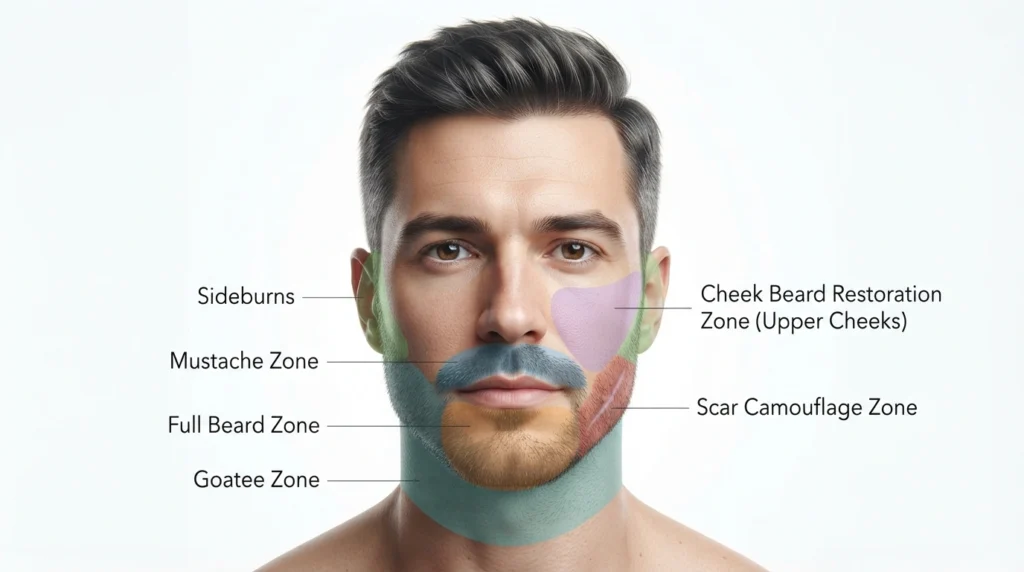
The graft ranges below are purely indicative and are provided for general planning only; they are not fixed requirements or a substitute for an individual surgical assessment. Actual graft needs vary with existing facial-hair density, treatment area, desired design, donor supply and the amount of coverage required. A surgeon should determine the final graft plan during an individual assessment.
| Procedure | What It Targets | Illustrative Graft Range |
|---|---|---|
| Full Beard Transplant | Cheeks, jawline, chin, full coverage | 1,800 – 3,000+ |
| Mustache Transplant | Upper lip density and shape | 300 – 500 |
| Goatee Transplant | Chin and surrounding definition | 400 – 700 |
| Sideburn Transplant | Symmetry between scalp and beard | 200 – 500 |
| Cheek Beard Restoration | Patchy cheek coverage | 400 – 800 |
| Scar Camouflage | Hair coverage over acne, burn, or surgical scars | Varies by scar size |
These graft ranges are purely indicative. They are not standardized clinical requirements, and different surgeons may recommend substantially different numbers based on facial dimensions, existing hair, desired density, donor supply and treatment goals.
Which Type Do You Actually Need?
| Your Goal | Likely Procedure |
|---|---|
| Fuller beard everywhere | Full beard transplant |
| Fill cheek gaps | Cheek beard restoration |
| Stronger mustache | Mustache transplant |
| Better chin definition | Goatee transplant |
| Improve facial framing | Sideburn transplant |
| Cover scar areas | Scar camouflage transplant |
Number of Grafts Graft count tends to be highly different depending on which facial region is being operated on. Sparse regions of skin for a few sparse follicles in the cheek region or for some loose sideburn hair, only take a few hundred grafts according to RealSelf. Some patients for the operation of full bearded growth have more than 1000 grafts inserted into their face. The ultimate quantity that should be applied to your facial region must be calculated in a one to one consultation rather than with the beard type.
You’ll still get the best recommendation by chatting with a professional consultation, but it’s not a bad idea to know a few things beforehand.
How to Prepare Before Surgery
A more seamless process and recovery typically begins before you even enter the clinic. Most often, your surgeon will suggest:
- Giving all your medical history and medication use during your session.
- Stopping smoking before the procedure if possible, as this can impact on wound healing and blood flow.
- Getting any medication that could increase your risk of bleeding from taking a professional and that will only come from this advice.
- Arranging your transportation from the procedure.
- Going through every pre-op instruction that your individual clinic gives you.
Do not stop any medication without the permission of your prescriber, even if a particular clinic suggests stopping all prescriptions.
How the Procedure Actually Works
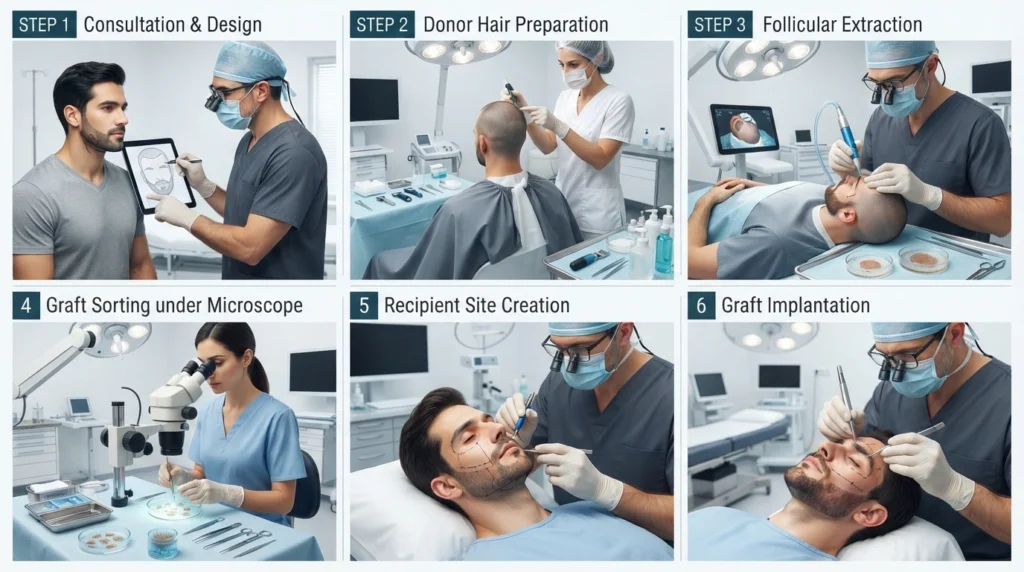
Step 1: Consultation and Facial Design
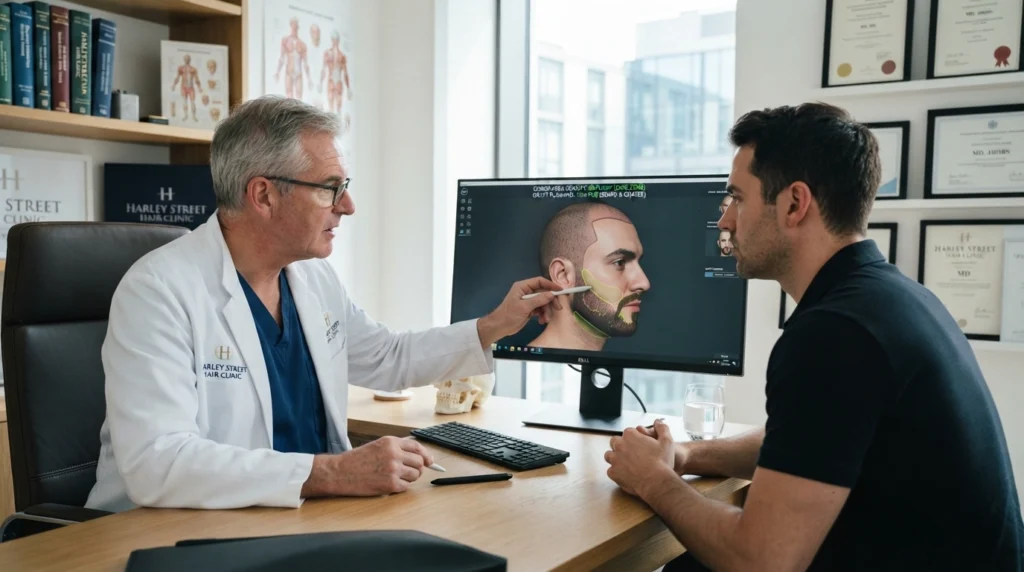
During the consultation, the surgeon assesses facial symmetry, your existing beard pattern and density, available donor hair, skin condition and relevant medical history. The graft requirement is then planned according to your individual facial zones, desired design and target coverage rather than using a one-size-fits-all estimate.
At a consultation, they should also inquire: Which beard style do you really want? Do you have a relaxed, medium thickness appearance, or are you after full density? Do you have any history of facial surgery or trauma? Is there a history of poor healing? Have you used beard medications (like Rogaine), and was there a response? A graft estimate should ideally be developed alongside facial design, donor assessment and the patient’s desired coverage rather than being based on facial dimensions alone.
Step 2: Donor Area Preparation
Your surgeon will then clip and cleanse the donor site (most likely the back of your head) before injecting local anesthetic to numb it.
Step 3: Follicle Extraction (FUE)
The surgeon extracts the healthy follicular units with the help of the micro-punch instrument.Follicular units may have one or more hairs in it. The usage of single-hair grafts can benefit areas, like mustache border and outline of the beard border where they’re readily seen. The selection is, however, decided with regard to the patients natural hair traits and the designers intended plan.
| Area | Preferred Graft Type |
|---|---|
| Beard outline | Single-hair grafts |
| Mustache edge | Single-hair grafts |
| Goatee | Mixed grafts |
| Central beard | Multi-hair grafts |
| Cheeks | Mixed grafts |
| Jawline | Multi-hair grafts |
By carefully selecting graft types across each of these regions, we can achieve a seamless transition that allows treated and natural hair to melt together into the overall look rather than appearing patched or unnatural.
Step 4: Graft Sorting and Preparation
Each follicle that’s removed is inspected under a microscope, grouped by how many strands, and sorted by curl, and size careful handling and preparation are important parts of the transplantation process and are intended to protect graft viability.
Step 5: Recipient Site Creation
Several very small openings are made at a slight angle into the skin at the recipient site. Since the hairs on the face have a flatter profile compared to the scalp, using a shallow angle such as that of natural hair growth is because facial hair normally grows at characteristic angles and directions, recipient-site design and graft placement are important contributors to a natural-looking result.
Step 6: Grafts Implantation
The prepared grafts are placed into the recipient sites according to the planned design. The surgeon or qualified clinician determines factors such as placement, spacing, direction and density to create a natural transition with the existing facial hair. The duration of this stage depends on the number of grafts and the complexity of the treatment area.
Beard Design: Why Shape Matters More Than Just Density
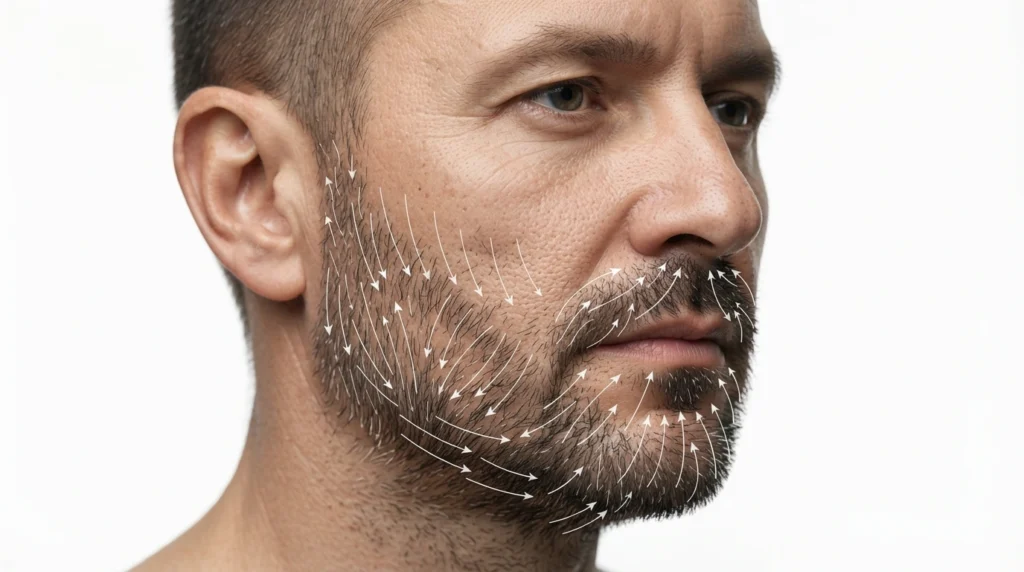
With beard transplantation, patients often focus on graft count and density, but shape, placement and facial-hair direction can have an equally important effect on how natural the result appears.
The cheek line The placement of this line can make more of a difference than most clients initially realize: a cheek line set too low results in an sparse-looking and incomplete beard; placed too high, and the face may look unbalanced as a whole. The definition of your jawline should compliment your face shape and beard profile – not conform to an average mold as a round face and a square face require very different cheek-line heights. Mustache connection Most surgeons would be glad to have a candid conversation regarding the desire for a connected beard, as a connected beard appears fuller, so long as the junction of the beard and mustache reflects your actual hair growth angle and not one based upon grafts that do not coincide.
And in essence that’s the difference between the surgeon that considers facial hair transplantation as a technical procedure and one that looks at it as a design art, this latter type of approach brings the truly ‘natural look’ to this procedure.
| Face Shape | Common Beard Goal |
|---|---|
| Round | Add definition along the jawline |
| Square | Maintain natural balance without excessive width |
| Oval | Preserve facial symmetry with even density |
| Long | Add fullness to the sides for better proportion |
| Diamond | Strengthen the chin and jawline |
FUE vs FUT for Facial Hair Transplants
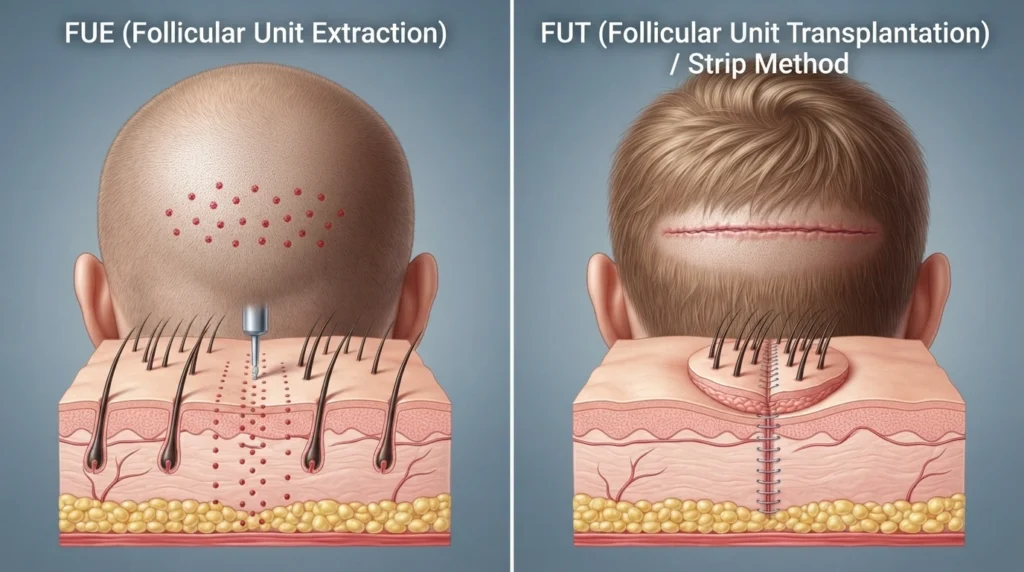
| Feature | FUE | FUT |
|---|---|---|
| Donor extraction | Individual follicles | Strip of scalp removed |
| Scarring | Tiny dot scars | Linear scar |
| Recovery | Generally shorter donor-site recovery | Slightly longer |
| Pain level | Mild | Moderate |
| Commonly used for facial hair | Yes | Rarely used |
| Suitable for short haircuts | Yes | Usually not |
As for why FUE is commonly used for facial-hair transplantation when it comes to facial hair, the simple truth is because it doesn’t create a linear donor strip and also gives the surgeon a chance to choose each individual graft by hand and carefully match the angle factors that are even more important here than in restoring hair on the scalp.
Facial Hair Transplant vs. Beard Transplant: Are They the Same?
Not really. But as the two are thrown around all the time on the internet, let’s settle the matter. The term “beard transplant” describes hair restoration that is concentrated to the cheek, chin, jawline, or full beard.
The umbrella term “facial hair transplant” covers both that and the transplantation of a mustache, goatee, sideburns or the use of facial hair transplants to conceal scars. Basically, a beard transplant is a kind of facial hair transplant- not an entirely different thing with a unique process.
FUE vs DHI: Which Technique Wins for Facial Hair?
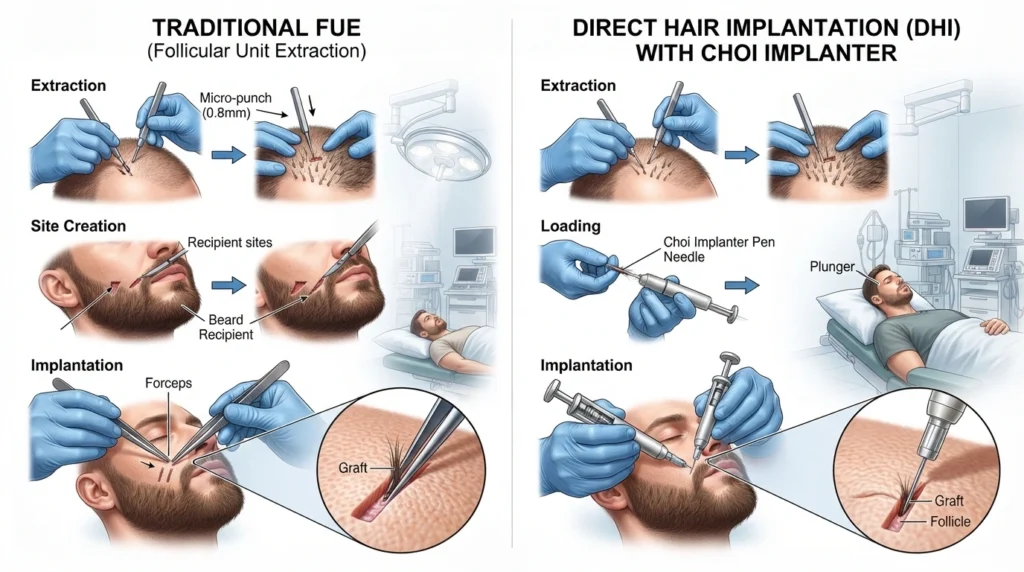
| Factor | Standard FUE | DHI (Direct Hair Implantation) |
|---|---|---|
| Tool used | Punch extraction, then separate incision + placement | Choi implanter pen – extracts and implants in one motion |
| Precision | Depends on surgeon and placement technique | Implanter-assisted placement may be useful in selected areas |
| Best for | Larger areas – full beard, cheeks | Precision zones – mustache border, jawline outline |
| Cost | Varies by clinic and treatment plan | Varies by clinic and treatment plan |
There is no ideal technique for all candidates. Each strategy of achieving growth of new hair at a site of Hair Loss is chosen depending upon the Area to be Grafted , Amount of Donor Available , The design desired by the patient , The Experience of the Hair Restoration Surgeon and finally the standard of operating procedure done by the clinic to establish new hair roots at.
Facial Hair Transplant Recovery Timeline
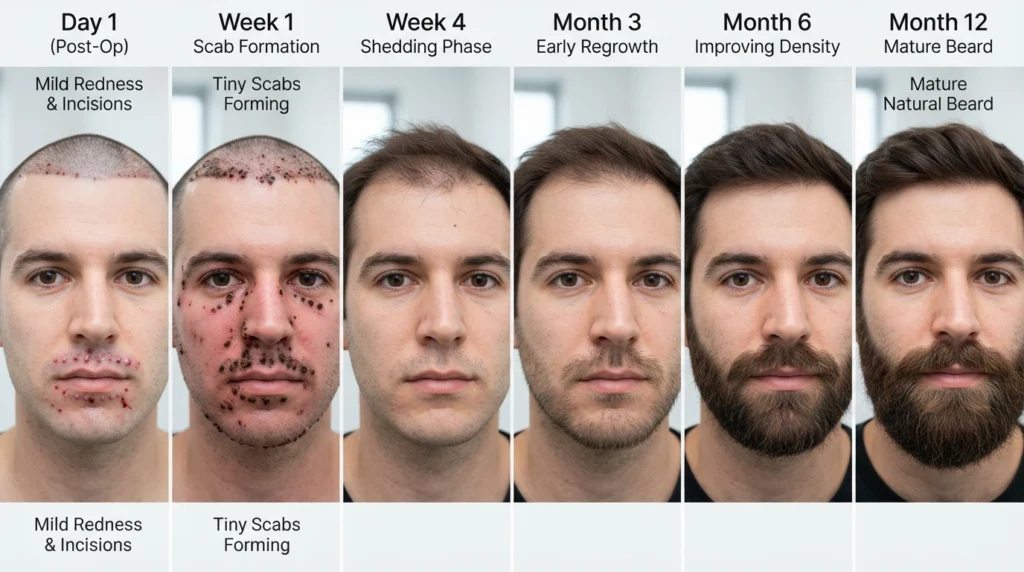
| Timeframe | What to Expect |
|---|---|
| Day 1 – 3 | Redness, mild swelling, small scabs; donor area may feel sore |
| Days 4 – 7 | Scabs begin flaking off naturally; swelling starts improving |
| Week 2 | Most visible healing resolves; many return to work and social activities |
| Weeks 2 – 6 | Temporary shedding may occur; this does not necessarily indicate graft failure |
| Months 3 – 4 | Early new growth becomes visible, often fine and lighter in color at first |
| Months 5 – 6 | Noticeable density improvement |
| Months 9 – 12 | Final, mature density, texture, and shape |
During temporary postoperative shedding, the visible hair shaft may fall out while the transplanted follicular unit remains in the recipient skin. Shedding therefore does not necessarily mean that the transplanted graft has failed.
Essential Aftercare
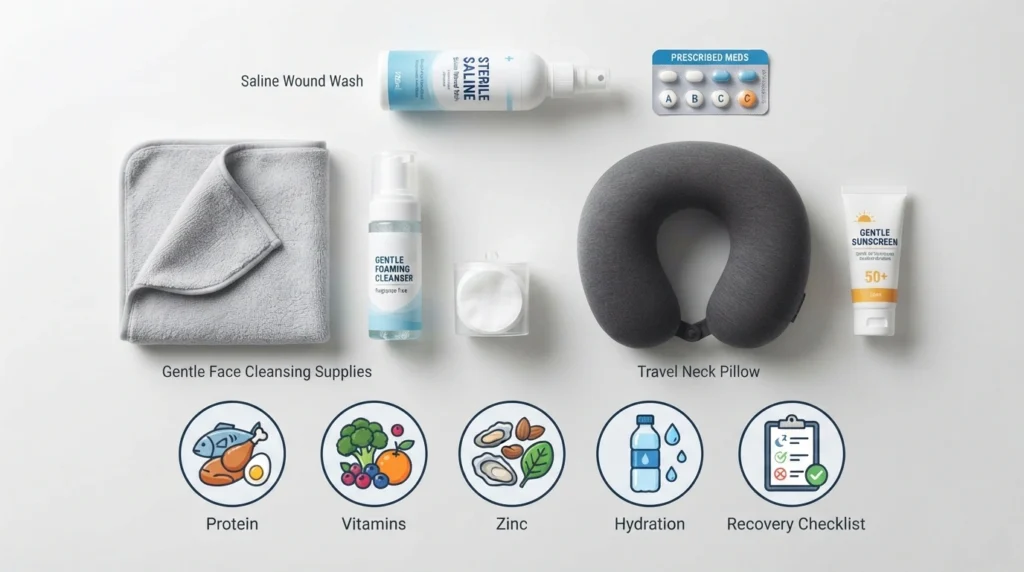
While the surgery of transplanting the hairs from the donor area is as crucial, post-op care is equally important:
- Maintain clean follow your surgeons directions to washing; no rough detergents, scrubs, or products containing alcohol unless otherwise directed.
- Elevate head of bed for first few nights to decrease swelling.
Please do not touch, scratch or pick at scabs, your newly placed follicles are extremely fragile and could be displaced. - Avoid strenuous exercise (weight training, running, contact sports, swimming, saunas) for one or two weeks as sweat can affect the process of healing and the increase of circulation to the wound may be undesirable in the initial phase.
- Don’t smoke and stay away from drinking alcohol too much as these factors can slow down the recovery and limit circulation to the treatment zone.
- Avoid getting direct sunlight, and don’t put a soft hat back on your head until your surgeon says it’s ok.
| Activity | Typical Timeframe |
|---|---|
| Light trimming | Around 3 – 4 weeks |
| Electric trimmer | Usually after complete healing |
| Traditional razor shaving | Only once your surgeon approves |
| Return to desk work | A few days |
| Return to public-facing work | About 1 – 2 weeks |
| Return to exercise | Usually after surgeon approval |
Common Recovery Mistakes to Avoid
- Scratching or picking at the grafts, even mildly.
- Expecting visible results within the first few weeks.
- Comparing your personal healing timeline to someone else’s, every patient heals at a different pace.
- Returning to intense exercise too early.
- Ignoring your specific surgeon’s instructions in favor of generic advice found online.
How We Classify Facial Hair Transplant Prices
Published provider pricing: Pricing that is posted directly by either a provider or a clinic is defined as provider-published pricing and is not to be considered a generic market average.
Independent market data: We compare market values and reference a number of consumer pricing data and other market leading sites; these prices should serve as guidance only as they are typically based on recorded and aggregated data rather than on a particular clinic quote.
HairGrowNeeds estimate: When a trusted current local price can’t be located, HairGrowNeeds may offer an estimation based on market research, which will be reflected in editorial material. This information is for planning purposes and should not be treated as a price quote.
Currency conversions: Local currency conversions are estimates and are subject to exchange rates. Best to check directly with the clinic for pricing and packages and ask for current packages.
Facial Hair Transplant Surgery Cost by Country 2026
The range below represents editorial market estimations and does not represent any particular clinic’s quotes. The Provider-Published Pricing data represents when a current provider for that service publicizes cost, otherwise range value represents market estimations only. Any currency conversions are approximate estimates, not clinic quotes/live rates.
| Country | Estimated Market Range (USD) | Local Currency | Illustrative Graft Range | Notes |
|---|---|---|---|---|
| United States | $2,000 – $18,000 | USD is the local currency | 300 – 3,000+ | Pricing varies widely by surgeon, location, graft count and treatment area |
| Canada | $2,500 – $15,000 | CA$3,500 – CA$20,000 | 300 – 3,000+ | Toronto is the primary hub for facial hair specialists |
| United Kingdom | $2,800 – $16,000 | £2,200 – £12,500 | 300 – 3,000+ | GMC-registered surgeons, strict regulatory oversight |
| Australia | $2,200 – $12,000 | A$3,400 – A$18,500 | 300 – 3,000+ | Fewer dedicated facial-hair specialists than US/UK |
| Mexico | 2,000 – 5,000+ | USD | 300 – 3,000+ | Provider-published 2026 example; package price varies by coverage/grafts |
| Turkey | (£1,500–£4,000) $2,000+ – $5,000+ | Often quoted directly in USD/EUR packages; confirm TRY rate with clinic | 300 – 4,000+ | Large international medical-tourism market with widely advertised hair-transplant packages |
| UAE (Dubai) | $2,500 – $7,500 | AED 9,200 – AED 27,550 (estimate – confirm live rate) | 300 – 3,000+ | Growing hub for Gulf-region and South Asian patients |
| India | $400 – $2,000 | ₹34,000 – ₹170,000 | 300 – 3,000+ | Generally marketed as a lower-cost international option |
Turkey provider-published example: Acıbadem Beauty Center reports 2026 comprehensive beard-transplant package range of approximately £1,500–£4,000. This is an individual provider’s published pricing example, not a verified national Turkish average.
Sources: Pricing data used throughout this article comes from current CareCredit consumer pricing data, RealSelf consumer and surgeon provided pricing data, and provider stated pricing examples when attributed as such. Pricing labeled as “Estimates” per country/city or state is a HairGrowNeeds editorial estimate only and not binding clinic pricing.
Turkey vs. USA vs. Mexico: Which Country Should You Actually Pick
| Turkey | United States | Mexico | |
|---|---|---|---|
| Best for | Maximum graft count at the lowest price, all-inclusive packages | Board-certification, easiest follow-up access | US patients wanting short travel + real savings |
| Relative price | Often marketed as lower-cost than U.S. treatment | Baseline varies by provider | Often marketed as lower-cost than U.S. treatment |
| Travel burden | Long-haul for most Western patients | None | Short flight/drive for US patients |
| Regulatory oversight | Varies significantly by clinic – vet carefully | Regulatory and credentialing requirements differ; verify the individual provider | CMCPER/ISO accreditation available at top clinics |
| Follow-up access | Limited once home | Easiest | Easier – many patients drive back for check-ups |
There is no single “correct” option amongst these – it is simply about the amount of value that you put into your direct follow up vs how much you value saving money by traveling to an alternative location.
Facial Hair Transplant Cost by Treatment Area: U.S. Estimates
The treatment area figures given below are HairGrowNeeds estimations to assist your planning and should not be used as national averages or clinic pricing; graft allocation and costs should always be confirmed in a consultation.
| Treatment Area | Graft Range | Estimated Cost |
|---|---|---|
| Mustache Transplant | 300–500 | $2,000 – $5,000 |
| Goatee Restoration | 400–700 | $3,000 – $6,000 |
| Sideburn Restoration | 200–500 | $2,000 – $5,000 |
| Beard Patch Filling | 500–1,000 | $3,500 – $8,000 |
| Partial Beard Restoration | 800–1,500 | $5,000 – $10,000 |
| Full Beard Transplant | 1,800–3,000+ | $7,000 – $18,000 |
As context, typical 2026 CareCredit data states $4,734 on average nationally for partial beard transplants and $11,461 on average nationally for full beard transplants, within a range of $3,311 – $8,126 for partial and $7,607 – $19,870 for full beard transplantation. It’s important to note these are wider beard transplant ranges, and not a representation of cost for any single area.
Prices will vary significantly depending on the area being treated An estimate for a facial hair transplant, without identifying what area of the face is being operated on is almost meaningless and it is exactly because of this that the vast majority of articles produced by our competitors give a broad generic range that helps no one to estimate cost.
Warning Signs of Unrealistic Pricing
Be cautious if a clinic:
- Promises guaranteed results.
- A crazy low price with absolutely zero detail on what is provided.
- Don’t talk about the risks.
- Can’t clearly state how your graft number was derived.
- Only present heavily edited/filtered photos of prior results.
- Will not allow you to reflect on the procedure, and press to book today.
Facial Hair Transplant Cost by 15 Major U.S. States (Estimated)
Methodology note: These ranges are HairGrowNeeds editorial planning estimates derived from available provider pricing, broader U.S. beard-transplant pricing data, consumer pricing sources and treatment-area/graft considerations. They are not statistical state or city averages and should not be interpreted as verified local market prices or clinic quotes. Where current third-party state-level averages are available, such as CareCredit‘s partial-beard averages, HairGrowNeeds reports those figures separately rather than presenting them as HairGrowNeeds estimates. Actual pricing can vary substantially by surgeon, clinic, graft count, treatment area, technique, donor supply and individual treatment plan.
| State | CareCredit Partial-Beard Average | Major Cities |
|---|---|---|
| California | $5,751 | Los Angeles, San Diego, Beverly Hills |
| New York | $5,385 | NYC, Westchester, Long Island |
| Texas | $4,671 | Houston, Dallas, Austin |
| Florida | $4,669 | Miami, Orlando, Tampa |
| Illinois | $4,677 | Chicago |
| New Jersey | $5,345 | Newark, Hoboken |
| Massachusetts | $5,326 | Boston |
| Pennsylvania | $4,637 | Philadelphia, Pittsburgh |
| Washington | $5,294 | Seattle |
| Michigan | $4,442 | Detroit |
| Arizona | $4,612 | Phoenix |
| Georgia | $4,522 | Atlanta |
| Virginia | $4,681 | Richmond |
| Wisconsin | $4,562 | Milwaukee |
| Utah | $4,475 | Salt Lake City |
These are CareCredit’s published average costs for partial beard transplantation, not full-beard prices and not guaranteed prices from clinics in these states. They should not be used as a quote for a specific treatment plan. Full-beard costs can be substantially higher.
Facial Hair Transplant Cost by 20 Major U.S. Cities (Estimated)
The city averages referenced in the following section are estimates from the HairGrowNeeds editorial team for content planning purposes and are not official published cityverages; they are estimated based on general U.S. Beard transplant costs, treatment area size and graft volumes, and overall provider pricing trends. HairGrowNeeds has no reasonable basis to represent these as standard averages for each city. Clinics may charge significantly higher or lower prices.
| City | Estimated Cost (USD) |
|---|---|
| New York City, NY | $4,500 – $18,000 |
| Los Angeles, CA | $4,200 – $17,500 |
| Houston, TX | $3,200 – $15,000 |
| Dallas, TX | $3,000 – $14,000 |
| Miami, FL | $3,200 – $14,000 |
| Chicago, IL | $3,200 – $14,500 |
| Boston, MA | $3,800 – $16,000 |
| Philadelphia, PA | $3,000 – $14,000 |
| Pittsburgh, PA | $2,900 – $13,000 |
| Austin, TX | $3,000 – $14,500 |
| Long Island, NY | $4,000 – $16,500 |
| Westchester, NY | $4,200 – $17,000 |
| Seattle, WA | $3,500 – $15,000 |
| Denver, CO | $3,000 – $14,000 |
| Milwaukee, WI | $2,800 – $12,500 |
| Detroit, MI | $2,900 – $12,500 |
| Phoenix, AZ | $2,800 – $13,000 |
| Atlanta, GA | $2,800 – $13,000 |
| Salt Lake City, UT | $2,800 – $12,500 |
| Richmond, VA | $2,900 – $13,500 |
Both the state and city tables have a suggested market price range. Experience of the surgeon and technique along with number of grafts would play much greater a role in your final price quote then geographical location would. Always verify with a private consultation.
Facial Hair Transplant Surgeons & Clinics to Research in 2026
Below are example surgeons and clinics known for their facial hair restoration practice. This listing is not an endorsement or guarantee of a provider’s credentials, work, price or availability. Confirm licensing, board-certification (if applicable), clinic registration and experience with facial-hair directly before booking any provider.
United States
| Surgeon / Clinic | Location | Notes |
|---|---|---|
| Dr. Anthony Bared | Miami, FL | Dual board-certified; Foundation Aesthetic Hair Restoration Method, treats brow and beard loss from aging, scarring, genetics |
| Dr. Lawrence Barnard / MAXIM Hair Restoration | NYC & Chicago | Multiple clinics, 3,000+ procedures, dedicated beard/mustache work |
| Dr. Michael Gartner / Nova Medical Hair Transplant | New Jersey | High-volume FUE/FUT clinic |
| Dr. Michael Vories / Carolina Hair Surgery | North & South Carolina | FUE-exclusive practice |
| Dr. Carlos Wesley | New York City | Long-established hair restoration specialist |
Canada
| Surgeon / Clinic | Location | Notes |
|---|---|---|
| Dr. Cory Torgerson / Toronto Hair Transplant Clinic | Toronto, ON | Head & neck surgical background, dedicated facial hair sessions |
| Dr. Jamil Asaria | Toronto, ON | Board-certified facial plastic surgeon, facial hair specialist |
| Dr. Paul Cotterill | Toronto, ON & St. John’s, NL | 30+ years exclusively in hair restoration |
| Dr. Ashlin Alexander | Toronto, ON | Facial plastic surgeon, artistic approach to beard design |
| Dr. Rahal / Rahal Hair Transplant | Ottawa, ON | 13,000+ hair restorations performed |
United Kingdom
| Surgeon / Clinic | Location | Notes |
|---|---|---|
| Wimpole Clinic (Dr. Michael May, Dr. Ismail Ughratdar) | Harley Street, London | GMC-registered, FRCS-qualified surgeons |
| Westminster Medical Group | Harley Street, London | GMC-registered team |
| Berkeley Hair Clinic | Central London | Surgeon-led FUE, dedicated facial hair team |
Australia
| Surgeon / Clinic | Location | Notes |
|---|---|---|
| Dr. TJ / FUE Clinics | Perth, Sydney, Brisbane, Melbourne | 1,500+ procedures performed, Micro FUE and DHI specialist |
Mexico
| Surgeon / Clinic | Location | Notes |
|---|---|---|
| Dr. Ileana Martinez | Guadalajara | Sapphire FUE specialist for international patients |
| Dr. Joaquin Ayala Del Muro | Mexico | 33+ years plastic surgery experience |
| Esthetic Hair Mexico Clinic | Tijuana, Monterrey, CDMX | Turkish-trained surgeons relocated to Mexico |
| Kaloni Clinic | Tijuana, Monterrey, Guadalajara | Popular with North American patients |
Turkey
| Surgeon / Clinic | Location | Notes |
|---|---|---|
| Dr. Serkan Aygin | Istanbul | High-volume facial hair clinic, DHI-dominant protocols |
| Dr. Oya Şişman | Istanbul | 2,800+ procedures |
| Dr. Mehmet Erdogan / Smile Hair Clinic | Istanbul, Turkey | Co-founder of Smile Hair Clinic, Sapphire FUE specialist, 5,000+ procedures performed |
| Dr. Fuzun Erdogan / Adem and Havva Medical Center | Turkey | Sapphire FUE specialist, 4,000+ transplants |
UAE (Dubai)
| Surgeon / Clinic | Location | Notes |
|---|---|---|
| Dr. Cagatay Sezgin | Dubai | ISHRS member, Turkish board-certified surgeon |
| Dr. Vikesh Vij / Kaya Skin Clinic | Dubai | Advanced hair restoration techniques |
| Dr. Yasaman Shariati / Helia Clinic | Dubai | 5,000+ hair and facial hair procedures over 14+ years |
India
| Surgeon / Clinic | Location | Notes |
|---|---|---|
| Dr. Navnit Haror / Dr. Haror’s Wellness | Delhi | 17+ years experience, trained 14,000+ doctors across 31 countries |
| Dr. Shankar Sawant / Rejoice Hair Transplant | Mumbai | 25+ years experience |
| Dr. Malay Mehta | Mumbai | FUE Sapphire specialist |
| Dr. Suneet Soni / Medispa | Jaipur, Delhi, Dubai | 15+ years, 10,000+ patients globally |
The associations, professional credentials etc. Can vary. All users are therefore encouraged to verify their desired provider, licensing, board certification (if necessary) and services available through direct provider confirmation before booking their appointment.
How to Choose the Right Clinic
| Consultation Question | Why It Matters |
|---|---|
| How many facial hair procedures have you personally performed? | Facial hair needs different artistry than scalp work — general experience alone isn’t enough |
| Who performs the extraction and implantation? | In high-volume clinics, technicians sometimes handle placement instead of the surgeon |
| Can I see 12-month results, not just week-one photos? | Early photos always look better than they end up during the shedding phase |
| Is pricing based on graft count or a flat package? | Determines whether your final cost can change mid-treatment |
| What’s included in aftercare? | Medication, follow-up visits, and touch-up policy vary significantly between clinics |
Risks and Complications
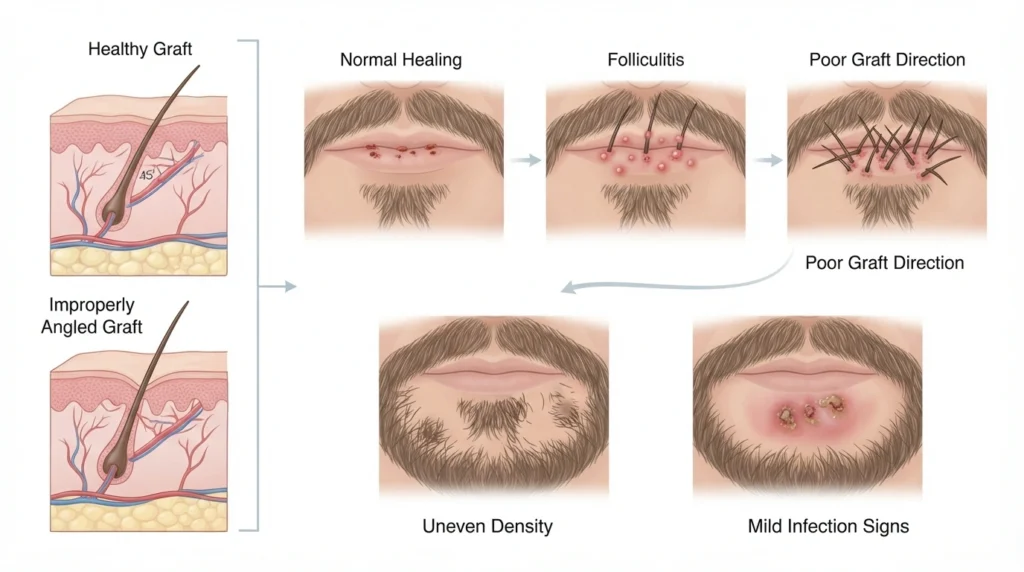
Facial hair transplantation is a surgical procedure and, like other hair-transplant procedures, can involve complications or undesirable outcomes.
Incorrect angle and direction:
Incorrect angle or direction can produce an unnatural-looking result because facial hair follows characteristic growth patterns. Anthony Bared, M.D, ISHRS Beard Mustache Transplant & ISHRS Beard Transplant
Graft failure:
Some transplanted grafts may not survive or may produce less growth than expected. The final result can also vary depending on graft handling, recipient-site preparation, healing and other patient-specific factors.
Infection:
Infection is an uncommon but recognized surgical risk. Increasing redness, warmth, worsening pain, swelling or drainage should be reported to the treating clinician. But, be looking for increasing redness, warmth, or drainage.
Folliculitis:
Folliculitis can present as small inflamed or acne-like bumps around transplanted hairs during healing. Persistent or worsening symptoms should be assessed by the treating clinician.
Uneven growth:
Transplanted hairs may not grow at exactly the same rate or density, particularly during the early growth and maturation period. Persistent unevenness can require assessment by the treating surgeon.
Unnatural appearance:
An unnatural appearance can result from factors such as inappropriate graft direction or angle, poorly planned beard design, or unsuitable density.
Myths Worth Killing
More grafts always mean better results. No it does not. Naturalness is a factor of placement, angle and design. The moderate-density beard with good design looks better than a maximum-density beard with bad placement.
Beard transplants always look fake. Although bad procedures can lead to unnatural looking results, an effective procedure is designed to mimic nature precisely, ideally something that’s imperceptible.
Results are visible immediately. But no, and that is normal. All of the transplanted hairs fall out around week 2-6 then regrow when it’s natural to. But that won’t show real density until 9-12 months.
Any hair can be transplanted anywhere. You will want donor hair with a similar thickness and curl pattern as your recipient area, as well as a growth angle that matches. In other words, scalp hair behaves in a beard quite differently than it will on your mustache.
Facial Hair Transplant vs Alternatives
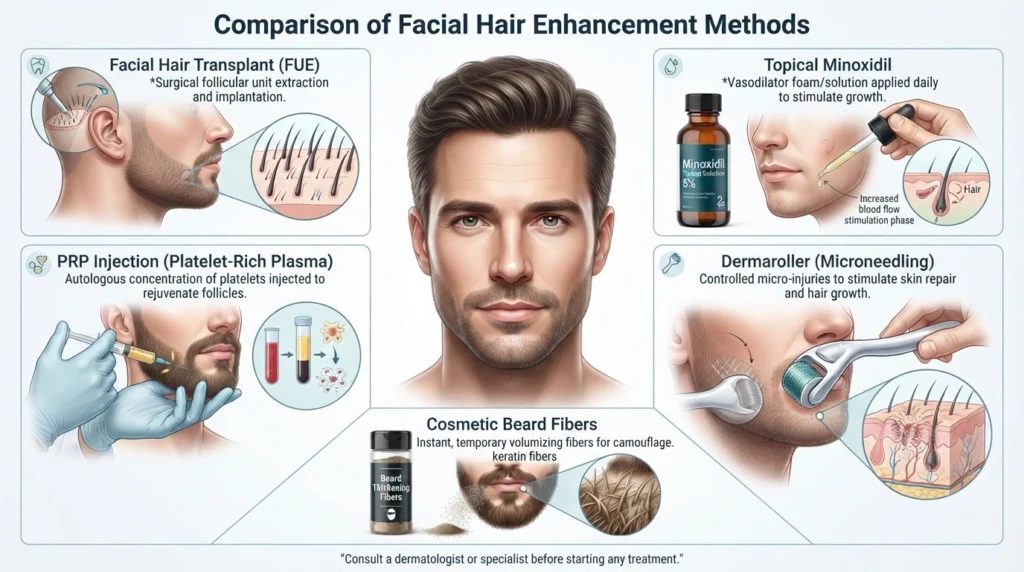
| Option | Permanent? | Creates New Hair? | Requires Surgery? |
|---|---|---|---|
| Facial Hair Transplant | Usually long-lasting | Yes | Yes |
| Minoxidil | Depends on continued use | May stimulate existing follicles only | No |
| PRP Therapy | No | No | Minimal (injection-based) |
| Beard Fibers/Concealers | No | No | No |
| Microneedling | No | No | No |
All nonsurgical therapies (like Minoxidil) can potentially activate or enhance the existing follicles in some patients. It does not, however, contain follicular units as in transplantation which place a follicular unit in an area that needs more coverage. It’s only appropriate if the cause of baldness is suitable.
Straight Hair vs. Curly Hair: Does Texture Change the Approach?
Yes and this is a key thing to know about before meeting with us! Straight hair is a little trickier on density (as a few straight hairs are more obvious than several curlier ones when out of place, straight and curly hair can create different visual effects after transplantation, so the surgeon should account for hair caliber, curl pattern and natural growth direction during planning. The tradeoff here is that the direction of the curls need to be figured out in advance, as a badly angled curl shows up more easily than a badly angled straight hair does, once it has grown out.
What Results Actually Look Like: Realistic Before-and-After Expectations
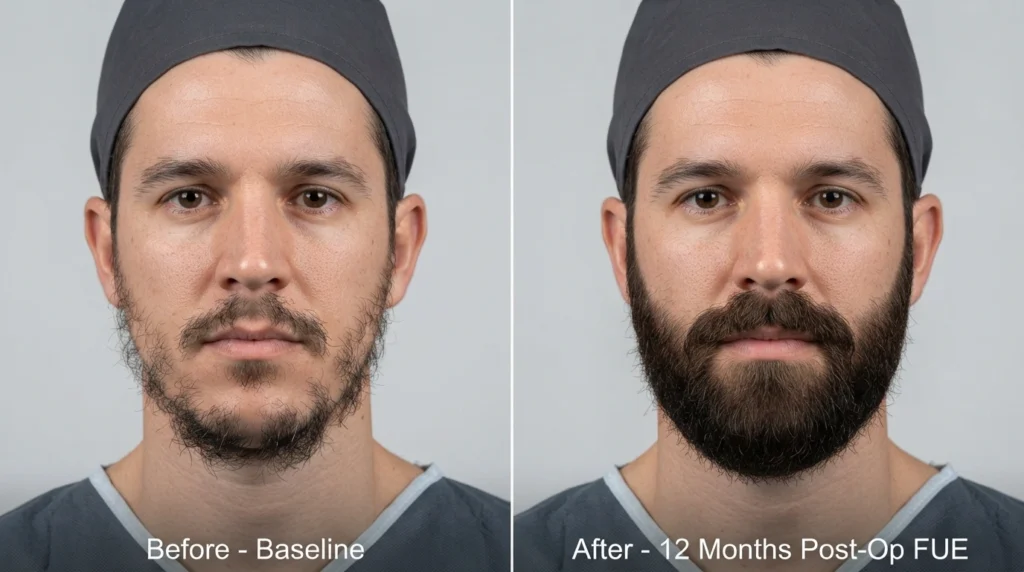
This isn’t something most clinic marketing pages tell you, Many clinic before-and-after galleries emphasize later results, so patients should ask to see consistent long-term follow-up rather than relying only on early postoperative photographs. Compare this picture to your progress photo at week 2 or month 3, and you’ll likely believe that things aren’t going well. They are, but you’re just looking at two very different times on the same curve.
The “realistic” before and after shouldn’t consist of just the “after”. There should be early redness and scabbing within week one, obvious thinning and patches when shedding between week 2 and month 6, thickness starting to fill in between month 3 and months 9, and the final shape and density set no earlier than months 9-12. When browsing any clinics portfolio, make sure that the before images most closely match your starting point and that the “afters” match your beard goals. Photos need to have consistent lighting, but more importantly long-term follow up.
Corrective Facial Hair Transplant Procedures
But sometimes the first procedure is a success and the more of this work there is being done now for a growing amount of patients there has to be a need for someone to go and fix things for someone elsewhere which hasn’t produced the result they desired. There are several issues that result in someone wanting a corrective treatment including the wrong growth direction, uneven density, fake beard lines and scarring from a strip operation (FUT).
Corrective surgeries are far more complicated than a first time transplant. In these procedures, you’re going to be operating on areas where there have been previous grafts, you’re going to have scarring, you’re going to have existing growth, and in these cases, it’s even more important to get someone with a good amount of experience. A good question to ask a surgeon directly is how many corrective cases they’ve handled, not just first-time procedures.
Long-Term Maintenance After Facial Hair Transplant Surgery
One aspect that often goes unmentioned is that a successful transplant maintenance is quite straight forward. Once everything has healed-at least the earliest in month 3-4 and best after 9-12 months to allow the grafts to mature-you can shave, trim, style, sculpt, and condition the transplants the same way you do your natural facial hair.
Another common fear is Will I lose my transplanted beard hair permanently? Transplanted follicles can provide long-lasting growth, but their long-term behavior varies between individuals and transplanted hair can still change with aging and other biological factors, most candidates experience very long-term results. But, keep in mind, over the course of natural aging, both native hair and transplant hair can continue to thin; and taking care of your overall health and following your surgeon’s lifetime maintenance guidance is what is the real reason you look like you did decades ago rather than years ago.
Does Age Affect Candidacy?
Many younger men want to know if they should simply wait. Some men continue to grow beards until their late twenties and family history, hormone levels, or their rate of current growth could mean that improvement might continue naturally. The only really definitive way to know if the time is right for patience vs transplantation is with a visit.
Older people may be concerned that their age in itself makes them an unsuitable candidate. It normally doesn’t. General health is a far more important factor as is, crucially, your supply of available donor hair. Age alone does not necessarily determine candidacy; overall health, donor supply, facial-hair pattern and treatment goals are more relevant factors.
Financing Options
Generally, insurance doesn’t cover facial hair transplants since the procedure is voluntary and cosmetic. One of the few exceptions would be if reconstructive work is needed as a result of injury, burning or disease for which there is a record of these conditions. Financing options may be available through some facial-hair transplant clinics and third-party providers, including:
- Payment plans offered directly by some clinics, including short-term promotional options where available.
- Medical financing products such as CareCredit when accepted by the provider.
- Personal loans as an alternative to clinic-specific financing.
- International clinics may advertise deposits or staged payment arrangements, but terms vary by provider.
Always inquire about the interest and overall price – a short term 0% scheme is vastly different from 18-24% interest credit card pitched similarly to.
FAQs:
Q: Is facial hair transplant surgery permanent?
Follicle transplants can be long-term, often permanent, results, however each individual differs; how successful these results are in the long run is dependent on the quality of the donor, survival of the transplanted grafts, and also what hair the patient genetically has.
Q: How many grafts are needed for a full beard?
The number of grafts for a full beard varies. Some people may only require 200-300 grafts for a thin area, while others may undergo treatment with 1000+ grafts, and in even larger treatment plans, even more! Number of grafts will vary based on coverage, density, donor hair supply, and design.
Q: Is the procedure painful?
A majority of patients feel minimal pain from the anesthetic shots; the procedure is usually painless after the local anesthesia takes effect.
Q: How long does recovery take?
The visible healing mostly finishes within the first 7 to 14 days. However, new facial hair grows to its full potential over a number of months. Some individuals take 12 months to fully reach maturation.
Q: Can women get facial hair transplants?
Candidates may also be suitable for facial hair transplantation in some reconstructive and cosmetic cases where factors such as anatomy, patient desires and available donor hair can be evaluated by their doctor.
Q: Can transgender men get facial hair transplants?
Yes. In some cases, facial-hair transplantation may be considered as part of gender-affirming care. Suitability, timing and treatment goals should be discussed with qualified healthcare professionals.
Q: Can a facial hair transplant cover scars?
Yes, facial-hair transplantation may be used to camouflage certain scars in suitable candidates. The potential result depends on factors such as the type and extent of scarring, the condition of the recipient skin, blood supply and available donor hair. A surgeon should assess the scar before determining whether transplantation is appropriate.
Q: Does insurance cover it?
No for the vast majority of cases as it is deemed cosmetic some exceptions might apply to reconstructive surgery following an injury.
Q: Can body hair be used instead of scalp hair?
In some instances yes, however most body hair is different in texture and density as the normal growing pattern differs from the scalp therefore making the scalp hair is commonly used because its characteristics can be suitable for facial restoration, but donor selection depends on the patient’s hair characteristics, donor supply and treatment goals.
Q: What happens if a facial hair transplant doesn’t turn out well?
Usually the options are to determine the cause of the problem, an extra transplant procedure for a coverage gap or surgery to repair the problem the best choice is dependent on the nature of the issue, the problem can be related to density or the angles of the transplant or scarring.
Q: Should I choose a clinic based only on price?
No, a surgeon’s skill, evidence of successful patients, approach and safety protocols are all more important than the lowest price offered. Low cost may result in expensive re-operations down the track, costing you far more than a reasonable quote the first time.
Conclusion
Facial hair transplantation is a surgical procedure by which living hair follicular units are added to the face where more hair is required. These include where coverage is needed in a genetically sparser areas of the face, to cover scar tissue that has caused hair loss, or to thicken an existing beard and/or mustache. As with all procedures like this, outcome is based on many factors; the donor supply available, graft survival, design, placement of grafts, healing factors & surgeon skill; not the country of surgery or the quoted cost of the procedure.
Request a minimum of two consultations, ask for the actual 12 month results instead of before shots, and ascertain who exactly is doing the implantation on a highly visible area such as your face (that aspect alone carries far more weight than just about anything else you’ll read here).
Written & Reviewed By
Written by: Wajiha Aqeel
Co-Founder & Hair Restoration Research Lead
Data & publication oversight: Daniel Brooks
Co-Founder & Senior Operations & Data Director
Published Date: July 20, 2026
Clinic & Pricing Data Last Reviewed: August 2026
Last Updated: August 24, 2026
Published pricing examples and provider information were reviewed against available clinic, consumer-pricing and professional sources. Figures labeled as estimates are HairGrowNeeds editorial estimates rather than verified clinic quotes. Provider credentials, staffing and treatment availability can change and should be confirmed directly before booking. Local prices are noted as estimates when a clinic does not have a local quote listed. Surgeon names and clinic associations were confirmed on public listing information of clinics as of August 2026.
Note: Staffing and credentials may vary; confirm with clinic prior to scheduling.
Sources & References:
- CareCredit – Beard Transplant Cost and Procedure Guide. Current consumer pricing data, including the reported U.S. partial-beard average of $4,734, full-beard average of $11,461, published ranges, and state-level partial-beard averages.
- International Society of Hair Restoration Surgery (ISHRS) – Beard and Mustache Transplant. Used for facial-hair transplant zones, factors affecting graft quantity, medical considerations and expected growth timeline.
- Epstein J. – Facial Hair in Hair Restoration Surgery: Beard Transplantation and Beard-To-Scalp Hair Restoration. Facial Plastic Surgery Clinics of North America, 2024. Used for facial-hair graft preparation, angulation, recipient-site direction and aesthetic design considerations.
- Bared A. – Beard Hair Transplantation. Facial Plastic Surgery Clinics of North America, 2020. Used as a professional reference for facial-hair transplantation.
- RealSelf — How Much Does a Beard Transplant Cost? Used as a consumer-platform pricing reference and for discussion of factors affecting beard-transplant costs, graft requirements and technique.
- ACIBADEM Beauty Center – How Much Does a Beard Transplant in Turkey Cost in 2026? Used only as an attributed provider-published Turkey pricing example, not as a national average.
- Liu R.H. et al. – A Scoping Review on Complications in Modern Hair Transplantation. Aesthetic Plastic Surgery, 2025. Used for general hair-transplant complication context.
- Complications of Hair Transplant Procedures-Causes and Management. Journal of Cutaneous and Aesthetic Surgery, 2021. Used for discussion of infection, folliculitis, edema, graft dislodgement and other complications.
- Facial Hair Transplantation for Transgender Patients: A Literature Review and Guidelines for Practice. Used for the transgender facial-hair transplantation section.
- Use of Body Hair and Beard Hair in Hair Restoration. Used for discussion of alternative donor-hair sources.
Editorial Sourcing Note: HairGrowNeeds distinguishes provider-published prices, third-party consumer pricing data and HairGrowNeeds editorial estimates. Figures identified as estimates are not presented as verified clinic quotes or statistical local averages. Provider pricing, credentials, staffing and treatment availability can change and should be confirmed directly with the relevant provider before treatment.
Medical & Affiliate Disclaimer:
The content on Hair Grow Needs is for general informational and educational purposes only and should not be considered professional medical advice. For full details regarding our policies, please read our official Disclaimer.