
Medical Disclaimer: This article is for informational purposes only and does not replace professional medical advice. Read our full Medical Disclaimer.
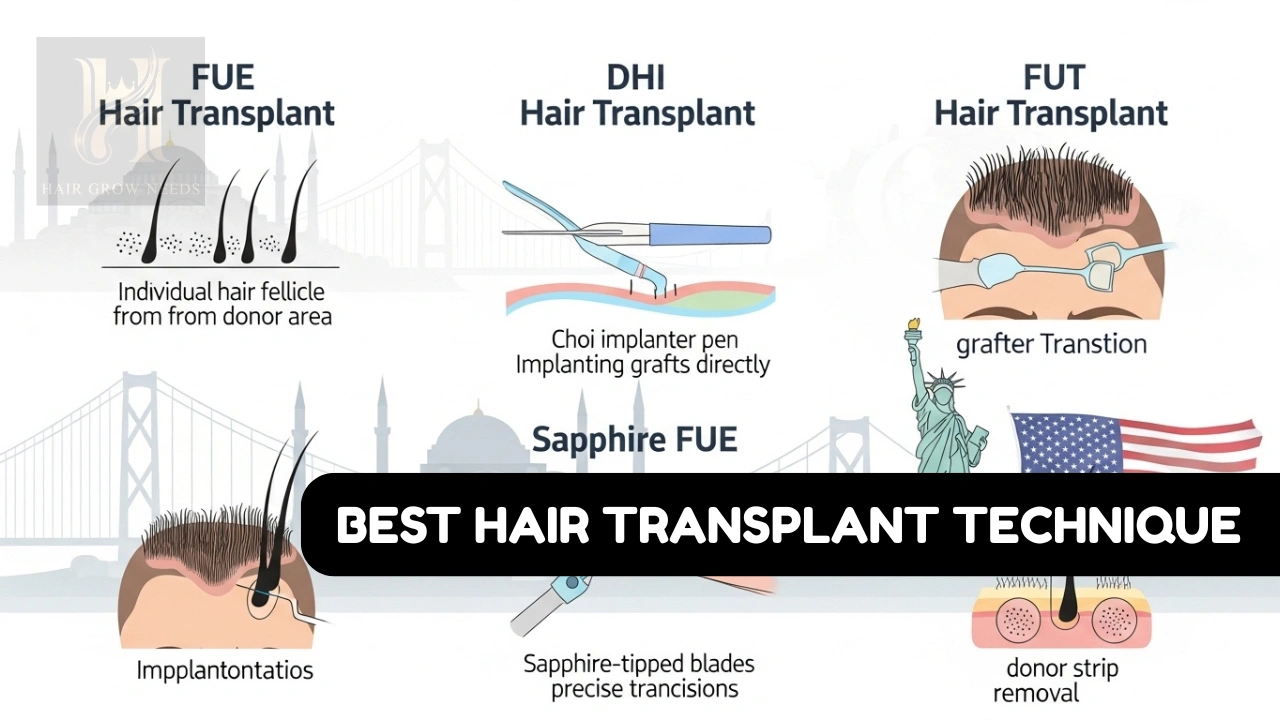
There are 4 major best hair transplant methods in 2026: FUE (Follicular Unit Extraction), DHI (Direct Hair Implantation), Sapphire FUE and FUT (Follicular Unit Transplantation). FUE is the most popular around the world. DHI is highest precision on hairline. Sapphire FUE takes fastest recovery and smaller scar. FUT provides highest number of grafts per session for the lowest price. Costs are from $1,500-$6,000 inclusive Turkey and from $5,000-$20,000 per session USA.
Hair loss is a common problem that causes many people to consider permanent solutions like hair transplant surgery. However, once you begin to research, the first thing that you will encounter is how many best hair transplant technique and list and describe them? Nowadays, there is more than one technique in hair restoration. In fact, there are several methods, each with different pros, cons, and suitable patients. In this post, we will discuss the 4 best hair transplant techniques, what are the main reasons that make them work and also the cost differences in two popular destinations for medical tourism: Turkey and the USA.
If you think that a FUE hair transplant (Follicular Unit Extraction), DHI hair transplant (Direct Hair Implantation), Sapphire FUE technique, or FUT (Follicular Unit Transplantation) is the best hair transplant option, you will find out the way each of them is done, what makes it one of the best hair transplant technique choices, and how much it usually costs in the main markets for treatment.
What Are the Best Hair Transplant Techniques in 2026?
In 2026, hair restoration surgery has become highly sophisticated compared to 10 years ago. The four best hair transplant techniques are performed worldwide-each with its own benefits according to hair loss condition, budget, lifestyle and outcome goals.
To choose which of the best hair transplant techniques suits you best- you will want to weigh the following against each other- the surgical method, scarring, recovery time, graft survival rate, costs, and long-term outcome.
Here you will find a clinical break-down of all four- which most rival websites lack- helping you make an educated decision before attending a consultation
The 4 Best Hair Transplant Techniques Overview Table
| Technique | Method | Scarring | Graft Yield | Recovery | Cost USA | Cost Turkey | Best For |
|---|---|---|---|---|---|---|---|
| FUE | Individual follicle extraction | Tiny dot scars | 2,000 – 4,000/session | 7 – 10 days | $5,000 – $12,000 | $1,500 – $4,500 | Most patients; all loss stages |
| DHI | Choi pen direct implantation | Minimal dots | 1,500 – 3,000/session | 5 – 7 days | $8,000 – $20,000 | $2,500 – $6,000 | Hairline precision; density boost |
| Sapphire FUE | Sapphire blade channel creation | Minimal dots | 2,000 – 4,500/session | 5 – 8 days | $9,000 – $15,000 | $2,000 – $5,500 | High density; faster healing |
| FUT | Strip excision + dissection | Linear scar | 3,000 – 5,000+/session | 10 – 14 days | $4,000 – $15,000 | $1,400 – $3,000 | Advanced loss; maximum grafts |
How Many Best Hair Transplant Techniques Exist?
Presently, four main hair transplant methods are mainly considered effective for obtaining natural and long-lasting results. These techniques are also very popular among the clinics that specialize in Afro hair restoration. Besides, each procedure has its own advantages.
1. FUE Hair Transplant
2. DHI Hair Transplant
3. Sapphire FUE Hair Transplant
4. FUT Hair Transplant
1. FUE Hair Transplant (Follicular Unit Extraction):
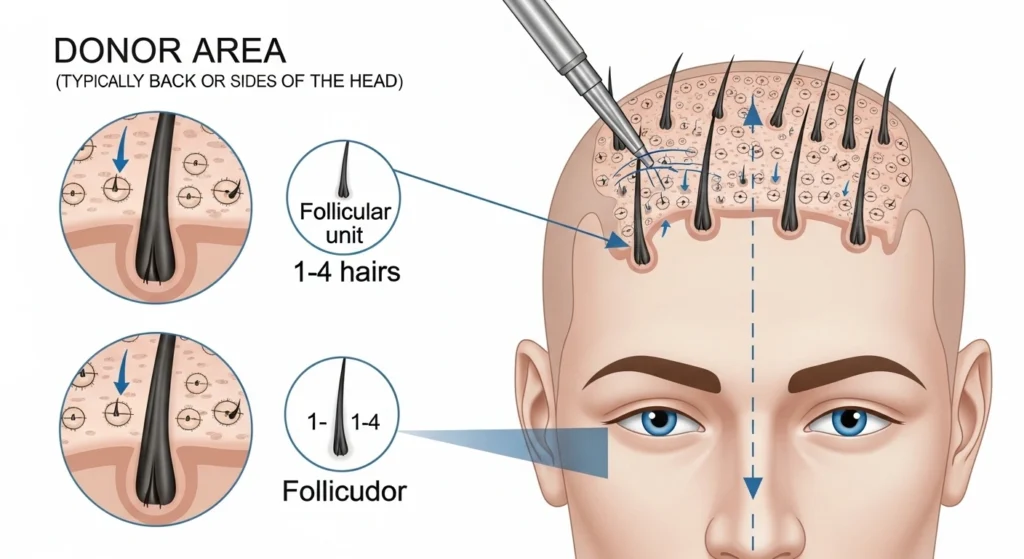
What is FUE Hair Transplant?
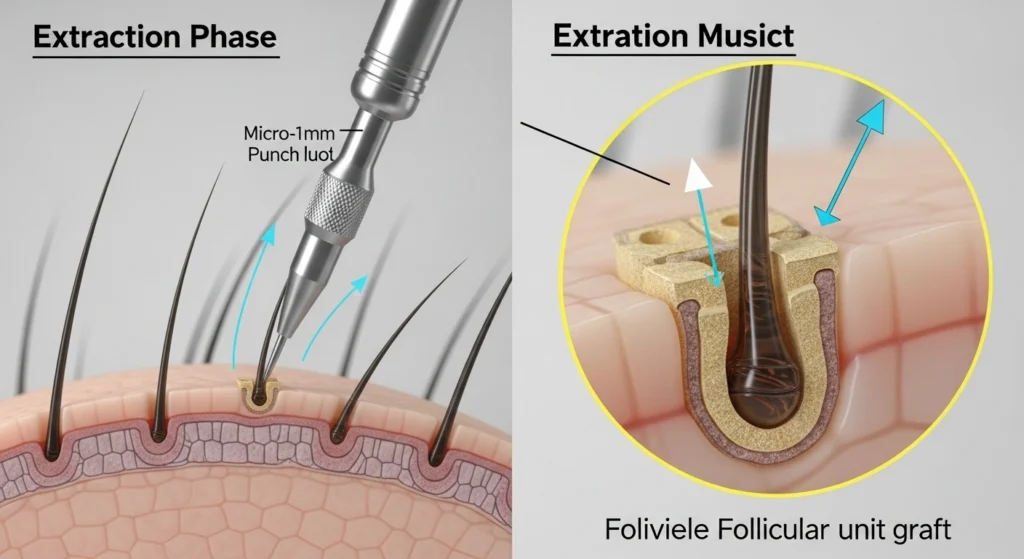
The FUE technique is the world’s leading hair transplant method. In FUE, individual follicular units (1-4 hairs per follicular unit) are extracted from the permanent donor site and transplanted one by one into the recipient area at predetermined angles and depth, with a micro-punch tool (0.7-1.0mm in diameter).
The linear donor scar that results from the strip technique FUT has been removed by FUE to become the number one method used worldwide by patients wanting to have short hair.
How FUE Works Step by Step
| Step | Action | Duration |
|---|---|---|
| 1 | Donor zone shaved, local anesthesia administered | 30 – 60 min |
| 2 | Individual follicles extracted with micro-punch | 2 – 5 hours |
| 3 | Grafts stored in chilled HypoThermosol solution | Concurrent |
| 4 | Recipient site incisions created at natural angles | 1 – 2 hours |
| 5 | Each graft individually implanted | 2 – 4 hours |
| 6 | Post-op dressing, instructions provided | 30 min |
Total procedure time: It’ll take between 6 and 10 hours for a 2-3000 graft session
Who Should Choose FUE
FUE is suitable for the patient who desires short hair options in the aftermath, falls within Norwood levels 2-5, desires minimal noticeable scarring and wants to undergo the most readily available and best hair transplant procedure worldwide. You will find FUE is offered in almost all of the best hair transplant clinics Turkey, USA, Europe etc.
FUE Key Facts
| Factor | FUE Data |
|---|---|
| Graft survival rate | 85 – 95% (experienced surgeon) |
| Scarring | Tiny dot scar – invisible at normal hair length |
| Recovery to work | 3 – 5 days (desk work) |
| Full social recovery | 10 – 14 days |
| Max grafts per session | 4,000 |
| Head shaving required | Yes (donor zone) |
| Best Norwood stage | 2 – 5 |
| Pain level | Mild – local anesthesia |
FUE Cost Comparison 2026
| Location | FUE Cost Range | Per-Graft Cost | Package Includes |
|---|---|---|---|
| Turkey | $1,500 – $4,500 | $0.50 – $1.50 | Hotel, transfers, meds, PRP |
| USA | $5,000 – $12,000 | $4 – $8 | Procedure only typically |
| UK | $5,000 – $12,000 | $4 – $8 | Procedure only typically |
| Poland/Hungary | $2,000 – $5,000 | $2 – $4 | Partial packages |
2. DHI Hair Transplant (Direct Hair Implantation):
What is DHI Hair Transplant?
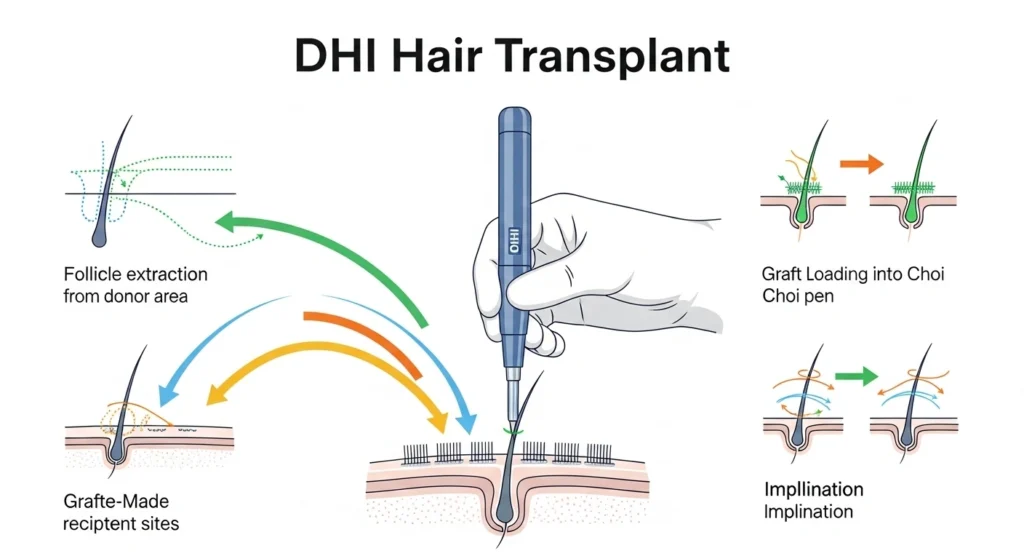
The most high-tech of all hair transplant techniques is the DHI. The special hair transplant instrument used is the Choi Implanter Pen, which is a hollow needle capable of creating the recipient site and implanting the graft in a single motion. This means there is no “site creation” phase like in normal FUE.
DHI was designed to give surgeons more control over where hair will grow – direction, angle and depth being the three criteria to give a natural result post transplant surgery.
How DHI Works Step by Step
| Step | Action | Key Difference vs FUE |
|---|---|---|
| 1 | Follicles extracted individually (same as FUE) | Identical to FUE extraction |
| 2 | Extracted grafts loaded into Choi pen | Grafts not placed in holding solution as long |
| 3 | Pen simultaneously creates channel + implants graft | No separate incision step |
| 4 | Surgeon controls exact angle, depth, direction | Superior precision vs FUE |
DHI Key Facts
| Factor | DHI Data |
|---|---|
| Graft survival rate | 90 – 97% (reduced handling time) |
| Scarring | Minimal – no pre-made incisions |
| Recovery to work | 3 – 5 days |
| Full social recovery | 7 – 10 days |
| Max grafts per session | 3,000 |
| Head shaving required | No shave option available |
| Best Norwood stage | 2 – 4 (hairline focus) |
| Density control | Highest of all techniques |
DHI vs FUE Key Differences
| Factor | FUE | DHI |
|---|---|---|
| Implantation method | Forceps into pre-made incisions | Choi pen simultaneous |
| Handling time per graft | Longer | Shorter – higher survival |
| Hairline precision | Good | Excellent |
| Graft volume per session | Higher | Lower |
| Cost | Lower | 20 – 40% higher than FUE |
| No-shave option | Rarely | Yes – available |
| Best use case | Large coverage areas | Hairline + density boost |
Who Should Choose DHI
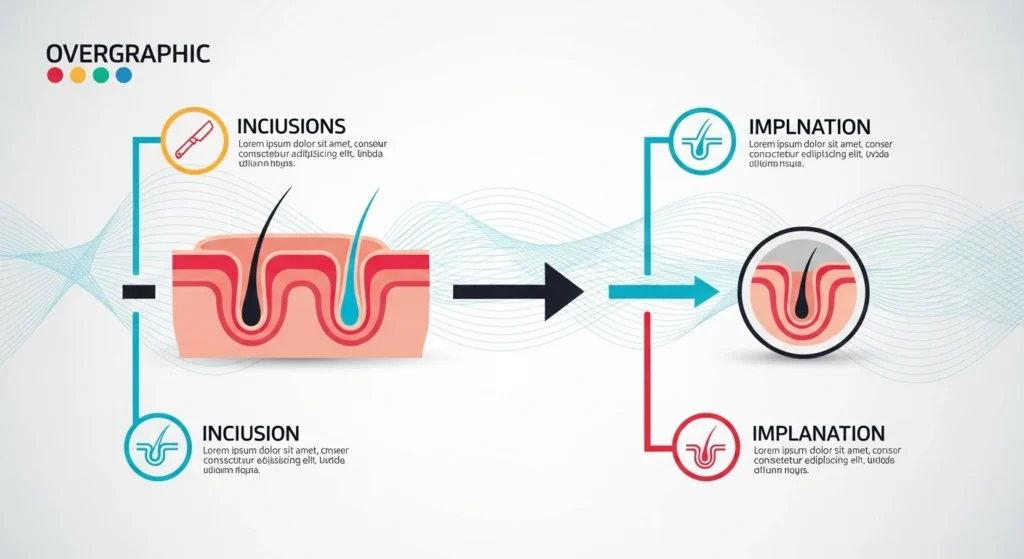
If precision in hairline is important, and shaving off whole head is not desired, the target areas such as the hairline or the crown need to be densified, or the budget is not restricted for the highest graft survival rate, then DHI is the most effective procedure. DHI would be unsuitable if a large amount of grafts need to be implanted, where FUT has an advantage
DHI Cost Comparison 2026
| Location | DHI Cost Range | Per-Graft Cost | Notes |
|---|---|---|---|
| Turkey | $2,500 – $6,000 | $1 – $2 | All-inclusive packages |
| USA | $8,000 – $20,000 | $6 – $12 | Premium pricing |
| UK | $7,000 – $15,000 | $5 – $10 | London clinics highest |
3. Sapphire FUE Hair Transplant:
What is Sapphire FUE Technique?
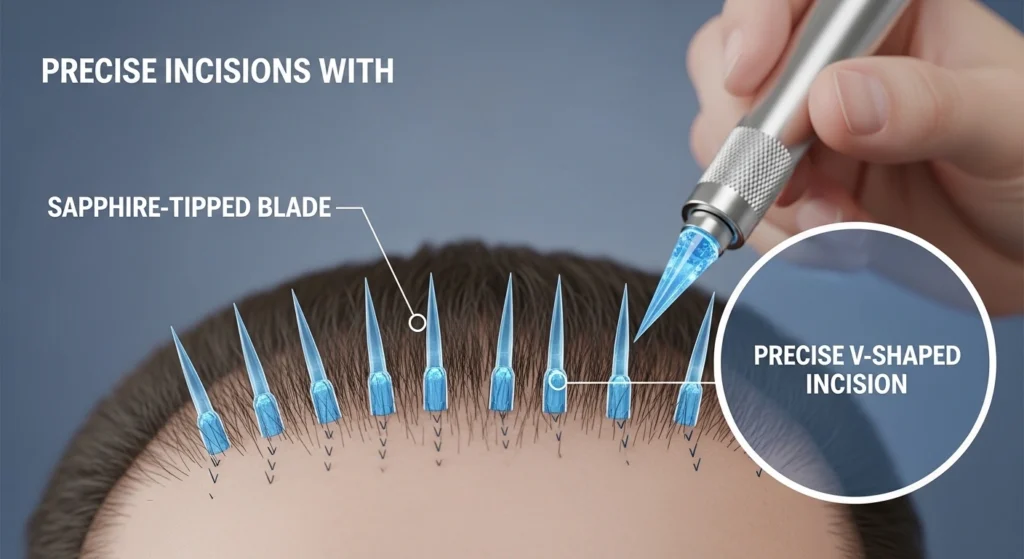
The Sapphire FUE method is an advanced modification of traditional FUE, replacing steel micro-blades with sapphire gemstone-tipped blades to prepare therecipient site incisions, while the graft extraction stage remains unchanged. This difference only applies to the implantation phase.
Sapphire blades are stronger, sharper, and form V-shaped cuts which are finer than steel blades are able to make. This results in less trauma to the surrounding tissue, better fitting grafts, and higher density capacity per cm2, as well as the ability to heal faster.
Sapphire vs Standard FUE Technical Comparison
| Factor | Standard FUE (Steel) | Sapphire FUE |
|---|---|---|
| Blade material | Medical steel | Sapphire gemstone |
| Incision shape | Slit | V-shaped |
| Incision size | Standard | Smaller |
| Tissue trauma | Moderate | Lower |
| Post-op redness | 7 – 10 days | 3 – 5 days |
| Healing speed | Standard | 30 – 40% faster |
| Density potential | Standard | Higher per cm² |
| Infection risk | Standard | Lower (smooth blade) |
| Cost premium | Baseline | +15 – 25% above FUE |
| Graft survival | 85 – 95% | 90 – 97% |
Sapphire FUE Key Facts
| Factor | Sapphire FUE Data |
|---|---|
| Graft survival rate | 90 – 97% |
| Scarring | Minimal – smaller dot scars |
| Recovery to work | 3 – 5 days |
| Full social recovery | 7 – 10 days |
| Max grafts per session | 4,500 |
| Head shaving required | Yes (donor zone) |
| Best Norwood stage | 2 – 6 |
| Unique advantage | Faster healing + higher density |
Who Should Choose Sapphire FUE
The Sapphire FUE method is the superior technique for individuals who are looking for greater density than can be provided by standard FUE, and who also want faster visible recovery and a decrease in post-op redness. It is readily available in all leading Turkish clinics, and in more luxury US and UK practices. This technique is especially favored for those patients who have fine or thinning hair, as it offers maximum density.
Sapphire FUE Cost Comparison 2026
| Location | Sapphire FUE Cost | vs Standard FUE |
|---|---|---|
| Turkey | $2,000 – $5,500 | +20 – 30% premium |
| USA | $9,000 – $15,000 | +20 – 30% premium |
| UK | $7,000 – $14,000 | +20 – 30% premium |
4. FUT Hair Transplant (Follicular Unit Transplantation):
What is FUT Hair Transplant?
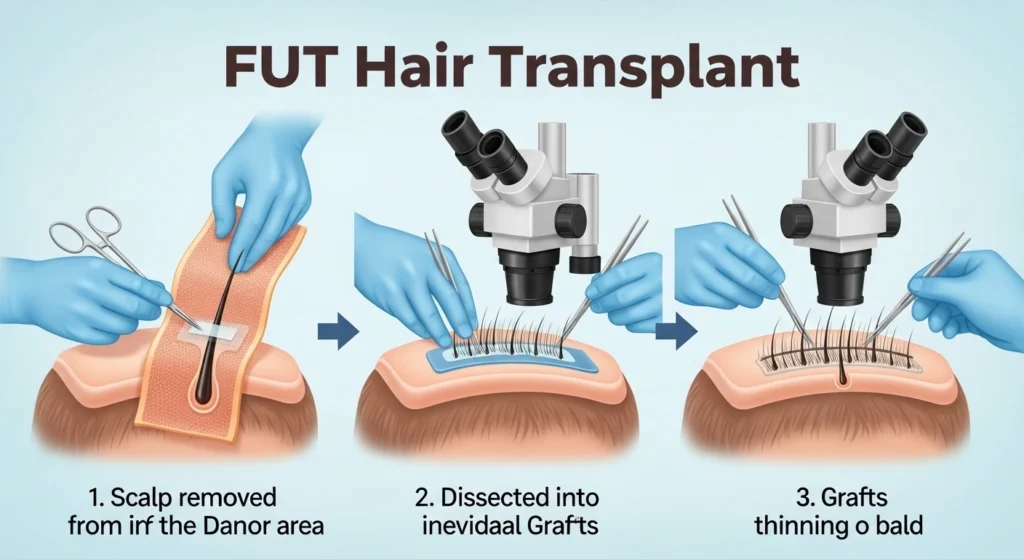
FUT (also know as strip surgery) is the oldest of all the current best hair transplant methods in use. The technique involves surgically extracting a strip of skin (often of size 1 cm 25cm-30cm) from the permanent donor area and dividing it using stereoscopic microscopes to isolated follicular units, which can then be implanted into recipient sites using the same channel and implantation method as with FUE.
Dr. Robert Bernstein is credited with introducing the FUT technique in the 1990s and the system he developed is still considered the standard technique for the very advanced balding patient with Norwood levels 5-7, where large number of grafts can be performed.
FUT Key Facts
| Factor | FUT Data |
|---|---|
| Graft survival rate | 90 – 98% (highest of all techniques) |
| Scarring | Linear scar – concealed by hair |
| Recovery to work | 10 – 14 days |
| Suture removal | Day 10 – 14 |
| Max grafts per session | 5,000+ |
| Head shaving required | Donor strip area only |
| Best Norwood stage | 5 – 7 (advanced loss) |
| Cost per graft | Lowest of all techniques |
FUT Scar The Honest Truth
Linear FUT scar: most of the patients do not like this procedure for this single reason. The factual clinical picture:
| Scar Factor | Reality |
|---|---|
| Width with skilled surgeon | Less than 1 – 2mm (trichophytic closure) |
| Visibility at normal hair length | Generally invisible |
| Visibility with very short hair | Potentially visible |
| Solution if visible | FUE into scar, scalp micropigmentation |
| Patient satisfaction with scar | 90%+ report scar invisible at normal length |
FUT vs FUE Complete Comparison
| Factor | FUT | FUE |
|---|---|---|
| Max grafts/session | 5,000+ | 4,000 |
| Graft survival | 90 – 98% | 85 – 95% |
| Scarring | Linear (hidden) | Dot scars |
| Cost per graft | $3 – $6 | $4 – $8 |
| Recovery | 10–14 days | 7 – 10 days |
| Short hair compatible | No | Yes |
| Future FUE sessions | Still possible | Less donor depletion |
| Best for | Norwood 5 – 7 | Norwood 2 – 5 |
Who Should Choose FUT
FUT would be the ideal technique in: patients with advanced hair loss (Norwood 5-7) where the maximum number of grafts are needed in one procedure; when the price per graft is the primary factor, and in repair hair transplant cases where donor strip harvesting would provide a very high number of grafts. FUT would not be ideal for people with very short hair styles.
FUT Cost Comparison 2026
| Location | FUT Cost Range | Per-Graft Cost |
|---|---|---|
| Turkey | $1,400 – $3,000 | $0.50 – $1.20 |
| USA | $4,000 – $15,000 | $3 – $6 |
| UK | $3,500 – $9,000 | $3 – $6 |
All 4 Techniques Master Comparison Table 2026
| Factor | FUE | DHI | Sapphire FUE | FUT |
|---|---|---|---|---|
| Graft survival | 85 – 95% | 90 – 97% | 90 – 97% | 90 – 98% |
| Scarring | Dot scars | Minimal | Minimal dots | Linear |
| Max grafts/session | 4,000 | 3,000 | 4,500 | 5,000+ |
| Recovery (desk work) | 3 – 5 days | 3 – 5 days | 3 – 5 days | 10 – 14 days |
| Full recovery | 7 – 10 days | 7 – 10 days | 5 – 8 days | 14 days |
| Short hair compatible | Yes | Yes | Yes | No |
| No shave option | Rarely | Yes | No | No |
| Hairline precision | Good | Excellent | Very Good | Good |
| Density potential | High | High | Highest | High |
| Cost Turkey | $1,500 – $4,500 | $2,500 – $6,000 | $2,000 – $5,500 | $1,400 – $3,000 |
| Cost USA | $5,000 – $12,000 | $8,000 – $20,000 | $9,000 – $15,000 | $4,000 – $15,000 |
| Best Norwood stage | 2 – 5 | 2 – 4 | 2 – 6 | 5 – 7 |
| Global availability | ⭐⭐⭐⭐⭐ | ⭐⭐⭐⭐ | ⭐⭐⭐⭐ | ⭐⭐⭐ |
| ISHRS recommended | Yes | Yes | Yes | Yes |
Which Hair Transplant Technique Is Right for You?
Decision Guide by Hair Loss Stage
| Norwood Stage | Hair Loss Description | Recommended Technique |
|---|---|---|
| Stage 1 – 2 | Minimal recession | DHI or Sapphire FUE |
| Stage 3 | Clear recession, temples | FUE or Sapphire FUE |
| Stage 4 | Crown thinning begins | FUE or Sapphire FUE |
| Stage 5 | Crown + frontal merge | FUE or FUT |
| Stage 6 – 7 | Extensive baldness | FUT (max grafts) |
Decision Guide by Patient Priority
| Patient Priority | Best Technique |
|---|---|
| No visible scar | FUE or DHI |
| Maximum graft count | FUT |
| Fastest healing | Sapphire FUE or DHI |
| Lowest cost | FUT |
| Best hairline precision | DHI |
| Short hairstyle post-op | FUE or DHI |
| Female hair restoration | DHI or Sapphire FUE |
| Afro/textured hair | Sapphire FUE or DHI |
| Repair/corrective work | FUT + FUE combination |
Combination Approaches
Most top surgeons advise the combined technique for best results:
FUT + FUE Combination: Use FUT to produce the most possible yield for a donor, supplement later with FUE from remainder of donor zone. Most beneficial for the Norwood 6-7 patient who will need their donor zone managed for life.
FUE + DHI Combination: FUE to increase density in the crown and mid-scalp area. DHI to provide excellent precision to the hairline. Only used when there is not one optimal technique that can cover both areas.
Sapphire FUE + PRP: A session of Sapphire FUE surgery along with the injections of PRP to enhance the survival rate of the grafts, and minimize post-operative redness. Normally offered as a package deal by the Turkish clinics.
Turkey vs USA Best Hair Transplant Technique Cost 2026
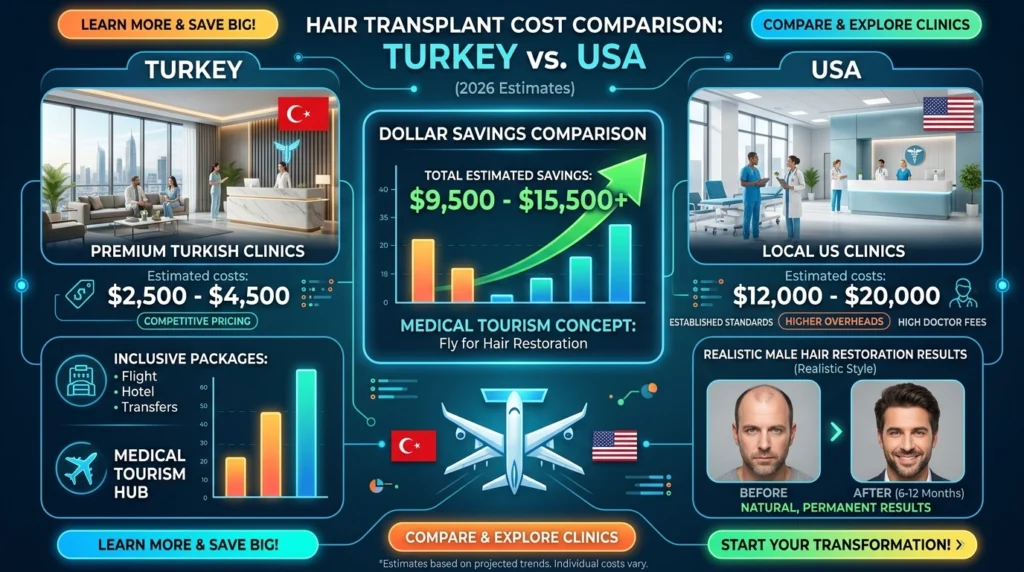
A price comparison chart is given below. Turkey offers cheapest prices, common among medical tourists. The U. S. Charges more due to higher overheads and regulation. Prices are vary based on clinic location, quality and region.
| Technique | Turkey All-Inclusive | USA Procedure Only | Savings vs USA |
|---|---|---|---|
| FUE | $1,500 – $4,500 | $5,000 – $12,000 | 60 – 75% |
| DHI | $2,500 – $6,000 | $8,000 – $20,000 | 65 – 75% |
| Sapphire FUE | $2,000 – $5,500 | $9,000 – $15,000 | 60 – 75% |
| FUT | $1,400 – $3,000 | $4,000 – $15,000 | 60 – 80% |
What Turkey All-Inclusive Packages Include
| Included in Turkey | NOT Included |
|---|---|
| Full surgical procedure | International flights |
| 3 – 5 nights hotel (4-star) | Travel insurance |
| VIP airport transfers | Extra PRP sessions |
| Post-op medications + shampoo | Touch-up procedures |
| PRP therapy (1 – 3 sessions) | – |
| 12-month online follow-up | – |
| English-speaking coordinator | – |
Turkey vs USA Risk-Adjusted Comparison
| Factor | Turkey | USA |
|---|---|---|
| Cost | Excellent | Premium |
| Post-op surgeon access | None locally | Same surgeon |
| FDA/regulatory oversight | Turkish Ministry of Health | FDA regulated |
| Language | English available | Native |
| Legal recourse | Limited | Full US legal system |
| Travel complication risk | Present | None |
| Best for | Budget-priority patients | Follow-up priority |
Graft Survival Rate Why It Matters More Than Technique
A graft survival rate, refers to the number of transplanted hairs successfully and permanently engrafted. It is arguably the most important end-point measure of hair transplantation – even more so than the name of the technique.
Graft Survival by Technique (Experienced Surgeon)
| Technique | Typical Survival Range | Key Factor |
|---|---|---|
| FUT | 90 – 98% | Strip dissection preserves maximum follicle integrity |
| DHI | 90 – 97% | Reduced graft handling time via Choi pen |
| Sapphire FUE | 90 – 97% | Smaller incisions reduce scalp trauma |
| Standard FUE | 85 – 95% | Technique dependent on surgeon skill |
What Reduces Graft Survival
| Risk Factor | Impact |
|---|---|
| Technician extraction (not surgeon) | Up to 30% survival reduction |
| Improper storage solution | 15 – 20% reduction |
| Extended out-of-body time | Progressive decline after 6 hours |
| Over-harvesting donor zone | Follicle shock, reduced yield |
| Incorrect extraction angle | Direct follicle transection |
Key takeaway: An experienced surgeon with standard FUE would be more successful than an amateur with the highest spec DHI equipment. Expertise of surgeon is more important than technique.
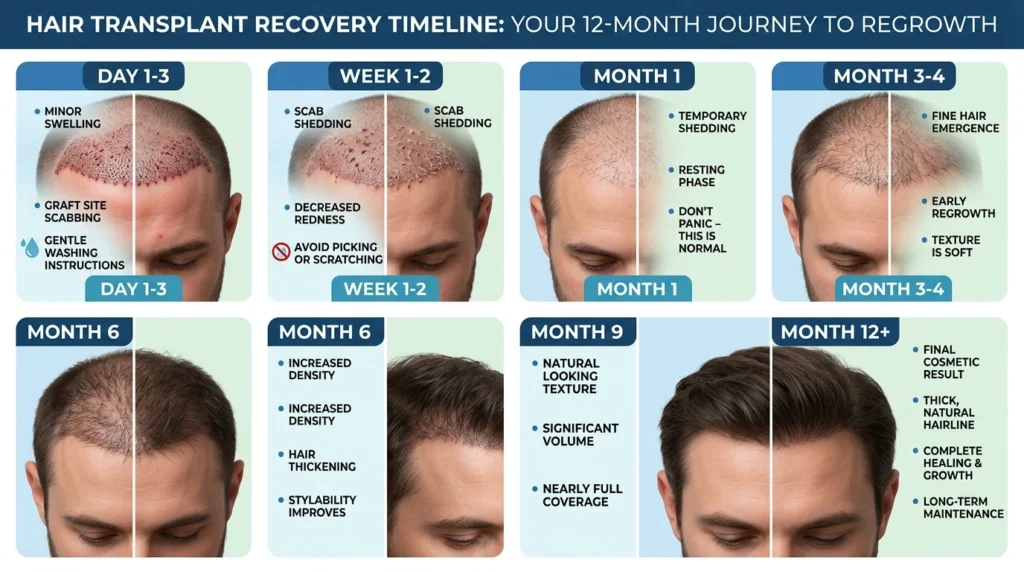
Recovery Timeline All 4 Techniques Compared
| Timeframe | FUE | DHI | Sapphire FUE | FUT |
|---|---|---|---|---|
| Day 1 – 3 | Scabbing, mild swelling | Minimal swelling | Less redness than FUE | Donor tightness, swelling |
| Day 4 – 7 | Scabs softening | Scabs minimal | Scabs resolving faster | Sutures in place |
| Week 2 | Scabs shed | Almost clear | Clear | Suture removal |
| Month 1 | Shock loss begins | Shock loss begins | Shock loss begins | Shock loss begins |
| Month 3 – 4 | First growth | First growth | First growth (slightly earlier) | First growth |
| Month 6 | 50 – 60% density | 50 – 60% density | 55 – 65% density | 50 – 60% density |
| Month 9 – 12 | Final results | Final results | Final results | Final results |
Best Hair Transplant Techniques for Specific Groups
For Women
| Technique | Suitability for Women | Why |
|---|---|---|
| DHI | Excellent | No shave option; hairline precision |
| Sapphire FUE | Very Good | High density; faster healing |
| FUE | Good | Widely available; natural results |
| FUT | Limited | No full shave required but linear scar |
For African/Afro-Textured Hair
| Technique | Suitability for Afro Hair | Why |
|---|---|---|
| Sapphire FUE | Best | Smaller incisions accommodate curved follicles |
| DHI | Best | Choi pen precision for natural Afro hairline |
| FUE (curved punch) | Good | Requires specialized curved extraction tools |
| FUT | Moderate | Dissection complexity for coiled follicles |
For Beard Transplants
| Technique | Suitability | Why |
|---|---|---|
| DHI | Best | Precise direction control for natural beard pattern |
| FUE | Good | Standard choice for beard cases |
| Sapphire FUE | Good | Higher density for beard coverage |
| FUT | Not recommended | Linear scar in donor zone |
How to Choose the Right Clinic for Your Technique
Non-Negotiable Checklist
| Factor | What to Verify |
|---|---|
| ISHRS/ABHRS membership | Verify at ishrs.org or abhrs.org |
| Surgeon performs extraction | Ask explicitly – not technicians |
| Technique-specific portfolio | Before/after cases matching your hair type |
| Graft survival rate disclosure | Ask for their documented rate |
| Storage solution quality | HypoThermosol or equivalent |
| All-inclusive written quote | No hidden fees |
Red Flags Any Technique, Any Country
- Not present by the surgeon during extraction.
- Unlimited grafts” claims-not possible, at least not for this level of quality.
- No named physician on website.
- Under $1000 total-impossible at this quality level (Turkey).
- No Ministry of Health license (Turkey clinics)
- Not verifiable as a member of ISHRS/ABHRS.
Non-Surgical Alternatives to Hair Transplant Techniques
For patients not yet ready for surgery:
| Treatment | Effectiveness | Duration | Cost | Best For |
|---|---|---|---|---|
| PRP Therapy | Moderate | 12 – 18 months | $1,500 – $4,500/yr | Early loss; post-transplant |
| Minoxidil | Moderate | Ongoing | $200 – $600/yr | Slowing loss |
| Finasteride | High (men) | Ongoing | $200 – $800/yr | DHT reduction |
| Low-Level Laser | Mild-Moderate | Ongoing | $300 – $3,000 | Complement therapy |
| Scalp Micropigmentation | Cosmetic only | 3 – 5 years | $1,500 – $4,000 | Illusion of density |
FAQs
Q: What are the best hair transplant techniques 2026?
The four best hair transplant methods include FUE, DHI, Sapphire FUE and FUT. FUE can be found most widely, while DHI allows for the most precision, Sapphire FUE ensures the fastest healing, and FUT for the largest possible graft session.
Q: Which hair transplant method provides the best results?
Each hair transplant method provides excellent, long lasting and natural results if performed by a skilled surgeon. DHI and Sapphire FUE provide the best success rates for graft survival (90-97%). FUT provides a 90-98% survival rate, particularly in advanced cases. Technique over name provides the better results.
Q: Is DHI better than FUE?
While DHI offers finer hairline results, as well as increased graft survival due to reduced handling time, FUE is the better option if you have large areas to cover and allow for larger graft sessions, as it is most readily available.
Q: What is Sapphire FUE and is it worth it?
Sapphire FUE uses sapphire tipped micro-blades rather than steel. These smaller, sharper blades produce more precise and therefore, faster healing incisions. The technique allows for greater density than normal FUE as well as quicker post-operative recovery and less swelling and redness. It costs 20-30% more than standard FUE. The top Turkish clinics include Sapphire FUE as the standard method.
Q: What is the cheapest hair transplant method?
The cheapest technique on a per-graft basis ($3-$6 USA, $0.50-$1.20 Turkey) is FUT, followed by standard FUE then the higher-priced DHI.
Q: How many grafts can each method transplant per session?
FUT methods have up to 5,000+ grafts per session, Sapphire FUE up to 4,500, and FUE up to 4,000. The largest capacity with DHI is up to 3,000 grafts per session. This varies greatly depending on donor hair density.
Q: Which method is best for women?
DHI is generally considered the best hair transplant technique for women – allowing for non-shaved procedures, hairline precision, and high density restoration. Sapphire FUE is second best.
Q: Is Turkey or the USA better for hair transplants?
While Turkey allows for 60-75% savings with all-inclusive packages including aftercare, the USA offers same-surgeon post-op visits, strict FDA regulations and more legal recourse. For patients where budget is key, and the quality is still comparable, top clinics in Turkey are a great option; otherwise the USA.
Q: How long is the recovery for each method?
Recovery is around 3-5 days to return to desk work in FUE and DHI and 7-10 for full recovery. It is slightly quicker with Sapphire FUE (5-8 days). Sutures removed from FUT on days 10-14.
Q: Which method is best for afro-textured hair?
Sapphire FUE and DHI provide the best results for Afro-textured hair. The smaller incisions made with the sapphire tipped blades, and the DHI Choi pen’s precise implantation allow for curved follicle structures, with an experienced surgeon particularly trained in this.
Conclusion:
In 2026 four of the best hair transplant procedures meet the needs of various patients-and truly understanding the distinctions between FUE, DHI, Sapphire FUE and FUT is the first step in making the best choice.
The biggest decision is not what procedure-but what doctor performs it. An expert FUE surgeon will always out-perform an average DHI surgeon. Before scheduling make sure you:
- Are the performing doctor ISHRS or ABHRS board certified.
- The specific named physician performing the procedure actually does your extraction.
- The performing doctor has excellent, and has given you graft survival rate information.
Whether your preference is FUE to maximize availability, DHI for the hairline, Sapphire FUE for faster recovery or FUT for a maximize graft yield, the four best hair transplant procedures will produce permanent natural results when performed by the correct doctor.
Medical Review & References
Co-Founder & Lead Medical Researcher: Wajiha Aqeel
Oversees clinic auditing process and medical research compliance.
Co-Founder & Director of Healthcare Data Transparency: Daniel Brooks
Manages nationwide cost-index verification and operational growth.
Verification: Fact-Checked & Institutional Verification: July 2026
References:
- International Society of Hair Restoration Surgery (ISHRS) – ishrs.org
- American Board of Hair Restoration Surgery (ABHRS) – abhrs.org
- Bernstein RM, Rassman WR. Follicular Transplantation. IJARS, 1995
- American Academy of Dermatology (AAD) – aad.org
- Mayo Clinic Hair Loss Resources – mayoclinic.org
- PubMed FUE/DHI/FUT Clinical Studies – pubmed.ncbi.nlm.nih.gov
- FUE Europe – fue-europe.com
The content of this article is for informational use only. Please see a board certified hair restoration surgeon to get properly diagnosed and have a treatment plan developed for you.
Medical & Affiliate Disclaimer:
The content on Hair Grow Needs is for general informational and educational purposes only and should not be considered professional medical advice. For full details regarding our policies, please read our official Disclaimer.