
Medical Disclaimer: This article is for informational purposes only and does not replace professional medical advice. Read our full Medical Disclaimer.
The cost of hair transplant in Pittsburgh in 2026 ranges from $4,000 to $15,000, depending on the amount of grafts transplanted and the procedure performed. Standard FUE averages between $3 and $6 per graft. Robotic ARTAS FUE, available at Hair Restoration Pittsburgh with Dr. Brian Heil, ranges from $4 to $7 per graft. A typical 1,500 to 2,000 grafts to restore the front hairline will cost about $5,500 to $9,000 all included at a reputable clinic in Pittsburgh. Pittsburgh is about 40-60% cheaper than New York and 15-25% cheaper than Philadelphia with similar quality. Highly regarded and verified surgeons include Dr. Brian Heil, Dr. Paul Leong, and Dr. James Fernau. You should expect to see final results of hair restoration in about 9-12 months.
Most hair transplant guides written in Pittsburgh offer a list of clinic names, a broad price range, and the five FAQ answers you would expect to find everywhere on the Internet. This is not a guide of that sort. If you have been seriously considering getting a hair transplant in Pittsburgh for a month, or a year, or more – you need a clear and comprehensive overview.
Pittsburgh has quietly emerged as a strong choice for hair transplant surgery in the US. It’s one of the locations where you can receive the ARTAS robotic FUE treatment, several doctors with specialized experience have built credible practices there, and pricing is actually affordable at a significant discount from New York, LA or even Chicago. If you are located in Pennsylvania, or nearby, then this opportunity is likely worth your consideration.
What Is a Hair Transplant and How Does It Actually Work
A hair transplant actually transfers viable hair follicles from the donor area, the areas of your scalp on the back and sides of your head genetically resistant to DHT, to areas where hair growth has receded or stalled. Once the follicles are transplanted, they continue to retain their genetic programming, and thus, the transplanted hair remains permanent; this theory is known as donor dominance and has provided the biological basis for hair transplantation for decades.
What has evolved over the years since the era of hair plugs in the 1970’s and 1980’s is precision. FUE hair transplant methods take a single follicular unit containing 1-4 hairs and removes it using a micro punch tool 0.7-1.0 mm in diameter. It does not leave a linear scar and after surgery, it becomes undetectable; if properly performed, density appears natural.
Multiple surgical methods-standard FUE, ARTAS robotic FUE, FUT and DHI-are available at the hair transplant clinics established in Pittsburgh; here is what it means to you:
Hair Transplant Procedures Available in Pittsburgh
FUE Follicular Unit Extraction

FUE is the most widely performed procedure at all of the Pittsburgh hair clinics in 2026. A single follicle is removed from a donor site and implanted into a recipient site. The result is no linear scar, a faster healing time than FUT, and a results that is imperceptible at any hairstyle.
It is the ideal procedure for the majority of patients with Norwood Type II through Type V hair loss and for beard and eyebrow transplants.
Robotic FUE ARTAS iX System
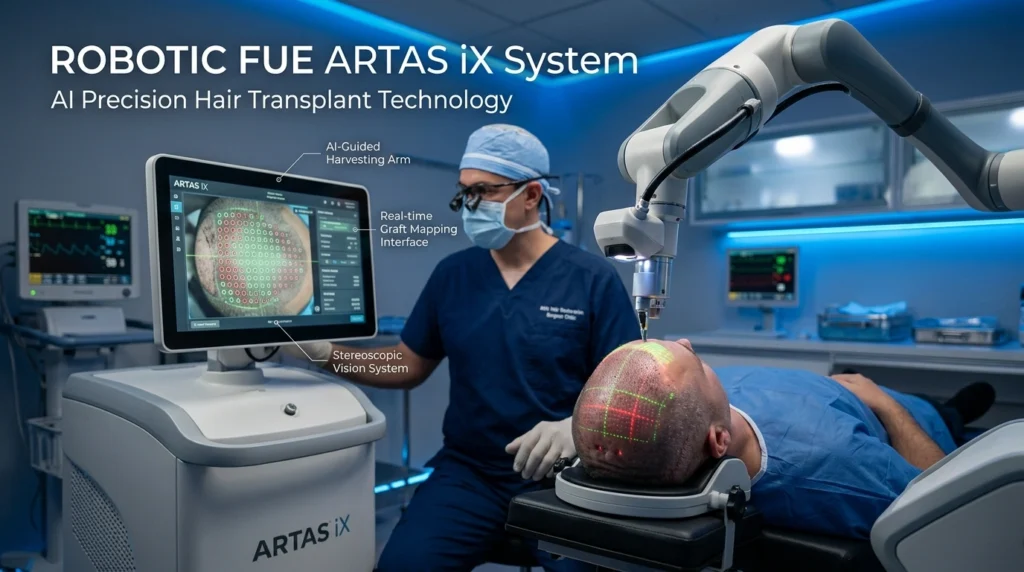
This is one of those cities that has the ARTAS system (robotic FUE) really available in the US – in Pittsburgh, Hair Restoration Pittsburgh with Dr Brian Heil is the place that has it. ARTAS uses AI robots for the extraction process which makes the extraction itself very consistent and lower rates of transection for large graft sessions over manual extraction.
It is more expensive than normal FUE, however-but the increased accuracy is a real benefit for the proper case. If you’re considering 2,500 grafts and above you need to be asking about it in your consultation.
FUT Follicular Unit Transplantation
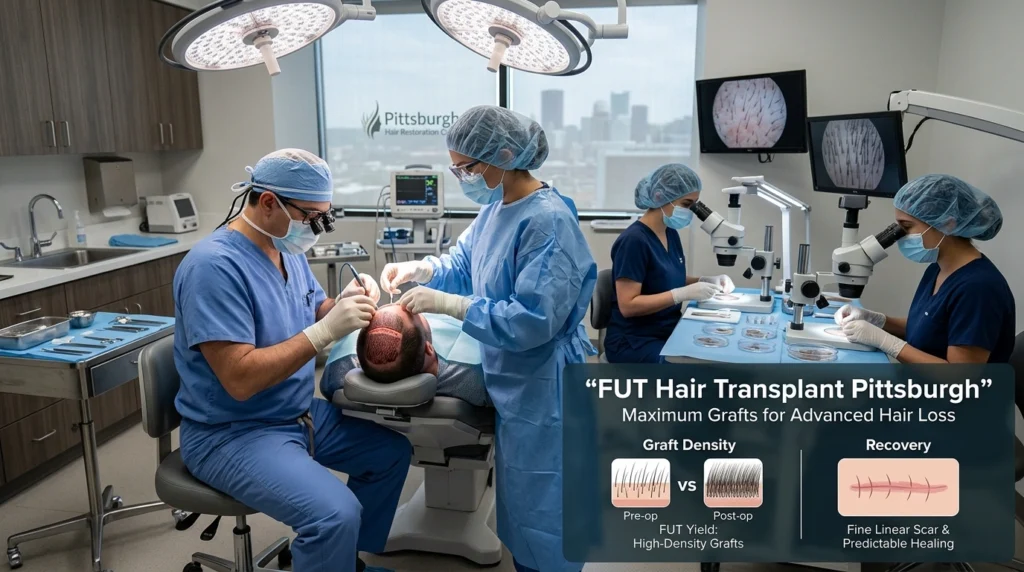
FUT surgery involves excising a strip of scalp tissue from the donor area, separating it into individual grafts with a microscope and then transplanting them. This procedure results in a linear scar that can be covered by surrounding hair but will be apparent when the hair is very short.
This method permits a larger number of grafts in a single session, making it suitable for a patient who requires maximum density with minimal or no need for future sessions and who have more extensive Norwood V or VI hair loss. Clinics can be found in the Pittsburgh area.
DHI Direct Hair Implantation
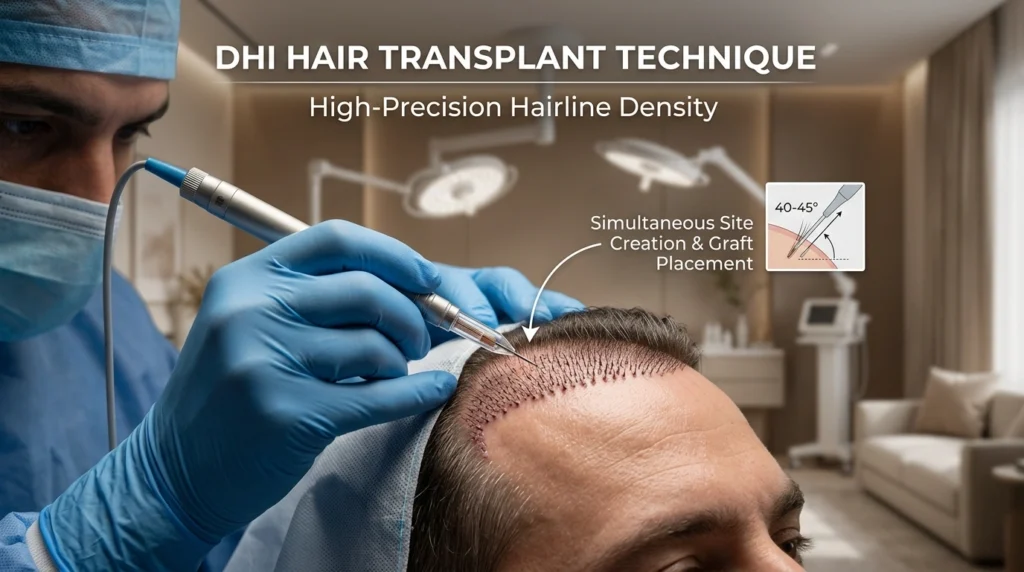
DHI uses a Choi implanter pen to implant the grafts directly into the scalp without a pre-made channel. This allows greater accuracy in the angle and direction of the graft placement and is capable of achieving a very precise density at the hairline.
This technique needs further training and tends to be more expensive. You must ask whether your surgeon has specific experience in the DHI technique and not simply whether the clinic offers it.
No-Shave FUE
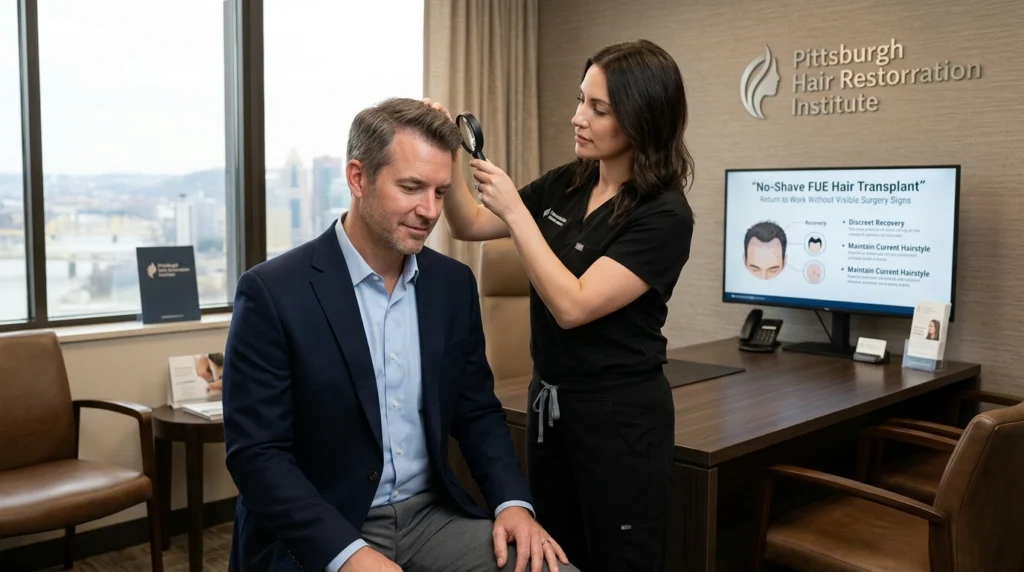
You can find no-shave FUE (both extraction and planting) at a couple of different clinics in the Pittsburgh area. This is especially good for patients with a profession or public life who need to return immediately without any sign that they had surgery.
No-shave is explicitly mentioned as one of Natural Transplants’ specialty services.
PRP Therapy Platelet-Rich Plasma
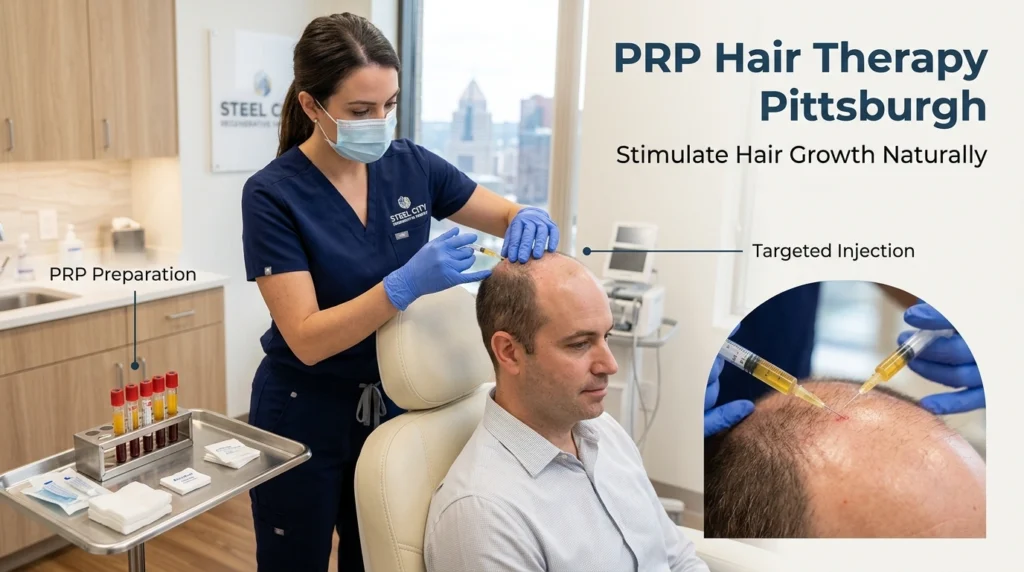
PRP isn’t a transplant, instead the growth factors concentrated from your blood stimulate existing hair and help with the viability of grafts post-transplant.
Offered at most Pittsburgh clinics as a standalone treatment for early stages of thinning or an additional to FUE. Best to discuss it at consultation, but is no replacement for hair restoration if there is major loss.
Understanding Your Hair Loss The Norwood Scale
You know exactly what surgery and graft number you should get prior to any Pittsburgh consultation. Walking in without that information opens you up to being upsold graft number or procedure complexity.
| Norwood Type | Hair Loss Pattern | Typical Graft Need | Realistic Pittsburgh Cost |
|---|---|---|---|
| Type I – II | Minimal temple recession | 500 – 1,000 | $2,500 – $5,500 |
| Type IIa – IIIa | Moderate frontal and temple recession | 1,000 – 2,000 | $4,000 – $9,000 |
| Type III – IV | Significant frontal loss, early crown thinning | 2,000 – 3,500 | $7,000 – $13,000 |
| Type IV – V | Extensive crown and frontal loss | 3,000 – 5,000 | $10,000 – $15,000 |
| Type VI – VII | Advanced loss across full scalp | 5,000+ | Multiple sessions needed |
Hair Transplant Cost in Pittsburgh Real 2026 Numbers
Pittsburgh is priced competitively. Here is the real market.
| Procedure | Cost Range Pittsburgh | Average Per Graft | Recovery Time |
|---|---|---|---|
| Standard FUE | $4,000 – $15,000 | $3.00 – $6.00 | 7 – 10 days |
| Robotic FUE ARTAS | $6,000 – $16,000 | $4.00 – $7.00 | 7 – 10 days |
| DHI Hair Transplant | $5,000 – $15,000 | $3.50 – $6.50 | 7 – 10 days |
| FUT Strip | $3,500 – $12,000 | $2.50 – $5.00 | 10 – 14 days |
| No-Shave FUE | $5,500 – $16,000 | $4.00 – $7.00 | 7 – 10 days |
| Beard Transplant | $3,000 – $8,000 | – | 7 – 10 days |
| Eyebrow Transplant | $2,000 – $5,500 | – | 7 – 10 days |
| PRP Therapy per session | $400 – $1,000 | – | None |
| PRP Add-on Post Transplant | $500 – $1,500 | – | None |
Overall graft number is the biggest determinant. Technique will influence the price one way or another – robotics FUE is a more expensive option that manual FUE given a specific graft count. Surgeon experience level, clinic prestige are also factors. For a front hairline restoration of 1500-2000 grafts, you can expect anywhere from $5,500 to $9,000 all inclusive for a good, respected clinic in Pittsburgh prior to add on features.
Pittsburgh vs Other US Cities
| City | Average FUE Cost | Robotic FUE Available | vs Pittsburgh |
|---|---|---|---|
| Pittsburgh PA | $4,000 – $15,000 | Yes – ARTAS | Baseline |
| Philadelphia PA | $5,500 – $16,000 | Yes | 15 – 25% higher |
| New York NY | $8,000 – $20,000 | Yes | 40 – 60% higher |
| Boston MA | $7,500 – $18,000 | Yes | 35 – 55% higher |
| Chicago IL | $5,500 – $17,000 | Yes | 20 – 35% higher |
| Miami FL | $6,000 – $18,000 | Yes | 25 – 40% higher |
| Los Angeles CA | $8,000 – $22,000 | Yes | 45 – 65% higher |
| Houston TX | $4,500 – $14,000 | Limited | Comparable |
| Dallas TX | $5,000 – $15,000 | Yes | 10 – 15% higher |
| Phoenix AZ | $4,500 – $14,000 | Yes | Comparable |
Pittsburgh lies in the lower-middle price range for US hair transplantation while providing robotic ARTAS technology not commonly found in cities with similar price points.
Pennsylvania patients, and anyone willing to drive there, will find Pittsburgh offers a desirable blend of accessibility, quality and affordability which is only marginally surpass able by the state of Texas and the American Southwest.
Top Hair Transplant Surgeons in Pittsburgh PA 2026
Make sure to verify each surgeon with abhrs.org/find-a-surgeon and the Pennsylvania Board of Medicine before scheduling any procedure.
Dr. Brian Vassar Heil – Hair Restoration Pittsburgh / VERO Hair
Most specialized hair restoration surgeon in the Pittsburgh area. Specializes in ARTAS robot FUE and regenerative hair restoration procedures. If you require robotic precision for your procedure, Dr. Heil’s practice is the most relevant choice in the Pittsburgh market.
Dr. Paul Leong – Leong Hair Restoration / Leong Plastic Surgery
Proficient in tailored hair restoration for men and women. Highly respected for natural hairline design, incorporation of PRP therapy, and provision of non-surgical methods in conjunction with surgical techniques. Offices situated in both the city of Pittsburgh and in Wexford to cover distinct sections of the metropolitan area.
Dr. James Fernau – James Fernau Plastic Surgery
Skilled in aesthetic plastic surgery and hair restoration, with a specific focus on balanced facial and hairline aesthetics. Ideal for patients interested in having both their plastic and hair restoration treatments coordinated by a single surgeon.
Dr. Julio Clavijo-Alvarez – Premier Plastic Surgery
Board-certified surgeon with expertise in reconstructive and advanced cosmetic surgery. Engaged in the planning of hair restoration at Premier Plastic Surgery and their other cosmetic procedures.
Dr. Jason Tomsic – The Skin Center
Concentrates on dermatological procedures, hair restoration, and PRP therapy. It can be a good choice for patients with a dermatological cause of hair loss – condition of the scalp, early stages of hair loss or an alopecia – which requires investigation before transplantation.
The question that matters most at every consultation: Question the surgeon you’re meeting directly about whether he will do the entire procedure – removing the tumor, creating the channel, and placing the implant. This is common in some clinics, where a credentialed surgeon might do the consult, and technicians will do the procedure. This is the #1 thing you need to find out before you sign.
Top Hair Transplant Clinics in Pittsburgh PA
| Clinic | Surgeon | Specialty | Location |
|---|---|---|---|
| Hair Restoration Pittsburgh | Dr. Brian Heil | ARTAS Robotic FUE, regenerative restoration | Upper St Clair |
| Leong Hair Restoration | Dr. Paul Leong | Custom FUE, PRP, men and women | Pittsburgh city |
| Leong Plastic Surgery | Dr. Paul Leong | FUE, cosmetic surgery | Wexford |
| Premier Plastic Surgery | Dr. Clavijo-Alvarez | FUE, advanced reconstructive | Upper St Clair |
| Maxim Hair Restoration | Specialist team | High graft FUE, beard, eyebrow | Pittsburgh |
| Bosley Pittsburgh | Bosley surgical team | FUE, FUT, national brand protocols | Wexford |
| Hair Club Pittsburgh | Medical team | Non-surgical, PRP, maintenance | Wexford |
| Natural Transplants | Surgical team | No-shave FUE, natural density | Pennsylvania region |
| Restore Hair | Multi-specialist | FUE, FUT, structured planning | North Shore |
| Pittsburgh Plastic Surgery | Multiple surgeons | Hair transplant plus cosmetic | Oakland |
Before visiting any clinic: Check to see if the address, phone number, and whether it’s open or closed are still correct in Google Maps. Information and lists are out-of-date far more quickly than most people realize.
1. Hair Restoration Pittsburgh Dr. Brian Heil

Doctor: Dr. Brian Heil
Location: Siena at St Clair 100 Siena Drive, Suite 295 Pittsburgh, PA 15214
Phone: (412) 275-4785
Website: https://www.hairrestorationpittsburgh.com/
Dr. Brian Heil Specialty: ARTAS robotic hair transplant, FUE, regenerative hair restoration.
This hair restoration center in Pittsburgh is experienced in the use of ARTAS robotic hair transplantation, NeoGraft FUE hair transplants, PRP (platelet rich plasma) and regenerative hair restoration procedures.
Dr. Brian Heil directs this clinic where knowledge of cosmetic surgery is paired with new hair restoration systems, to offer the most natural looking density, and accelerated healing time. They are most notable for custom treatment planning, male hairline restoration, and the minimally invasive treatment of hair loss and baldness.
2. Leong Hair Restoration Dr. Paul Leong

Doctor: Dr. Paul Leong
Location: 5655 Bryant St, Pittsburgh, PA 15206
Phone: +1 412-754-3948
Website: https://www.leonghairrestoration.com/
Dr. Paul Leong Specialty: Custom hair restoration, PRP therapy, female + male hair loss
Under the expertise of Dr. Paul Leong, a double board-certified facial plastic surgeon who also specializes in customized FUE hair restoration and regenerative treatments, Leong Hair Restoration is a premier Pittsburgh hair clinic dedicated to natural aesthetic.
Individualized surgical plans and personal attention, and the preservation of your donor hair in a state of natural restoration, offering both non-surgical hair restoration options and FUE hair restoration for both men and women.
3. Leong Plastic Surgery Dr. Paul Leong

Doctor: Dr. Paul Leong
Location: 1000 Stonewood Dr #200 Wexford, PA 15090
Phone: 412-693-6475
Website: https://www.leongplasticsurgery.com/
Dr. Paul Leong Specialty: Hair transplant surgery, cosmetic surgery, FUE procedures.
Dr. Paul Leong’s Leong Plastic Surgery is a practice that focuses on facial plastic surgery alongside state-of-the-art hair transplantation services. The practice is well known for its holistic approach by fusing the use of aesthetic facial proportions and tailored hair transplantation procedures.
Patients interested in a dual plastic surgery solution or the restoration of their hairline are drawn to Dr. Leong’s practice due to the personalized treatments, state of the art FUE procedure, and long-term regenerative therapy treatments.
4. Bosley Hair Restoration Pittsburgh

Location: 2100 Corporate Dr, Suite 550 Wexford, PA 15090
Phone: +1 800-985-6405
Website: https://www.bosley.com/
Doctor: various surgical team specialists
Specialty: FUE, FUT, consultation-based hair restoration
One of the largest national hair transplant networks in the USA, Bosley Pittsburgh performs both surgical and non-surgical hair restoration. Options provided include FUE, FUT, SMP, medications, and individual consultations.
Customers seek Bosley for its brand, its uniform systems across America and the ability to maintain long term follow-up options at locations throughout the country.
Note for Patients: This particular Bosley facility is a premier diagnostic and consultation facility. All of the evaluations and consultations will take place in the local Bosley clinic; however the actual surgeries can be performed in connection with one of Bosley’s multi-facility medical groups or with surgeons on specific rotating surgery dates.
5. Hair Club Pittsburgh
Location: 2100 Corporate Dr Ste 550 Wexford, Pennsylvania 15090
Phone: (412) 203-5208
Website: https://www.hairclub.com/
Doctor: Medical team specialists
Specialty: non-surgical hair systems, PRP, hair maintenance.
Hair Club offers tailor made hair restoration programs for both men and women facing bald patches, thinning and receding hair. Hair Club uses procedures like hair transplants, non surgical hair pieces and treatments and maintenance plans, customized according to individual requirements.
Patients often choose Hair Club because of its flexibility and consistent aftercare as well as offering alternative treatments to transplant.
Clinical Administration Note: Even Though the principal officer of the company is listed in corporate documents as CEO, Ahmad M. Wardak, surgical hair restoration procedure at this location are performed by licensed surgeons from the HairClub network.
6. Natural Transplants
Location: Pennsylvania and nearby area
Phone: 844-619-9346
Website: https://naturaltransplants.com/
Doctor: Surgical team (different cases)
Specialty: No-shave FUE, bear + eyebrow transplant.
Physician-directed FUE with natural hairline design and long graft survival is a core part of Natural Transplants’ appeal. They emphasize a minimally invasive procedure that does not rely too heavily on technicians, thus appealing to patients who want an involved surgeon.
They emphasize aggressive dense packing, preservation of the donor area, and planning for a patient’s entire future hair restoration in cases of progressive loss.
7. Premier Plastic Surgery (Hair Restoration Division)

Location: 100 Siena Dr ste 295, Upper St Clair, PA 15241
Phone: 724-933-1800
Website: https://www.premierplasticsurgerypa.com/
Doctor: Dr. Brian V. Heil & Dr. Clavijo-Alvarez
Premier Plastic Surgery is an extremely recognized cosmetic surgery and hair restoration practice within Pittsburgh. The practice offers robotic hair transplantation, NeoGraft FUE and PRP therapy as well as sophisticated scalp restoration treatments.
With Dr. Brian and lead surgeon Dr. Julio Clavijo-Alvarez Heil as a director, the practice stresses top-quality cosmetic outcomes as well as a minimally invasive, tailored approach toward naturally dense and aesthetic results for many years to come.
8. Maxim Hair Restoration
Location: 100 Roessler Rd., Pittsburgh, PA 15220
Phone: (412) 533-8242
Website: https://www.maximhairrestoration.com/
Doctor: specialized hair surgeons
Specialty: high graft FUE, beard transplant, eyebrow transplant,
Led by physicians, Maxim Hair Restoration offers state-of-the-art non-surgical hair loss solutions as well as the hair transplant procedures for patients throughout Pittsburgh and the surrounding states. The clinic has a strong commitment to providing natural-looking results, preserving donor sites, and developing future restoration plans.
Maxim Hair Restoration’s options consist of FUE hair transplants, PRP treatments, and a customized plan tailored to your individual hair loss needs.
9. Restore Hair (Regional Clinic)

Location: 322 North Shore Drive. Building 1B, Suite 200
Phone: (866) 488-9356
Website: https://restorehair.com/
Doctor: multi-specialist team
Specialty: FUE, FUT
Restore Hair specializes in sophisticated hair regrowth techniques such as FUE transplant procedures, regenerative scalp treatments, and individualized hair loss strategies. The practice employs a balance of new surgical procedures and non-surgical support treatments to maximize density and support healthy scalp function.
Patients in search of a non-invasive approach to restoration and individual long term growth strategies investigate the clinic.
10. Pittsburgh Plastic Surgery Clinics

Location: 3109 Forbes Ave, Ste 500 Pittsburgh, PA 15213
Phone: (412) 543-8754
Website: https://www.pittsburghplasticsurgery.com/
Doctor: numerous certified plastic surgeons
Specialty: hair transplant + cosmetic surgery is a general category of different experienced surgeons that provide hair restoration and cosmetic procedures.
Pittsburgh Plastic Surgery performs surgical and regenerative hair restoration to treat concerns such as thinning, receding, and lack of hair density on the scalp. Utilizing expertise in cosmetic surgery in conjunction with modern hair restoration techniques, individualized plans for surgical and regenerative treatments are tailored to meet the aesthetic and restoration objectives of each patient.
Hair Transplant for Men vs Women in Pittsburgh
Men and women experience hair loss differently and your surgery should accommodate the specifics of the pattern of loss.
With men, the main areas of concern usually involve reconstruction of the receding hairline, thinning in the crown and general pattern hair loss of Norwood Types II through VII. Consideration must be given to the future loss pattern when designing the hairline, because a hairline designed for a 28-year-old who will not age into 45 will result in problems which are expensive to correct.
Women tend to present with a thinning across the crown area which tends to be diffuse and not have the recession line that men usually display. The approach required for female hair restoration is very different in terms of donor area management, density distribution and surgical execution, which is frequently more conservative.
Women who are naturally prone to have high hairlines also frequently request to have the hairline lowered and the temple areas rebuilt regardless of hair loss. Several Pittsburgh facilities-Leong Hair Restoration among them-claim to specialize in female hair restoration.
It is important that if you are a woman looking for hair restoration in Pittsburgh, you ensure during the consultation that your surgeon specifically deals with female hair loss and not just FUE in general.
What Happens on Procedure Day
Knowing exactly what to expect takes a lot of the fear and anxiety out of the process that most people feel going into it. You will be checked in and will receive local anesthetic for both donor and recipient areas. The shots are really the only thing that is even remotely painful through the day – most people say a 3 to 4 out of 10. When the local kicks in the process is painless.
The surgeon will then harvest follicular units one at a time using the micro-punch tool from your donor area. These grafts will be kept in a holding solution while your recipient areas are being created. Grafts are then placed at proper angles and depths that would imitate natural hair growth.
The entire session takes about 4 to 8 hours depending on how many grafts are placed and you will be awake the entire time. People just relax and listen to music or watch a movie on their phone. You will go home the same day and transplants in Pittsburgh are an out patient procedure.
Recovery Timeline
The shock loss phase is the bit that ambushes most people. Be aware that this occurs.
| Timeframe | What Happens | What To Do | What To Avoid |
|---|---|---|---|
| Days 1 – 3 | Redness, minor swelling, small crusts around grafts | Rest, sleep with head elevated | Touching grafts, any exercise |
| Days 4 – 14 | Crusts soften and shed naturally | Follow clinic wash protocol exactly | Hats pressing on scalp |
| Weeks 3 – 6 | Shock loss – transplanted hairs shed | Resume normal daily activity | Gym, swimming, alcohol |
| Months 2 – 3 | Dormant phase – nothing visible | All normal activities | Harsh hair products |
| Months 3 – 5 | Fine new hairs begin emerging | Monthly progress photos | Clippers near transplant area |
| Months 6 – 9 | Visible density building | Continue medications if prescribed | Nothing restricted |
| Months 12 – 15 | Full permanent results visible | Schedule 12-month follow-up | Nothing restricted |
Most patients will be writing worried messages to the clinic around weeks three through six as it appears to the patient that their hair transplant has not worked and that all the hairs are coming out. This is absolutely not the case at all, the hair follicle is simply underneath the skin alive and resting before the new hairs grow. This phase is telogen effluvium and almost every hair transplant patient goes through it and knowing it’s going to happen makes all the difference.
Is a Hair Transplant in Pittsburgh Permanent
Yes- there is one critical factor many sites overlook.
The transplanted hairs come from the donor site which has genetic immunity to the hormone DHT- the trigger for male pattern baldness. The transplanted follicles do not shed their genes when they are transplanted- they retain their DHT resistance, and continue to grow as before. This is the principle known as donor dominance and is the reason for transplanted hair being ‘permanent’.
What is NOT assured is that the surrounding native hair will not continue to thin in years to come, and this is why if you are 25 and actively thinning many experienced Pittsburgh surgeons would recommend medication- like Finasteride or Minoxidil alongside your surgery to hold that surrounding native hair. The transplant holds. The native hair does not always do so.
The Mistakes Pittsburgh Patients Make Before Booking
Scheduling before your hair loss has stabilized. If your hairline has receded in the past year it has likely moved. A transplant at an aggressive position now may look unnatural relative to your own hair in five years. Most ABHRS-certified surgeons want either stabilization, or a trial of medical therapy.
Choosing the lowest cost. A $3,500 FUE that has the wrong hairline angle can’t be covered with a hat or by styling. Corrective surgery is usually more expensive then performing the procedure correctly in the first place-and if your donor supply has been depleted, it may not be possible.
Not asking who does each part. The consulting surgeon is not always the surgeon performing the surgery. Ask explicitly.
Ignoring aftercare advice. The outcome is influenced significantly by care received in the first two weeks following surgery, by sun exposure, by exercise, and by medication used. Your clinic’s aftercare regimen is written for a purpose.
FAQs:
Q: How much does a hair transplant cost in Pittsburgh in 2026?
Hair transplant prices in Pittsburgh range between $4,000 and $15,000, and are highly dependent upon the total number of grafts required and the surgical method and specialist performing the transplant. Typical cost of a standard FUE transplant ranges from $3-$6 per graft, and robotic ARTAS FUE transplant from $4-$7 per graft. A realistic price for an average frontal hairline restoration requiring 1,500-2,000 grafts would be between $5,500 and $9,000 in its entirety from a quality Pittsburgh hair transplant facility.
Q: Is robotic hair transplant worth it in Pittsburgh?
However, for those patients needing in excess of 2,500 grafts or wishing for maximum follicular unit extraction consistency, ARTAS robotic FUE with Hair Restoration Pittsburgh under Dr. Heil is worth the extra money. Those looking for smaller sessions and Norwood II-III may achieve superior results with a skilled technician doing standard FUE.
Q: Which Pittsburgh clinic is best for hair transplants?
The right clinic for you will vary from case to case. For robotic FUE: Hair Restoration Pittsburgh. For female hair loss, or with combined PRP: Leong Hair Restoration. Coordinated cosmetic & hair restoration surgery: James Fernau Plastic Surgery or Premier Plastic Surgery. Research surgeon’s credentials thoroughly on abhrs.org before scheduling with any of them.
Q: How many grafts do I need?
That all depends on your Norwood stage! Most frontal hairline transplants will involve between 1200 to 2500 grafts. If you’ve experienced complete hair loss, you might need anywhere between 4,000 to 6,000 grafts, performed over the course of two procedures. Without a personal scalp examination, it is impossible to estimate precisely how many grafts you will need.
Q: Do Pittsburgh hair transplants look natural?
An excellent FUE or DHI with the right hairline design, correct angle for the grafts and density for the design, should not be noticeable in any way at all. Cases with unnatural results are due to the wrong hairline design and graft angle; rarely due to FUE itself.
Q: Can women get hair transplants in Pittsburgh?
Yeah. We perform diffuse thinning procedures, lowering of the hairline and temples at multiple Pittsburgh locations. Be sure your surgeon has experience with specifically female pattern hair loss, as treatment strategies are considerably different from men.
Q: How long does recovery take after a Pittsburgh hair transplant?
Healing initially 7-14 days. The shock loss at 3-6 weeks is normal, and is not the result of a failed procedure. Hair begins to grow in 3-4 months. Improvement visible 6-8 months. Final and permanent result at 9-12 months.
Q: Is a hair transplant painful?
The uncomfortable part is the local anesthetic injections, which most people rate at 3-4 out of 10. As soon as the local anesthetic has worked, the procedure is not painful at all. Soreness and tightness in the days after are easily treated with paracetamol or ibuprofen.
Q: What questions should I ask at my Pittsburgh consultation?
Ask: Will you be personally performing each step of my procedure? How many hair transplant procedures do you perform annually? Are there any other patient results for my loss pattern? What is the survival rate of the grafts? What is your post-operative protocol? Do you know what if I have issues with my procedure after it is completed?
Q: Is FUE better than FUT in Pittsburgh?
To majority of patients-yes. FUE can be considered the optimum choice as there is no linear scar, recovery time is less and it allows the hair to be cut to very short length without being noticeable. The FUT Follicular Unit Transplantation method suits those with significant (Norwood V-VII) hair loss with minimal downtime in order to attain maximum amount of grafts at one time and no concern regarding very short hair styles.
Q: Guide to Hair Transplant Pittsburgh:
Hair loss is a growing problem experienced by millions worldwide and not only can affect looks it can impact a person’s self-image significantly. Today, thanks to medical advancements hair restoration treatments are the most realistic they’ve ever been. If you are looking at offering hair transplant pittsburgh we give you a thorough guide covering all crucial points.
Author and Editorial
Co-Founder & Lead Medical Researcher: Wajiha Aqeel
Oversees clinic auditing process and medical research compliance.
Co-Founder & Director of Healthcare Data Transparency: Daniel Brooks
Manages nationwide cost-index verification and operational growth.
Verification: Fact-Checked & Institutional Verification: July 2026
All content is carefully reviewed against trusted medical organizations including ISHRS, ABHRS, AAD, Mayo Clinic, and FDA references to maintain clinical accuracy and transparency.
HairGrowNeeds maintains full editorial independence and does not accept sponsored clinic placements, paid rankings, or financial compensation from surgeons, clinics, or medical device manufacturers.
References
- American Board of Hair Restoration Surgery – abhrs.org
- International Society of Hair Restoration Surgery – ishrs.org
- American Academy of Dermatology – aad.org
- Mayo Clinic, hair transplant procedure – mayoclinic.org
- Pennsylvania Medical Board – dos.pa.gov
- FDA, hair restoration device information – fda.gov
- Bernstein RM, Rassman WR – Dermatologic Surgery 2002
Medical & Affiliate Disclaimer:
The content on Hair Grow Needs is for general informational and educational purposes only and should not be considered professional medical advice. For full details regarding our policies, please read our official Disclaimer.