
Medical Disclaimer: This article is for informational purposes only and does not replace professional medical advice. Read our full Medical Disclaimer.
There is no single best age for a hair transplant. Many surgeons prefer to assess whether hair loss has stabilized, particularly in younger patients, because ongoing native-hair loss can affect long-term planning. Age 25–40 is sometimes discussed as a common treatment window, but age alone should not determine candidacy.
Under 25: Rarely advised. Still going through very active hair loss. Revision rate is 20-30%.
25–35: Best window for the majority of men. 92-95% graft survival, 5-10% revision rate and the donor area at maximum density.
35–45: Good candidate. Hair loss is generally quite established so will have predictable surgical results. Satisfaction rates vary from 89 to 95%.
45–60: Possible if evaluated correctly. Donor assessment takes more of a key role, but outcomes will be natural and long-lasting.
60+: Possible for a healthy patient that has the potential for donor hair. Often focus is on frontal density improvement.
According to ISHRS practice census data, a majority of male hair transplant patients are in their 30s and 40s at the time of their procedure, aligning with expert recommendations for the 25-40 window.
Hair loss that has remained unchanged for at least two years, is greater than 25 years of age, and in whom the board-certified surgeon believes there to be sufficient donor density is most appropriate for transplantation.
Why the Best Age for a Hair Transplant Matters More Than Most Patients Realize

When most men are looking into the best age for hair transplant, the issue they’re concerned with is the wrong one. The right issue is not “how old am I?”-but, “how stable is my hair loss?”.
Age becomes relevant as the single best surrogate for the stability of the hair loss. A 25 year old with 3 years of stable loss may be a better candidate than a 30 year old with 3 years of rapid loss. Nevertheless, age is still the single best predictor because men’s hair loss follows definite timetables that correlate with biological maturity.
Key Stat: Industry data suggests most men seeking their first hair transplant consultation are in their 30s and 40s, aligning with expert recommendations for the 25-40 window as the optimal timing.
Timing the procedure too early is an expensive error. Performing the procedure too early (before the male’s pattern of baldness has fully matured) will result in a hair transplant procedure that looked perfectly natural initially, but continues to look increasingly unnatural as more of the native hair continues to shed. Revision procedures are significantly more involved and costly than waiting for the appropriate timing.
How We Assess the Best Age For a Hair Transplant
| Assessment Factor | Why It Matters |
|---|---|
| Hair loss stability (2+ years) | Unstable loss = unpredictable future design |
| Norwood Scale stage | Determines graft requirement and coverage planning |
| Donor area density | Sets the ceiling for what surgery can achieve |
| Family history of baldness | Predicts future loss progression |
| Age (biological marker) | Correlates with loss stability timeline |
| Scalp health | Affects graft survival and healing |
| Realistic expectations | Determines patient satisfaction outcome |
Best Age for Hair Transplant: Complete Age-by-Age Breakdown
Hair Transplant at 18 – 20: Almost Never Recommended
At this age of 18-20,male pattern baldness is almost guaranteed to be in its infancy and unstable. That is to say, the Norwood scale pattern today, will most likely appear incredibly different than in 3-5 years.
Why surgeons avoid hair transplant at 18 – 20:
- Progression of hair loss is fast and often unpredictable.
- A plan for progression cannot be accurately mapped for the future.
- Donor area is immature.
- Any hairline drafted today would be quite abnormal at 5–10 years from now when surrounding hair falls out.
- The psychological preparedness and expectation levels of the patient are rarely adequate.
- The demand for revision is very high for patients of this age.
Rare exceptions: If there is the presence of scarring alopecia, traction alopecia or hair loss secondary to an injury or a congenital abnormality and surgical correction is required it is permissible to undertake surgery in such young individuals under specialist care.
Hair Transplant at 20 – 22: Rarely Recommended
Rarely appropriate – extreme caution required
Hair transplant at 20, 21 and 22 are done in rare cases but are still controversial within the field of hair restoration. The main issue is still the same as with under-20 patients -hair loss is almost guaranteed to still be taking place quite rapidly.
What typically happens when men get hair transplants at 20 – 22:
- The grafted hairs in the anterior zone initially appear natural.
- The original hair behind the grafted area continues to shed.
- After 5-10 years the patient is left with a thick frontal zone of grafted hairs, which surround thinning native hairs.
- This begins to look progressively more unnatural, and will need to be revised (at significant expense).
- The original donor area may have been significantly reduced, restricting what can be done with further correction.
The only reasonable outcome for this group. Very conservative, not to many grafts, carefully planned hair line design that is age appropriate and the expectation of further treatments.
Surgeon requirement: At 20-22 you should only see the best, board certified surgeons for a hair transplant. This age group has the most risk for injury from aggressive, or poor planning techniques.
Hair Transplant at 23 – 24: Borderline – Case by Case
Possible in select cases with careful evaluation
A 24-year-old having a hair transplant is becoming more and more accepted-but not by everyone. A 24-year-old with 2+ years of physician verified, static loss with an obvious and predictable Norwood 2-3 pattern may be considered a rational candidate for a procedure of a conservative nature.
Requirements for hair transplant at 23 – 24:
- Confirmation of stable hair loss over at least 2 consecutive years
- Detailed family hair loss history required
- Suggest finasteride trial pre-surgery (for hair stabilisation)
- Conservative hairline design considering possible future progression
- Full informed consent regarding possible future procedures
- Must use surgeon listed in ABHRS or ISHRS
Hair Transplant at 25 – 35: The Optimal Window
Best age for a hair transplant for most men.
As already noted above, 25-35 represents the expert opinion on the optimal age for a hair transplant on the majority of males in the US today. Within this window you will find:
Why 25 – 35 is the best age for hair transplant:
1. Hair loss pattern is stabilizing or stable
Androgenetic alopecia, by mid-late 20s, has usually advanced enough that a skilled surgeon can predict, accurately, the future course of the hair loss of the patient and design a hairline that appears natural both now and in 20 years.
2. Donor area is at or near peak density
The donor area located on the back and the sides of the scalp generally has the greatest density in late 20s or early 30s, providing the surgeon with the greatest amount of material for the graft coverage and the reconstruction of density.
3. Norwood Scale 2 – 4 – ideal surgical candidates
The majority of men this age come in stages 2-4 on the Norwood Scale-these are the best stages for surgical outcome success rates and predictability. There is still generally enough natural hair remaining to blend seamlessly with grafted hair.
4. Realistic expectations
Men in their late 20s and early 30s typically know what hair restoration can and cannot accomplish – as a result the patient satisfaction rates tend to be higher than the younger patient.
5. Recovery is faster
Age range for best results. Healing, survival of graft and overall recovery physiology are at their peak-hence higher graft survival rate, rapid visual results.
Typical procedure at 25 – 35:
- Number of grafts: 1500-3500 (depends on Norwood stage)
- Method: FUE (most common), Sapphire FUE, DHI
- Sessions: generally one, occasionally two spaced 12 months apart
- Time to see results: 9-12 months for full density
Hair Transplant in 30s: Prime Candidate Territory
Excellent – highest success rate age group
The FUE hair transplant is statistically proven by clinical data to consistently result in the highest patient satisfaction rates when done in the 30s. By the early to middle 30s most men have experienced most of their stable hair loss, and the fact that the donor area is stable and predictable and their expectation is mature makes this one of the more successful groups.
Hair transplant at 30 specifically benefits from:
- Near-complete pattern loss already to a good extent
- Good density across all patients for the most part
- Many years in a career, socially – maximizing years of benefit
- Decided maturely, realistically
This is also the age which men living in major American cities-including New York, Los Angeles, Chicago, Miami, and Houston-most often seek their first hair transplant consultation, representing a convergence of both their income level and the stage of their hair loss.
Hair Transplant at 35 – 45: Very Good Candidates
Strong candidates with excellent outcomes
Between the ages of 35-45 hair loss is normally stabilized in most males thus allowing for very predictable planning for a surgery. The key variable then becomes how much to do as opposed to when and as it relates to your donor area and the amount of grafts available.
Advantages of hair transplant at 35 – 45:
- Complete established hair loss- no assumptions made with design.
- Realistic outcome expectations have been fully realized.
- Good probability of success at this age.
- Single session may cover Norwood 3-4 in its entirety.
- High graft survival rates.
Considerations:
- In terms of drug therapy for the remaining native hair, use of finasteride is highly suggested.
- Future hair loss needs to be considered so the design can incorporate remaining hair loss over time.
- Some patients may need a second hair transplant.
Hair Transplant at 45 – 60: Possible – Assessment Critical
Viable — requires thorough evaluation
Within this bracket, patients approaching 60 and beyond can also expect a common and achievable hair restoration outcome due to its proven track record.
Key considerations for 45 – 60:
- Hair loss completely stable–good for surgery.
- Donor area density could be slightly less compared to a younger patient.
- Medical assessment is required-cardiac evaluation, blood tests.
- Scalp tissue may have some subtle changes which can affect healing slightly.
- Expectations must be realistic given the amount of donor available.
What changes at this age:
In most cases, the surgeon’s aim is not to give coverage to the entire bald scalp, which is not always feasible, particularly in older patients, due to limited donor material. Their focus is on regaining density in the visible parts of the scalp; the frontal region and the frontal line.
Hair transplant age 60:
Perfectly doable for healthy individuals with good donor hair. The cosmetic outcome at this age is natural and lifelong with the same technique standards as younger patients. A clearance note from their internist is the protocol.
Hair Transplant for Teenagers (Under 18): Not Recommended
Not appropriate in standard cases
Generally speaking, hair transplants for teenagers, for androgenetic alopecia, are regarded as inappropriate. Hair loss in the teenage period invariably represents the most unstable and vigorous phase – rendering a surgical hairline design a premature event, requiring revision within ten years.
Why teenagers should not get hair transplants:
- Totally unpredictable the speed of hair loss.
- No way to get an objective and stable view of the donor area.
- Psychological maturity not guaranteed to take an informed decision.
- The patient has not yet tried the available medical treatments (finasteride-aged 18+, minoxidil).
- Moral aspects of cosmetic surgery on under-aged people.
Alternative for teenagers experiencing hair loss:
Dermatologic workup (to exclude medical etiologies like alopecia areata, nutritional deficiency, thyroid problems). Topical minoxidil might be useful in specific cases under physician’s supervision. Psychological support to restore self-esteem and body image.
Norwood Scale: How Hair Loss Stage Affects Best Age for Transplant
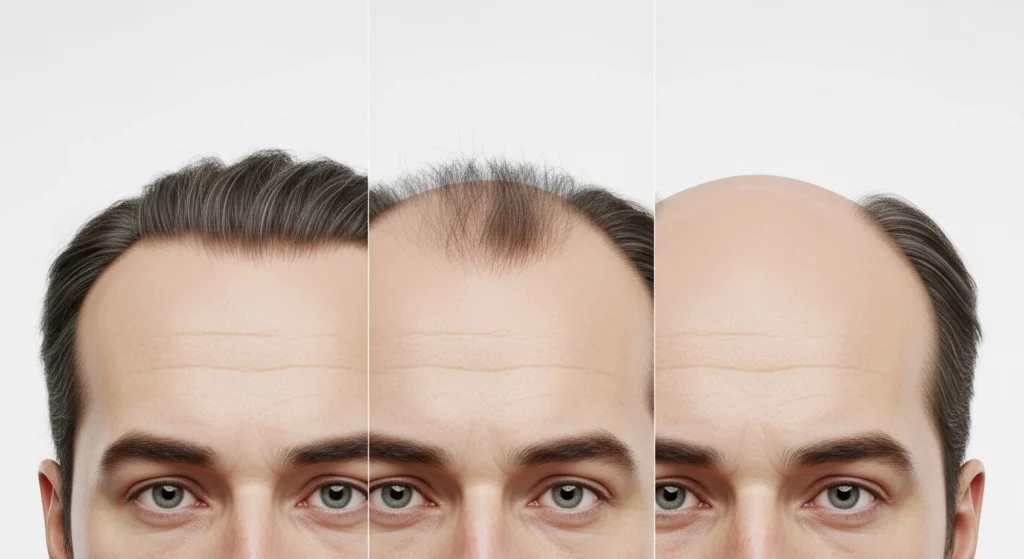
| Norwood Scale | Description | Typical Age | Transplant Readiness |
|---|---|---|---|
| Scale 1 | No recession | Any | Not a candidate |
| Scale 2 | Minor temple recession | 20s – 30s | Wait – too early usually |
| Scale 3 | Noticeable recession | 25 – 35 | Possible – assess stability |
| Scale 4 | Moderate baldness | 28 – 40 | Strong candidate |
| Scale 5 | Significant baldness | 30 – 50 | Excellent candidate |
| Scale 6 | Advanced baldness | 35 – 55 | Good candidate – donor limits |
| Scale 7 | Extensive baldness | 40 – 65+ | Possible – limited coverage |
Gender Differences: Best Age for Hair Transplant – Men vs Women
Men (Male Pattern Baldness)
For men undergoing hair transplant surgery the ideal time frame is listed above according to each age range.Male pattern baldness is relatively easy to estimate when the time will be right due to the predicted Norwood Scale progression.
Key male-specific considerations:
- Progressive hair loss as a result of DHT driven androgenetic alopecia, finasteride is highly indicated for hair transplantation.
- The best surgical candidates are those in stages 3-5 of the Norwood Scale.
- The most frequently treated areas are the front and vertex.
Women (Female Pattern Hair Loss)
Women have a wider range of considerations than men for hair transplants. They often present with a more general, diffused thinning rather than the more focal recession typically encountered in men. Candidacy is therefore more intricate.
Female hair transplant age factors:
- Hormonal assessment is crucial pre-operatively (thyroid, PCOS, post-menopause).
- Hair loss needs to be stable and prove so – harder to prove in females generally.
- Ludwig Scale I-II (mild-moderate diffuse thinning) – good female patients
- Non-shaven FUE preferred for females.
- PRP therapy generally used as initial therapy prior to surgical options.
Lifestyle Factors That Affect Hair Transplant Timing
These factors affect hair loss and surgery outcomes both in addition to age.

| Factor | Impact on Hair Loss | Recommendation |
|---|---|---|
| Chronic stress | Elevated cortisol accelerates shedding | Address before surgery |
| Smoking | Reduces scalp blood flow – lowers graft survival | Quit 4+ weeks before procedure |
| Poor nutrition | Protein/iron/vitamin deficiency worsens loss | Optimize diet pre-surgery |
| Sleep deprivation | Disrupts hair growth cycle | Establish healthy sleep before procedure |
| DHT levels | Primary driver of male pattern baldness | Finasteride evaluation recommended |
| Scalp health | Seborrheic dermatitis, psoriasis affect healing | Treat conditions before surgery |
When Is It Too Late for a Hair Transplant?
Is there such a thing as too late for hair transplantation? That is arguably one of the most searched phrases by men in their 50s looking to get hair transplants. The reality is: for hair transplants, it is almost never too late. The restriction for hair transplants would only be the supply of donor hair available.
Hair transplants have been successfully performed on patients in their 60s and even 70s and with favorable outcomes. What age to get hair transplants is really a consideration on not whether the age is too great to get the procedure done, but whether the hair to use as donor hair is healthy and the patients overall health is okay.
Signs that hair transplant may not be viable:
- Donor area density that is too low for adequate coverage.
- Scarring alopecia of donor zone.
- Diseases where surgery cannot be performed (uncontrolled heart disease, active autoimmune disease, etc).
- Inappropriate expectations regarding achievable density with the available donor supply.
Signs it is not too late:
- Obvious donor hair present on sides and back of the scalp.
- Hair loss stabilized completely.
- Generally healthy condition.
- Realistic about level of coverage possible with donor hair on hand.
When Should You Get a Hair Transplant? Decision Framework
Apply the following decision framework to measure your own readiness:
| Question | If YES | If NO |
|---|---|---|
| Has my hair loss been stable for 2+ years? | Positive sign for surgery | Wait – reassess in 12 months |
| Am I 25 or older? | Proceed to evaluation | Consult specialist – caution required |
| Have I tried medication (finasteride/minoxidil)? | Good – optimized position | Consider medication first |
| Do I have realistic expectations? | Ready for consultation | Education needed before proceeding |
| Have I consulted an ISHRS/ABHRS surgeon? | Proceed with confidence | Essential first step |
| Is my donor area assessed as adequate? | Strong candidate | May need alternative approach |
Should I Get a Hair Transplant? Honest Assessment
Arguments for proceeding:
- Permanent results with one or more sessions
- Natural look, not recognizable as transplanted hair
- Lifelong investment vs. Recurrent cost of hairpieces/cover-ups
- Evidence of increases in self-confidence and quality of life
- 90-95% retention of grafts with board certified providers
Arguments for waiting:
- I’m still losing hair and it is too early to make any concrete long-term plans for stable and steady progress.
- Still under the age of 25 so a higher revision risk than older age.
- Various illnesses that impact suitability for treatment.
- Financially not able to achieve.
- No more medicinal approaches to try.
Hair Transplant Cost USA by Age Group (2026)
| Age Group | Typical Graft Count | Estimated USA Cost |
|---|---|---|
| 23 – 25 (conservative) | 800 – 1,500 | $4,000 – $8,000 |
| 25 – 35 (standard) | 1,500 – 3,500 | $7,000 – $14,000 |
| 35 – 45 (comprehensive) | 2,000 – 4,000 | $9,000 – $16,000 |
| 45 – 60 (targeted) | 1,500 – 3,000 | $7,000 – $13,000 |
| 60+ (conservative) | 1,000 – 2,500 | $5,000 – $11,000 |
Recovery Timeline After Hair Transplant (All Ages)
| Time Period | What Happens | Patient Action |
|---|---|---|
| Days 1 – 5 | Redness, mild swelling, scab formation | Rest, sleep elevated |
| Days 7 – 10 | Scabs naturally fall off | Follow wash protocol |
| Weeks 3 – 8 | Shock loss – transplanted hair sheds | Normal – continue aftercare |
| Months 3 – 4 | New hair growth begins | Monthly progress photos |
| Months 6 – 8 | Visible density improvement | Continue medications |
| Month 12 | Full final results visible | 12-month follow-up |
How We Selected These Clinics
Board certified (ABHRS/ISHRS) practitioners of more than ten years, listed to provide a solid and objective foundation of trustworthy professionals using actual patient review information. Please note that this is not an advertisement and that each surgeon is listed to make your own independent verifications, including current credentials (abhrs.org/find-a-surgeon), before scheduling any work.
Best Hair Transplant Clinics USA by City (2026)
These American cities have the most talented professionals available for men who have identified their peak age for a hair transplant and are prepared for consultation:
| City | Notable Clinic | Surgeon | Techniques |
|---|---|---|---|
| New York, NY | Bernstein Medical | Dr. Robert Bernstein | FUE, FUT |
| Chicago, IL | Chicago Hair Institute | Dr. Raymond Konior | FUE, FUT |
| Los Angeles, CA | Alvi Armani | Dr. Baubac Hayatdavoudi | FUE |
| Miami, FL | Foundation for Hair Restoration | Dr. Bernard Nusbaum | FUE, FUT |
| Dallas, TX | Parsa Mohebi Hair Restoration | Dr. Parsa Mohebi | FUE |
| Houston, TX | Houston Hair Transplant Center | Dr. Goran Jezic | FUE, FUT |
| Austin, TX | Austin Hair Transplant | Specialist Team | FUE |
| Orlando, FL | Hair Restoration of Orlando | Specialist Team | FUE, PRP |
| Boston, MA | Leonard Hair Transplant Associates | Dr. Robert Leonard | FUE, FUT |
| San Francisco, CA | Parsa Mohebi Hair Restoration | Dr. Parsa Mohebi | FUE |
Real Patient Outcome Data by Age Group
These approximate ranges are compiled from published clinic outcome data and industry surveys; individual results vary significantly by surgeon, technique, and patient health. Ask your surgeon for their specific outcome statistics during consultation.
| Age Group | Avg Graft Survival | Patient Satisfaction | Revision Rate |
|---|---|---|---|
| Under 25 | 88 – 92% | 65 – 75% | 20 – 30% |
| 25 – 35 | 92 – 95% | 88 – 94% | 5 – 10% |
| 35 – 45 | 91 – 95% | 89 – 95% | 4 – 8% |
| 45 – 60 | 90 – 94% | 87 – 93% | 5 – 10% |
| 60+ | 88 – 93% | 85 – 92% | 6 – 12% |
In terms of satisfaction and revision rate this age band of 25-45 is the strongest performing band and therefore vindicates general professional opinion regarding this as the best age for hair transplantation for the majority of men.
FAQs:
Q: So, what’s the sweet spot age-wise for getting a hair transplant?
For most fellas, the ideal time to consider a hair transplant is between 25 and 40. By this time, hair loss has usually stabilized, giving surgeons a clear pattern to work with when designing your new hairline, and ensuring that your donor area has reached its full density. Of course, everyone’s different – the key thing is when your hair loss has stopped advancing rather than a specific age.
Q: What’s the youngest someone can get a hair transplant?
Typically, a reputable surgeon will want you to be at least 25 to be considered for a hair transplant, assuming you’re dealing with common pattern baldness. Some top specialists may consider patients as young as 23 or 24, but only if they have documented 2 years of stable hair loss, a very conservative design planned, and are fully aware that future procedures might be necessary.
Q: Am I too young to get a hair transplant if I’m 20?
For the most part, a board-certified surgeon will strongly advise against getting a hair transplant at 20. Hair loss at this age is usually at its most aggressive, and any procedure planned at this stage would likely need to be revised within a decade – which is a lot of unnecessary expense.
Q: Is it a good idea to get a hair transplant in your 30s?
Absolutely! In fact, the 30s are some of the best years to get a hair transplant. By this age, your hair loss pattern should be pretty stable, your donor area will likely be at its prime, and your body will be in top shape to heal well, all of which leads to consistently high levels of patient satisfaction.
Q: When is it considered ‘too late’ to get a hair transplant?
Honestly, it’s rarely “too late” in terms of age. You’ll find plenty of men in their 60s and even 70s who have had FUE hair transplants and achieved fantastic results. The real deciding factor is whether you have enough healthy hair in the donor area to create a natural-looking outcome, which is something a board-certified surgeon will assess.
Q: Should I get a hair transplant at 25?
If your hair loss has been consistent for at least 2 years, a board-certified surgeon has determined your donor area is sufficient, and your expectations are realistic, 25 can be a good age. However, at the younger end of this optimal range, it’s usually best to opt for a conservative approach-fewer grafts and a hairline designed for your future look.
Q: What’s the best age for a hair transplant if I have really aggressive hair loss?
If you have a strong family history of significant baldness (like Norwood 6 or 7), it’s particularly important to be patient. You should wait until your hair loss has definitely stabilized, which is typically late 20s or early 30s. Combining this with medication like finasteride will also help protect any remaining native hair.
Q: Are hair transplants worth it for men in their 40s?
Definitely. A hair transplant for men between 40 and 45 often leads to outstanding results. Your hair loss will most likely be completely stable, planning the surgery will be straightforward, and men in this age group are usually extremely happy with the final outcome. The amount of hair in the donor area will be the primary consideration.
Q: So, when should I get a hair transplant?
Get a hair transplant when: your hair loss has been steady for at least 2 years, you are at least 25, you’ve had a consultation with a board-certified surgeon and they’ve confirmed you have enough donor hair, your expectations are realistic, and you’ve considered or tried non-surgical options.
Looking for the ideal age for a hair transplant? Save this post – we update it every six months to reflect the latest clinical recommendations and data on US hair transplant clinics.
Written & Reviewed By
Written by: Wajiha Aqeel
Co-Founder & Hair Restoration Research Lead
Data & publication oversight: Daniel Brooks
Co-Founder & Senior Operations & Data Director
Content reviewed by:
Mehwish Fareed Clinical Aesthetician & Content Reviewer
Asma Shamshad Medical Student & Content Contributor
Published Date: April 17, 2026
Clinic & Pricing Data Last Reviewed: August 2026
Last Updated: September 9, 2026
Sources & References
- Dr. Serkan Aygin Clinic – Is There a Best Age for a Hair Transplant?
- Charles Medical Group – ISHRS census data (minimum age median 23, 60% patients aged 30-49)
- Shapiro Medical – Hair Transplant Age Requirements, stabilization criteria
- Utah Hair MD – Best Age for Hair Transplant, ISHRS-cited 30-40 range
Hair Doctor NYC – Stability research stats (70% by 25, 85% by 30, 95% by 35) - Medifue – Ideal Age for Hair Transplant
- Capilar Hair Center – Ideal Age for Hair Transplant Surgery
- Elithair – Hair Transplant and Age, ISHRS Census 2025 reference
- Sarasat Hospital – Best Age for Hair Transplant, ISHRS.org cited
- International Society of Hair Restoration Surgery (ISHRS)
- American Board of Hair Restoration Surgery (ABHRS)
- American Academy of Dermatology (AAD)
- National Library of Medicine / PubMed (androgenetic alopecia research) – pubmed.ncbi.nlm.nih.gov
Medical & Affiliate Disclaimer:
The content on Hair Grow Needs is for general informational and educational purposes only and should not be considered professional medical advice. For full details regarding our policies, please read our official Disclaimer.