
Medical Disclaimer: This article is for informational purposes only and does not replace professional medical advice. Read our full Medical Disclaimer.
Is Stem Cell Hair Transplant Permanent?
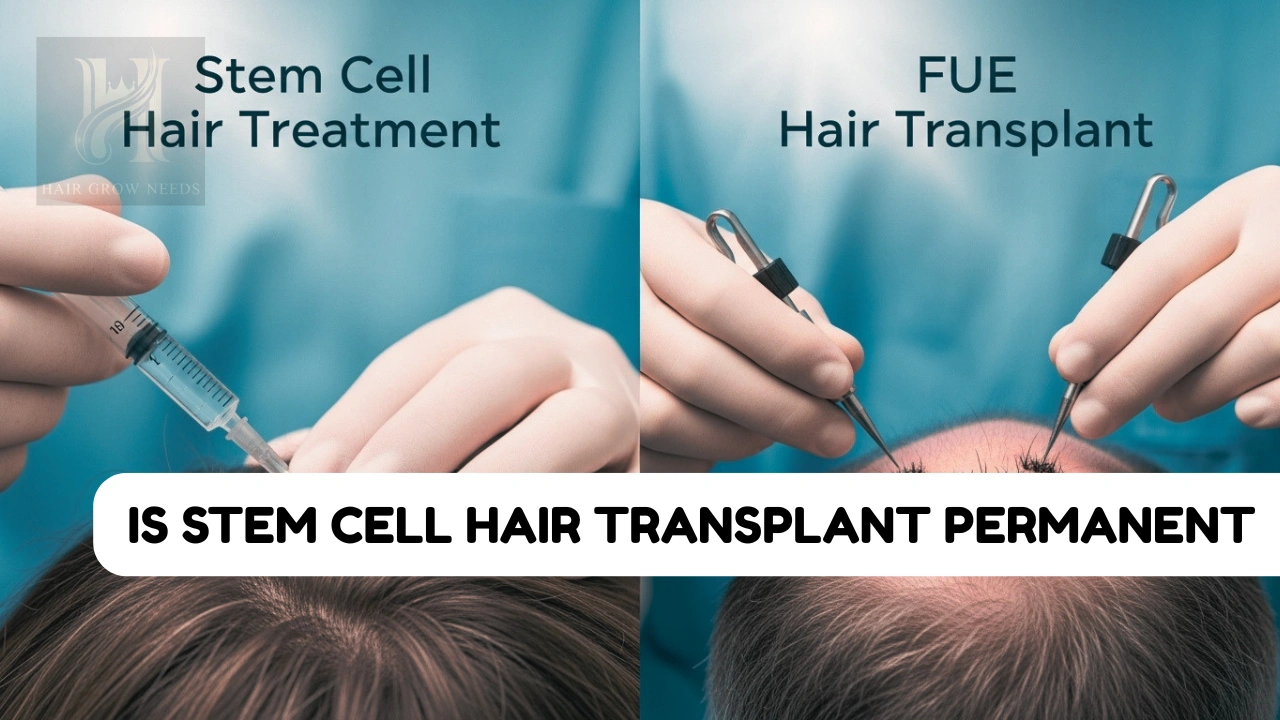
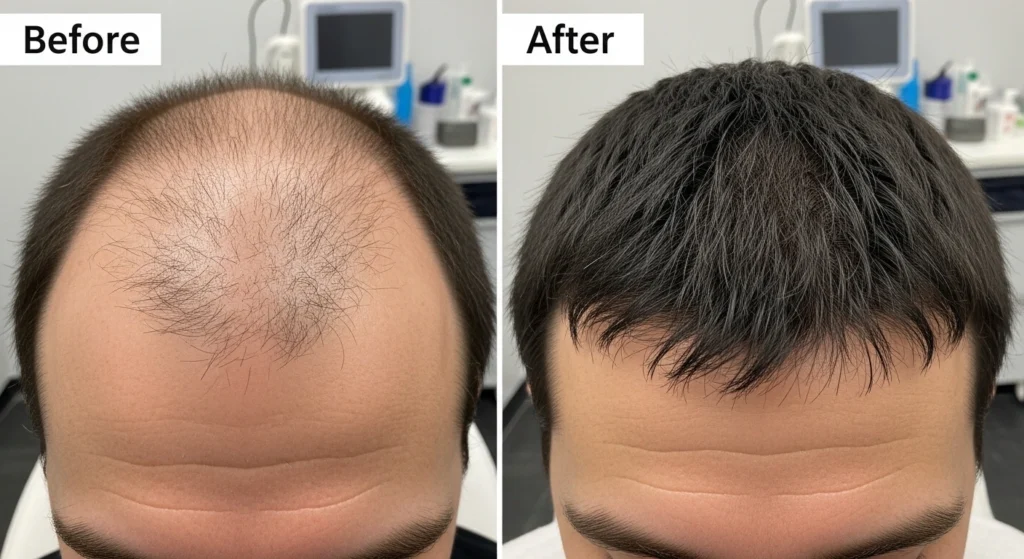
No, as of 2026 stem cell hair transplants are not permanent in the USA. Stem cell hair treatments are considered semi-permanent with outcomes typically lasting for 1-3 years before additional boost sessions are required. As of yet, no stem cell hair therapy has gained FDA approval in the United States. There are a few very small peer-reviewed studies showing an average increase in hair density of between 20-30% after six months, which is positive but still not permanent. For permanent results, a FUE or FUT hair transplant is currently the gold standard.
Stem cell hair transplant-Not permanent USA. FUE will move DHT resistant hairs from one area of your scalp to another in a permanent way, stem cell hair treatment stimulates the existing sleeping follicles by injecting ADSC into them, so the effect will wear off because your natural hair is going through the typical hair loss pattern. Result lasts for 1 to 3 years. The price varies from $3,000 to $10,000, and requires 2 to 6 treatments. As of 2026, it is not FDA approved. It’s suitable for: early stage hair loss, if you do not want surgery, or if you want to combine with FUE.
What is Stem Cell Hair Transplant and How Does It Work?
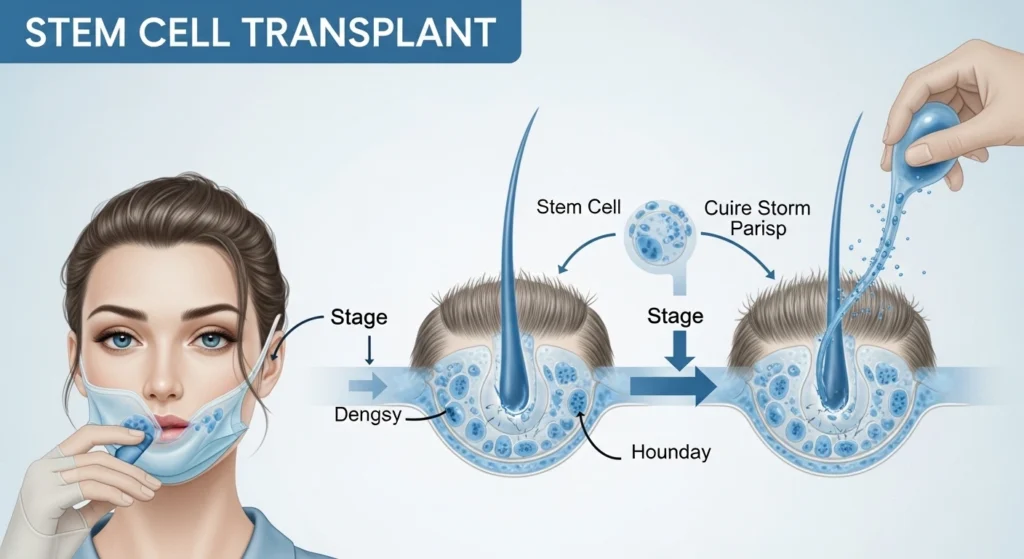
So in simple terms, stem cell hair treatment is an injection rather than a traditional hair transplant procedure. It’s important to highlight this before answering if stem cell hair transplant is permanent. It is fundamentally different to FUE/FUT hair transplants because, instead of moving existing, functioning hair follicles to different areas of the scalp, the injected processed stem cells coaxing hair follicles already dormant in your scalp into a growth phase.
The type of stem cells used for hair loss treatments are usually adipose-derived stem cells (ADSCs). These are removed from your own body using a small liposuction procedure, processed at a clinic, and then injected into the scalp. These stem cells secrete growth factors that then signal miniaturized hair follicles to grow again.
Key Types of Stem Cell Hair Therapy in USA 2026
| Type | Source | Mechanism | FDA Status | USA Availability |
|---|---|---|---|---|
| ADSC Therapy Most Common | Patient’s own fat tissue | Growth factor release stimulates follicles | Not approved | Select US clinics |
| Exosome Therapy | Stem cell secretions | RNA + growth factor cargo without cells | Under FDA scrutiny | Limited US clinics |
| PP405 (Pelage Pharma) | Pharmaceutical compound | Direct follicle stem cell reactivation | Phase 3 trials 2026 – 27 | Clinical trials only |
| RCH – 01 (Replicel) | Dermal sheath cup cells | DSC cell injection for androgenetic alopecia | Phase 2 trials | Clinical trials only |
| Hair Cloning | Lab-multiplied follicles | Creates new follicles from patient cells | Not available anywhere | Not commercially available 2026 |
Important Distinction: “Stem cell hair transplant” and “hair cloning” are entirely different concepts. Hair cloning- an entirely new hair follicle grown in a lab- is not commercially available anywhere in the world, as of 2026. Clinics that claim to do hair cloning, are instead, doing another type of procedure and giving it the false, misleading name of ‘hair cloning’. This is another sign that you have landed at a shady clinic.
Is Stem Cell Hair Transplant Permanent? The Science Answer
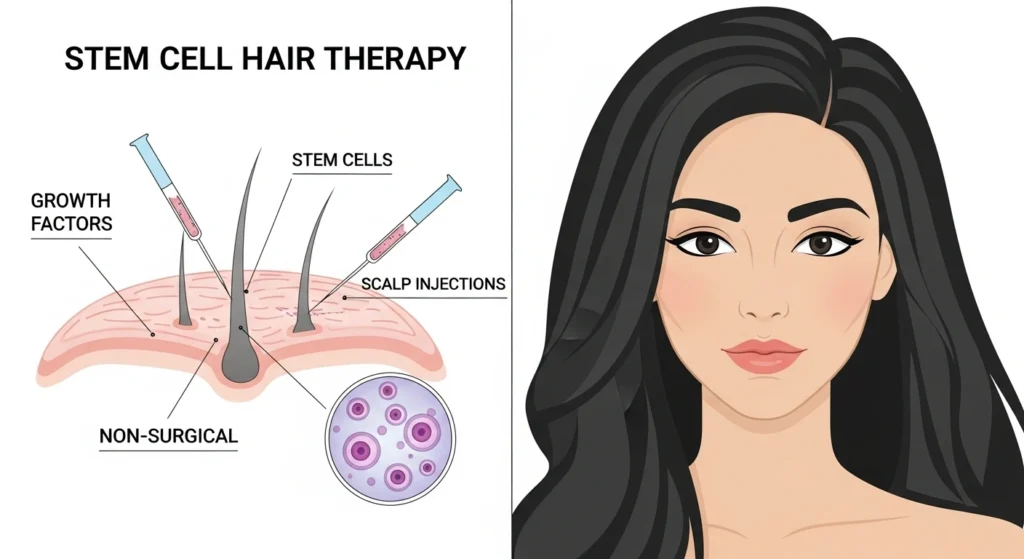
Direct answer to the question: Is stem cell hair transplant permanent? No, at 2026 it is not permanent. Let’s go into more detail – via science, not the clinic marketing language
Why Stem Cell Therapy Is NOT Permanent
For a permanent solution, one would implant follicles that are immune to DHT from a permanent safe donor area into a thinned area. These implanted follicles would have retained the property of being resistant to DHT the culprit of androgenetic alopecia. The hairs would grow permanently irrespective of the fact that they were transferred from another area of the scalp.
In stem cell therapy, no follicles are implanted. One injects growth-stimulating stem cells to make a dormant miniaturized follicle in a thinned area functional again. The follicle still remains susceptible to DHT genetically. After the simulative effect of the stem cell treatment wanes off-after approximately 1-3 years-the follicle would again go back into its miniaturizing phase and hairs would be lost.
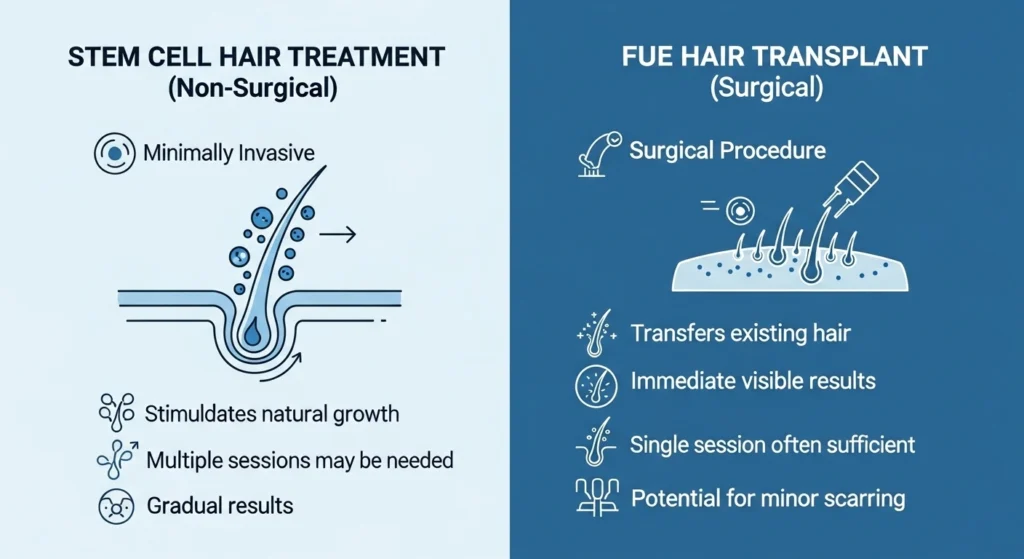
| Factor | Stem Cell Therapy | FUE Hair Transplant |
|---|---|---|
| What Is Moved/Added | Stem cell injections – no follicle movement | DHT-resistant follicles physically relocated |
| DHT Resistance | Treated follicles still DHT – sensitive | Transplanted follicles are DHT-resistant |
| Permanence | Semi-permanent 1 – 3 years | Permanent – lifetime growth |
| Mechanism | Stimulates existing dormant follicles | Creates new permanent follicle population |
| What Happens After Treatment | Effects fade, follicles resume loss cycle | Transplanted follicles grow permanently |
| Booster Sessions Needed | Yes – every 1 – 3 years | No – one-time procedure |
| Best For | Early-stage thinning, dormant follicles present | Any stage with adequate donor supply |
Does a stem cell hair transplant grow permanently? No, as it merely increases the stimulation of a DHT sensitive follicle, which is destined to eventually miniaturize on its own. A FUE transplant is of DHT resistant follicles and will grow permanently. The only difference lies in follicle genetics.
FDA Status of Stem Cell Hair Treatment USA 2026 What You Must Know
The most important fact that you’ll find missing from the website of most clinic services is this: No stem cell hair restoration treatment has been FDA-approved in the U.S. (as of 2026), so all stem cell therapies offered by U.S. Clinics are still experimental.
FDA Official Statement: The FDA has given official warnings to US citizens, recommending to only use treatments that the FDA has approved, or for treatments to have undergone Investigational New Drug Applications (IND) studies. Clinics offering unapproved stem cell treatments outside IND registered trials are operating outside FDA regulation. Source: FDA.gov consumer advisory.
| Treatment | FDA Status 2026 | Evidence Level | Permanence |
|---|---|---|---|
| Minoxidil (Topical) | FDA-Approved | High – decades of trials | Semi-permanent (requires continued use) |
| Finasteride (Oral) | FDA-Approved (men) | High – RCT evidence | Semi-permanent (requires continued use) |
| FUE Hair Transplant | FDA-Cleared (surgical device) | Highest – 30+ years data | Permanent |
| FUT Hair Transplant | FDA-Cleared (surgical) | Highest – 30+ years data | Permanent |
| PRP Therapy | Not FDA-Approved (procedure) | Moderate – growing evidence | Semi-permanent |
| Stem Cell Hair Therapy Not Approved | Not FDA-Approved 2026 | Low-Moderate – small trials only | Semi-permanent 1 – 3 years |
| PP405 (Pelage Pharma) | Phase 3 trials 2026 – 27 | Early – Phase 2a showed 31% density improvement | Unknown – pending trials |
| Hair Cloning | Not available anywhere | Preclinical only | N/A |
Most Promising Pipeline PP405 (Pelage Pharmaceuticals)
The furthest advanced stem cell treatment toward a possible FDA review in the USA is PP405 by Pelage Pharmaceuticals. Phase 2a testing concluded that, compared to the initial study data, 31% of men with advanced baldness saw over 20% increases in hair density. The company has projected that phase 3 testing will occur in 2026-2027 and that the treatment will be potentially available for use in the US by 2028-2030 if phase 3 testing validates PP405 as both a safe and effective stem cell therapy.
How Long Does Stem Cell Hair Treatment Last in USA?
| Timeframe | What Happens | Visible Change |
|---|---|---|
| Month 1 – 3 | Stem cells release growth factors, follicle reactivation begins | Minimal visible change |
| Month 4 – 6 | Initial improvements – follicles entering active growth phase | Early density improvements visible |
| Month 6 – 12 Peak Results | Significant density improvement – 20–30% average (clinical data) | Most visible improvement period |
| Month 12 – 18 | Full effects stabilize | Maximum density achieved |
| Year 1 – 3 | Results holding – DHT-sensitive follicles still active | Maintained density |
| After Year 2 – 3 | Effects fade – follicles resume natural miniaturization | Gradual density reduction |
| Booster Session | Repeat treatment recommended to maintain results | Density restored to peak levels |
Factors That Affect How Long Results Last
Age: The younger patients (25-40) and those who have less active but more hair follicle viability will typically show results that last longer.
Hair loss stage: Patients who are Norwood 1-3 stages of loss will show more and longer lasting results compared to patients with a higher stage of hair loss.
Genetics: DHT sensitivity rate-how long it takes for follicles to begin miniature again after treatment.
Complementary treatment: The results of stem cell therapy are long lasting when paired with another medication such as Minoxidil or Finasteride.
Lifestyle factors: Factors such as chronic stress, nutritional deficiencies, hormonal imbalance, smoking hasten the rate of miniaturization of the follicles after the treatment.
Number of sessions: Multiple number of sessions (2-4) of the treatment provide relatively longer results compared to a single session of the treatment.
Stem Cell Hair Treatment Real Clinical Data USA 2026
Clinical evidence, not clinic marketing, is the factor that should be relied upon when judging if stem cell hair transplant is permanent or cost-effective. Here’s what the scientific literature and peer-reviewed journals actually state as of 2026:
| Study / Source | Treatment Type | Key Finding | Evidence Quality |
|---|---|---|---|
| Peer-reviewed studies 2020 – 2024 | ADSC therapy | 20 – 30% average hair density increase over 6 months | Moderate – small trial sizes |
| Pelage PP405 Phase 2a | Follicle stem cell reactivation | 31% of men saw 20%+ density improvement | Moderate – Phase 2a data |
| Exosome therapy 2024 – 2025 series | Exosome injections | Comparable density gains to ADSC with fewer steps | Low-Moderate – early clinical series |
| Replicel RCH-01 | DSC cell injections | Phase 2 trial – 160 male subjects enrolled | Ongoing – results pending |
| 4,900+ clinical trials globally | Various stem cell applications | Positive early signals – no definitive conclusions yet | Ongoing |
What Clinical Data Tells Us: This looks very promising – a density increase of 20-30% is clinically relevant for early hair loss patients. On the negative side, sample size is small, there is a lack of long-term data (>3 years), and consistency between patients. This is why it has yet to be approved by the FDA.
Stem Cell Hair Treatment Cost USA 2026
| Treatment | Cost Per Session (USA) | Sessions Needed | Total Investment | Permanence |
|---|---|---|---|---|
| Stem Cell Therapy (ADSC) | $3,000 – $10,000 | 2 – 6 sessions | $6,000 – $60,000 | Semi-permanent 1 – 3 yrs |
| FUE Hair Transplant Best Value Long-Term | $4,000 – $20,000 | 1 session (usually) | $4,000 – $20,000 | Permanent |
| FUT Hair Transplant | $4,000 – $15,000 | 1 session (usually) | $4,000 – $15,000 | Permanent |
| PRP Therapy | $500 – $2,500 | 3 – 6 sessions/year | $1,500 – $15,000/year | Semi-permanent |
| Minoxidil (Topical) | $20 – $50/month | Daily – ongoing | $240 – $600/year | Semi-permanent (requires use) |
| Finasteride (Oral) | $30 – $100/month | Daily – ongoing | $360 – $1,200/year | Semi-permanent (requires use) |
What Affects Stem Cell Hair Treatment Cost in USA?
Stem cell source and processing: ADSC Therapy (Adipose-derived stem cells) need to be harvested using liposuction – this then need to be processed in the lab – higher cost than PRP
Clinic location: The cost atNYC and LA clinicsis $7,000- $10,000 a session while the other cheaper cities in the US charge $3,000-$5,000 a session.
Number of sessions: Typically patients require between 2-6 sessions (depending on case) then multiple the per session fee accordingly.
Surgeon credentials: In plastic surgery, plastic surgeons board certified in their area of practice will demand more per procedure than aesthetic clinics that are run by specialists.
Add-ons: Added benefit with combination PRP, minoxidil protocol, or post treatment laser therapy will increase the price but lengthen result.
Cost Reality Check: $5,000 a visit at 4 times over a period of 6 years is $20,000, which is the cost of a one-time permanent FUE transplant. For the vast majority of USA based patients with medium to significant hair loss, FUE is the most cost-effective long term solution, since it’s a permanent solution. Stem cell is only logical on a cost basis for early stage patients, or as a complement to surgery.
Stem Cell Hair Transplant vs FUE vs FUT vs PRP USA
| Factor | Stem Cell Therapy | FUE | FUT | PRP |
|---|---|---|---|---|
| Is It Permanent? | No – 1 – 3 years | Yes – lifetime | Yes – lifetime | No – ongoing |
| FDA Status USA | Not approved | FDA-cleared | FDA-cleared | Not approved |
| Surgical? | Minimally invasive | Surgical | Surgical | Non-surgical |
| USA Cost | $3K – $10K/session | $4K – $20K total | $4K – $15K total | $500 – $2,500/session |
| Recovery Time | 2 – 5 days | 7 – 10 days | 10 – 14 days | 1 – 2 days |
| Scarring | None visible | Tiny dot scars | Linear scar | None |
| Best For | Early-stage thinning | All stages, natural result | Advanced baldness, max grafts | Complement to transplant |
| Clinical Evidence | Low-Moderate | Highest | Highest | Moderate |
| Booster Sessions | Yes – every 1 – 3 years | No | No | Yes – every 6 – 12 months |
Who Is a Good Candidate for Stem Cell Hair Treatment in USA?
Good Candidates
- Early stage hair loss (Norwood 1-3)
- Diffuse thinning – dormant follicles still present
- Candidates for non surgical treatments
- FUE candidates wishing to maximize survival rate of grafts
- Male and Female with early AGA
- Candidates with realistic semi permanent desires
Poor Candidates
- Patients fully bald (Norwood 6-7)
- patients wanting a permanent, single procedure
- patients with scarring alopecia
- patients with no viable hair follicles remaining
- patients unwilling to undergo maintenance sessions
- patients on blood-thinners/bleeding disorders
How Stem Cell Hair Treatment Works USA Step-by-Step
| Step | What Happens | Duration |
|---|---|---|
| 1. Consultation | Scalp analysis, hair loss staging, candidacy assessment | 30 – 60 minutes |
| 2. Fat Extraction | Small liposuction from abdomen or thigh under local anesthesia | 30 – 45 minutes |
| 3. Lab Processing | Fat tissue centrifuged and processed to isolate ADSCs | 60 – 90 minutes |
| 4. Scalp Injection | Processed stem cells injected into thinning areas via microneedle | 30 – 60 minutes |
| 5. Post-Treatment | Mild scalp redness resolves within 24–48 hours | 1 – 3 days recovery |
| 6. Follow-Up | Progress assessment at 3, 6, and 12 months | Ongoing |
| 7. Booster Sessions | Repeat treatment at 12–36 months to maintain results | Same as initial |
Stem Cell Hair Treatment Recovery Timeline USA
Day 1 – 2: Mild Redness & Swelling
Injection sites are mildly reddened, with pinpoint swelling. Otherwise normal and should be gone within 24-48 hours. Patients can usually return to work Day 2.
Week 1 – 2: Full Activity Resumed
Can resume all activities immediately. Avoid swimming & the sun for the 1st week. Can wash hair normally after 24 hours.
Month 1 – 3: Dormant Phase
Not many visual changes yet, stem cells sending messages to follicles under the scalp. Will take some patience. There is no shedding phase unlike FUE.
Month 4 – 6: First Improvements Visible
First signs of density thickening occur. Your hair should feel and look stronger and thicker. Most patients start to notice a change at this stage.
Month 6 – 12: Peak Results
Best densification – a clinically proven, 20-30% improvement in the densification is shown here. This is arguably the best part of the stem cell treatment, as far as the visual aspect of it is concerned.
Month 12 – 18: Full Effects Stable
There is a plateauing of the results at the highest density. There should be another evaluation done soon to determine when to give the booster session.
Year 2 – 3: Booster Session Planning
The effects slowly start to wear off as the DHT sensitive hair follicles begin to miniaturize again. A booster session is suggested to keep up the gains in hair density.
Risks & Side Effects of Stem Cell Hair Treatment USA
Common & Temporary (Resolve Within Days)
- Slight redness & swelling at injection sites – should resolve in 24-48 hrs.
- Transient scalp tenderness or mild discomfort – treat with over-the-counter analgesia.
- Small bruise at the fat harvesting site – should resolve in 1-2 weeks.
Uncommon Risks
- Infection at the site of injection or withdrawal- extremely rare if sterile technique is strictly followed.
- Irregular distribution of cell density if not mapped well before injecting.
- Allergic reaction- extremely rare due to autologous (using patient’s own) cells.
Key Risk Unregulated Clinics
Highest Risk USA; Stem cell hair therapy has no FDA approval so there are clinics running unregulated operations where they use unapproved cell sources, unsterile processing or call their results “permanent”. Stem cell hair restoration in the USA is a market in excess of $280 million; and there are no FDA-approved procedures on offer. In the USA ensure the stem cell clinic you visit has a registered FDA Investigational New Drug Application (IND) or can prove they are operating 100% legally.
Future of Stem Cell Hair Treatment in USA 2026 to 2030
| Timeline | Development | Significance |
|---|---|---|
| 2026 – 2027 | PP405 (Pelage) Phase 3 trials begin | Most significant advance possible – could lead to first FDA-approved stem cell hair treatment |
| 2026 – 2027 | ET-02 exosome Phase 2 results expected | Could confirm exosome therapy as viable FDA-regulated option |
| 2027 – 2028 | Potential FDA guidance update on exosome regulation | Regulatory clarity for exosome-based hair therapies |
| 2027 – 2030 | Hair follicle multiplication technology | Creates new follicles – would represent first truly permanent non-surgical solution |
| 2028 – 2030 | iPSC (induced pluripotent stem cell) approaches | Potential for patient-specific follicle generation – still preclinical stage |
| 2030+ | Hair cloning commercially available | Theoretical – multiple technical barriers remain unsolved |
Optimistic Outlook: As an overall medical field, the use of stem cells in hair treatment is developing extremely quickly, with more than 4,900 stem cell therapies being tested around the world for a variety of different ailments. PP405 moving to phase 3 of its clinical trial in 2026 is the most relevant and concrete avenue for an FDA-approved stem cell hair treatment in the near future. Future candidates should watch PP405’s Phase 3 results in 2027/2028.
Stem Cell Hair Treatment Red Flags & Scams to Avoid in USA
| Claim / Practice | Verdict | What It Means |
|---|---|---|
| Our stem cell treatment is permanent | Red Flag | Scientifically false – no stem cell therapy is permanent as of 2026 |
| We offer FDA-approved stem cell hair treatment | Red Flag | No such approval exists – this is a false claim |
| Hair cloning available now | Red Flag | Hair cloning is not commercially available anywhere in the world |
| One session – permanent results | Red Flag | Impossible with current stem cell technology |
| Results vary – 1 – 3 years typical | Green Flag | Honest, accurate expectation setting |
| We operate under an FDA IND application | Green Flag | Regulatory compliance – verify at clinicaltrials.gov |
| We recommend combining with FUE or Minoxidil | Green Flag | Honest about limitations, suggests proven complementary treatments |
| Cannot provide peer-reviewed study citations | Red Flag | Evidence-free marketing claims |
Stem Cell Hair Transplant USA Pros & Cons Summary
Advantages
- Non-surgical – no need to cut the scalp
- Fast recovery (2 – 5 days)
- No noticeable scar on the scalp
- Use the patient’s own cells-highly safe
- 20-30% improvement in density established by studies
- Great adjunct to FUE, increases FUE graft survival
Limitations
- Not permanent – just 1 – 3 years
- Not FDA approved in USA by 2026
- Costly – between $3K – $10K per session
- Many sessions required – very expensive
- Not effective in completely bald patients
- Highly variable results between individuals
FAQs:
Q: Does a stem cell hair transplant last forever in the US?
No. Stem cell hair transplant will not last forever in the USA as of 2026. This hair treatment offers semi-permanent results lasting 1 to 3 years before repeat boost sessions are required. Unlike FUE, which transplants DHT-resistant follicles which will continue to grow for a lifetime, stem cell therapy stimulates remaining existing DHT-sensitive follicles-which continue to naturally cycle after the treatment effects fade.
Q: Has stem cell hair treatment been FDA approved in the US?
No. As of 2026, stem cell hair restoration treatment has yet to receive FDA approval in the USA. The FDA warns that the public should only be interested in FDA approved, or IND-registered treatments. PP405-the leading pipeline candidate by Pelage Pharmaceuticals-will enter Phase 3 trials in 2026-2027 and if approved could be available to consumers from 2028-2030.
Q: How long does stem cell hair treatment last in the US?
Stem cell hair treatment in the US offers results for approximately 1 to 3 years. Maximum density improvement typically peaks between 6-12 months and becomes established at 12-18 months. Booster sessions will be needed every 2-3 years. The durability of treatment may depend on a patient’s age, genetics, stage of hair loss, lifestyle and whether complementary treatments, such as Minoxidil are used.
Q: How much does stem cell hair treatment cost in the US?
Stem cell hair treatment in the USA can cost between $3,000 and $10,000 per treatment in 2026. The average patient will require 2-6 treatments for best results, therefore the total cost will be between $6,000 and $60,000-compared to the $4,000- $20,000 for a FUE hair transplant. Stem cell hair treatment is not covered by insurance as it is currently experimental.
Q: Is stem cell hair treatment better for US patients than FUE?
No, for the vast majority of patients. FUE is currently the most effective hair treatment with permanent results from one treatment. Stem cell therapy produces semi-permanent results which require further treatments; a better option is FUE which produces lifetime growth. The only situations in which stem cell therapy would be a superior choice would be for Norwood 1-3 stages where only non-surgical cosmetic improvement is desired, or as an enhancement to FUE.
Q: What is the difference between stem cell hair therapy and PRP therapy?
PRP therapy uses growth factors extracted from the patient’s own blood to stimulate the follicles, it cost $500-$2,500 per treatment, and takes 3-6 months to notice the best results. Treatment of PRP is now considered strong clinical evidence, whereas stem cell hair therapy is experimental in the USA, and may offer greater density improvements. PRP is FDA recognized; stem cell therapy is not currently FDA approved. The only common factors they both share is the fact they both produce semi-permanent results with a non-surgical cosmetic benefit.
Q: Is hair cloning available in the USA in 2026?
No. There is no commercial hair cloning available anywhere in the world, as of 2026, let alone in the USA. There are many clinics currently offering this procedure with vastly different outcomes; many may be simply offering a standard treatment under a misleading title. DNovo (San Francisco) & Stemson Therapeutics are the main US pipeline companies, and neither are close to commercially viable hair cloning yet.
Q: Will stem cell hair treatment work for someone who is completely bald in the US?
No. Stem cell hair therapy works by activating the dormant follicles to start growing again. Completely bald patients have lost their follicles, and therefore there is no source for the treatment to begin the hair regeneration process. Complete baldness for Norwood 6 and 7 is typically treated with FUE and FUT hair transplantation. Stem cell treatment may help with some existing native hairs for a partially bald patient.
Conclusion Is Stem Cell Hair Transplant Permanent in USA?
To the all-important 2026 question – is stem cell hair transplant permanent – the answer is simply no, not yet and for most patients. Stem cell hair treatment offers significantly meaningful results-a clinically documented 20-30% increase in density, however these results are semi-permanent lasting 1-3 years until requiring booster treatments. Not one stem cell hair treatment has been FDA approved in the United States. The treated follicles remain DHT sensitive and revert back to miniaturizing.
For those in early stages 1-3 Norwood, stem cell therapy is a viable non-surgical option to slow loss and increase density, when paired with FDA-approved options such as minoxidil and finasteride. For medium to advanced hair loss, hair transplant with FUE or FUT remains the established gold standard and provides a greater value per decade when dealing with permanent results.
The field is progressing, with PP405 due to enter Phase 3 trials in 2026-2027 offering the most promising road to a truly FDA-approved stem cell hair treatment in the short-term. Patients who want to know more should keep a close eye on this study-we may see a completely different answer in the next 3-5 years to is stem cell hair transplant permanent.
Making Your Decision USA 2026
For early stage hair loss (when the goal is non-surgical treatment), a board-certified dermatologist or hair restoration physician could discuss a combination of stem cell therapy and a FDA approved hair restoration treatment. For moderate to advanced hair loss, when a permanent result is the goal, you would need to find a board-certified FUE surgeon who is ABHRS certified. Ensure any stem cell clinic you visit is FDA regulated prior to treatment.
Verified Sources & Clinical References
- FDA.gov – Consumer Advisory on Unapproved Stem Cell Therapies (2017, updated 2026)
- Pelage Pharmaceuticals – PP405 Phase 2a Trial Results (2025-2026)
- Charles Medical Group – Stem Cell Therapy for Hair Restoration: Science vs Marketing 2026
- Bioinformant – Progress in Stem Cell Treatment for Hair Loss 2026
- Hair Doctor NYC – Stem Cell Therapy Hair Restoration: 2026 FDA Facts
- Dr. Terziler Clinic – Stem Cell Hair Treatment Evidence & Results 2026
- Replicel Life Sciences – RCH-01 Clinical Trial Documentation (Phase 2)
- ISHRS – International Society of Hair Restoration Surgery – ishrs.org
- American Hair Loss Association – americanhairloss.org
- ClinicalTrials.gov – Stem Cell Hair Loss Trial Registry (4,900+ trials)
- Mayo Clinic – Hair Loss: Diagnosis and Treatment Guidelines
- PRP Treatment Beverly Hills – Stem Cell vs FUE Comparison (2025)
Author Bio:
Co-Founder & Lead Medical Researcher: Wajiha Aqeel
Oversees clinic auditing process and medical research compliance.
Co-Founder & Director of Healthcare Data Transparency: Daniel Brooks
Manages nationwide cost-index verification and operational growth.
Verification: Fact-Checked & Institutional Verification: July 2026
Medical & Affiliate Disclaimer:
The content on Hair Grow Needs is for general informational and educational purposes only and should not be considered professional medical advice. For full details regarding our policies, please read our official Disclaimer.