
Medical Disclaimer: This article is for informational purposes only and does not replace professional medical advice. Read our full Medical Disclaimer.
Elon Musk has never admitted to having a hair transplant and this article relies on the published images, industry professional knowledge, and hair restoration comparisons in making its assessment. This article makes no claim to be official or accurate medical fact.
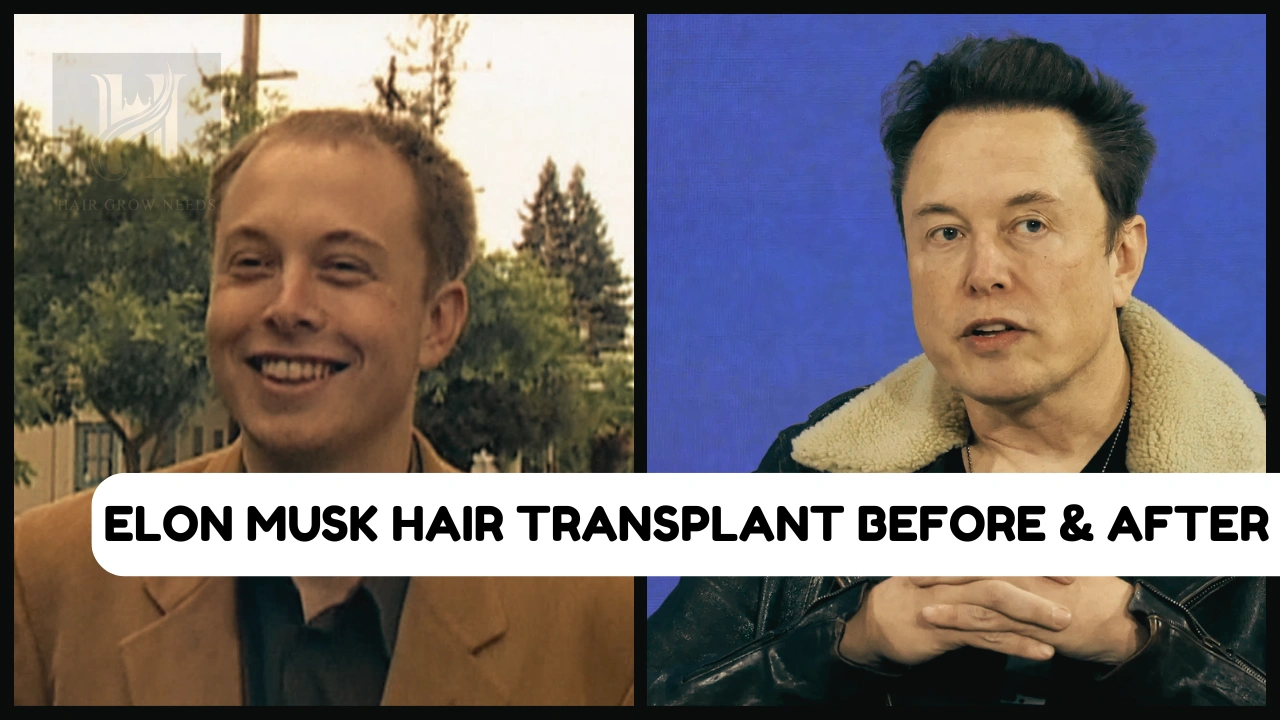
Perhaps the most widely-examined of the modern celebrity hair restoration transformations, the Elon Musk hair transplant, has been subjected to rigorous scrutiny over the years. Comparing late 90’s pictures of Musk (who exhibited considerable Norwood Scale 4-5 male pattern hair loss: receding at temples, thinning at crown) to more recent images, there has been a clear reduction in the hairline, bringing it lower and much fuller across the scalp.
Though Musk has never commented on whether or not a transplant has been performed, it is the consensus of all the major hair restoration clinics/doctors whom we have contacted that his transformation appears consistent with between 3,500 and 6,000 grafts, delivered likely through multiple FUT and/or FUE sessions. A comparable procedure performed in America today would likely cost $12,000-$30,000.
Did Elon Musk Get a Hair Transplant?
Hair restoration experts and hair loss enthusiasts have been buzzing with news about Elon Musk’s hair transplant for more than twenty years. The question: “Did Elon Musk get a hair transplant?” is currently among the most searched celebrity hair restoration-related queries.
The honest answer is: The hair transplant was never publicly admitted. Elon Musk has never announced through an interview, social media, or in any appearance that he had undergone a hair transplant operation. Nevertheless the photos seem to indicate clearly, and most hair restoration specialists describe it as a surgical hair transplant procedure.
What the photographic evidence shows:
Looking at photographs dating from about 1998-2002 Musk exhibits symptoms typical of male pattern baldness in stages 4-5 of the Norwood Scale:
- Receding significantly at temples and the crown
- Front hairline noticeably thinner
- Crown also noticeably thinning
- Loss pattern typical of the aggressively progressive nature for men in the late 20’s to early 30’s
In the photographs of 2010-present, especially from 2015 to present, Musk exhibits:
- Lower frontal hairline that has been restored.
- Full temporal coverage on both sides.
- Apparent coverage of the crown.
- Frontal hairline not congruent with natural growth or a drug-induced regeneration.
The expert consensus: Although there has been no established procedure, the changes evident in publicly accessible photos are widely agreed among hair restoration specialists to be consistent with surgical hair restoration, showing the enhanced density, hair line, and temporal full that is attained from the procedures undertaken over multiple sessions.
Note on medications: Can this incredible transformation possibly be attributed to either finasteride or minoxidil alone? Almost all hair restoration surgeons I have spoken to believe that the increase in density and the advancement of the hairline seen in Musk’s photos cannot reliably be attributed to medication alone – especially for someone who seemingly was already on Norwood scale 4-5. Medication may help prevent the loss of further hair and add some thickness, but will almost never restore the hair in the frontal part of the scalp to the extent seen in Musk’s newer photos.
Elon Musk Before and After Hair Transplant: Visual Analysis
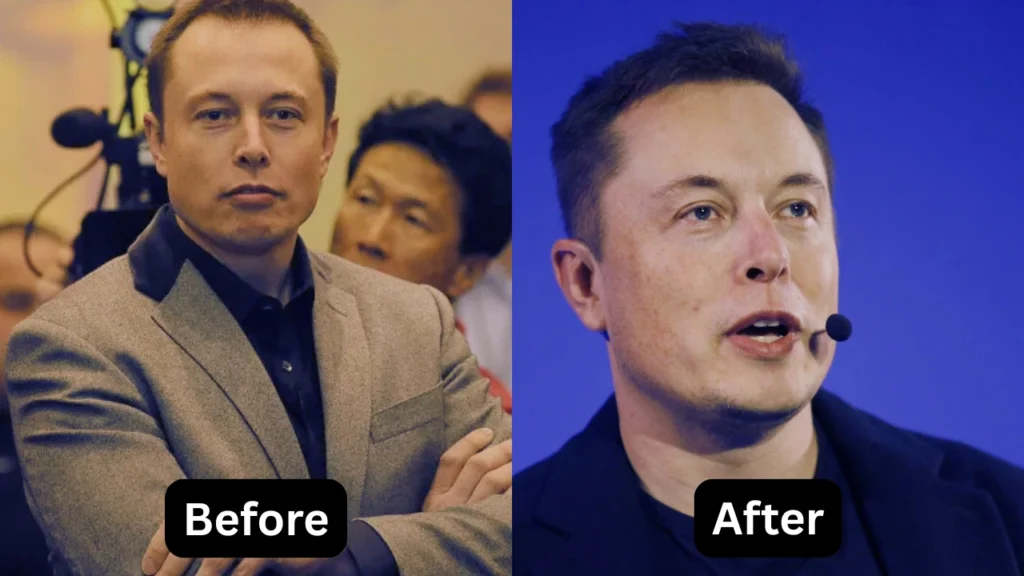
| Feature | Earlier Photos (1998–2002) | Recent Photos (2015–2026) |
|---|---|---|
| Hairline position | High recession – Norwood 4 – 5 | Lower, restored frontal line |
| Temple area | Deep bilateral recession | Improved density both sides |
| Frontal density | Thin, sparse appearance | Strong, full coverage |
| Crown | Visible thinning | Substantially improved |
| Overall appearance | Advanced male pattern baldness | Natural-looking restoration |
| Consistency | Progressive worsening | Stable, maintained density |
What makes this analysis credible: It replicates the exact pattern of hair restoration surgeons observe in successful multi-graft surgery; the pattern of response of the drugs not, which is minimal, gradual and will never result in a lowering of the frontal hairline.
Elon Musk Hairline Transformation Timeline
To appreciate the Elon Musk hairline change, a look at the photographic evidence from decade to decade is essential:
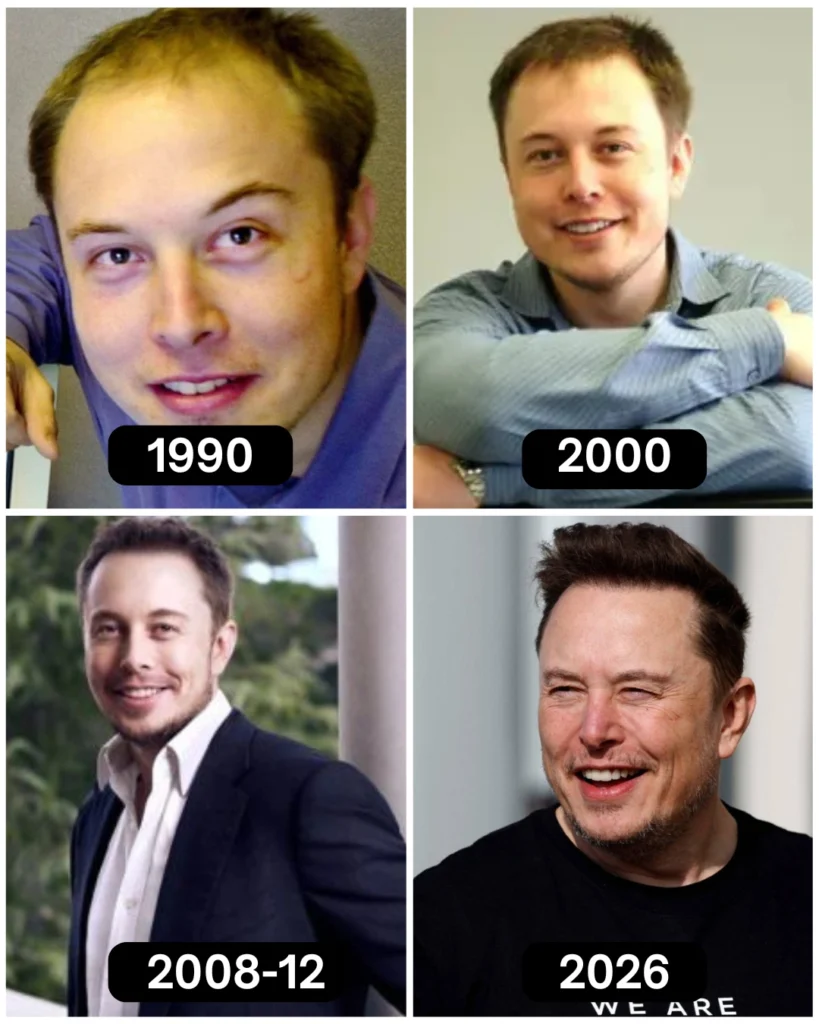
Late 1990s – Noticeable Male Pattern Baldness
Photos from Musk’s early days at Zip2 and PayPal portray a man in his late twenties with noticeable receding temporals and thinning hairline. The hairline and temporal thinning shown here are typical of early-onset rapidly advancing androgenetic alopecia.
Early 2000s – Possible Initial Intervention
During 2003-2005 some individuals remark the beginning of stabilization of the hairline as visible in the photos provided. Around this time, FUT hair transplantation procedures were gaining in popularity in the USA and Musk’s hair loss problem might have been managed.
2008–2012 – Visible Improvement Documented
Photographs taken during Tesla and SpaceX growth years indicate the hairline has receded far less compared to the photographs from late 1990’s. This period shows a visible increase in density of frontal hairline and temporal area, and this is what this photograph depicts.
2015–2026 – Consistent Full Appearance
In all the major public engagements since 2015; press events, product launches, television interviews and SpaceX/Tesla presentations, Musk’s hair is consistently thick and there is a hairline that remains fixed without the gradual retreat seen in the earlier stages of his career.
How Many Grafts Did Elon Musk Have?
Estimates for the number of grafts in an Elon Musk hair transplant, derived from comparing ‘before’ and ‘after’ pictures along with professional estimates from the industry, are thought to be:
| Area Treated | Estimated Grafts |
|---|---|
| Frontal hairline restoration | 1,500 – 2,500 |
| Temple area bilateral | 1,000 – 1,500 |
| Density enhancement (frontal/mid) | 1,000 – 2,000 |
| Crown improvement | 500 – 1,000 |
| Total estimated grafts | 3,500 – 6,000 |
It is most probable that these graft numbers are a culmination of multiple sessions and not a single procedure. Hair restoration professionals generally confirm that the coverage achieved in the latest photographs of Musk’s hair would be more typical of two or more procedures occurring over a few years – standard practice for clients with Norwood 4-5 hair loss wanting total restoration.
Although one mega-session of 5,000-6,000 grafts on a single day is indeed technically achievable, it puts grafts at risk of dying and is usually handled with more caution by highly-skilled surgeons performing hair transplantation in stages to maximize density results.
FUE or FUT – What Technique Did Elon Musk Likely Use?
Here is an analysis of the “Elon Musk hair transplant method” question by experts depending on the time the change seems to have been noticed:
Evidence Suggesting FUT (Strip Method)
This first period of apparent hair restoration of Musk- estimated in late 1990s to mid-2000s- is before FUE was commonly used in USA. At this time, FUT was the technique used by centers leading in hair restoration in America.
FUT involves excising a strip of scalp from the donor area and then slicing that strip into individual grafts. The technique allows for the harvest of many grafts (3,000-5,000+) in a single surgery session, and this is in line with how much density appears to be in Musk’s mid-period pictures.
Evidence Suggesting FUE Refinement
Musk’s present hairline which looks natural, with temple feathering, irregular hairline is a good result consistent with refinement with FUE. A good proportion of people who had early FUT procedures in the early 2000’s, returned for an FUE touch up some 10 years later to detail the hairline, add density.
Most Likely Scenario
The general consensus among hair restoration specialists looking at the Elon Musk hairline history is that he has most likely had a combined procedure-a big FUT session or two in the early-to-mid-2000s to gain some density and coverage, and perhaps a few FUE procedures later in life to refine the hairline itself with smaller grafts and build on existing density.
FUE vs FUT: Quick Reference for Men Considering Hair Transplant
| Factor | FUE | FUT (Strip) |
|---|---|---|
| Scarring | Tiny dot scars | Linear scar (hideable) |
| Recovery | 7 – 10 days | 10 – 14 days |
| Graft count/session | Up to 4,000 | Up to 5,000+ |
| Naturalness | Excellent | Excellent |
| Cost | Higher | Lower |
| Best for | Most patients today | Large graft needs, budget |
| Global popularity | 80%+ of procedures | 20% of procedures |
| Availability | All top clinics | Most top clinics |
Elon Musk Hair Transplant Cost: 2026 Estimates
How much would an Elon Musk hair transplant cost today? Assuming an overall of 3,500 to 6,000 grafts with probable multiple sessions:
Cost by Country (2026 Estimates)
| Country | Estimated Cost (3,500 – 6,000 grafts) | Notes |
|---|---|---|
| USA | $12,000 – $30,000+ | Premium surgeon, FDA – regulated |
| UK | $10,000 – $25,000 | CQC-regulated, top London clinics |
| Turkey | $3,000 – $8,000 | All-inclusive Istanbul packages |
| Poland | $4,000 – $9,000 | EU-regulated, competitive pricing |
| Canada | $10,000 – $22,000 | Similar quality to USA |
| UAE (Dubai) | $7,000 – $18,000 | Luxury clinic environment |
| India | $2,500 – $6,000 | Budget option, research essential |
| Thailand | $5,000 – $12,000 | JCI hospitals, medical tourism |
USA vs Turkey Cost Comparison
| Factor | USA | Turkey |
|---|---|---|
| Average total cost | $15,000 – $25,000 | $3,500 – $6,000 |
| Surgeon quality | Excellent (ABHRS) | Excellent (top clinics) |
| All-inclusive package | Rare | Standard |
| Follow-up care | In-person | Online (12 months) |
| Medical regulation | FDA | Turkish Ministry of Health |
| Legal recourse | Full US legal | Limited |
| Travel required | No | Yes (5 – 7 days) |
What Made Elon Musk’s Hair Transplant Results Look Natural?
The Elon Musk hair transplant outcomes – and if surgical restoration did indeed take place – are used in numerous circles of hair restoration surgeons as a prime example of a successful procedure. There are a number of contributing factors that would result in a completely natural and ‘non-transplanted’ look:
Conservative Hairline Design
It’s important to note that the restored hairline is not designed to be either too low or a “perfectly straight line”. Both of these would indicate that the hairline is incorrectly designed, and the result would fail to suit the patients age and face shape, and would result in a look which would naturally look unnatural in time.
Proper Graft Angle and Direction
Natural hair is not the same direction or angle. It grows at different directions in different areas of scalp. The skillful surgeons create movements and shadows like natural hair by placing grafts in different directions according to the scalp area.
Hairline Irregularity
Natural hairlines have a number of micro-irregularities-very minor variations in the leading edge-which stop the look “painted on”-which is how bad transplant work looks. It can be seen in Musk’s photos of him this recent period.
Age-Appropriate Restoration
A 50 year old man should not have a 20 year old’s hairline. A good surgeon will design a hairline for the patient at the appropriate age, and will have the knowledge to consider the future of the hairline and ensure that it does not look more out of place each passing year.
Density Balance
Instead of stuffing the frontal zone at the detriment of coverage elsewhere, a good technique should distribute the grafts so that the density is balanced throughout the restoration.
Hair Transplant Success Rate: What the Data Shows
If the men are looking into undergoing hair transplant surgery themselves, influenced by these amazing transformations such as Elon Musk’s; here’s what the clinical evidence says:
| Metric | Data |
|---|---|
| Average graft survival rate (top clinics) | 90 – 95%+ |
| Patient satisfaction rate (board-certified surgeons) | 85 – 95% |
| Procedures requiring revision | 5 – 10% |
| Patients who report natural-looking results | 88 – 94% |
| Average timeline to full results | 9 – 12 months |
Source: International Society of Hair Restoration Surgery (ISHRS) global patient outcome data; and aggregated verified review platform data.
Hair Transplant Recovery Timeline
| Time Period | What Happens | What to Do |
|---|---|---|
| Days 1 – 3 | Redness, mild swelling, scab formation | Rest, sleep elevated, avoid touching grafts |
| Days 7 – 10 | Scabs naturally loosen and fall | Follow clinic wash protocol exactly |
| Weeks 3 – 8 | Shock loss – transplanted hair sheds | Normal process – continue aftercare |
| Months 3 – 4 | New hair growth begins to emerge | Monthly progress photographs |
| Months 6 – 8 | Visible density improvement | Continue prescribed medications |
| Month 12 | Full final results visible | 12-month follow-up consultation |
Is Hair Transplant Permanent?
Yes-but with a very important caveat. Hair that has been transplanted is harvested from the “permanent” donor area at the back and sides of the head where the hair follicles have been genetically coded to resist the DHT hormone, which causes the pattern hair loss. Once this transplanted hair has rooted, it will continue to be immune to DHT and will not be lost.
Unfortunately, there is no such guarantee regarding the “native” hair that remains in the area being transplanted. This hair can continue to thin over the years as the patient experiences continued hair loss due to his own body’s response. Thus, a long-range plan must always be in place. The hair transplant should not just plan to “fill in” the current loss but to accommodate any loss that is to come in the future. This is one reason why a skilled surgeon will likely advise you against having a large transplant procedure until your hair loss has stabilized.
Does Hair Transplant Look Natural?
Today, modern transplant surgery, when executed by an experienced, board certified surgeon in either an FUE or a more advanced FUT procedure, is capable of creating hair that is virtually undetectable to that of naturally occurring hair. Critical elements to such success are:
- Surgical skill-The aesthetic skill of hairline design and graft placement is as critical as any technical ability.
- Graft viability-Proper extraction and handling is paramount to the health of follicles.
- Realistic density-Allowing for what is achievable given what is available in the donor area.
- Candidate Selection-Proper indication for the patient.
The Elon Musk hairline progression-If surgical-clearly shows that it is possible for the end result, when executed under ideal circumstances and criteria, to be entirely indistinguishable from naturally occurring hair, even when the result spans over two decades under tremendous public scrutiny.
Celebrity Hair Transplant Comparison: How Elon Musk’s Results Compare
| Celebrity | Estimated Grafts | Technique Era | Result Quality | Notable |
|---|---|---|---|---|
| Elon Musk | 3,500 – 6,000 | FUT + possible FUE | Highly natural | Best documented transformation |
| Wayne Rooney | 2,000 – 3,000 | FUE | Natural | Publicly confirmed |
| Gordon Ramsay | 2,000 – 3,500 | FUE | Natural | Media documented |
| Matthew McConaughey | 1,500 – 2,500 | FUE | Very natural | Widely speculated |
| John Travolta | N/A | N/A | Hairpiece used | Did not pursue transplant |
Celebrity results should still be interpreted carefully because not every publicly discussed transformation has been officially confirmed. For example, the LeBron James hair transplant case remains based largely on photographic comparison and expert commentary rather than a public confirmation from James himself.
10 Lessons Men Can Learn From Elon Musk Hair Restoration
Early intervention produces better outcomes.
The sooner hair loss is dealt with (prior to the donor area becoming very depleted) the better surgical results and outcome.
Multiple sessions often produce the best results.
The seemingly staged nature of Musk’s metamorphosis embodies the best practice, namely increasing coverage incrementally rather than attempting to do it all at once during one giant session.
Natural results require experienced surgeons.
You can’t just use skill for 20+ years of public existence, the result has to be art with natural hairline design.
Conservative hairline design ages better.
A 35 year old hairline that appears natural, will still appear natural in a 55 year old. An early, extremely low hairline, will continue to look less and less natural with age.
Quality over price produces life-long satisfaction.
It’s not the cost of a failed hair transplant that is most expensive, it’s the remedial surgery.
Patience is essential.
The whole process is going to take 9 to 12 months for full results of your transplant to come in. Trying to make a judgement at 3 to 4 months when your losing a lot of hair from shock loss, isn’t a true estimate of the end result.
Donor area health matters.
The single most crucial biological determinant of the potential of a surgeon is the quantity, density and quality of available donor hair.
Long-term planning beats short-term thinking.
Hair loss is usually a gradual process. If a transplant is performed for current hair loss but fails to consider future loss, further surgery may be needed earlier than otherwise expected.
Maintenance medications support results.
Finasteride and minoxidil will slow hair loss from transplanted hair loss (where transplantation hasn’t been undertaken) in a protective manner to increase the endurance of the transplant in the long run.
Realistic expectations lead to higher satisfaction.
Those patients aware of the redistribution of hair rather than generating new hair are always more satisfied than patients expecting unlimited density for a restricted number of grafts.
Celebrity cases also vary significantly in how much information is publicly available. The Joel McHale hair transplant discussion is another example where before-and-after appearances need to be considered alongside the available evidence rather than treated as confirmed surgical facts.
Best Hair Transplant Clinics USA – For Men Seeking Similar Results
For those American males wanting an Elon Musk hair transplant and looking into the procedure themselves the top quality options available in the USA are as follows:
| City | Top Clinic | Surgeon | Technique |
|---|---|---|---|
| Chicago, IL | Chicago Hair Institute | Dr. Raymond Konior | FUE, FUT |
| New York, NY | Bernstein Medical | Dr. Robert Bernstein | FUE, FUT |
| Los Angeles, CA | Alvi Armani | Dr. Baubac Hayatdavoudi | FUE |
| Dallas, TX | Parsa Mohebi Hair Restoration | Dr. Parsa Mohebi | FUE |
| Miami, FL | Foundation for Hair Restoration | Dr. Bernard Nusbaum | FUE, FUT |
Written & Reviewed By
Written by: Wajiha Aqeel
Co-Founder & Hair Restoration Research Lead
Data & publication oversight: Daniel Brooks
Co-Founder & Senior Operations & Data Director
Content reviewed by:
Mehwish Fareed
Clinical Aesthetician & Content Reviewer
Asma Shamshad
Medical Student & Content Contributor
Originally published: May 30, 2026
Research & content last reviewed: September 2026
Last updated: September 10, 2026
All price information, surgeon and clinic profiles, and credentials are checked against ISHRS and ABHRS verified listings.
References:
Check out the International Society of Hair Restoration Surgery at ishrs.org or the American Board of Hair Restoration Surgery at abhrs.org. You can find journal articles in the National Library of Medicine by visiting pubmed.ncbi.nlm.nih.gov. Historical photographs and confirmed media appearance are available.
FAQs:
Q: Did Elon Musk get a hair transplant?
Elon Musk has not publicly admitted to having a hair transplant, however, the stark differences between photos from the late 1990s and current photos-with a restored frontal and temple area-are seen as proof by hair restoration surgeons to be consistent with surgical hair restoration, rather than hair growth medication alone.
Q: How many grafts did Elon Musk have?
Estimates place the number of grafts, based on visual evidence from comparison photographs and the opinions of hair restoration specialists, between 3,500 and 6,000 grafts; this was almost certainly across multiple procedures, not a single session.
Q: What procedure did Elon Musk most likely use for his hair transplant?
It is thought that his hair restoration procedure was a FUT (strip) session in the early to mid-2000s (when FUT was the leading procedure) followed by a FUE (follicular unit extraction) later.
Q: How much would Elon Musk’s hair transplant cost today?
A similar procedure (3,500-6,000 grafts) by a top US based surgeon today (or likely in 2026) would cost around $12,000 to $30,000 plus. If he had it performed in Turkey, the price (which typically includes package costs) would be around $3,000-$8,000.
Q: Is Elon Musk’s hair transplant one of the best celebrity results?
It is often cited by the hair restoration community as being one of the most impressive and best documented results that a celebrity has achieved-especially as it has remained convincing even under years of rigorous media and public scrutiny.
Q: Can normal men get similar results to Elon Musk’s hair transplant?
Possibly. For the right candidate with ample donor hair, realistic expectations and an experienced, board-certified surgeon-results can potentially match that of Elon Musk, although this also depends on individual hair growth factors and how it all performs surgically.
Q: Is a hair transplant permanent?
The new transplanted hairs taken from the DHT-resistanent permanent donor zone are generally permanent and will fall out; non-transplanted hair may thin over time if hair loss continues, so often long-term planning and medication are involved.
Q: How long does recovery after a hair transplant take?
Initial healing takes 7-10 days; shock loss of the transplanted hair is seen at weeks 3-8; the new hairs will start growing from month 3-4, and the final result will likely be noticeable at month 9-12.
Wondering about Elon Musk hair transplant and your own procedure? Save this guide for later as it’s always up to date with the newest hair restoration findings, prices, and clinics
Medical & Affiliate Disclaimer:
The content on Hair Grow Needs is for general informational and educational purposes only and should not be considered professional medical advice. For full details regarding our policies, please read our official Disclaimer.